Apple’s strengths in the AI era include its massive user base, premium brand loyalty, and integrated hardware-software ecosystem that enables seamless AI implementation across devices. The company’s substantial R&D budget and cash reserves provide resources for AI talent acquisition and development. However, Apple faces weaknesses including later market entry compared to Google and Microsoft in AI services, limited cloud infrastructure, and historically conservative approach to new technologies. The company’s closed ecosystem, while beneficial for integration, may limit AI partnership opportunities and data collection compared to more open platforms.
Apple will likely integrate AI deeply into existing products rather than creating standalone AI services, focusing on privacy-preserving on-device processing to maintain competitive differentiation.
Strengths
💪 World’s most valuable brand with extreme customer loyalty
⚡ EU Digital Markets Act forcing ecosystem openness
⚡ China market uncertainty and geopolitical risks
⚡ Commoditization of smartphone hardware
the interface layer wars reshaping consumer tech — -inc”>Apple can leverage a strong consumer brand and set of successful products as a strength. Yet the company is still too reliant on the iPhone as a primary revenue stream. Though Apple is working to open up new markets as an opportunity, it has to make sure to sustain its stores’ sales.
Strengths
Apple can leverage a strong consumer brand and set of successful products as a strength. Yet the company is still too reliant on the iPhone as a primary revenue stream.
iPhone and Services sales represented the main revenue drivers in 2022. Within the service revenues, the fastest growing sub-segment was the advertising business Apple built on top of the App Store, followed by the Mac, Accessories & Wearables, and the iPad.By February 2024, Apple was worth nearly three trillion dollars. Apple generated over $200 billion from iPhone sales in 2023, which accounted for over 52% of its net sales—followed by services revenues at over $85.2 billion, wearables and accessories at over $39.84 billion, Mac sales at $29.36 billion, and iPad sales at over $28 billion.
Brand: Apple is among the most valuable recognized consumer brands in the world. With the ability to launch new, breakthrough successful products in the last two decades, Apple devices have become for millions of people part of their daily lives. This alone can make Apple still a viable company in the next decade.
Products: Apple products are still among the most innovative companies. It opened up new markets when it launched the iPod, the iPad, and the iPhone. And now it’s redefining the boundaries of new markets with other devices like wearables (Apple Watch) and other accessories (AirPods and glasses). If any of those products will turn out to be successful Apple can once again create a whole new category.
Apple is a tech giant, and as such, it encompasses a set of value propositions that make Apple’s brand recognized, among consumers. The three fundamental value propositions of Apple’s brand leverage the “Think Different” motto; reliable tech devices for mass markets; and starting in 2019, Apple also started to emphasize more and more privacy to differentiate itself from other tech giants.Apple’s mission is “to bring the best user experience to its customers through its innovative hardware, software, and services.” And in a manifesto dated 2019 Tim Cook set the vision specified as “We believe that we are on the face of the earth to make great products and that’s not changing.”
Weaknesses
iPhone saturation: the iPhone has been an incredible success for Apple, however, it also is the primary revenue stream. And if the primary revenue stream slows down that affects the whole company. That is what’s happening as sales of the iPhone have reached saturation.
Lack of revenue diversification: the iPhone represented more than 50% of Apple revenues as of 2019, and while Apple sells other devices (Mac, iPad, iPod, and accessories), the company’s bottom line is still too skewed toward the iPhone. However, Apple has been able to diversify its revenues in the last few years.
In this infographic, you can appreciate the evolution of Apple by looking at how the sales of its central products evolved in the decade 2008-18.
Opportunities
When looking at the Apple Business Model, it is easy to assume that it is solely a product company, which sells devices that are beautifully crafted. However, there would have been no success for the Mac without its OS operating system. There would not have been iPod success without iTunes. And no success for iPhones without the Apple Store. What’s next for Apple’s success?
New strong accessory market: Apple’s revenues in accessories have been among the fastest-growing. This creates massive short-term opportunities for Apple, as the company keeps monetizing the customer base developed on top of the iPhone.
Other revenue streams with high potential growth: Beyond accessories, wearables might become also a segment with extremely high growth potential.
Opening adjacent markets with high potential: A whole new set of products, like Apple Glasses or accessories able to monitor the biometrical data of users, might become a whole new category for the company, thus opening great opportunities.
Threats
In 2023, most of Apple’s sales (63%) came from indirect channels (comprising third-party cellular networks, wholesalers/retailers, and resellers). These channels are critical for sales amplification, scale, and subsidies (to enable the iPhone to be purchased by many people). In comparison, the direct channel represented 37% of the total revenues. Stores are critical for customer experience, enabling the service business and branding at scale.
Competition, markets for the Company’s products and services are highly competitive and Apple is in the midst of aggressive competition in all areas of its business.
The supply of Components can also represent a risk. True, most of Apple’s product components are generally available from multiple sources, however, certain components are available from a single-source. This might make the production of new devices slower, less reliable and in any case, increase the cost of production.
Intellectual Property: If the company fails to protect its intellectual properties that can also become a future threat.
Performance of carriers, wholesalers, retailers, and other resellers: a major chunk of Apple’s distribution goes through indirect channels like carriers and resellers. Changed agreements or inability to fuel this channel might result in massive losses in terms of product distribution and sales.
Performance of direct stores: Apple has built over the years also a direct distribution system, where customers could purchase directly from those stores. While those stores have been the temples of Apple’s success. If the company will fail in attracting a continuous flow of customers in those same stores, they might become an unbearable cost, thus making the transition from temples to cathedrals in the desert.
Key Highlights:
Strengths:
Strong brand recognition and successful product lineup.
iPhone and Services are primary revenue drivers.
Innovation in product categories and brand philosophy.
Diversification of revenue streams, particularly through accessories and wearables.
As of 2024, major Apple shareholders comprised Warren Buffet’s Berkshire Hathaway with 5.92% of the company’s stock (valued at nearly $170 billion as of February 2024). Followed by other individual shareholders like Tim Cook, CEO of Apple, with about 3.3 million shares, and Artur Levinson, chairman of Apple, with over 4.5 million shares. Top institutional investors comprise The Vanguard Group with 8.27% ownership and BlackRock with 6.66% ownership.
Apple has a business model that is divided into products and services. Apple generated over $383 billion in revenues in 2023, of which over $200 billion came from iPhone sales, $29.36 billion came from Mac sales, $39.84 billion came from accessories and wearables (AirPods, Apple TV, Apple Watch, Beats products, HomePod, iPod touch, and accessories), $28.3 billion came from iPad sales, and $85.2 billion came from services.
iPhone and Services sales represented the main revenue drivers in 2022. Within the service revenues, the fastest growing sub-segment was the advertising business Apple built on top of the App Store, followed by the Mac, Accessories & Wearables, and the iPad.
In 2023, most of Apple’s sales (63%) came from indirect channels (comprising third-party cellular networks, wholesalers/retailers, and resellers). These channels are critical for sales amplification, scale, and subsidies (to enable the iPhone to be purchased by many people). In comparison, the direct channel represented 37% of the total revenues. Stores are critical for customer experience, enabling the service business and branding at scale.
Apple is a tech giant, and as such, it encompasses a set of value propositions that make Apple’s brand recognized, among consumers. The three fundamental value propositions of Apple’s brand leverage the “Think Different” motto; reliable tech devices for mass markets; and starting in 2019, Apple also started to emphasize more and more privacy to differentiate itself from other tech giants.
By February 2024, Apple was worth nearly three trillion dollars. Apple generated over $200 billion from iPhone sales in 2023, which accounted for over 52% of its net sales—followed by services revenues at over $85.2 billion, wearables and accessories at over $39.84 billion, Mac sales at $29.36 billion, and iPad sales at over $28 billion.
In 2023, iPhone sales represented 52% of Apple’s net sales, the same in 2022. Yet in 2023 revenue from the iPhone slightly slew down to over $200 billion in sales, compared to over $205 billion in iPhone sales in 2022, still a growth compared to almost $192 billion in iPhone sales in 2021.
Apple generated nearly $97 billion in profits in 2023, compared to almost a hundred billion dollars in profits in 2022, $94.6 billion in 2021, and over $57 billion in 2020.
Apple’s mission is “to bring the best user experience to its customers through its innovative hardware, software, and services.” And in a manifesto dated 2019 Tim Cook set the vision specified as “We believe that we are on the face of the earth to make great products and that’s not changing.”
It costs Apple $501 to make an iPhone 14 Pro Max, and the company sells it at a base price of $1099. This makes Apple’s base markup on the latest iPhone model at 119% Apple is the only tech company able to sell its tech products at such a premium, thanks to a combination of hardware, software, and marketplace.
While Apple Tim Cook’s salary has been $3 million since 2016, most of Tim Cook’s compensation is performance-based. For instance, in 2023, while the salary of Tim Cook was $3 million, he had total compensation of over $63.2 million, which comprised stock awards and other incentives and bonuses.
Tim Cook’s net worth is primarily comprised of his Apple stocks. As of 2024, he owned 3,28 million shares of Apple worth over $600 million at the current rate. However, Tim Cook has sold part of his Apple stocks over the years for hundreds of millions of dollars, making him a billionaire.
Samsung was founded in South Korea in 1938 by Lee Byung-Chul. Originally a trading company, it took Samsung 22 years to become the fully-fledged electronics company that most people recognize today. Indeed, the company is a leader in technological innovation through telecommunications, electronics, and home appliances.
Costco is a large American multinational corporation with a focus on low-cost, membership-only retail warehouse clubs. Costco is the 4th largest retail operator in the world, operating 785 warehouses in 10 different countries. Indeed, it has enjoyed rapid success growing from zero to $3 billion in sales within six years.
From humble beginnings just over 50 years ago, Walmart has grown to become the world’s largest retail company. A single small discount store in Arkansas has now expanded to over 11,000 stores in 28 countries. Some reports suggest that the company now makes $1.8 million of profit every hour.
Headquartered in San Francisco, California, Uber started as a peer-to-peer ridesharing platform. In more recent times, the company has moved into food delivery, rental cars, and bike-sharing. In one form or another, Uber now has a presence in over 900 cities worldwide.
It would be hard to argue the case for a more recognizable entertainment brand than Disney. Disney is of course synonymous with Walt Disney, but it was Walt and his brother Roy who started the company in 1923 in Burbank, California. Disney content is now broadcast on over 100 channels in 34 different languages across the globe.
Coca-Cola is the market leader of the soft drink industry. It is also the most widely recognized brand, with a Business Insider study revealing that a staggering 94% of the world population recognizes the red and white logo. However, Coca-Cola faces significant challenges with increasingly health-conscious consumers and less access to water resources.
Founded in 1903 by Henry Ford and is the fifth-largest family-owned company in the world. Ford is a globally recognized brand in the automotive industry for a couple of reasons. First, Henry Ford is well-known as the inventor of the production line and thus the modern automobile industry. Today, Ford has also maintained relevance as the seventh-largest car manufacturer worldwide, selling a range of passenger cars, trucks, and vans.
Tesco was founded in 1919 by Jack Cohen, as a small group of market stalls. After rapid expansion in the following years, the company became the largest retailer in the UK and is now the second-largest in the world. To put their dominance into perspective, consider that Tesco serves around 66 shoppers per second across 7000 retails stores, delivering approximately $180,000 worth of sales every minute.
Nestlé is a large multinational food and beverage manufacturer with more than 2000 brands spread across 197 countries. Some of Nestlé’s well-known brands include Nescafe, Kit-Kat, Purina, Aero, Butterfinger, Maggi, and Haagen-Dazs. Originally a producer of infant food in 1867, it is now considered to be the world’s largest food manufacturer.
Amazon is among the most diversified business model in the tech industry. The company is well-positioned to dominate e-commerce further. And while its online stores have tight profit margins, Amazon still unlocks cash for growth, while consolidating its dominance in the cloud and grabbing new opportunities like voice.
Facebook, with its products, with its strong appeal, and consumer brand has a solid business model, threatened in the last years by privacy concerns, which open up the way to potential regulation to break up the company. If that will not happen, Facebook will have the chance to expand to define other markets like VR.
Starbucks is a global consumer brand with direct distribution, recognized brands, and products that make it a viable business. Its reliance on the Americas as a primary operating segment makes it a weakness. At the same time, Starbucks faces risks related to coffee beans price volatility. Yet the company still has global expansion opportunities.
Among the most recognized car manufacturers, Tesla is valued more than the combined market capitalization of GM and Ford. While the company’s direct distribution is a strength, its lack of financial viability is a weakness. Competition is a future threat. However, if Tesla defines a new market for car manufacturing its potential growth will be massive.
Netflix is among the most popular streaming platforms, with a subscription-based business model. The brand, platform, and content are strengths. The volatility of content licensing and production are weaknesses. The streaming market is a potential blue ocean. Inability to attract and retain premium members, and its fixed long-term costs are threats to its business model.
Apple can leverage a strong consumer brand and set of successful products as a strength. Yet the company is still too reliant on the iPhone as a primary revenue stream. Though Apple is working to open up new markets as an opportunity, it has to make sure to sustain its stores’ sales.
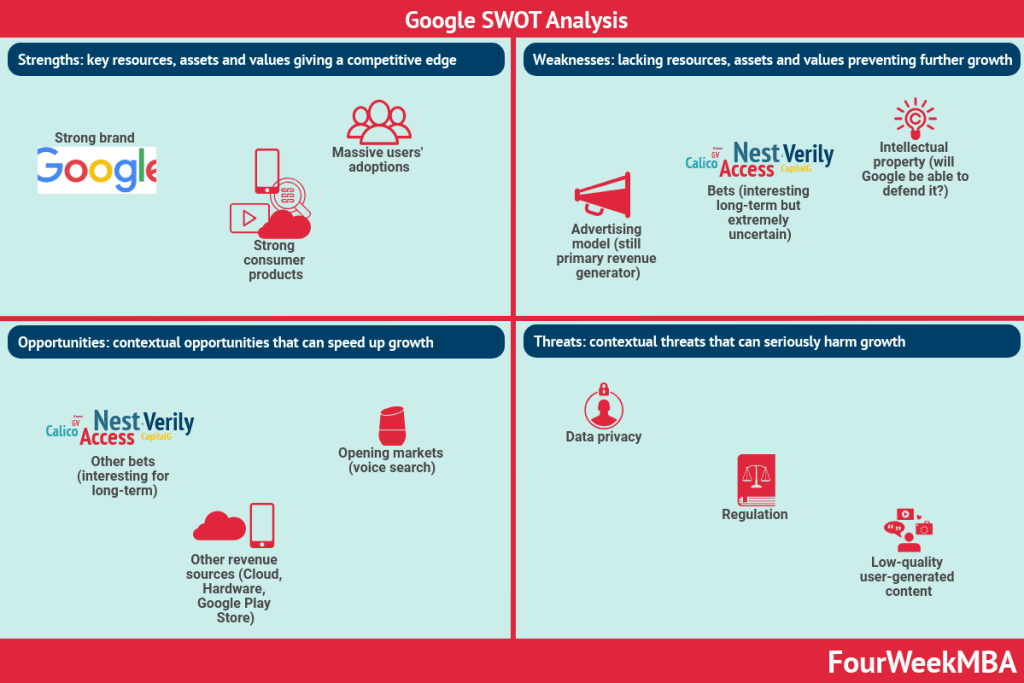
Google’s strength is its strong consumer brand. The company is grabbing new opportunities by opening up industries like voice search and consolidating in industries like the cloud. As a weakness, its revenues primarily come from advertising. A primary threat is the quick change of search and potential intervention by regulators.