



惯性聚合 高效追踪和阅读你感兴趣的博客、新闻、科技资讯
阅读原文 在惯性聚合中打开

推荐订阅源

Google DeepMind News
MongoDB | Blog
MongoDB | Blog
有赞技术团队
有赞技术团队
让小产品的独立变现更简单 - ezindie.com
人人都是产品经理
人人都是产品经理
奇客Solidot–传递最新科技情报
奇客Solidot–传递最新科技情报
B
Blog RSS Feed
T
Tor Project blog
T
Threat Research - Cisco Blogs
Microsoft Azure Blog
M
MIT News - Artificial intelligence
V
Vulnerabilities – Threatpost
Project Zero
Project Zero
C
CXSECURITY Database RSS Feed - CXSecurity.com
The Register - Security
Latest news
Latest news
cs.CL updates on arXiv.org
The Hacker News
The Hacker News
Google DeepMind News
L
LINUX DO - 最新话题
U
Unit 42
Cyber Security Advisories - MS-ISAC
博客园 - 司徒正美
T
Tenable Blog
H
Hacker News: Front Page
B
Blog
宝玉的分享
宝玉的分享
C
Check Point Blog
美团技术团队
cs.CV updates on arXiv.org
C
CERT Recently Published Vulnerability Notes
P
Proofpoint News Feed
The GitHub Blog
The GitHub Blog
G
GRAHAM CLULEY
Google Online Security Blog
Security Archives - TechRepublic
P
Proofpoint News Feed
GbyAI
GbyAI
酷 壳 – CoolShell
酷 壳 – CoolShell
Hugging Face - Blog
Hugging Face - Blog
Y
Y Combinator Blog
D
Darknet – Hacking Tools, Hacker News & Cyber Security
Hacker News - Newest:
Hacker News - Newest: "LLM"
OSCHINA 社区最新新闻
OSCHINA 社区最新新闻
Scott Helme
Scott Helme
L
Lohrmann on Cybersecurity
量子位
A
About on SuperTechFans
V2EX - 技术
V2EX - 技术
T
The Exploit Database - CXSecurity.com

FourWeekMBA

Musk vs Altman: The $90B Fight That Will Define AI’s Future Why DeepMind’s $1.1B Bet Signals the End of Human-Trained AI The AI Orchestrator's Leverage Points AI & The Harness Theory Why AI Companies Are Selling Fiction as Partnership Strategy Google’s $40B Anthropic Bet Reveals AI Infrastructure Wars Anthropic’s Agent Economy Signals End of Human-Mediated Commerce Claude OS: The AI Strategy Skill That Turns Claude Into Your Analyst Agent Harness OS: Build AI-Augmented Strategic Operations 🔥 AI & The Harness Theory 🔥 The Harnessing Players Map of AI 🔥 The Business Engineer’s Claude Code OS 🔥 Skills as the Architecture of the Personal OS Google's $40B Anthropic Bet Exposes Big Tech's AI Desperation Google's $40B Anthropic Bet Signals Platform Wars 2.0 20 Mental Models For AI Business Google's TPU Gambit: Why Hardware Will Crown the AI King LinkedIn Business Model: How LinkedIn Makes Money (2026) Netflix Organizational Structure: The Culture of Freedom (2026) Amazon Pricing Strategy: How Amazon Uses Price to Win Amazon Supply Chain: The Logistics Empire (2026) Apple Supply Chain: How Apple Built the World’s Best Supply Chain Tesla Supply Chain: Vertical Integration Strategy (2026) Anthropic Business Model: How Anthropic Makes Money (2026) OpenAI Business Model: How OpenAI Makes Money (2026) Meta (Facebook) Organizational Structure 2026 Google's Agentic TPUs Signal the Death of Traditional SaaS Google's $40B Anthropic Bet Signals The End of AI Independence The OpenAI–Anthropic Convergent Bets Google’s $40B Anthropic Bet Signals the End of Open AI Innovation The Business Engineer's Claude Code OS Pentagon’s $54B Drone Budget Reveals the New Defense Economy Google's $40B Anthropic Bet Signals the End of Open AI Markets Apple’s CEO Transition Reveals the Platform Monopoly Trap Why Worldcoin’s Fake Partnership Signals AI’s Trust Crisis Google's TPU Play Signals the End of GPU Monopoly Artisan’s “Stop Hiring Humans” Stunt Reveals AI’s Marketing Problem GaaS vs SaaS: Why AI Agents Kill Per-Seat Pricing Defensible Moats in AI: What Actually Protects an AI Company The Software Collapse: When Code Becomes a Liability Apple's Subscription Empire Signals The End of Product Innovation Google’s TPU Gambit: The Hardware War for AI Agents AI & The Importance of System Thinking Why Prego’s Kitchen Surveillance Signals Audio’s Next Battleground Apple’s Subscription Pivot Reveals Platform Monopoly Endgame Tesla’s $25B Bet Signals Manufacturing’s AI Revolution Physical AI Market Map: Where Real-World AI Creates Value From SaaS to AgaaS: How AI Agents Are Killing Per-Seat Pricing Prego’s Kitchen Surveillance Reveals Big Food’s Data Desperation Tim Cook’s Subscription Trap Is Killing Apple’s Innovation DNA The Chinese AI Economy OpenAI-OpenClaw Deal & the War for Personal Agents The Shape of the Agentic Interface The RLVR-to-Agentic Use Case Map The Agentic Architecture Race The SaaS Destruction Map The State of Agentic AI The Turning Point The Post-SaaS Expansion Map Five Predictions for the Agentic Economy The Five Scaling Phases of AI The Great Interface Inversion The Agent-Native API The AI Value Chain of Work Capacity-Priority Mismatch Matrix Salesforce & The Agentic Cannibalization NVIDIA & The State of AI The System of Action The Strategic Bet Matrix AI Agents & The New Payment Infrastructure Why World Chose Tinder as Its Humanness Beachhead Uber's Assetmaxxing Era: The Robotaxi Reckoning AI Business Brief: OpenAI’s 12-Month Window and the Great Consolidation — April 20, 2026 Content Marketing Strategy vs Meta/Facebook Growth Strategy: Key Differences & When to Use Each [2026] Netflix Business Model vs Disney Business Model: Key Differences & When to Use Each [2026] Facebook/Meta Business Model vs Amazon Business Model: Key Differences & When to Use Each [2026] DTC Model vs Wholesale Model: Key Differences & When to Use Each [2026] Marketplace Model vs Platform Model: Key Differences & When to Use Each [2026] Value Chain Analysis vs Supply Chain: Key Differences & When to Use Each [2026] Apple Business Model vs Samsung Business Model: Key Differences & When to Use Each [2026] Uber Business Model vs Lyft Business Model: Key Differences & When to Use Each [2026] Cost Leadership vs Differentiation Strategy: Key Differences & When to Use Each [2026] Freemium vs Subscription Model: Key Differences & When to Use Each [2026] Porter’s Five Forces vs SWOT Analysis: Key Differences & When to Use Each [2026] Porter’s Five Forces vs PESTEL Analysis: Key Differences & When to Use Each [2026] Salesforce & The Agentic Cannibalization: Interactive Analysis Micron & The AI Memory Bottleneck: Constraint Map The AI Reasoning Growth Loop: Memory & Flywheel Framework - FourWeekMBA The Inference Economy: Interactive Framework - FourWeekMBA Amazon in the AI Era: From E-Commerce Giant to AI Infrastructure Power - FourWeekMBA Google in the AI Era: How the Business Model Is Evolving - FourWeekMBA AI Strategy Cheat Sheets: Top 10 Frameworks in One Page - FourWeekMBA AI Landscape Explorer: Every Company Analyzed - FourWeekMBA AI Strategy Learning Paths: Four Guided Journeys - FourWeekMBA Which AI Framework Do You Need? Interactive Quiz - FourWeekMBA NVIDIA’s Industrial AI Thesis: Five Structural Trends - FourWeekMBA The Business Engineer Database: 663 AI & Business Strategy Analyses - FourWeekMBA The State of Business AI — March 2026 Executive Report - FourWeekMBA The State of Agentic AI: Interactive Report - FourWeekMBA The SaaS Destruction Map: $2T Revenue Repriced - FourWeekMBA
Meta Doubles Down on AI Capex as Ad Revenue Funds the Bet
Gennaro Cuof · 2026-04-30 · via FourWeekMBA

Meta has allocated over $40 billion annually to capital expenditures, primarily for AI infrastructure development, funded almost entirely by its advertising revenue machine that generates nearly $135 billion in annual sales. The social media giant’s advertising business maintains operating margins exceeding 40%, creating a cash flow engine that supports one of the technology sector’s most aggressive AI infrastructure buildouts.

Advertising Revenue Fuels AI Infrastructure Spending

Meta’s advertising segment generated $131.9 billion in revenue during 2023, representing 97.5% of total company revenue. This advertising dominance provides the financial foundation for the company’s substantial AI investments, which include data center construction, specialized AI chips, and compute infrastructure.
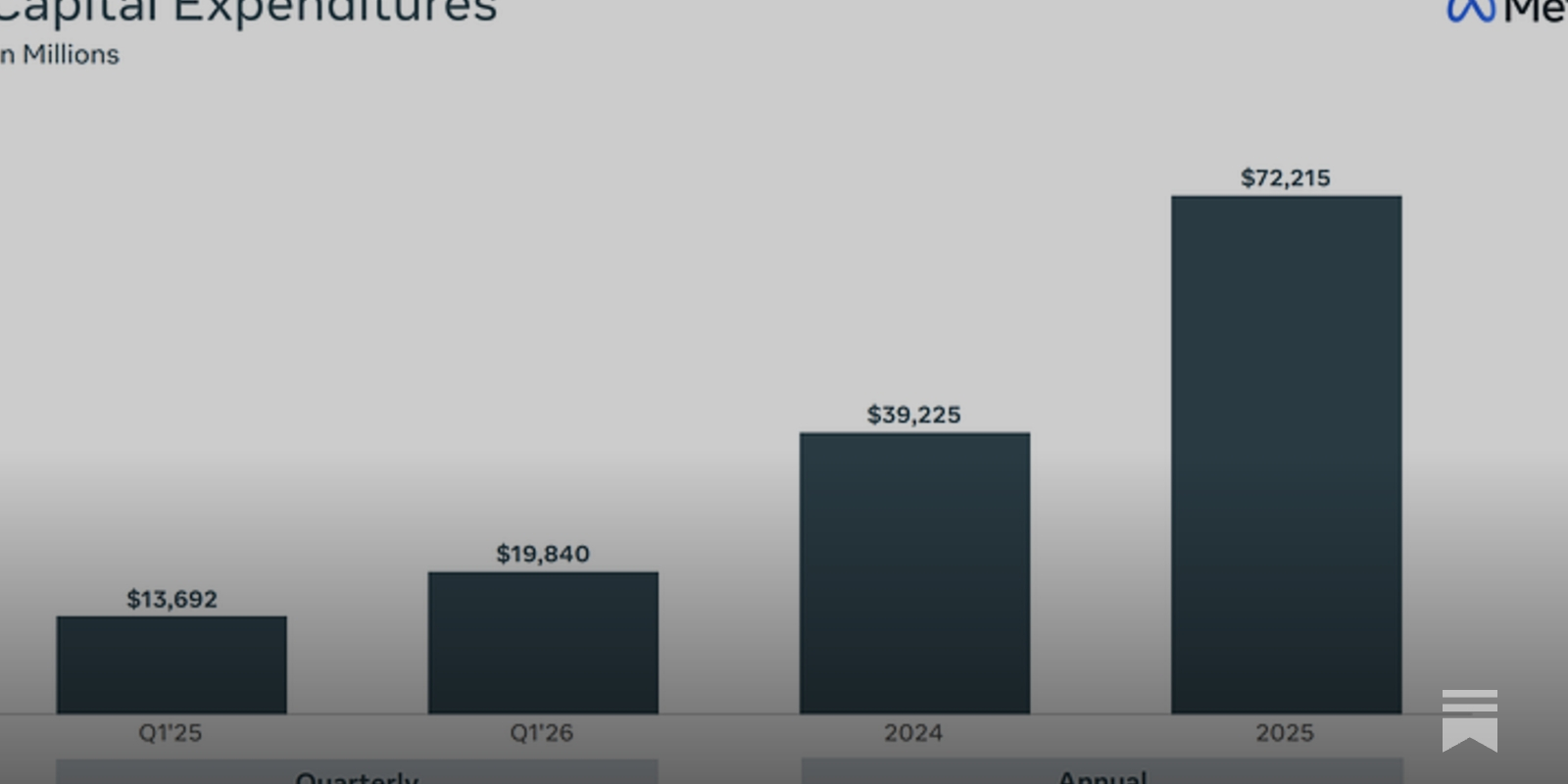
Meta Doubles Down on AI Capex as Ad Revenue Funds the Bet

Source: The Business Engineer

The company’s Reality Labs division, which houses its metaverse and AI hardware initiatives, posted an operating loss of $13.7 billion in 2023. Despite these losses, Meta continues expanding AI capabilities through its core advertising platform while simultaneously building next-generation AI infrastructure.

Capital Expenditure Trajectory Signals Long-Term Commitment

Meta’s capital expenditure guidance for 2024 ranges between $35-40 billion, with the majority allocated to AI-related infrastructure investments. This represents a significant increase from the $28.1 billion spent in 2023, according to analysis by The Business Engineer.

The company has constructed multiple data centers specifically designed for AI workloads, featuring custom-designed chips and advanced cooling systems. These facilities support both current advertising optimization algorithms and future AI product development initiatives.

Revenue Concentration Creates Strategic Dependency

Meta’s heavy reliance on advertising revenue creates both opportunity and risk for its AI investment strategy. The advertising business generates sufficient cash flow to fund AI development without external financing, but any significant downturn in digital advertising could impact investment capacity.

The company’s user base across Facebook, Instagram, WhatsApp, and Threads exceeds 3.98 billion monthly active users, providing scale advantages for both advertising revenue generation and AI model training data collection.

Competitive Position in AI Infrastructure Race

Meta competes directly with Google, Microsoft, and Amazon in AI infrastructure development, each company investing tens of billions annually. Meta’s approach differs through its focus on social media applications and consumer-facing AI products, rather than enterprise cloud services.

The company has open-sourced several AI models, including Llama 2, creating ecosystem benefits while reducing development costs compared to fully proprietary approaches adopted by competitors.

Strategic Implications for Technology Sector

Meta’s capital allocation strategy demonstrates how dominant digital platforms can leverage existing revenue streams to fund transformational technology investments. The sustainability of this approach depends on maintaining advertising revenue growth while achieving meaningful returns on AI infrastructure investments.

The company’s ability to self-fund AI development without diluting shareholders or increasing debt provides competitive advantages in the capital-intensive AI race. However, investor patience for return on AI investments may influence future spending levels and strategic priorities across the technology sector.