

惯性聚合 高效追踪和阅读你感兴趣的博客、新闻、科技资讯
阅读原文 在惯性聚合中打开

推荐订阅源

F
Fortinet All Blogs
Recent Announcements
H
Help Net Security
Y
Y Combinator Blog
酷 壳 – CoolShell
酷 壳 – CoolShell
有赞技术团队
有赞技术团队
小众软件
小众软件
Last Week in AI
Last Week in AI
U
Unit 42
Google DeepMind News
博客园 - 司徒正美
H
Hackread – Cybersecurity News, Data Breaches, AI and More
J
Java Code Geeks
Microsoft Security Blog
G
Google Developers Blog
N
Netflix TechBlog - Medium
Blog — PlanetScale
Blog — PlanetScale
云风的 BLOG
云风的 BLOG
V
V2EX
博客园 - 聂微东
人人都是产品经理
人人都是产品经理
博客园 - 三生石上(FineUI控件)
阮一峰的网络日志
阮一峰的网络日志
爱范儿
爱范儿

FourWeekMBA

Musk vs Altman: The $90B Fight That Will Define AI’s Future Why DeepMind’s $1.1B Bet Signals the End of Human-Trained AI The AI Orchestrator's Leverage Points AI & The Harness Theory Why AI Companies Are Selling Fiction as Partnership Strategy Google’s $40B Anthropic Bet Reveals AI Infrastructure Wars Anthropic’s Agent Economy Signals End of Human-Mediated Commerce Claude OS: The AI Strategy Skill That Turns Claude Into Your Analyst Agent Harness OS: Build AI-Augmented Strategic Operations 🔥 AI & The Harness Theory 🔥 The Harnessing Players Map of AI 🔥 The Business Engineer’s Claude Code OS 🔥 Skills as the Architecture of the Personal OS Google's $40B Anthropic Bet Exposes Big Tech's AI Desperation Google's $40B Anthropic Bet Signals Platform Wars 2.0 20 Mental Models For AI Business Google's TPU Gambit: Why Hardware Will Crown the AI King LinkedIn Business Model: How LinkedIn Makes Money (2026) Netflix Organizational Structure: The Culture of Freedom (2026) Amazon Pricing Strategy: How Amazon Uses Price to Win Amazon Supply Chain: The Logistics Empire (2026) Apple Supply Chain: How Apple Built the World’s Best Supply Chain Tesla Supply Chain: Vertical Integration Strategy (2026) Anthropic Business Model: How Anthropic Makes Money (2026) OpenAI Business Model: How OpenAI Makes Money (2026) Meta (Facebook) Organizational Structure 2026 Google's Agentic TPUs Signal the Death of Traditional SaaS Google's $40B Anthropic Bet Signals The End of AI Independence The OpenAI–Anthropic Convergent Bets Google’s $40B Anthropic Bet Signals the End of Open AI Innovation
Apple's AI Gap — 2B Devices, Zero Frontier Model
Gennaro Cuof · 2026-05-04 · via FourWeekMBA

The visual below maps Apple’s striking AI paradox: massive distribution power coupled with glaring capability gaps. Despite controlling 2 billion+ devices globally, Apple lacks a single frontier AI model while paying competitors billions for basic AI functionality.
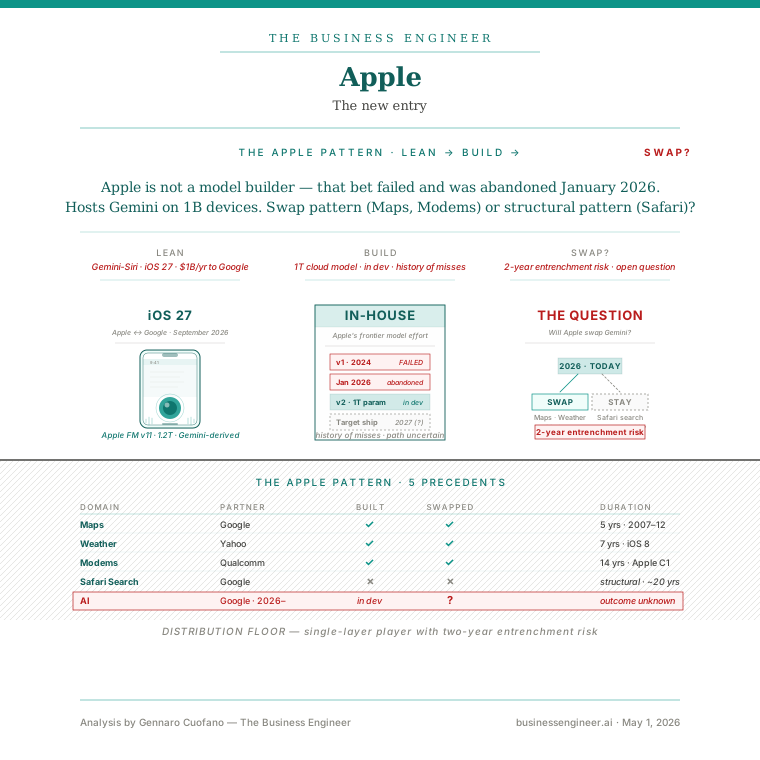
Apple's AI Gap — 2B Devices, Zero Frontier Model

Source: The Business Engineer — Map of AI, May 2026

Apple’s hardware advantage is undeniable. The Neural Engine silicon runs across 1.5 billion iPhones, 100 million iPads, and 50 million Macs. This creates the world’s largest edge AI distribution network.

Yet the framework reveals a stunning weakness. Apple pays Google approximately $1 billion annually to power Gemini-enhanced Siri functionality. The company has no GPT-4 equivalent, no Claude competitor, no frontier model whatsoever.

Recent leaked documents show Apple’s scramble to catch up. The Claude.md file discovered in Apple’s Support app suggests desperate partnerships with Anthropic. Meanwhile, OpenAI’s ChatGPT integration represents another admission of AI dependence.

The contrast with competitors is stark. Google operates both Gemini models and the Android ecosystem reaching 3 billion devices. Microsoft combines OpenAI partnership with Azure cloud infrastructure generating $28 billion quarterly revenue.

Apple’s $394 billion revenue in 2023 creates massive R&D capacity. The company spends $29 billion annually on research and development. Yet this investment hasn’t produced competitive AI models despite having superior on-device processing capabilities.

The visual framework illustrates how distribution without differentiated AI models creates strategic vulnerability. Every Siri query enriches Google’s data while Apple pays for the privilege. Every AI feature depends on external partnerships rather than proprietary innovation.

This gap becomes more critical as AI transforms computing interfaces. Voice assistants, image recognition, and predictive text represent the new battlegrounds for user engagement and data collection.

How can Apple leverage its unmatched device distribution to build competitive AI models without strengthening the very competitors it pays billions to access?

THE MAP OF AI — MAY 2026

See All 25 Visual Frameworks

7 layers, 7 players, 5 cascades — the complete visual map of AI.

Read the Full AI Map →