Products and Services Revenue Streams Customer Segments Distribution Channels Key Partnerships Key Resources Cost Structure Competitive Advantage
Key Elements
Products and Services
Nestlé is a multinational food and beverage company offering a wide range of products and services. These include various food and beverage brands such as Nestl
Revenue Streams
Nestlé generates revenue primarily through the sale of its food and beverage products. Additional revenue comes from pet care, health science, and skin health d
Customer Segments
Nestlé serves a broad and diverse customer base, including consumers of all age groups, families, pet owners, health-conscious individuals, and professionals in
Distribution Channels
Nestlé distributes its products through a global network of retailers, supermarkets, convenience stores, e-commerce platforms, and foodservice outlets. It lever
Key Partnerships
Nestlé collaborates with farmers, suppliers, and agricultural organizations to ensure a sustainable and responsible supply chain. It also partners with retail c
Key Resources
Nestlé's key resources include its research and development capabilities, brand portfolio, supply chain and distribution network, global workforce, and a commit
Cost Structure
Nestlé incurs costs in raw materials, production and manufacturing, marketing and advertising, employee salaries, research and development, and distribution log
Competitive Advantage
Nestlé's competitive advantage lies in its vast brand portfolio, research and development capabilities, global distribution network, commitment to sustainabilit
businessengineer.ai · Updated 2026
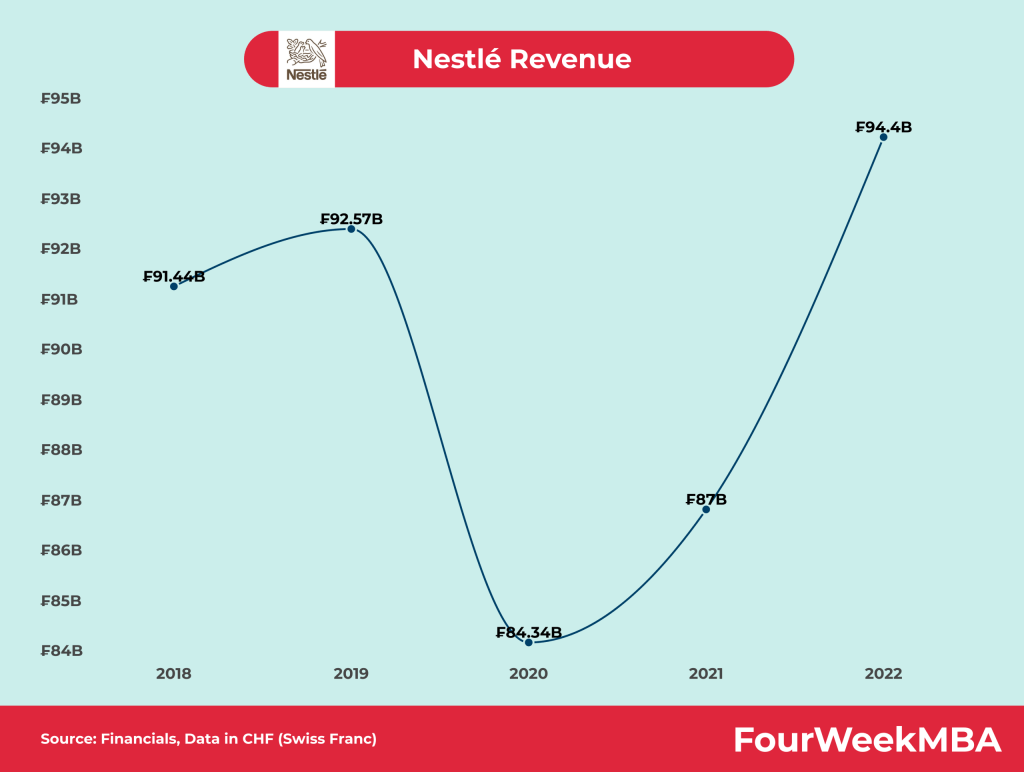
Nestlé’s principal shareholders comprise Nestlé S.A., which owns 3% of the company, and institutional investors like BlackRock, which holds over 5%. The public owns a good chunk of its shares. Nestlé is a giant in the consumer business segment, owning many brands spanning from powder to liquid beverages, confectionery, pet care, and more. The company generated over CHF94.4B in 2022 (over $100B) primarily from segments such as powdered & liquid beverages, nutrition, and prepared dishes.
All companies owned by Nestlé refers to the comprehensive portfolio of over 2,000 brands and subsidiaries under Nestlé S. A., the world's largest food and beverage company. This includes major brands like KitKat, Nescafé, Purina, Gerber, Smarties, and Häagen-Dazs across categories including confectionery, beverages, pet care, and infant nutrition.
| Aspect | Description | Analysis | Examples |
|---|---|---|---|
| Products and Services | Nestlé is a multinational food and beverage company offering a wide range of products and services. These include various food and beverage brands such as Nestlé, Nescafé, KitKat, Purina, and many more. Nestlé also provides nutrition and health-related products, bottled water, pet care, and infant nutrition. | Nestlé’s diverse portfolio covers various food and beverage categories, catering to consumers’ nutritional, health, and lifestyle needs. | Nestlé’s Nespresso coffee, Nestlé Pure Life bottled water, Purina pet food, infant formula brands like Gerber. |
| Revenue Streams | Nestlé generates revenue primarily through the sale of its food and beverage products. Additional revenue comes from pet care, health science, and skin health divisions. The company also earns income through licensing, partnerships, and joint ventures. | Sales of food and beverages are the core revenue source. Diversified business segments provide stability. Licensing and partnerships contribute to brand expansion. | Revenue from food and beverage sales, pet care products, health science products, licensing agreements. |
| Customer Segments | Nestlé serves a broad and diverse customer base, including consumers of all age groups, families, pet owners, health-conscious individuals, and professionals in the food and healthcare industries. | Nestlé’s expansive product range allows it to address a wide range of customer needs, from daily nutrition to indulgent treats and pet care. | Families, health-conscious consumers, pet owners, healthcare professionals. |
| Distribution Channels | Nestlé distributes its products through a global network of retailers, supermarkets, convenience stores, e-commerce platforms, and foodservice outlets. It leverages a vast distribution and logistics network. | Extensive distribution channels ensure that Nestlé products are accessible to consumers worldwide, whether through traditional retail or online platforms. | Supermarkets, convenience stores, e-commerce platforms, partnerships with restaurants and cafes. |
| Key Partnerships | Nestlé collaborates with farmers, suppliers, and agricultural organizations to ensure a sustainable and responsible supply chain. It also partners with retail chains and distributors for product placement and promotions. | Collaborations with suppliers and retailers help maintain a consistent product supply and visibility. Sustainability partnerships emphasize responsible sourcing. | Collaborations with coffee farmers for sustainable coffee beans, partnerships with major retail chains. |
| Key Resources | Nestlé’s key resources include its research and development capabilities, brand portfolio, supply chain and distribution network, global workforce, and a commitment to sustainability. | Research and development drive product innovation and quality. A vast brand portfolio offers market reach. An efficient supply chain ensures product availability. Sustainability efforts contribute to brand image. | R&D centers, brand portfolio, global logistics network, sustainability initiatives. |
| Cost Structure | Nestlé incurs costs in raw materials, production and manufacturing, marketing and advertising, employee salaries, research and development, and distribution logistics. | Investment in research and development and marketing is essential for product innovation and brand promotion. Employee salaries are significant due to a large workforce. | Sourcing raw materials, manufacturing products, advertising campaigns, employee wages, R&D expenses. |
| Competitive Advantage | Nestlé’s competitive advantage lies in its vast brand portfolio, research and development capabilities, global distribution network, commitment to sustainability, and a focus on consumer nutrition and well-being. It strives for continuous innovation and consumer-centric solutions. | A wide range of well-known brands and a strong commitment to sustainability set Nestlé apart in the food and beverage industry. Research and development enable product innovation and quality. | Iconic brands like Nescafé, sustainability initiatives like Project REBORN, commitment to nutrition and health. |
| Value Proposition | Nestlé offers consumers a diverse selection of food and beverage products, focusing on quality, nutrition, and sustainability. It aims to enhance the quality of life and contribute to healthier living. | Nestlé’s value proposition centers on providing consumers with nutritious and sustainable products while offering a wide range of choices and convenience. | Enjoying a cup of Nescafé coffee, feeding pets with Purina, choosing Nestlé’s healthy snacking options. |
Origin Story
Nestlé is a multinational food and beverage conglomerate that has held the title of the largest publicly held food company in the world since 2014.
Today, the company sells products such as baby food, bottled water, cereal, coffee, tea, dairy products, and pet food, to name a few.
Nestlé has been in operation (in one form or another) since the middle of the 19th century. With that in mind, let’s discover the pivotal moments in its history below.
Anglo-Swiss Condensed Milk Company
In the mid-1800s, fresh milk was a prized commodity across Europe. But at a time before adequate refrigeration methods had been invented, milk spoiled easily and was a major source of bacteria that caused serious illness or even death.
This was the situation that greeted US Vice Consul of Trade Charles Page when he was posted to Zurich in 1865. When Page saw dairy cows grazing in the verdant Swiss countryside, he was reminded of the condensed milk military rations he wrote about as a journalist covering the American Civil War.
Condensed milk was safe, portable, nutritious, and had a long shelf life which made it extremely popular with ordinary Americans after the war.
Intending to replicate this popularity in Europe, Page and his brother George founded the Anglo-Swiss Condensed Milk Company in Cham, Switzerland, in 1866.
Less than two years later, the company had already sold 374,000 cartons of its Milkmaid Brand condensed milk.
Nestlé baby formula
In nearby Vevey, Switzerland, another recent immigrant to the country started his own endeavor. German-born pharmacist Henri Nestlé released his farine lactée (flour with milk) formula for infants who couldn’t be breastfed.
The product, which Nestlé hoped would address high infant mortality rates, was released in 1867 and soon featured the company’s now iconic nest logo. Nestlé retired in 1875, but the new owners retained the name Farine Lactée Henri Nestlé.
Anglo-Swiss and Nestlé merge
Over subsequent years, the two companies experienced rapid growth and became direct competitors after each imitated the other’s products.
Despite their rivalry, however, both succeeded where other competitors had failed because of an unyielding commitment to quality and science-based nutrition.
As the turn of the century loomed, a merger of equals made sense. George Page opposed such a move, but a few years after he died in 1899, the two companies did merge to become the Nestlé and Anglo-Swiss Condensed Milk Company.
Over this time, Nestlé had also been working on a new chocolate manufacturing process that removed water from the mix and prevented mildew. The company started selling chocolate for the first time in 1904.
Expansion and diversification
Nestlé grew rapidly in the early part of the 20th century – particularly after the outbreak of World War I when it was awarded large government contracts to produce chocolate and condensed milk.
However, with a shortage of raw materials and a slowdown in trade, Nestlé was forced to open or acquire facilities in the United States and Australia. By 1919, the company was already operating 40 factories around the world.
After the war, demand for Nestlé products decreased and, thanks to the Great Depression, the company posted its first financial loss in 1921. But with a strong management and research ethos, it soon rebounded.
Nestlé acquired Swiss chocolatier Peter-Cailler-Kohler in 1929 with its chocolate bars becoming a staple of the company’s business. By 1936, Nestlé & Anglo-Swiss had also added malted drinks and vitamin supplements to the product range.
The Second World War was not as kind to Nestlé in terms of revenue, but soldiers did popularize the Nescafé brand of instant coffee which was invented in 1930 and first released in 1938.
Post-war acquisitions
The late 1940s marked the start of a dynamic decades-long period for Nestlé. Growth in the sales of convenience and frozen food increased as refrigerators and freezers became commonplace in homes.
Growth was also facilitated by numerous acquisitions. Nestlé’s spree started in 1947 with the purchase of the now billion-dollar brand Maggie, and this was also the year that Nestlé & Anglo-Swiss Condensed Milk Company formally changed its name to Nestlé.
The Maggi acquisition was then followed by Crosse & Bakewell (1950), Findus (1963), Libby’s (1971), and Stouffer’s (1973), to name a few.
Nestlé diversified beyond food and drink for the first time in 1974 when it became a minority shareholder in L’Oréal. It then acquired the Swiss-American pharmaceutical device company Alcon Laboratories in 1977 and, later, the American pet food brand Friskies in 1984.
International growth
As the globalization trend started to emerge in the early 1990s, Nestlé extended its tentacles to Eastern Europe, Asia, and other parts of the world.
It also sold off unprofitable brands and started to cater to the needs of health-conscious consumers as part of its Nutrition, Health, and Wellness strategy. This strategy was the brainchild of incoming CEO Peter Brabeck-Letmathe who was appointed in 1997.
The late 1990s were also marked by a push into bottled water, with acquisitions of French company Perrier and Italian mineral water business Sanpellegrino Group.
New initiatives and further diversification
In 2000, the Sustainable Agriculture Initiative Nestlé (SAIN) promoted collaboration with farmers and sustainable sourcing of raw materials. In the process, the company started to move from a processor of agricultural commodities to a food producer with key interests in nutrition, health, and wellness.
In 2006, Nestlé launched its Creating Shared Value approach to doing business. Central to the approach was that any action in support of shareholder value must also add value to local communities and wider society.
Further diversification into medical nutrition occurred later with the acquisitions of Wyeth Nutrition (2012) and medical foods company Pamlab in 2013. To bolster its science-based research into products that prevented chronic medical conditions, Nestlé also established the Nestlé Institute of Health Sciences.
From 2017 onwards under new CEO Mark Schneider, the company renewed its focus on the high-growth categories of pet care, infant nutrition, coffee, and plant-based products. Nestlé’s health sciences efforts were also expanded via the acquisitions of Zenpep, Vital Proteins, and Aimmune in 2020.
That same year and like many other companies, Nestlé released its strategy to achieve net zero emissions.
Ownership Structure of Nestlé:
Nestlé, a multinational food and beverage conglomerate, has a diversified ownership structure, with key stakeholders including:
- Nestlé S.A.: Nestlé S.A. is the main company that owns 3% of the total shares in Nestlé. It is the parent company and holds a strategic position in the corporate structure.
- Institutional Investors:
- BlackRock: BlackRock is one of the top institutional investors in Nestlé, holding over 5% of the company’s ownership. They are a major asset management company.
- The Vanguard Group: The Vanguard Group owns 5.4% of Nestlé’s shares. Like BlackRock, they are one of the largest investment companies globally.
Business Overview of Nestlé:
Nestlé is a global leader in the consumer business segment, owning a wide range of well-known brands in various product categories, including powdered and liquid beverages, nutrition, confectionery, and pet care.
The company’s key highlights include:
- Diverse Product Portfolio: Nestlé offers a vast array of food and beverage products, including baby food, bottled water, cereals, coffee, tea, dairy products, pet food, and more.
- Global Presence: Nestlé operates in numerous countries worldwide, with a strong presence in both developed and emerging markets.
- Revenue and Growth: In 2022, Nestlé generated over CHF 94.4 billion in revenue (equivalent to over $100 billion). The company’s growth is fueled by successful brands and strategic expansion.
Organizational History of Nestlé:
Nestlé’s history dates back to the mid-1800s when two separate companies were founded in Switzerland.
The Anglo-Swiss Condensed Milk Company, founded by Charles and George Page, and Henri Nestlé’s Farine Lactée (flour with milk) formula for infants.
Over the years, these companies experienced rapid growth and success, and their product lines overlapped.
In 1905, after years of competition and imitating each other’s products, the two companies merged to become Nestlé and Anglo-Swiss Condensed Milk Company. The name was later simplified to Nestlé.
Throughout the 20th century, Nestlé expanded its operations globally, making strategic acquisitions and diversifying its product range into various categories, including chocolates, beverages, and frozen foods.
In recent years, Nestlé has focused on sustainability, nutrition, and health. It established the Sustainable Agriculture Initiative Nestlé (SAIN) and adopted the Creating Shared Value approach, aiming to create value for both shareholders and society.
Frequently Asked Questions
Q. Q: What are the major brands owned by Nestlé?
Major Nestlé-owned brands include KitKat, Nescafé, Smarties, Aero, Butterfinger, Purina, Gerber, Häagen-Dazs, Perrier, San Pellegrino, Maggi, and Hot Pockets across food, beverages, confectionery, and pet care categories.
Q. How many companies does Nestlé own worldwide?
Nestlé owns over 2,000 brands and operates through numerous subsidiaries across more than 180 countries, making it the world's largest food and beverage company by revenue.
Q. What types of companies are under the Nestlé umbrella?
Nestlé owns companies across multiple sectors including confectionery, coffee, bottled water, baby food, pet care, frozen foods, dairy products, health nutrition, and food service operations globally.
Key takeaways:
- Nestlé is a multinational food and beverage conglomerate that has held the title of the largest publicly held food company in the world since 2014. The company has been in operation (in one form or another) since the middle of the 19th century.
- Nestlé is a product of two companies that were founded in Switzerland in the mid-1800s. The first, Anglo-Swiss Condensed Milk Company, was founded by brothers Charles and George Page. The second company was founded by Henri Nestlé. The two companies merged in 1905 after imitating each other’s product lines.
- The late 1940s marked the start of a dynamic decades-long period for Nestlé. Growth in the sales of convenience and frozen food increased as refrigerators and freezers became commonplace in consumer homes. Growth continued more or less unabated and was encouraged by increasing globalization in the 1990s.
- In 2006, Nestlé launched its Creating Shared Value approach to doing business. Central to the approach was that any action that increased shareholder value must also create add value to local communities and wider society. More recently, Nestlé has renewed its focus on high-growth categories and outlined its plan to achieve net zero emissions.
Key Highlights of Nestlé:
- Ownership Structure: Nestlé’s principal shareholders include Nestlé S.A. (owning 3% of the company) and institutional investors like BlackRock (holding over 5%). A significant portion of shares is owned by the public.
- Diverse Product Portfolio: Nestlé is a global leader in the consumer business segment, with a wide range of products spanning powdered and liquid beverages, nutrition, confectionery, pet care, and more.
- Revenue: In 2022, Nestlé generated over CHF 94.4 billion (equivalent to over $100 billion) in revenue, primarily from segments like powdered and liquid beverages, nutrition, and prepared dishes.
- Global Presence: Nestlé operates in numerous countries worldwide, with a strong presence in developed and emerging markets.
- Organizational History: Nestlé’s roots date back to the mid-1800s when two separate companies, Anglo-Swiss Condensed Milk Company and Henri Nestlé’s infant formula, were founded in Switzerland. They merged in 1905 to become Nestlé.
- Strategic Growth: Nestlé expanded rapidly throughout the 20th century through acquisitions and diversification, entering various product categories and global markets.
- Sustainability and Shared Value: Nestlé has a focus on sustainability and created the Sustainable Agriculture Initiative Nestlé (SAIN) and adopted the Creating Shared Value approach, aiming to create value for both shareholders and society.
- Recent Initiatives: Under new leadership, Nestlé renewed its focus on high-growth categories like pet care, infant nutrition, coffee, and plant-based products. The company has also outlined its strategy to achieve net-zero emissions.
Related Visual Stories