

惯性聚合 高效追踪和阅读你感兴趣的博客、新闻、科技资讯
阅读原文 在惯性聚合中打开

推荐订阅源

Google DeepMind News
C
Check Point Blog
J
Java Code Geeks
腾讯CDC
Martin Fowler
Martin Fowler
MongoDB | Blog
MongoDB | Blog
H
Hackread – Cybersecurity News, Data Breaches, AI and More
博客园 - 三生石上(FineUI控件)
Apple Machine Learning Research
大猫的无限游戏
大猫的无限游戏
Engineering at Meta
Engineering at Meta
罗磊的独立博客
Last Week in AI
Last Week in AI
B
Blog
IT之家
IT之家
S
SegmentFault 最新的问题
D
DataBreaches.Net
Cyber Security Advisories - MS-ISAC
GbyAI
GbyAI
博客园 - 聂微东
U
Unit 42
有赞技术团队
有赞技术团队
Y
Y Combinator Blog
MyScale Blog
MyScale Blog

FourWeekMBA

Musk vs Altman: The $90B Fight That Will Define AI’s Future Why DeepMind’s $1.1B Bet Signals the End of Human-Trained AI The AI Orchestrator's Leverage Points AI & The Harness Theory Why AI Companies Are Selling Fiction as Partnership Strategy Google’s $40B Anthropic Bet Reveals AI Infrastructure Wars Anthropic’s Agent Economy Signals End of Human-Mediated Commerce Claude OS: The AI Strategy Skill That Turns Claude Into Your Analyst Agent Harness OS: Build AI-Augmented Strategic Operations 🔥 AI & The Harness Theory 🔥 The Harnessing Players Map of AI 🔥 The Business Engineer’s Claude Code OS 🔥 Skills as the Architecture of the Personal OS Google's $40B Anthropic Bet Exposes Big Tech's AI Desperation Google's $40B Anthropic Bet Signals Platform Wars 2.0 20 Mental Models For AI Business Google's TPU Gambit: Why Hardware Will Crown the AI King LinkedIn Business Model: How LinkedIn Makes Money (2026) Netflix Organizational Structure: The Culture of Freedom (2026) Amazon Pricing Strategy: How Amazon Uses Price to Win Amazon Supply Chain: The Logistics Empire (2026) Apple Supply Chain: How Apple Built the World’s Best Supply Chain Tesla Supply Chain: Vertical Integration Strategy (2026) Anthropic Business Model: How Anthropic Makes Money (2026) OpenAI Business Model: How OpenAI Makes Money (2026) Meta (Facebook) Organizational Structure 2026 Google's Agentic TPUs Signal the Death of Traditional SaaS Google's $40B Anthropic Bet Signals The End of AI Independence The OpenAI–Anthropic Convergent Bets Google’s $40B Anthropic Bet Signals the End of Open AI Innovation
Where Every AI Player Sits — The Complete Competitive Map
Gennaro Cuof · 2026-05-04 · via FourWeekMBA

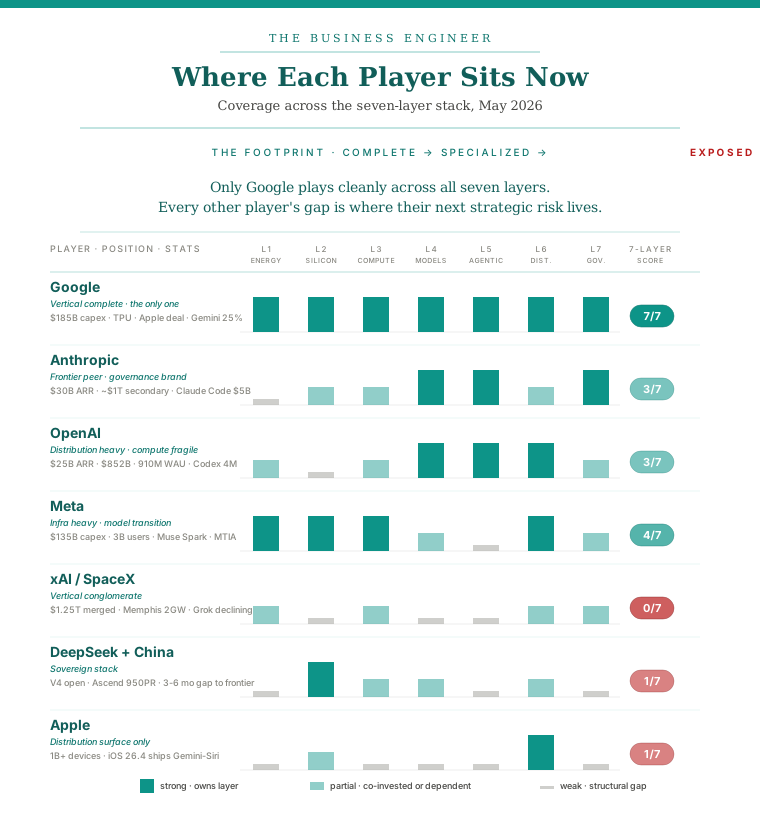
The visual below shows exactly where 47 major AI companies compete across the 7-layer technology stack — from silicon chips at the bottom to AI agents at the top. This framework maps the complete competitive landscape, revealing who overlaps with whom and where the biggest gaps exist.
Where Every AI Player Sits — The Complete Competitive Map

Source: The Business Engineer — Map of AI, May 2026

Google dominates by spanning all 7 layers, from custom TPU chips to Gemini models to cloud infrastructure. Only 3 companies achieve this full-stack presence, giving them massive competitive advantages through vertical integration.

The model layer shows the fiercest competition, with 12 major players clustered around large language models. OpenAI and Anthropic lead here but remain vulnerable — they control just 2 layers each while depending on others for compute and distribution.

NVIDIA and TSMC own the silicon foundation, powering 89% of AI training workloads between them. Apple sits in an interesting position with massive edge distribution through 1.8 billion devices but zero presence in AI models or cloud services.

Meta presents the biggest strategic puzzle — they’ve invested $30 billion in AI infrastructure and released Llama models for free, yet generate zero cloud revenue from their AI investments. Their strategy relies entirely on advertising monetization through their social platforms.

The visual reveals 5 distinct competitive clusters: cloud giants (Google, Microsoft, Amazon), model specialists (OpenAI, Anthropic), hardware kings (NVIDIA, AMD), consumer platforms (Apple, Meta), and emerging challengers spanning multiple categories.

Most telling is what the map shows about defensive positioning. Companies with presence in only 1-2 layers face existential risks as competitors integrate vertically and horizontally across the stack.

Which companies are best positioned to survive the next wave of AI consolidation, and where are the biggest opportunities for new entrants to break through?

THE MAP OF AI — MAY 2026

See All 25 Visual Frameworks

7 layers, 7 players, 5 cascades — the complete visual map of AI.

Read the Full AI Map →