惯性聚合 高效追踪和阅读你感兴趣的博客、新闻、科技资讯
阅读原文 在惯性聚合中打开

推荐订阅源

V
Visual Studio Blog
T
The Exploit Database - CXSecurity.com
The GitHub Blog
The GitHub Blog
量子位
S
SegmentFault 最新的问题
小众软件
小众软件
酷 壳 – CoolShell
酷 壳 – CoolShell
P
Proofpoint News Feed
Exploit-DB.com RSS Feed
T
Threat Research - Cisco Blogs
I
Intezer
Hugging Face - Blog
Hugging Face - Blog
Spread Privacy
Spread Privacy
Microsoft Security Blog
P
Proofpoint News Feed
Know Your Adversary
Know Your Adversary
人人都是产品经理
人人都是产品经理
G
Google Developers Blog
Cyberwarzone
Cyberwarzone
L
LINUX DO - 热门话题
让小产品的独立变现更简单 - ezindie.com
H
Hackread – Cybersecurity News, Data Breaches, AI and More
J
Java Code Geeks
cs.CL updates on arXiv.org
T
Tenable Blog
Jina AI
Jina AI
A
About on SuperTechFans
freeCodeCamp Programming Tutorials: Python, JavaScript, Git & More
OSCHINA 社区最新新闻
OSCHINA 社区最新新闻
MyScale Blog
MyScale Blog
AWS News Blog
AWS News Blog
宝玉的分享
宝玉的分享
WordPress大学
WordPress大学
T
Threatpost
大猫的无限游戏
大猫的无限游戏
I
InfoQ
T
Tor Project blog
Project Zero
Project Zero
F
Full Disclosure
L
Lohrmann on Cybersecurity
P
Palo Alto Networks Blog
G
GRAHAM CLULEY
B
Blog
Apple Machine Learning Research
The Hacker News
The Hacker News
S
Securelist
Threat Intelligence Blog | Flashpoint
V
V2EX
The Cloudflare Blog
D
Darknet – Hacking Tools, Hacker News & Cyber Security

FourWeekMBA

Musk vs Altman: The $90B Fight That Will Define AI’s Future Why DeepMind’s $1.1B Bet Signals the End of Human-Trained AI The AI Orchestrator's Leverage Points AI & The Harness Theory Why AI Companies Are Selling Fiction as Partnership Strategy Google’s $40B Anthropic Bet Reveals AI Infrastructure Wars Anthropic’s Agent Economy Signals End of Human-Mediated Commerce Claude OS: The AI Strategy Skill That Turns Claude Into Your Analyst Agent Harness OS: Build AI-Augmented Strategic Operations 🔥 AI & The Harness Theory 🔥 The Harnessing Players Map of AI 🔥 The Business Engineer’s Claude Code OS 🔥 Skills as the Architecture of the Personal OS Google's $40B Anthropic Bet Exposes Big Tech's AI Desperation Google's $40B Anthropic Bet Signals Platform Wars 2.0 20 Mental Models For AI Business Google's TPU Gambit: Why Hardware Will Crown the AI King LinkedIn Business Model: How LinkedIn Makes Money (2026) Netflix Organizational Structure: The Culture of Freedom (2026) Amazon Pricing Strategy: How Amazon Uses Price to Win Amazon Supply Chain: The Logistics Empire (2026) Apple Supply Chain: How Apple Built the World’s Best Supply Chain Tesla Supply Chain: Vertical Integration Strategy (2026) Anthropic Business Model: How Anthropic Makes Money (2026) OpenAI Business Model: How OpenAI Makes Money (2026) Meta (Facebook) Organizational Structure 2026 Google's Agentic TPUs Signal the Death of Traditional SaaS Google's $40B Anthropic Bet Signals The End of AI Independence The OpenAI–Anthropic Convergent Bets Google’s $40B Anthropic Bet Signals the End of Open AI Innovation The Business Engineer's Claude Code OS Pentagon’s $54B Drone Budget Reveals the New Defense Economy Google's $40B Anthropic Bet Signals the End of Open AI Markets Apple’s CEO Transition Reveals the Platform Monopoly Trap Why Worldcoin’s Fake Partnership Signals AI’s Trust Crisis Google's TPU Play Signals the End of GPU Monopoly Artisan’s “Stop Hiring Humans” Stunt Reveals AI’s Marketing Problem GaaS vs SaaS: Why AI Agents Kill Per-Seat Pricing Defensible Moats in AI: What Actually Protects an AI Company The Software Collapse: When Code Becomes a Liability Apple's Subscription Empire Signals The End of Product Innovation Google’s TPU Gambit: The Hardware War for AI Agents AI & The Importance of System Thinking Why Prego’s Kitchen Surveillance Signals Audio’s Next Battleground Apple’s Subscription Pivot Reveals Platform Monopoly Endgame Tesla’s $25B Bet Signals Manufacturing’s AI Revolution Physical AI Market Map: Where Real-World AI Creates Value From SaaS to AgaaS: How AI Agents Are Killing Per-Seat Pricing Prego’s Kitchen Surveillance Reveals Big Food’s Data Desperation Tim Cook’s Subscription Trap Is Killing Apple’s Innovation DNA The Chinese AI Economy OpenAI-OpenClaw Deal & the War for Personal Agents The Shape of the Agentic Interface The RLVR-to-Agentic Use Case Map The Agentic Architecture Race The SaaS Destruction Map The State of Agentic AI The Turning Point The Post-SaaS Expansion Map Five Predictions for the Agentic Economy The Five Scaling Phases of AI The Great Interface Inversion The Agent-Native API The AI Value Chain of Work Capacity-Priority Mismatch Matrix Salesforce & The Agentic Cannibalization NVIDIA & The State of AI The System of Action The Strategic Bet Matrix AI Agents & The New Payment Infrastructure Why World Chose Tinder as Its Humanness Beachhead Uber's Assetmaxxing Era: The Robotaxi Reckoning AI Business Brief: OpenAI’s 12-Month Window and the Great Consolidation — April 20, 2026 Content Marketing Strategy vs Meta/Facebook Growth Strategy: Key Differences & When to Use Each [2026] Netflix Business Model vs Disney Business Model: Key Differences & When to Use Each [2026] Facebook/Meta Business Model vs Amazon Business Model: Key Differences & When to Use Each [2026] DTC Model vs Wholesale Model: Key Differences & When to Use Each [2026] Marketplace Model vs Platform Model: Key Differences & When to Use Each [2026] Value Chain Analysis vs Supply Chain: Key Differences & When to Use Each [2026] Apple Business Model vs Samsung Business Model: Key Differences & When to Use Each [2026] Uber Business Model vs Lyft Business Model: Key Differences & When to Use Each [2026] Cost Leadership vs Differentiation Strategy: Key Differences & When to Use Each [2026] Freemium vs Subscription Model: Key Differences & When to Use Each [2026] Porter’s Five Forces vs SWOT Analysis: Key Differences & When to Use Each [2026] Porter’s Five Forces vs PESTEL Analysis: Key Differences & When to Use Each [2026] Salesforce & The Agentic Cannibalization: Interactive Analysis Micron & The AI Memory Bottleneck: Constraint Map The AI Reasoning Growth Loop: Memory & Flywheel Framework - FourWeekMBA The Inference Economy: Interactive Framework - FourWeekMBA Amazon in the AI Era: From E-Commerce Giant to AI Infrastructure Power - FourWeekMBA Google in the AI Era: How the Business Model Is Evolving - FourWeekMBA AI Strategy Cheat Sheets: Top 10 Frameworks in One Page - FourWeekMBA AI Landscape Explorer: Every Company Analyzed - FourWeekMBA AI Strategy Learning Paths: Four Guided Journeys - FourWeekMBA Which AI Framework Do You Need? Interactive Quiz - FourWeekMBA NVIDIA’s Industrial AI Thesis: Five Structural Trends - FourWeekMBA The Business Engineer Database: 663 AI & Business Strategy Analyses - FourWeekMBA The State of Business AI — March 2026 Executive Report - FourWeekMBA The State of Agentic AI: Interactive Report - FourWeekMBA The SaaS Destruction Map: $2T Revenue Repriced - FourWeekMBA
McDonald's Sales Per Year: 2026 Revenue Data
Gennaro Cuof · 2026-05-03 · via FourWeekMBA

M

McDonald's Revenue

MCD · FY2024

$25.9B

Total Revenue (FY2024)

+1.6% YoY

Total $25.9B Revenue U.S. $10.2B (39%) IOM $12.5B (48%) IDL: $3.2B (12%)

title="2019: $21B">2019

title="2020: $19B">2020

title="2021: $23B">2021

title="2022: $23B">2022

2023

2024

McDonald's operates ~40,000 restaurants globally with 95% franchised. System-wide sales exceed $130B annually.

Explore In-Depth AI & Business Strategy →

fourweekmba.com data card · Updated FY2024

McDonald’s generated $25.49 billion in revenue in 2023, compared to over $23.18 billion in revenue in 2022 and $23.22 billion in 2021.

McDonald's revenue refers to the total income generated by McDonald's Corporation from all its operations worldwide. In 2023, McDonald's reported annual revenue of $25.49 billion, primarily from franchised restaurant royalties, company-operated restaurant sales, and real estate income from franchisees.

Related Visual Stories

Who Owns McDonald’s

Who Owns McDonald's?
The major institutional shareholders comprise The Vanguard Group (8.83%) and BlackRock (7.1%). Major individual shareholders include Kevin Ozan (Executive Vice President and Chief Financial Officer), Stephen Easterbrook (President and CEO), and John Rogers, Jr., an investor, philanthropist, and Ariel Capital Management founder. And a few other individual shareholders.

McDonald’s Business Model

mcdonalds-business-model
McDonald’s is a heavily franchised business model. In 2023, 61% of the total revenues came from franchised restaurants. The company’s long-term goal is to transition toward 95% of franchised restaurants (by 2023, franchised restaurants were 94.9% of the total restaurants). The company generated over $25 billion in revenues in 2023, of which $9.74 billion was from owned restaurants and $15.43 billion from franchised restaurants.

McDonald’s Revenue

McDonald's Revenue Breakdown
Of over $25 billion in revenues for 2023, $9.74 billion came from company-operated stores, while $15.43 billion came from franchised restaurants compared to $23 billion in revenue in 2022, of which $8.74 came from company-operated stores, while $14.1 billion came from franchised restaurants. And over $23 billion in revenue in 2021, McDonald’s generated almost ten billion dollars from company-operated restaurants, while it generated $13 billion from franchised restaurants.

McDonald’s EV/Revenue Multiple

McDonald's EV : Revenue Multiples
In 2023, McDonald’s EV/Revenue Multiples was 8.43 in 2023, compared to 8.33 in 2022, and 8.53 in 2021.

McDonald’s Profits

McDonald's Profits
In 2023, McDonald’s generated $8.47 billion in net profits compared to $6.18 billion in net profits for 2022, and $7.54 billion in 2021. The company runs a heavily franchised business model, where it has reached its target of nearly 95% franchised restaurants worldwide.

McDonald’s Strategy

McDonald's Heavy Franchised Strategy
In 2023, McDonald’s generated $8.47 billion in net profits compared to $6.18 billion in net profits for 2022, and $7.54 billion in 2021. The company runs a heavily franchised business model, where it has reached its target of nearly 95% franchised restaurants worldwide.

McDonald’s Employees

McDonald's Employees
McDonald’s had 150,000 employees in 2023, compared to 150,000 employees in 2022, 200,000 employees in 2021, and the same in 2020. The company runs a heavily franchised business model, where most stores are franchised restaurants vs. owned ones. In 2022, McDonald’s franchised locations employed over two million individuals.

McDonald’s Margins

McDonald's Owned vs. Franchised Restaurants
McDonald’s runs a heavy franchise business model, where it has been substantially increasing its franchised restaurants while reducing its company-operated ones. For instance, by 2023, McDonald’s had 39,680 franchised restaurants vs. 2,142 owned and operated ones.

McDonald’s Operates vs. Franchised Restaurants Margins

McDonald's Operated vs. Franchised Operating Margins
McDonald’s runs a heavily franchised business model, where most of its margins come from franchised restaurants vs. operated ones. For instance, in 2023, $1.52 billion came from owned restaurants whereas $12.96 came from franchised restaurants.

Who Owns Burger King

who-owns-burger-kint
Burger King is an American multinational chain of fast-food restaurants that is headquartered in Miami, Florida. The first Burger King restaurant, then known as Insta-Burger King, was opened in Jacksonville, Florida, in 1953 by Keith Cramer and his stepfather Matthew Burns. Burger King Worldwide merged with the Canadian coffee chain Tim Hortons in 2014. This precipitated the formation of parent company Restaurant Brands International, which is part-owned by former Burger King owner 3G Capital.

McDonald’s Organizational Structure

mcdonald-organizational-structure
McDonald’s has a divisional organizational structure where each division – based on geographical location – is assigned operational responsibilities and strategic objectives. The main geographical divisions are the US, internationally operated markets, and international developmental licensed markets. And on the other hand, the hierarchical leadership structure is organized around regional and functional divisions.

McDonald’s PESTEL Analysis

mcdonalds-pestel-analysis

McDonald’s SWOT Analysis

mcdonalds-swot-analysis

Franchising Business Model

Frequently Asked Questions

Q. Q: How much does McDonald's Corporation make a year?

McDonald's Corporation generates approximately $25-26 billion in annual revenue. The company's income comes from franchised restaurant fees, company-operated locations, and real estate earnings from its extensive global franchise network.

Q. How much did McDonald's make in 2024?

McDonald's 2024 full-year financial results have not been released yet, as the company reports annual earnings in early the following year. The most recent complete annual revenue figure is $25.49 billion for 2023.

Q. How much does a single McDonald's restaurant make per year?

An average McDonald's restaurant generates approximately $2.7 million in annual sales. However, revenue varies significantly based on location, with high-traffic urban locations often earning substantially more than suburban or rural restaurants.

franchising
Franchising is a business model where the owner (franchisor) of a product, service, or method utilizes the distribution services of an affiliated dealer (franchisee). Usually, the franchisee pays a royalty to the franchisor to be using the brand, process, and product. And the franchisor instead supports the franchisee in starting up the activity and providing a set of services as part of the franchising agreement. Franchising models can be heavy-franchised, heavy-chained, or hybrid (franchained).

Coca-Cola Business Model

coca-cola-business-strategy
Coca-Cola follows a business strategy (implemented since 2006) where through its operating arm – the Bottling Investment Group – it invests initially in bottling partners operations. As they take off, Coca-Cola divests its equity stakes, and it establishes a franchising model, as long-term growth and distribution strategy.

Coca-Cola Mission Statement

coca-cola-vision-statement-mission-statement
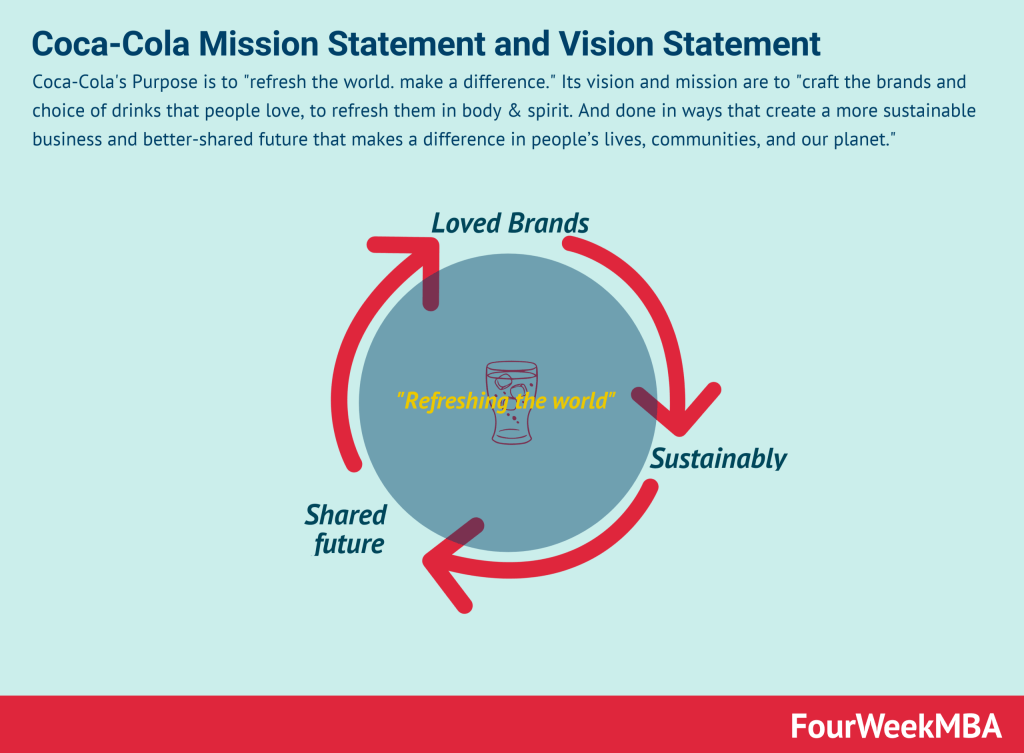
Coca-Cola’s Purpose is to “refresh the world. make a difference.” Its vision and mission are to “craft the brands and choice of drinks that people love, to refresh them in body & spirit. And done in ways that create a more sustainable business and better-shared future that makes a difference in people’s lives, communities, and our planet.”

Read Also: McDonald’s Business Model, Coca-Cola Business Model, Coca-Cola Distribution Strategy.