Artificial Intelligence Business Models - FourWeekMBA
Gennaro Cuofano·2026-05-02·via FourWeekMBA
Last Updated: May 2026 — Enhanced with AI business impact analysis
“`html
Artificial Intelligence Business Models in 2026: What Changed
The AI business landscape has fundamentally shifted since 2023. OpenAI’s GPT-4 Turbo now powers over 2.5 million applications, while the company’s revenue reached $3.4 billion annually. The subscriptionmodel dominance has given way to usage-based pricing, with 73% of AI companies adopting token-based billing. Multi-modal AI services combining text, image, and voice have become standard offerings. Enterprise AI spending increased 340% since 2023, driven by specialized industry models and on-premises deployment options that address data sovereignty concerns.
Key Metrics
Metric
2026 Value
Global AI Software Market Size
$251 billion
Average AI API Cost per 1M Tokens
$0.85
Enterprise AI Adoption Rate
89%
ChatGPT Plus Subscribers
45 million
AI Startups with $1B+ Valuation
127
Microsoft AI Revenue (Annual)
$28.6 billion
Average AI Model Training Cost
$63 million
Why This Matters in the AI Era
AI business models now determine competitive advantage across industries. Companies leveraging foundation models through APIs can launch AI-powered products 75% faster than building from scratch. The shift toward specialized, fine-tuned models has created new revenue streams for domain-specific AI solutions. Organizations must choose between platform dependency and costly in-house development, making AI partnership strategies critical for sustainable growth and innovation velocity.
OpenAI has built the foundational layer of the AI industry. With large generative models like GPT-3 and DALL-E, OpenAI offers API access to businesses that want to develop applications on top of its foundational models while being able to plug these models into their products and customize these models with proprietary data and additional AI features. On the other hand, OpenAI also released ChatGPT, developing around a freemium model. Microsoft also commercializes opener products through its commercial partnership.
OpenAI and Microsoft partnered up from a commercial standpoint. The history of the partnership started in 2016 and consolidated in 2019, with Microsoft investing a billion dollars into the partnership. It’s now taking a leap forward, with Microsoft in talks to put $10 billion into this partnership. Microsoft, through OpenAI, is developing its Azure AI Supercomputer while enhancing its Azure Enterprise Platform and integrating OpenAI’s models into its business and consumer products (GitHub, Office, Bing).
Stability AI is the entity behind Stable Diffusion. Stability makes money from our AI products and from providing AI consulting services to businesses. Stability AI monetizes Stable Diffusion via DreamStudio’s APIs. While it also releases it open-source for anyone to download and use. Stability AI also makes money via enterprise services, where its core development team offers the chance to enterprise customers to service, scale, and customize Stable Diffusion or other large generative models to their needs.
Large language models (LLMs) are AI tools that can read, summarize, and translate text. This enables them to predict words and craft sentences that reflect how humans write and speak.
Prompt engineering is a natural language processing (NLP) concept that involves discovering inputs that yield desirable or useful results.
Like most processes, the quality of the inputs determines the quality of the outputs in prompt engineering. Designing effective prompts increases the likelihood that the model will return a response that is both favorable and contextual.
Developed by OpenAI, the CLIP (Contrastive Language-Image Pre-training) model is an example of a model that utilizes prompts to classify images and captions from over 400 million image-caption pairs.
As any digital business, Baidu needs a continuous stream of traffic to monetize its pages. In 2017 Baidu managed to lower its Traffic Acquisition Costs as a percentage of its revenues at 11.4%. Primarily driven from its Baidu Union Members, and its iQIYI services. The former allows Baidu to have inexpensive content served by third-parties members. The latter will enable Baidu to have high-quality premium content at a low cost.
TikTok is the Chinese creative social media platform driven by short-form video content enabling users to interact and generate content at scale. TikTok primarily makes money through advertising, and it generated $4.6 billion in advertising revenues in 2021, thus making it among the most popular attention-based business models or attention merchants.
C3 AI is a cloud-based Enterprise AI SaaS company. It built a set of proprietary applications (known as the C3 AI suite) that offer its clients the ability to integrate digital transformation applications with fast deployment and no overheads. C3 AI makes money primarily via its subscription services and professional fees.
Google (now Alphabet) primarily makes money through advertising. The Google search engine, while free, is monetized with paid advertising. In 2021 Google’s advertising generated over $209 billion (beyond Google Search, this comprises YouTube Ads and the Network Members Sites) compared to $257 billion in net sales. Advertising represented over 81% of net sales, followed by Google Cloud ($19 billion) and Google’s other revenue streams (Google Play, Pixel phones, and YouTube Premium).
Founded less than six years ago, OpenAI maintains a philosophy that giant corporations should not control progressive technology development. The non-profit organization aims to research artificial intelligence (AI) to discover its potential and benefits to society. The goal is to produce open-source software and applications that allow various researchers to develop AI systems. Since the beginning of the organization, it has racked up several impressive achievements, which is the primary focus of this article.GPT-3 is Open AI’s latest natural language prediction model. With the emergence of Artificial Intelligence (AI) in the business landscape, this is one of the tools that will quickly increase in popularity. The Generative Pre-trained Transformer 3 offers limitless access to computing on top of its cloud infrastructure, promoting scalability. Nevertheless, GPT-3 should be the next big thing in tech. Following the rise of deep learning, advanced technology will transform how business gets conducted globally.
As one of the largest artificial intelligence research facilities, DeepMind aims to advance the technologies of AI. DeepMind was acquired by large tech corporation Google for $600 million in 2014. Since the organization’s founding, it raked plenty of achievements shaping the world we live in today.
Started in 1911 as a Computing-Tabulating-Recording Company (CTR), called then International Business Machines by 1924. IBM primarily makes money by five segments (cognitive solutions, global business services, technology services, and cloud platforms, systems, and global financing) with also innovative products such as IBM Watson and IBM Blockchain.
Founded in 1968 by Gordon Moore, which would go on to formulate one of the most reliable laws in technology, Intel has been able to survive and thrive through several waves of technology. Intel is transitioning from becoming a PC-centric company to becoming a data-centric company.
NVIDIA is a GPU design company, which develops and sells enterprise chips for industries spacing from gaming, data centers, professional visualizations, and autonomous driving. NVIDIA serves major large corporations as enterprise customers, and it uses a platform strategy where it combines its hardware with software tools to enhance its GPUs’ capabilities.
Microsoft has a diversified business model, spanning from Office to gaming (with Xbox), LinkedIn, search (with Bing), and enterprise services (with GitHub). In 2021, Microsoft made over $168 billion in revenues, of which over $52 billion came from Server products and cloud services and $39.8 billion came from Office products and cloud services. Windows generated over $23 billion, Gaming generated over $15 billion, LinkedIn over $10 billion, and search advertising (through Bing) over $8.5 billion.
Tencent is a Chinese multinational conglomerate founded in 1998 by Ma Huateng, Zhang Zhidong, and Xu Chenye. Among its various global subsidiaries are companies in the online services, music, and artificial intelligence industries. But it is perhaps best known for its interest in the video game sector – both as a game developer for the Chinese market and the acquirer of several established gaming companies. Tencent is a vast company with a stake in more than 600 companies. Following is a look at some of the companies and subsidiaries it has a majority stake in.
AI is fundamentally reshaping business models by enabling companies to shift from product-centric to service-centric approaches through continuous learning and adaptation. Traditional software companies that once sold static licenses are now leveraging AI to offer dynamic, subscription-based services that improve over time. A concrete example is Adobe’s transformation from selling perpetual Creative Suite licenses to offering Creative Cloud subscriptions powered by AI features like Sensei. This AI integration enables automatic photo tagging, intelligent cropping, and personalized content recommendations that continuously enhance user experience. The AI capabilities create higher customer retention rates and justify recurring revenue models, as users receive ongoing value through regular AI-driven feature updates rather than waiting for major version releases. This shift allows Adobe to maintain closer customer relationships, gather usage data for further AI improvements, and achieve more predictable revenue streams while providing increasingly sophisticated tools.
AIOps is the application of artificial intelligence to IT operations. It has become particularly useful for modern IT management in hybridized, distributed, and dynamic environments. AIOps has become a key operational component of modern digital-based organizations, built around software and algorithms.
Agile started as a lightweight development method compared to heavyweight software development, which is the core paradigm of the previous decades of software development. By 2001 the Manifesto for Agile Software Development was born as a set of principles that defined the new paradigm for software development as a continuous iteration. This would also influence the way of doing business.
Agile project management (APM) is a strategy that breaks large projects into smaller, more manageable tasks. In the APM methodology, each project is completed in small sections – often referred to as iterations. Each iteration is completed according to its project life cycle, beginning with the initial design and progressing to testing and then quality assurance.
Agile Modeling (AM) is a methodology for modeling and documenting software-based systems. Agile Modeling is critical to the rapid and continuous delivery of software. It is a collection of values, principles, and practices that guide effective, lightweight software modeling.
Agile Business Analysis (AgileBA) is certification in the form of guidance and training for business analysts seeking to work in agile environments. To support this shift, AgileBA also helps the business analyst relate Agile projects to a wider organizational mission or strategy. To ensure that analysts have the necessary skills and expertise, AgileBA certification was developed.
Business modelinnovation is about increasing the success of an organization with existing products and technologies by crafting a compelling value proposition able to propel a new business model to scale up customers and create a lasting competitive advantage. And it all starts by mastering the key customers.
That is a process that requires a continuous feedback loop to develop a valuable product and build a viable business model. Continuous innovation is a mindset where products and services are designed and delivered to tune them around the customers’ problem and not the technical solution of its founders.
A design sprint is a proven five-day process where critical business questions are answered through speedy design and prototyping, focusing on the end-user. A design sprint starts with a weekly challenge that should finish with a prototype, test at the end, and therefore a lesson learned to be iterated.
Tim Brown, Executive Chair of IDEO, defined design thinking as “a human-centered approach to innovation that draws from the designer’s toolkit to integrate the needs of people, the possibilities of technology, and the requirements for business success.” Therefore, desirability, feasibility, and viability are balanced to solve critical problems.
DevOps refers to a series of practices performed to perform automated software development processes. It is a conjugation of the term “development” and “operations” to emphasize how functions integrate across IT teams. DevOps strategies promote seamless building, testing, and deployment of products. It aims to bridge a gap between development and operations teams to streamline the development altogether.
Product discovery is a critical part of agile methodologies, as its aim is to ensure that products customers love are built. Product discovery involves learning through a raft of methods, including design thinking, lean start-up, and A/B testing to name a few. Dual Track Agile is an agile methodology containing two separate tracks: the “discovery” track and the “delivery” track.
Feature-Driven Development is a pragmatic software process that is client and architecture-centric. Feature-Driven Development (FDD) is an agile software development model that organizes workflow according to which features need to be developed next.
eXtreme Programming was developed in the late 1990s by Ken Beck, Ron Jeffries, and Ward Cunningham. During this time, the trio was working on the Chrysler Comprehensive Compensation System (C3) to help manage the company payroll system. eXtreme Programming (XP) is a software development methodology. It is designed to improve software quality and the ability of software to adapt to changing customer needs.
The Agile methodology has been primarily thought of for software development (and other business disciplines have also adopted it). Lean thinking is a process improvement technique where teams prioritize the value streams to improve it continuously. Both methodologies look at the customer as the key driver to improvement and waste reduction. Both methodologies look at improvement as something continuous.
A startup company is a high-tech business that tries to build a scalable business model in tech-driven industries. A startup company usually follows a lean methodology, where continuous innovation, driven by built-in viral loops is the rule. Thus, driving growth and building network effects as a consequence of this strategy.
Kanban is a lean manufacturing framework first developed by Toyota in the late 1940s. The Kanban framework is a means of visualizing work as it moves through identifying potential bottlenecks. It does that through a process called just-in-time (JIT) manufacturing to optimize engineering processes, speed up manufacturing products, and improve the go-to-market strategy.
RAD was first introduced by author and consultant James Martin in 1991. Martin recognized and then took advantage of the endless malleability of software in designing development models. Rapid Application Development (RAD) is a methodology focusing on delivering rapidly through continuous feedback and frequent iterations.
Scaled Agile Lean Development (ScALeD) helps businesses discover a balanced approach to agile transition and scaling questions. The ScALed approach helps businesses successfully respond to change. Inspired by a combination of lean and agile values, ScALed is practitioner-based and can be completed through various agile frameworks and practices.
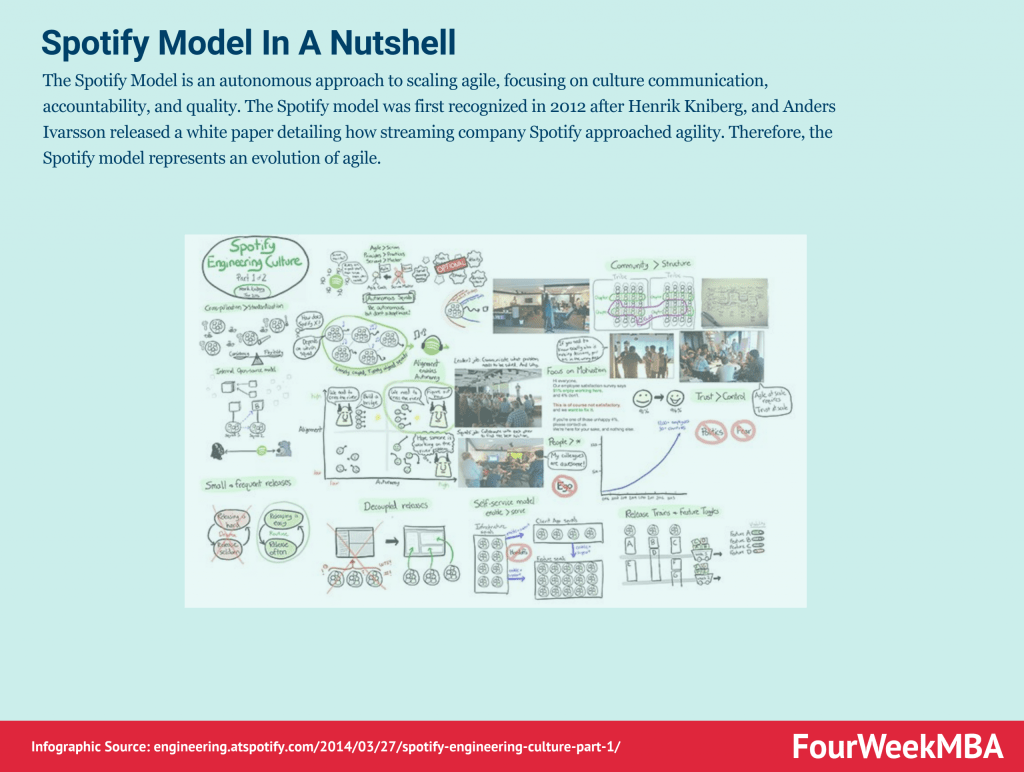
The Spotify Model is an autonomous approach to scaling agile, focusing on culture communication, accountability, and quality. The Spotify model was first recognized in 2012 after Henrik Kniberg, and Anders Ivarsson released a white paper detailing how streaming company Spotify approached agility. Therefore, the Spotify model represents an evolution of agile.
As the name suggests, TDD is a test-driven technique for delivering high-quality software rapidly and sustainably. It is an iterative approach based on the idea that a failing test should be written before any code for a feature or function is written. Test-Driven Development (TDD) is an approach to software development that relies on very short development cycles.
Timeboxing is a simple yet powerful time-management technique for improving productivity. Timeboxing describes the process of proactively scheduling a block of time to spend on a task in the future. It was first described by author James Martin in a book about agile software development.
Scrum is a methodology co-created by Ken Schwaber and Jeff Sutherland for effective team collaboration on complex products. Scrum was primarily thought for software development projects to deliver new software capability every 2-4 weeks. It is a sub-group of agile also used in project management to improve startups’ productivity.
Scrum anti-patterns describe any attractive, easy-to-implement solution that ultimately makes a problem worse. Therefore, these are the practice not to follow to prevent issues from emerging. Some classic examples of scrum anti-patterns comprise absent product owners, pre-assigned tickets (making individuals work in isolation), and discounting retrospectives (where review meetings are not useful to really make improvements).
Scrum at Scale (Scrum@Scale) is a framework that Scrum teams use to address complex problems and deliver high-value products. Scrum at Scale was created through a joint venture between the Scrum Alliance and Scrum Inc. The joint venture was overseen by Jeff Sutherland, a co-creator of Scrum and one of the principal authors of the Agile Manifesto.