惯性聚合 高效追踪和阅读你感兴趣的博客、新闻、科技资讯
阅读原文 在惯性聚合中打开

推荐订阅源

量子位
小众软件
小众软件
S
SegmentFault 最新的问题
人人都是产品经理
人人都是产品经理
博客园 - 【当耐特】
博客园 - 三生石上(FineUI控件)
C
Check Point Blog
S
Schneier on Security
Microsoft Azure Blog
N
Netflix TechBlog - Medium
Engineering at Meta
Engineering at Meta
GbyAI
GbyAI
罗磊的独立博客
有赞技术团队
有赞技术团队
V
V2EX
Y
Y Combinator Blog
博客园 - 叶小钗
让小产品的独立变现更简单 - ezindie.com
freeCodeCamp Programming Tutorials: Python, JavaScript, Git & More
Cyber Security Advisories - MS-ISAC
F
Fortinet All Blogs
W
WeLiveSecurity
OSCHINA 社区最新新闻
OSCHINA 社区最新新闻
Stack Overflow Blog
Stack Overflow Blog
The Cloudflare Blog
S
Security @ Cisco Blogs
TaoSecurity Blog
TaoSecurity Blog
MyScale Blog
MyScale Blog
Hugging Face - Blog
Hugging Face - Blog
cs.AI updates on arXiv.org
www.infosecurity-magazine.com
PCI Perspectives
PCI Perspectives
H
Heimdal Security Blog
Schneier on Security
Security Latest
Security Latest
AWS News Blog
AWS News Blog
月光博客
月光博客
Security Archives - TechRepublic
Recent Announcements
Google DeepMind News
博客园 - Franky
Cisco Talos Blog
Cisco Talos Blog
T
Threat Research - Cisco Blogs
M
MIT News - Artificial intelligence
T
Troy Hunt's Blog
N
News and Events Feed by Topic
Cloudbric
Cloudbric
Scott Helme
Scott Helme
云风的 BLOG
云风的 BLOG
Attack and Defense Labs

FourWeekMBA

Musk vs Altman: The $90B Fight That Will Define AI’s Future Why DeepMind’s $1.1B Bet Signals the End of Human-Trained AI The AI Orchestrator's Leverage Points AI & The Harness Theory Why AI Companies Are Selling Fiction as Partnership Strategy Google’s $40B Anthropic Bet Reveals AI Infrastructure Wars Anthropic’s Agent Economy Signals End of Human-Mediated Commerce Claude OS: The AI Strategy Skill That Turns Claude Into Your Analyst Agent Harness OS: Build AI-Augmented Strategic Operations 🔥 AI & The Harness Theory 🔥 The Harnessing Players Map of AI 🔥 The Business Engineer’s Claude Code OS 🔥 Skills as the Architecture of the Personal OS Google's $40B Anthropic Bet Exposes Big Tech's AI Desperation Google's $40B Anthropic Bet Signals Platform Wars 2.0 20 Mental Models For AI Business Google's TPU Gambit: Why Hardware Will Crown the AI King LinkedIn Business Model: How LinkedIn Makes Money (2026) Netflix Organizational Structure: The Culture of Freedom (2026) Amazon Pricing Strategy: How Amazon Uses Price to Win Amazon Supply Chain: The Logistics Empire (2026) Apple Supply Chain: How Apple Built the World’s Best Supply Chain Tesla Supply Chain: Vertical Integration Strategy (2026) Anthropic Business Model: How Anthropic Makes Money (2026) OpenAI Business Model: How OpenAI Makes Money (2026) Meta (Facebook) Organizational Structure 2026 Google's Agentic TPUs Signal the Death of Traditional SaaS Google's $40B Anthropic Bet Signals The End of AI Independence The OpenAI–Anthropic Convergent Bets Google’s $40B Anthropic Bet Signals the End of Open AI Innovation The Business Engineer's Claude Code OS Pentagon’s $54B Drone Budget Reveals the New Defense Economy Google's $40B Anthropic Bet Signals the End of Open AI Markets Apple’s CEO Transition Reveals the Platform Monopoly Trap Why Worldcoin’s Fake Partnership Signals AI’s Trust Crisis Google's TPU Play Signals the End of GPU Monopoly Artisan’s “Stop Hiring Humans” Stunt Reveals AI’s Marketing Problem GaaS vs SaaS: Why AI Agents Kill Per-Seat Pricing Defensible Moats in AI: What Actually Protects an AI Company The Software Collapse: When Code Becomes a Liability Apple's Subscription Empire Signals The End of Product Innovation Google’s TPU Gambit: The Hardware War for AI Agents AI & The Importance of System Thinking Why Prego’s Kitchen Surveillance Signals Audio’s Next Battleground Apple’s Subscription Pivot Reveals Platform Monopoly Endgame Tesla’s $25B Bet Signals Manufacturing’s AI Revolution Physical AI Market Map: Where Real-World AI Creates Value From SaaS to AgaaS: How AI Agents Are Killing Per-Seat Pricing Prego’s Kitchen Surveillance Reveals Big Food’s Data Desperation Tim Cook’s Subscription Trap Is Killing Apple’s Innovation DNA The Chinese AI Economy OpenAI-OpenClaw Deal & the War for Personal Agents The Shape of the Agentic Interface The RLVR-to-Agentic Use Case Map The Agentic Architecture Race The SaaS Destruction Map The State of Agentic AI The Turning Point The Post-SaaS Expansion Map Five Predictions for the Agentic Economy The Five Scaling Phases of AI The Great Interface Inversion The Agent-Native API The AI Value Chain of Work Capacity-Priority Mismatch Matrix Salesforce & The Agentic Cannibalization NVIDIA & The State of AI The System of Action The Strategic Bet Matrix AI Agents & The New Payment Infrastructure Why World Chose Tinder as Its Humanness Beachhead Uber's Assetmaxxing Era: The Robotaxi Reckoning AI Business Brief: OpenAI’s 12-Month Window and the Great Consolidation — April 20, 2026 Content Marketing Strategy vs Meta/Facebook Growth Strategy: Key Differences & When to Use Each [2026] Netflix Business Model vs Disney Business Model: Key Differences & When to Use Each [2026] Facebook/Meta Business Model vs Amazon Business Model: Key Differences & When to Use Each [2026] DTC Model vs Wholesale Model: Key Differences & When to Use Each [2026] Marketplace Model vs Platform Model: Key Differences & When to Use Each [2026] Value Chain Analysis vs Supply Chain: Key Differences & When to Use Each [2026] Apple Business Model vs Samsung Business Model: Key Differences & When to Use Each [2026] Uber Business Model vs Lyft Business Model: Key Differences & When to Use Each [2026] Cost Leadership vs Differentiation Strategy: Key Differences & When to Use Each [2026] Freemium vs Subscription Model: Key Differences & When to Use Each [2026] Porter’s Five Forces vs SWOT Analysis: Key Differences & When to Use Each [2026] Porter’s Five Forces vs PESTEL Analysis: Key Differences & When to Use Each [2026] Salesforce & The Agentic Cannibalization: Interactive Analysis Micron & The AI Memory Bottleneck: Constraint Map The AI Reasoning Growth Loop: Memory & Flywheel Framework - FourWeekMBA The Inference Economy: Interactive Framework - FourWeekMBA Amazon in the AI Era: From E-Commerce Giant to AI Infrastructure Power - FourWeekMBA Google in the AI Era: How the Business Model Is Evolving - FourWeekMBA AI Strategy Cheat Sheets: Top 10 Frameworks in One Page - FourWeekMBA AI Landscape Explorer: Every Company Analyzed - FourWeekMBA AI Strategy Learning Paths: Four Guided Journeys - FourWeekMBA Which AI Framework Do You Need? Interactive Quiz - FourWeekMBA NVIDIA’s Industrial AI Thesis: Five Structural Trends - FourWeekMBA The Business Engineer Database: 663 AI & Business Strategy Analyses - FourWeekMBA The State of Business AI — March 2026 Executive Report - FourWeekMBA The State of Agentic AI: Interactive Report - FourWeekMBA The SaaS Destruction Map: $2T Revenue Repriced - FourWeekMBA
Risk Pooling in Insurance: 5 Key Benefits for 2026 - FourWeekMBA
Gennaro Cuofano · 2026-05-20 · via FourWeekMBA

BUSINESS CONCEPT

Risk pooling is a strategy used to manage and mitigate risk by combining the risks of multiple entities or individuals. By aggregating these risks, the overall variability and impact of individual risks are reduced, leading to more predictable outcomes.

Key Components

What is Risk Pooling?

Risk pooling is a strategy used to manage and mitigate risk by combining the risks of multiple entities or individuals.

Importance of Understanding Risk Pooling

Understanding and effectively using risk pooling is crucial for enhancing risk management, reducing variability, and improving decision-making.

Components of Risk Pooling

Risk pooling involves several key components that contribute to its effectiveness in managing and mitigating risk.

Methods of Risk Pooling

Several methods can be used to implement risk pooling effectively, each offering different strategies and tools.

Benefits of Risk Pooling

Implementing risk pooling strategies offers numerous benefits, enhancing risk management, reducing variability, and improving overall outcomes.

Challenges of Risk Pooling

Despite its benefits, implementing risk pooling presents several challenges that need to be managed for successful implementation.

Best Practices for Implementing Risk Pooling

Implementing best practices can help effectively manage and overcome challenges, maximizing the benefits of risk pooling.

Future Trends in Risk Pooling

Several trends are likely to shape the future of risk pooling and its applications.

Strengths

Implementing risk pooling strategies offers numerous benefits, enhancing risk management, reducing variability, and…

Limitations

Despite its benefits, implementing risk pooling presents several challenges that need to be managed for successful…

Real-World Examples

Airbnb Amazon Apple Coca-Cola Costco Ebay

Key Insight

Understanding and effectively using risk pooling is crucial for enhancing risk management, reducing variability, and improving decision-making.

Exec Package + Claude OS Master Skill | Business Engineer Founding Plan

FourWeekMBA x Business Engineer | Updated 2026

Risk pooling is a fundamental concept in finance, insurance, and risk management. It involves the practice of aggregating various individual risks or exposures into a larger, more diversified pool to reduce the impact of adverse events on any single entity or individual. This risk management strategy plays a crucial role in ensuring financial stability, providing insurance coverage, and optimizing resource allocation.

Risk pooling in insurance refers to the practice of combining premiums from many policyholders into a collective fund to pay claims. Insurance companies collect monthly premiums from large groups of insured individuals and use this pooled money to cover losses when members file claims for accidents, medical expenses, or other covered events.

What is Risk Pooling?

Risk pooling is a strategy used to manage and mitigate risk by combining the risks of multiple entities or individuals. By aggregating these risks, the overall variability and impact of individual risks are reduced, leading to more predictable outcomes. This concept is widely used in various fields, including insurance, supply chain management, and finance.

Key Characteristics of Risk Pooling

  • Risk Aggregation: Combining risks from multiple sources to reduce the impact of individual risks.
  • Predictability: Increasing the predictability of outcomes by spreading risks across a larger group.
  • Risk Sharing: Distributing the impact of risks among all participants in the pool.

Importance of Understanding Risk Pooling

Understanding and effectively using risk pooling is crucial for enhancing risk management, reducing variability, and improving decision-making.

Enhancing Risk Management

  • Risk Mitigation: Reduces the impact of individual risks by spreading them across a larger group.
  • Stability: Provides stability and resilience by managing uncertainties collectively.

Reducing Variability

  • Predictable Outcomes: Leads to more predictable and stable outcomes by averaging out individual risks.
  • Reduced Volatility: Minimizes the volatility associated with individual risk factors.

Improving Decision-Making

  • Informed Choices: Enables better decision-making by providing a clearer understanding of aggregated risks.
  • Resource Allocation: Facilitates efficient allocation of resources by reducing uncertainty.

Components of Risk Pooling

Risk pooling involves several key components that contribute to its effectiveness in managing and mitigating risk.

1. Risk Identification

  • Risk Assessment: Identifying the types of risks faced by individual entities or participants.
  • Risk Categories: Categorizing risks based on their nature and potential impact.

2. Risk Aggregation

  • Combining Risks: Aggregating risks from multiple entities to form a risk pool.
  • Pooling Mechanisms: Establishing mechanisms for combining and managing the aggregated risks.

3. Risk Sharing

  • Distribution: Distributing the impact of risks across all participants in the pool.
  • Equitable Sharing: Ensuring that the sharing of risks is fair and proportionate.

4. Risk Management

  • Strategies: Developing strategies to manage the aggregated risks effectively.
  • Mitigation Measures: Implementing measures to mitigate the impact of pooled risks.

Methods of Risk Pooling

Several methods can be used to implement risk pooling effectively, each offering different strategies and tools.

1. Insurance

  • Premiums: Collecting premiums from policyholders to create a pool of funds for covering losses.
  • Claims: Paying out claims from the pooled funds to compensate for individual losses.

2. Supply Chain Risk Pooling

  • Inventory Pooling: Combining inventory from multiple locations to reduce stockouts and excess inventory.
  • Demand Aggregation: Aggregating demand across different markets to stabilize supply chain operations.

3. Financial Risk Pooling

  • Diversified Portfolios: Creating diversified investment portfolios to spread financial risks.
  • Risk Sharing Agreements: Establishing agreements to share financial risks among participants.

4. Health Care Risk Pooling

  • Health Insurance Pools: Creating health insurance pools to spread medical costs across a large group.
  • Public Health Initiatives: Implementing public health initiatives that pool resources for disease prevention and treatment.

5. Cooperative Arrangements

  • Cooperatives: Forming cooperatives where members pool resources and share risks collectively.
  • Mutual Aid Agreements: Establishing mutual aid agreements to support each other in times of need.

Benefits of Risk Pooling

Implementing risk pooling strategies offers numerous benefits, enhancing risk management, reducing variability, and improving overall outcomes.

Enhanced Risk Management

  • Risk Reduction: Reduces the impact of individual risks by spreading them across a larger group.
  • Stability: Provides stability and resilience in managing uncertainties.

Increased Predictability

  • Stable Outcomes: Leads to more predictable and stable outcomes by averaging out individual risks.
  • Reduced Volatility: Minimizes the volatility associated with individual risk factors.

Cost Efficiency

  • Economies of Scale: Achieves economies of scale by pooling resources and risks.
  • Cost Sharing: Reduces the cost burden on individual participants through collective sharing.

Improved Resource Allocation

  • Efficient Use: Facilitates efficient allocation of resources by reducing uncertainty.
  • Informed Decisions: Enables better decision-making by providing a clearer understanding of aggregated risks.

Challenges of Risk Pooling

Despite its benefits, implementing risk pooling presents several challenges that need to be managed for successful implementation.

Adverse Selection

  • Risk Imbalance: Higher-risk individuals or entities may be more likely to join the risk pool, leading to an imbalance.
  • Premium Setting: Difficulty in setting appropriate premiums or contributions to reflect individual risk levels.

Moral Hazard

  • Behavior Change: Participants may take on more risks knowing that the impact is shared with others.
  • Monitoring: Difficulty in monitoring and controlling risk-taking behavior among participants.

Administrative Complexity

  • Coordination: Coordinating and managing the risk pool can be complex and resource-intensive.
  • Regulation: Ensuring compliance with regulatory requirements and standards.

Equity Issues

  • Fair Distribution: Ensuring that the distribution of risks and benefits is fair and equitable.
  • Contribution Levels: Setting appropriate contribution levels that reflect individual risk levels without being prohibitive.

Best Practices for Implementing Risk Pooling

Implementing best practices can help effectively manage and overcome challenges, maximizing the benefits of risk pooling.

Ensure Proper Risk Assessment

  • Comprehensive Analysis: Conduct thorough risk assessments to identify and understand individual risks.
  • Risk Categorization: Categorize risks based on their nature and potential impact to facilitate pooling.

Set Appropriate Contributions

  • Risk-Based Contributions: Set contribution levels based on individual risk levels to ensure fairness.
  • Regular Reviews: Regularly review and adjust contributions to reflect changes in risk levels.

Monitor and Manage Behavior

  • Incentive Structures: Develop incentive structures to discourage excessive risk-taking.
  • Monitoring Mechanisms: Implement monitoring mechanisms to track and manage participant behavior.

Foster Transparency

  • Open Communication: Ensure open communication about the risk pooling process and its benefits.
  • Transparent Operations: Maintain transparency in the management and operation of the risk pool.

Promote Equity

  • Fair Distribution: Ensure that the distribution of risks and benefits is fair and equitable.
  • Inclusive Practices: Implement inclusive practices to ensure all participants are treated fairly.

Future Trends in Risk Pooling

Several trends are likely to shape the future of risk pooling and its applications.

Digital Transformation

  • Data Analytics: Leveraging data analytics to enhance risk assessment and management.
  • Blockchain Technology: Using blockchain for secure and transparent management of risk pools.

Collaborative Platforms

  • Online Platforms: Developing online platforms to facilitate risk pooling and resource sharing.
  • Crowdsourcing: Utilizing crowdsourcing to aggregate risks and resources from a larger community.

Sustainable Practices

  • Green Insurance: Promoting green insurance products that pool environmental risks.
  • Sustainable Investments: Creating investment pools that focus on sustainable and socially responsible projects.

Global Cooperation

  • International Risk Pools: Developing international risk pools to manage global risks, such as pandemics and climate change.
  • Cross-Border Collaboration: Enhancing cross-border collaboration to share risks and resources effectively.

Behavioral Insights

  • Nudge Theory: Applying nudge theory to encourage participation and responsible behavior in risk pools.
  • Behavioral Economics: Using insights from behavioral economics to design effective risk pooling strategies.

Conclusion

Risk pooling is a powerful strategy for managing and mitigating risks by combining the risks of multiple entities to reduce the impact of individual risks. By understanding the key components, methods, benefits, and challenges of risk pooling, organizations and individuals can develop effective strategies to enhance risk management, reduce variability, and improve overall outcomes. Implementing best practices such as ensuring proper risk assessment, setting appropriate contributions, monitoring and managing behavior, fostering transparency, and promoting equity can help maximize the benefits of risk pooling.

Read Next: Organizational Structure.

Types of Organizational Structures

organizational-structure-types
Organizational Structures

Siloed Organizational Structures

Functional

functional-organizational-structure
In a functional organizational structure, groups and teams are organized based on function. Therefore, this organization follows a top-down structure, where most decision flows from top management to bottom. Thus, the bottom of the organization mostly follows the strategy detailed by the top of the organization.

Divisional

divisional-organizational-structure

Open Organizational Structures

Matrix

matrix-organizational-structure

Flat

flat-organizational-structure
In a flat organizational structure, there is little to no middle management between employees and executives. Therefore it reduces the space between employees and executives to enable an effective communication flow within the organization, thus being faster and leaner.

How AI Is Changing This

AI is revolutionizing risk pooling by enabling more precise risk assessment and dynamic pricing models that create fairer, more efficient insurance pools. Traditional risk pooling relied on broad demographic categories and historical data, often leading to cross-subsidization where low-risk individuals overpaid to cover high-risk members. AI algorithms now analyze vast datasets including real-time behavioral data, IoT sensors, and predictive analytics to create more granular risk segments. For example, Progressive Insurance’s Snapshot program uses telematics to monitor actual driving behavior—acceleration patterns, braking habits, time of day driving, and mileage—rather than relying solely on age, gender, or credit scores. This allows them to offer personalized premiums that more accurately reflect individual risk, creating smaller, more homogeneous risk pools. While this increases pricing accuracy and can lower costs for safe drivers, it also raises concerns about potential discrimination and the exclusion of high-risk individuals from affordable coverage.

For deeper analysis: The Business Engineer — AI Strategy Intelligence

Connected Business Frameworks

Portfolio Management

project-portfolio-matrix
Project portfolio management (PPM) is a systematic approach to selecting and managing a collection of projects aligned with organizational objectives. That is a business process of managing multiple projects which can be identified, prioritized, and managed within the organization. PPM helps organizations optimize their investments by allocating resources efficiently across all initiatives.

Kotter’s 8-Step Change Model

kotters-8-step-change-model
Harvard Business School professor Dr. John Kotter has been a thought-leader on organizational change, and he developed Kotter’s 8-step change model, which helps business managers deal with organizational change. Kotter created the 8-step model to drive organizational transformation.

Nadler-Tushman Congruence Model

nadler-tushman-congruence-model
The Nadler-Tushman Congruence Model was created by David Nadler and Michael Tushman at Columbia University. The Nadler-Tushman Congruence Model is a diagnostic tool that identifies problem areas within a company. In the context of business, congruence occurs when the goals of different people or interest groups coincide.

McKinsey’s Seven Degrees of Freedom

mckinseys-seven-degrees
McKinsey’s Seven Degrees of Freedom for Growth is a strategy tool. Developed by partners at McKinsey and Company, the tool helps businesses understand which opportunities will contribute to expansion, and therefore it helps to prioritize those initiatives.

Mintzberg’s 5Ps

5ps-of-strategy
Mintzberg’s 5Ps of Strategy is a strategy development model that examines five different perspectives (plan, ploy, pattern, position, perspective) to develop a successful business strategy. A sixth perspective has been developed over the years, called Practice, which was created to help businesses execute their strategies.

COSO Framework

coso-framework
The COSO framework is a means of designing, implementing, and evaluating control within an organization. The COSO framework’s five components are control environment, risk assessment, control activities, information and communication, and monitoring activities. As a fraud risk management tool, businesses can design, implement, and evaluate internal control procedures.

TOWS Matrix

tows-matrix
The TOWS Matrix is an acronym for Threats, Opportunities, Weaknesses, and Strengths. The matrix is a variation on the SWOT Analysis, and it seeks to address criticisms of the SWOT Analysis regarding its inability to show relationships between the various categories.

Lewin’s Change Management

lewins-change-management-model
Lewin’s change management model helps businesses manage the uncertainty and resistance associated with change. Kurt Lewin, one of the first academics to focus his research on group dynamics, developed a three-stage model. He proposed that the behavior of individuals happened as a function of group behavior.

Organizational Structure Case Studies

the intelligence factory race between AI labs — -organizational-structure/”>OpenAI Organizational Structure

openai-organizational-structure
OpenAI is an artificial intelligence research laboratory that transitioned into a for-profit organization in 2019. The corporate structure is organized around two entities: OpenAI, Inc., which is a single-member Delaware LLC controlled by OpenAI non-profit, And OpenAI LP, which is a capped, for-profit organization. The OpenAI LP is governed by the board of OpenAI, Inc (the foundation), which acts as a General Partner. At the same time, Limited Partners comprise employees of the LP, some of the board members, and other investors like Reid Hoffman’s charitable foundation, Khosla Ventures, and Microsoft, the leading investor in the LP.

Airbnb Organizational Structure

airbnb-organizational-structure
Airbnb follows a holacracy model, or a sort of flat organizational structure, where teams are organized for projects, to move quickly and iterate fast, thus keeping a lean and flexible approach. Airbnb also moved to a hybrid model where employees can work from anywhere and meet on a quarterly basis to plan ahead, and connect to each other.

Amazon Organizational Structure

amazon-organizational-structure
The Amazon organizational structure is predominantly hierarchical with elements of function-based structure and geographic divisions. While Amazon started as a lean, flat organization in its early years, it transitioned into a hierarchical organization with its jobs and functions clearly defined as it scaled.

Apple Organizational Structure

apple-organizational-structure
Apple has a traditional hierarchical structure with product-based grouping and some collaboration between divisions.

Coca-Cola Organizational Structure

coca-cola-organizational-structure
The Coca-Cola Company has a somewhat complex matrix organizational structure with geographic divisions, product divisions, business-type units, and functional groups.

Costco Organizational Structure

costco-organizational-structure
Costco has a matrix organizational structure, which can simply be defined as any structure that combines two or more different types. In this case, a predominant functional structure exists with a more secondary divisional structure. Costco’s geographic divisions reflect its strong presence in the United States combined with its expanding global presence. There are six divisions in the country alone to reflect its standing as the source of most company revenue. Compared to competitor Walmart, for example, Costco takes more a decentralized approach to management, decision-making, and autonomy. This allows the company’s stores and divisions to more flexibly respond to local market conditions.

Dell Organizational Structure

dell-organizational-structure
Dell has a functional organizational structure with some degree of decentralization. This means functional departments share information, contribute ideas to the success of the organization and have some degree of decision-making power.

eBay Organizational Structure

ebay-organizational-structure
eBay was until recently a multi-divisional (M-form) organization with semi-autonomous units grouped according to the services they provided. Today, eBay has a single division called Marketplace, which includes eBay and its international iterations.

Facebook Organizational Structure

facebook-organizational-structure
Facebook is characterized by a multi-faceted matrix organizational structure. The company utilizes a flat organizational structure in combination with corporate function-based teams and product-based or geographic divisions. The flat organization structure is organized around the leadership of Mark Zuckerberg, and the key executives around him. On the other hand, the function-based teams are based on the main corporate functions (like HR, product management, investor relations, and so on).

Goldman Sachs’ Organizational Structure

goldman-sacks-organizational-structures
Goldman Sachs has a hierarchical structure with a clear chain of command and defined career advancement process. The structure is also underpinned by business-type divisions and function-based groups.

Google Organizational Structure

google-organizational-structure
Google (Alphabet) has a cross-functional (team-based) organizational structure known as a matrix structure with some degree of flatness. Over the years, as the company scaled and it became a tech giant, its organizational structure is morphing more into a centralized organization.

IBM Organizational Structure

ibm-organizational-structure
IBM has an organizational structure characterized by product-based divisions, enabling its strategy to develop innovative and competitive products in multiple markets. IBM is also characterized by function-based segments that support product development and innovation for each product-based division, which include Global Markets, Integrated Supply Chain, Research, Development, and Intellectual Property.

McDonald’s Organizational Structure

mcdonald-organizational-structure
McDonald’s has a divisional organizational structure where each division – based on geographical location – is assigned operational responsibilities and strategic objectives. The main geographical divisions are the US, internationally operated markets, and international developmental licensed markets. And on the other hand, the hierarchical leadership structure is organized around regional and functional divisions.

McKinsey Organizational Structure

Frequently Asked Questions

Q. Q: Why is risk pooling essential for the insurance industry to exist?

Risk pooling creates large groups to spread risk levels while maximizing premium collection. This allows insurance companies to predict losses statistically and maintain financial stability by distributing costs across many policyholders rather than individuals bearing full risk alone.

Q. What are the main benefits of risk pooling in insurance?

Risk pooling provides affordable coverage by spreading costs across many people, ensures claim payments through collective funding, reduces individual financial burden, enables predictable premium pricing, and allows insurance companies to remain financially stable while covering large losses.

Q. How does insurance risk pooling work in practice?

Insurance companies collect monthly premiums from all policyholders and combine the money into a shared fund. When someone files a claim for an accident or medical expense, the insurance company pays from this pooled money rather than individual accounts.

mckinsey-organizational-structure
McKinsey & Company has a decentralized organizational structure with mostly self-managing offices, committees, and employees. There are also functional groups and geographic divisions with proprietary names.

Microsoft Organizational Structure

microsoft-organizational-structure
Microsoft has a product-type divisional organizational structure based on functions and engineering groups. As the company scaled over time it also became more hierarchical, however still keeping its hybrid approach between functions, engineering groups, and management.

Nestlé Organizational Structure

nestle-organizational-structure
Nestlé has a geographical divisional structure with operations segmented into five key regions. For many years, Swiss multinational food and drink company Nestlé had a complex and decentralized matrix organizational structure where its numerous brands and subsidiaries were free to operate autonomously.

Nike Organizational Structure

nike-organizational-structure
Nike has a matrix organizational structure incorporating geographic divisions. Nike’s matrix structure is also present at the regional and sub-regional levels. Managerial responsibility is segmented according to business unit (apparel, footwear, and equipment) and function (human resources, finance, marketing, sales, and operations).

Patagonia Organizational Structure

patagonia-organizational-structure
Patagonia has a particular organizational structure, where its founder, Chouinard, disposed of the company’s ownership in the hands of two non-profits. The Patagonia Purpose Trust, holding 100% of the voting stocks, is in charge of defining the company’s strategic direction. And the Holdfast Collective, a non-profit, holds 100% of non-voting stocks, aiming to re-invest the brand’s dividends into environmental causes.

Samsung Organizational Structure

samsung-organizational-structure (1)
Samsung has a product-type divisional organizational structure where products determine how resources and business operations are categorized. The main resources around which Samsung’s corporate structure is organized are consumer electronics, IT, and device solutions. In addition, Samsung leadership functions are organized around a few career levels grades, based on experience (assistant, professional, senior professional, and principal professional).

Sony Organizational Structure

sony-organizational-structure
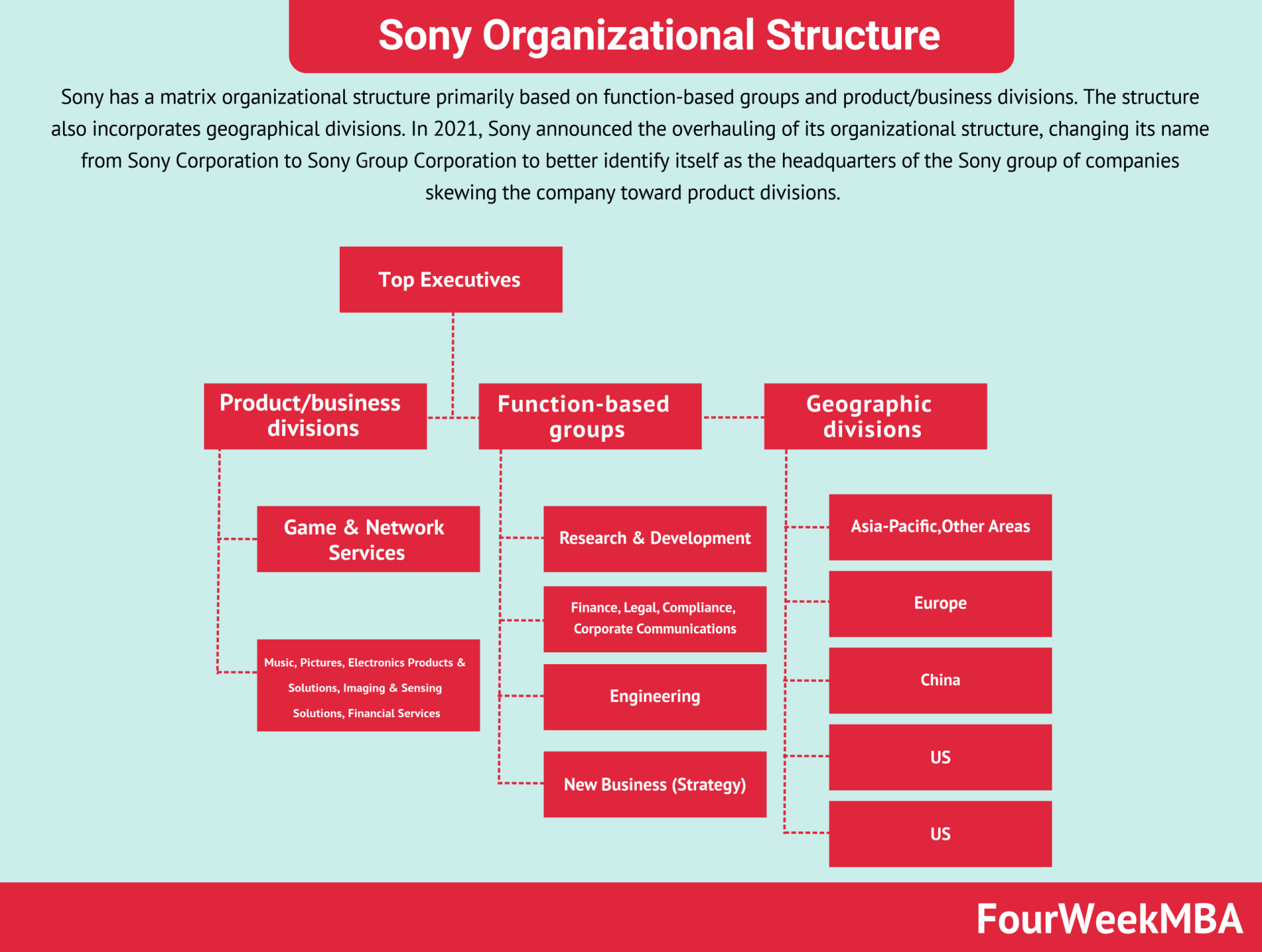
Sony has a matrix organizational structure primarily based on function-based groups and product/business divisions. The structure also incorporates geographical divisions. In 2021, Sony announced the overhauling of its organizational structure, changing its name from Sony Corporation to Sony Group Corporation to better identify itself as the headquarters of the Sony group of companies skewing the company toward product divisions.

Starbucks Organizational Structure

starbucks-organizational-structure
Starbucks follows a matrix organizational structure with a combination of vertical and horizontal structures. It is characterized by multiple, overlapping chains of command and divisions.

Tesla Organizational Structure

tesla-organizational-structure
Tesla is characterized by a functional organizational structure with aspects of a hierarchical structure. Tesla does employ functional centers that cover all business activities, including finance, sales, marketing, technology, engineering, design, and the offices of the CEO and chairperson. Tesla’s headquarters in Austin, Texas, decide the strategic direction of the company, with international operations given little autonomy.

Toyota Organizational Structure

toyota-organizational-structure
Toyota has a divisional organizational structure where business operations are centered around the market, product, and geographic groups. Therefore, Toyota organizes its corporate structure around global hierarchies (most strategic decisions come from Japan’s headquarter), product-based divisions (where the organization is broken down, based on each product line), and geographical divisions (according to the geographical areas under management).

Walmart Organizational Structure

walmart-organizational-structure
Walmart has a hybrid hierarchical-functional organizational structure, otherwise referred to as a matrix structure that combines multiple approaches. On the one hand, Walmart follows a hierarchical structure, where the current CEO Doug McMillon is the only employee without a direct superior, and directives are sent from top-level management. On the other hand, the function-based structure of Walmart is used to categorize employees according to their particular skills and experience.

Main Free Guides:

Frequently Asked Questions

What is Risk Pooling in Insurance: 5 Key Benefits for 2026?

Risk pooling is a strategy used to manage and mitigate risk by combining the risks of multiple entities or individuals. By aggregating these risks, the overall variability and impact of individual risks are reduced, leading to more predictable outcomes. This concept is widely used in various fields, including insurance, supply chain management, and finance.

What is Importance of Understanding Risk Pooling?

Understanding and effectively using risk pooling is crucial for enhancing risk management, reducing variability, and improving decision-making.

What are the components of risk pooling?

Risk pooling involves several key components that contribute to its effectiveness in managing and mitigating risk.

What is Best Practices for Implementing Risk Pooling?

Implementing best practices can help effectively manage and overcome challenges, maximizing the benefits of risk pooling.

What is Future Trends in Risk Pooling?

Several trends are likely to shape the future of risk pooling and its applications.

What is How AI Is Changing This?

AI is revolutionizing risk pooling by enabling more precise risk assessment and dynamic pricing models that create fairer, more efficient insurance pools. Traditional risk pooling relied on broad demographic categories and historical data, often leading to cross-subsidization where low-risk individuals overpaid to cover high-risk members.

What are the organizational structure case studies?

the intelligence factory race between AI labs — -organizational-structure/">OpenAI Organizational Structure