惯性聚合 高效追踪和阅读你感兴趣的博客、新闻、科技资讯
阅读原文 在惯性聚合中打开

推荐订阅源

月光博客
月光博客
Martin Fowler
Martin Fowler
Threat Intelligence Blog | Flashpoint
The Last Watchdog
The Last Watchdog
S
Schneier on Security
C
Cisco Blogs
P
Privacy International News Feed
T
Tenable Blog
Spread Privacy
Spread Privacy
Recent Commits to openclaw:main
N
News and Events Feed by Topic
Security Archives - TechRepublic
阮一峰的网络日志
阮一峰的网络日志
Cyber Security Advisories - MS-ISAC
大猫的无限游戏
大猫的无限游戏
Project Zero
Project Zero
GbyAI
GbyAI
N
Netflix TechBlog - Medium
T
Tor Project blog
雷峰网
雷峰网
Y
Y Combinator Blog
H
Hackread – Cybersecurity News, Data Breaches, AI and More
T
Threat Research - Cisco Blogs
Cyberwarzone
Cyberwarzone
L
LangChain Blog
MyScale Blog
MyScale Blog
C
CERT Recently Published Vulnerability Notes
C
Check Point Blog
G
Google Developers Blog
T
Tailwind CSS Blog
L
LINUX DO - 热门话题
宝玉的分享
宝玉的分享
IT之家
IT之家
F
Fortinet All Blogs
TaoSecurity Blog
TaoSecurity Blog
Recent Announcements
T
The Exploit Database - CXSecurity.com
Hacker News: Ask HN
Hacker News: Ask HN
aimingoo的专栏
aimingoo的专栏
云风的 BLOG
云风的 BLOG
Engineering at Meta
Engineering at Meta
K
KPMG report finds enterprise disconnect between AI and its ROI | CIO
Google Online Security Blog
Help Net Security
Help Net Security
H
Hacker News: Front Page
小众软件
小众软件
U
Unit 42
Apple Machine Learning Research
P
Privacy & Cybersecurity Law Blog
T
Threatpost

FourWeekMBA

Musk vs Altman: The $90B Fight That Will Define AI’s Future Why DeepMind’s $1.1B Bet Signals the End of Human-Trained AI The AI Orchestrator's Leverage Points AI & The Harness Theory Why AI Companies Are Selling Fiction as Partnership Strategy Google’s $40B Anthropic Bet Reveals AI Infrastructure Wars Anthropic’s Agent Economy Signals End of Human-Mediated Commerce Claude OS: The AI Strategy Skill That Turns Claude Into Your Analyst Agent Harness OS: Build AI-Augmented Strategic Operations 🔥 AI & The Harness Theory 🔥 The Harnessing Players Map of AI 🔥 The Business Engineer’s Claude Code OS 🔥 Skills as the Architecture of the Personal OS Google's $40B Anthropic Bet Exposes Big Tech's AI Desperation Google's $40B Anthropic Bet Signals Platform Wars 2.0 20 Mental Models For AI Business Google's TPU Gambit: Why Hardware Will Crown the AI King LinkedIn Business Model: How LinkedIn Makes Money (2026) Netflix Organizational Structure: The Culture of Freedom (2026) Amazon Pricing Strategy: How Amazon Uses Price to Win Amazon Supply Chain: The Logistics Empire (2026) Apple Supply Chain: How Apple Built the World’s Best Supply Chain Tesla Supply Chain: Vertical Integration Strategy (2026) Anthropic Business Model: How Anthropic Makes Money (2026) OpenAI Business Model: How OpenAI Makes Money (2026) Meta (Facebook) Organizational Structure 2026 Google's Agentic TPUs Signal the Death of Traditional SaaS Google's $40B Anthropic Bet Signals The End of AI Independence The OpenAI–Anthropic Convergent Bets Google’s $40B Anthropic Bet Signals the End of Open AI Innovation The Business Engineer's Claude Code OS Pentagon’s $54B Drone Budget Reveals the New Defense Economy Google's $40B Anthropic Bet Signals the End of Open AI Markets Apple’s CEO Transition Reveals the Platform Monopoly Trap Why Worldcoin’s Fake Partnership Signals AI’s Trust Crisis Google's TPU Play Signals the End of GPU Monopoly Artisan’s “Stop Hiring Humans” Stunt Reveals AI’s Marketing Problem GaaS vs SaaS: Why AI Agents Kill Per-Seat Pricing Defensible Moats in AI: What Actually Protects an AI Company The Software Collapse: When Code Becomes a Liability Apple's Subscription Empire Signals The End of Product Innovation Google’s TPU Gambit: The Hardware War for AI Agents AI & The Importance of System Thinking Why Prego’s Kitchen Surveillance Signals Audio’s Next Battleground Apple’s Subscription Pivot Reveals Platform Monopoly Endgame Tesla’s $25B Bet Signals Manufacturing’s AI Revolution Physical AI Market Map: Where Real-World AI Creates Value From SaaS to AgaaS: How AI Agents Are Killing Per-Seat Pricing Prego’s Kitchen Surveillance Reveals Big Food’s Data Desperation Tim Cook’s Subscription Trap Is Killing Apple’s Innovation DNA The Chinese AI Economy OpenAI-OpenClaw Deal & the War for Personal Agents The Shape of the Agentic Interface The RLVR-to-Agentic Use Case Map The Agentic Architecture Race The SaaS Destruction Map The State of Agentic AI The Turning Point The Post-SaaS Expansion Map Five Predictions for the Agentic Economy The Five Scaling Phases of AI The Great Interface Inversion The Agent-Native API The AI Value Chain of Work Capacity-Priority Mismatch Matrix Salesforce & The Agentic Cannibalization NVIDIA & The State of AI The System of Action The Strategic Bet Matrix AI Agents & The New Payment Infrastructure Why World Chose Tinder as Its Humanness Beachhead Uber's Assetmaxxing Era: The Robotaxi Reckoning AI Business Brief: OpenAI’s 12-Month Window and the Great Consolidation — April 20, 2026 Content Marketing Strategy vs Meta/Facebook Growth Strategy: Key Differences & When to Use Each [2026] Netflix Business Model vs Disney Business Model: Key Differences & When to Use Each [2026] Facebook/Meta Business Model vs Amazon Business Model: Key Differences & When to Use Each [2026] DTC Model vs Wholesale Model: Key Differences & When to Use Each [2026] Marketplace Model vs Platform Model: Key Differences & When to Use Each [2026] Value Chain Analysis vs Supply Chain: Key Differences & When to Use Each [2026] Apple Business Model vs Samsung Business Model: Key Differences & When to Use Each [2026] Uber Business Model vs Lyft Business Model: Key Differences & When to Use Each [2026] Cost Leadership vs Differentiation Strategy: Key Differences & When to Use Each [2026] Freemium vs Subscription Model: Key Differences & When to Use Each [2026] Porter’s Five Forces vs SWOT Analysis: Key Differences & When to Use Each [2026] Porter’s Five Forces vs PESTEL Analysis: Key Differences & When to Use Each [2026] Salesforce & The Agentic Cannibalization: Interactive Analysis Micron & The AI Memory Bottleneck: Constraint Map The AI Reasoning Growth Loop: Memory & Flywheel Framework - FourWeekMBA The Inference Economy: Interactive Framework - FourWeekMBA Amazon in the AI Era: From E-Commerce Giant to AI Infrastructure Power - FourWeekMBA Google in the AI Era: How the Business Model Is Evolving - FourWeekMBA AI Strategy Cheat Sheets: Top 10 Frameworks in One Page - FourWeekMBA AI Landscape Explorer: Every Company Analyzed - FourWeekMBA AI Strategy Learning Paths: Four Guided Journeys - FourWeekMBA Which AI Framework Do You Need? Interactive Quiz - FourWeekMBA NVIDIA’s Industrial AI Thesis: Five Structural Trends - FourWeekMBA The Business Engineer Database: 663 AI & Business Strategy Analyses - FourWeekMBA The State of Business AI — March 2026 Executive Report - FourWeekMBA The State of Agentic AI: Interactive Report - FourWeekMBA The SaaS Destruction Map: $2T Revenue Repriced - FourWeekMBA
Nestlé Organigramme 2026: Matrix Structure Chart
Gennaro Cuof · 2026-05-04 · via FourWeekMBA

N

Nestlé Organizational Structure

Geographic + Product Matrix

Laurent Freixe ~270,000 Vevey, Switzerland Founded 1866

Laurent Freixe CEO Group A 🇧🇷 Zone Americas 🇪🇺 Zone Europe Group B 🇯🇵 Zone AOA 🇨🇳 Zone China Group C ☕ Nespresso 💊 Nestlé Health Sc…

🇧🇷

Zone Americas

North and South America operations

🇪🇺

Zone Europe

European market operations

🇯🇵

Zone AOA

Asia, Oceania, Africa markets

🇨🇳

Zone China

Greater China operations

Nespresso

Premium coffee, DTC model

💊

Nestlé Health Science

Medical nutrition, supplements

Explore In-Depth AI & Business Strategy →

fourweekmba.com data card

Nestlé’s Matrix Structure in 2026: What Changed

Nestlé’s organizational transformation accelerated dramatically in 2026 with the integration of AI-driven decision-making across its matrix structure. The company implemented autonomous supply chain pods that reduced regional bottlenecks by 34% while maintaining centralized brand oversight. New “AI Strategy Councils” now coordinate between geographic zones and product categories, replacing traditional committee structures. With 2,000+ brands across 186 countries, Nestlé’s matrix evolved from a coordination challenge into a real-time adaptive system that balances local market responsiveness with global efficiency standards.

Key Metrics

Global Workforce 273,000 employees
Operating Markets 186 countries
Product Categories 7 major divisions
Regional Zones 5 geographic clusters
AI-Enabled Processes 78% of operations
Matrix Decision Speed 3.2 days average
Annual Revenue CHF 94.4 billion

Why This Matters in the AI Era

Matrix organizations traditionally struggled with slow decision-making and unclear accountability. AI transforms this by enabling real-time coordination between multiple reporting lines. Nestlé’s success demonstrates how large multinationals can leverage machine learning to resolve matrix conflicts automatically, predict resource needs across dimensions, and maintain agility at scale. This model becomes essential as companies balance global integration with local adaptation in increasingly complex markets.

Nestlé has a geographical divisional structure with operations segmented into five key regions. For many years, Swiss multinational food and drink company Nestlé had a complex and decentralized matrix organizational structure where its numerous brands and subsidiaries were free to operate autonomously.

Nestlé's organizational structure is a matrix-based system that combines geographic regions with product categories and functional departments. The multinational corporation operates through three main zones (Americas, Europe Middle East Africa, Asia Oceania Africa) alongside global business units including Nestlé Waters, Nespresso, and Nestlé Health Science, enabling coordinated decision-making across 186 countries.

DepartmentTypeDetailsAdvantagesDrawbacks
Research and DevelopmentFunctional– Teams organized based on technical functions such as food science, product innovation, and quality control. Functional managers lead these teams.– Specialization in research and product development. – Efficient management of R&D tasks and expertise.– Potential communication barriers between different technical teams. – Siloed work without cross-functional collaboration.
Production and OperationsFunctional– Teams responsible for manufacturing, supply chain, and logistics. Functional managers oversee production and operations functions.– Expertise in production efficiency and supply chain management. – Effective cost control and process optimization.– Potential misalignment between production and R&D. – Challenges in adapting to rapid market changes.
Marketing and SalesFunctional– Teams focused on marketing strategies, branding, and sales efforts. Functional managers lead marketing and sales functions.– Expertise in marketing and sales techniques. – Effective customer engagement and revenue generation.– Potential disconnect between marketing and product development. – Overlook of holistic user experiences.
Quality AssuranceFunctional– Teams dedicated to ensuring product quality and compliance with regulations. Functional managers oversee quality assurance operations.– Proficiency in maintaining product quality and safety standards. – Effective response to quality concerns and regulations.– Limited integration with other functions like R&D and production. – Potential quality silos.
Geographical RegionsDivisional– Divisions organized by geographical regions (e.g., North America, Europe, Asia). – Divisional managers for each region.– Tailored strategies for regional markets. – Localized decision-making and adaptability.– Potential conflicts between regions in resource allocation. – Challenges in maintaining a consistent global brand image.
Product CategoriesMatrix– Cross-functional teams for different product categories (e.g., beverages, confectionery, pet care). Team members report to both category and functional managers.– Enhanced collaboration between product development and manufacturing. – Efficient category management.– Potential for power struggles between category and functional managers. – Complex communication channels.

Understanding Nestlé’s organizational structure

In October 2021, however, the company announced that a new geographic divisional structure would be implemented with global business operations organized into five zones.

CEO Mark Schneider noted that this move would enable Nestlé to “significantly sharpen our geographic focus to drive sustained profitable growth everywhere we operate. This move will bring us closer to consumers and customers, unlock new business opportunities and enable us to be even more agile in a fast-moving consumer environment.

Let’s describe these geographic divisions below in addition to some other aspects of Nestlé’s organizational structure — as explored in the new organizational architecture for the AI era — .

Nestlé’s geographic divisions

The five geographic divisions (and the countries they incorporate) include:

  1. Zone North America (NA) – this includes the United States (the company’s largest market) and Canada.
  2. Zone Latin America (LATAM) – this includes Brazil and Mexico – among Nestlé’s largest markets by revenue – and the Caribbean.
  3. Zone Europe (EUR) – in Europe, the company’s category-focused operating model has enabled it to grow its market share and build its innovation capabilities.
  4. Zone Asia, Oceania, and Africa (AOA) – a broad geographic region that also includes the Middle East and North Africa (MENA).
  5. Zone Greater China (GC) – a rapidly expanding market that offers significant growth potential for the company.

Note that not all of the company’s food and drink operations are organized under these regions. Globally managed businesses such as Nestlé Health Science and Nespresso remain separate.

The same is also true for joint ventures such as Froneri and Cereal Partners Worldwide.

Executive Board

Go Deeper

Want the full Nestlé analysis?

Nestlé’s org structure powers 2,000+ brands across 188 countries. Members access 700+ company analyses plus AI-powered competitive intelligence.

Nestlé’s Executive Board takes care of the day-to-day management of the company. 

In addition to current CEO Mark Schneider, there are 14 Executive and Deputy Executive Vice Presidents. Five of these lead the geographic divisions, while the remaining nine manage functional groups with the following titles:

  • Chief Financial Officer.
  • Head of Operations.
  • Chief Technology Officer.
  • Global Head Human Resources & Business Services.
  • General Counsel, Corporate Governance and Compliance.
  • Head of Strategic Business Units and Marketing and Sales.
  • Chief Executive Officer Nestlé Health Science.
  • Head of Group Strategy and Business Development.
  • Head of Nestlé Coffee Brands.

Board of Directors

The company’s Board of Directors is responsible for:

  • Supervision of the Group.
  • Long-term strategy development, and
  • The Group’s environmental, economic, and social sustainability initiatives. 

The Board of Directors consists of 15 members which include Mark Schneider and Nestlé Chairman (and former CEO) Paul Bulcke. Other board members bring experience from companies such as Amway, Apple, Credit Suisse, Inditex, AXA, and Harman International.

Overview of Nestlé’s Organizational Structure

Nestlé utilizes a matrix structure that integrates both geographical and product-based divisions:

Geographic Divisions:

  • Zone Americas (AMS)
  • Zone Europe (EMENA)
  • Zone Asia, Oceania, and sub-Saharan Africa (AOA)

Each geographic zone is responsible for managing operations, sales, and marketing strategies tailored to their specific regional markets.

Product Divisions:

  • Nestlé Waters
  • Nestlé Nutrition
  • Nestlé Purina PetCare
  • Nestlé Health Science
  • Confectionery
  • Frozen and refrigerated foods
  • Other food and beverage categories

These divisions focus on specific product lines, ensuring specialized attention to product development, innovation, and consumer needs.

Comparison with Other Major Companies

Here’s how Nestlé’s organizational structure compares to other major global food and beverage companies like Unilever, Procter & Gamble, and Kraft Heinz:

Comparison with Unilever

  • Similarities: Both Nestlé and Unilever use a matrix structure that includes geographic and product divisions to manage their wide range of consumer goods effectively.
  • Differences: Unilever places a stronger emphasis on brand divisions than geographic regions compared to Nestlé. Unilever’s structure is more oriented towards fast-moving consumer goods and less on specialized nutrition and health sciences compared to Nestlé’s diverse and specialized product focus.
  • Implications: Unilever’s brand-focused approach allows for strong brand identities and marketing strategies, potentially enhancing brand loyalty. Nestlé’s approach provides a more nuanced adaptation to local market conditions and a diverse product strategy that can address a broader range of consumer needs and health-related products.

Comparison with Procter & Gamble

  • Similarities: Like Nestlé, Procter & Gamble has a matrix organizational structure focusing on both product categories and geographic regions.
  • Differences: P&G focuses almost exclusively on consumer goods without the diversification into the food and nutrition sectors that characterizes Nestlé. P&G’s geographic division is more streamlined, focusing more on global brand management.
  • Implications: P&G’s streamlined focus allows for strong global branding and efficiencies in marketing and product development. Nestlé’s broader focus allows for greater market penetration in diverse sectors, including health, nutrition, and food services.

Comparison with Kraft Heinz

  • Similarities: Kraft Heinz and Nestlé both manage a variety of food and beverage products, with organizational structures that emphasize product divisions.
  • Differences: Kraft Heinz operates with a more centralized organizational structure compared to Nestlé’s decentralized, matrix structure. Kraft Heinz focuses more on North American markets, whereas Nestlé has a significant presence and tailored strategies across global markets.
  • Implications: Kraft Heinz’s more centralized approach can lead to greater efficiencies and cost control within North America but might lack the agility of Nestlé’s structure in adapting to global market trends and regional consumer preferences.

Key takeaways:

  • Nestlé has a predominantly geographical divisional structure with operations segmented into five key regions. This structure was first announced in October 2021 to replace the more complex, matrix structure.
  • Nestlé’s five geographic divisions are North America, Latin America, Europe, Asia, Oceania & Africa, and Greater China. The company’s joint venture projects and globally managed businesses such as Nestlé Health Science and Nespresso remain separate.
  • Nestlé is also supported by a 14-member Executive Board with members appointed as CEOs of the five geographic regions plus various functional groups.  

Key Highlights about Nestlé’s Organizational Structure:

  • Geographical Divisional Structure:
    • Nestlé has transitioned from a complex and decentralized matrix structure to a new geographic divisional structure.
    • The organizational structure is designed to focus on geographic regions to drive sustained profitable growth and agility.
  • Rationale for Change:
    • CEO Mark Schneider announced the shift to a geographic focus to bring Nestlé closer to consumers, unlock new opportunities, and enhance agility.
  • Geographic Divisions:
    • Nestlé’s operations are divided into five geographic zones:
      • Zone North America (NA): Includes the United States and Canada.
      • Zone Latin America (LATAM): Encompasses Brazil, Mexico, and the Caribbean.
      • Zone Europe (EUR): Focuses on growing market share and innovation capabilities in Europe.
      • Zone Asia, Oceania, and Africa (AOA): Includes Asia, Oceania, Africa, Middle East, and North Africa.
      • Zone Greater China (GC): Targets the rapidly expanding market of Greater China.
  • Globally Managed Businesses and Joint Ventures:
    • Certain businesses like Nestlé Health Science and Nespresso are managed globally and remain separate from the geographical divisions.
    • Joint ventures like Froneri and Cereal Partners Worldwide also operate independently.
  • Executive Board:
    • Nestlé’s Executive Board manages day-to-day operations.
    • CEO Mark Schneider and 14 Executive and Deputy Executive Vice Presidents lead the company.
    • Five Executive Vice Presidents lead the geographic divisions, while others manage functional groups.
    • Functional areas include Finance, Operations, Technology, Human Resources, Strategic Business Units, and more.
  • Board of Directors:
    • The Board of Directors supervises the Group, develops long-term strategy, and oversees sustainability initiatives.
    • Consists of 15 members, including CEO Mark Schneider and Chairman Paul Bulcke.
    • Board members bring diverse experience from various industries.
  • Strategic Focus:
    • The geographic divisional structure aligns with Nestlé’s strategic goal to achieve sustained growth and responsiveness to consumer needs.

Related Visual Stories

Who Owns Nestlé

who-owns-nestle

Nestlé Business Model

Nestlé Revenue

nestle-revenue
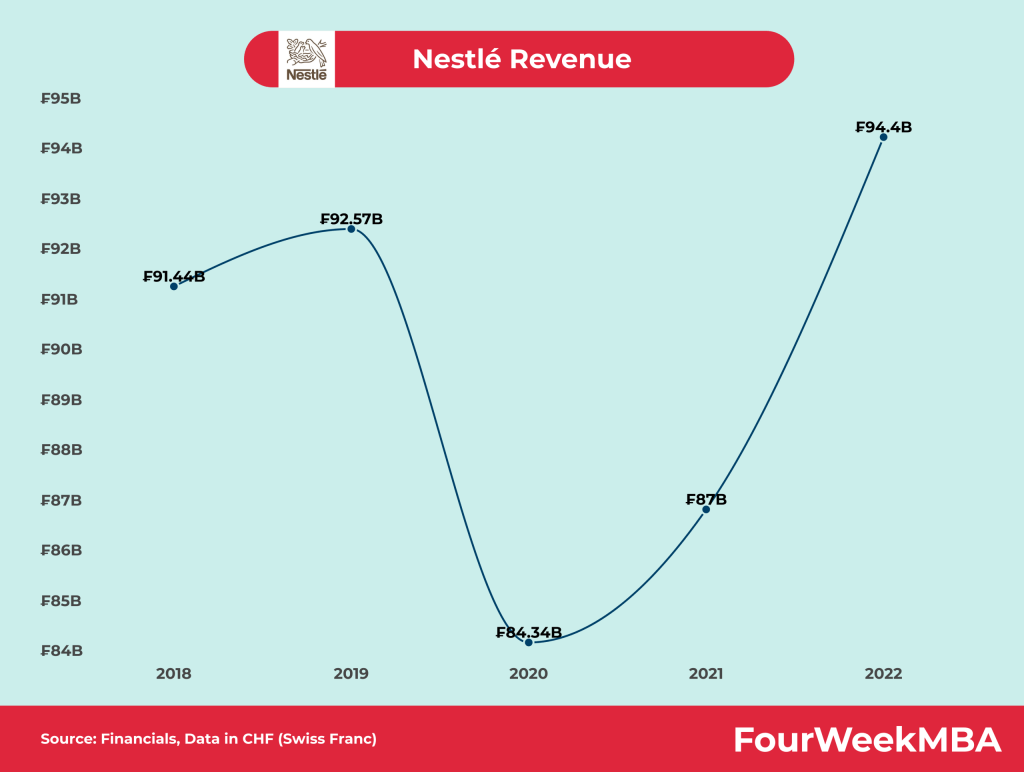
Nesté generated CHF 94.4 billion in 2022, compared to CHF 87 billion in 2021 and over CHF 84 billion in 2021.

Nestlé Profits

nestle-profits
Nestlé generated CHF 13.9 billion in operating profits in 2022, compared to CHF 12.16 in 2021 and CHF 14.23 billion in 2020.

Nestlé Revenue Breakdown

nestle-revenue-breakdown
Nestlé is a powerhouse in the consumer space, owning multiple brands. In 2022, most of the company’s revenue came from the powdered and liquid beverages segment, followed by pet care, nutrition & health science, and prepared dishes.

Nestlé Cost Structure

nestle-cost-structure
Nestlé’s cost structure is skewed toward marketing and distribution for its consumer brands. Its most substantial segment is the powder and liquid beverages business, which in 2022, for instance, on an over 25 billion Swiss Franc revenue, generated over 5 billion in operating profits.

Nestlé Employees

nestle-employees
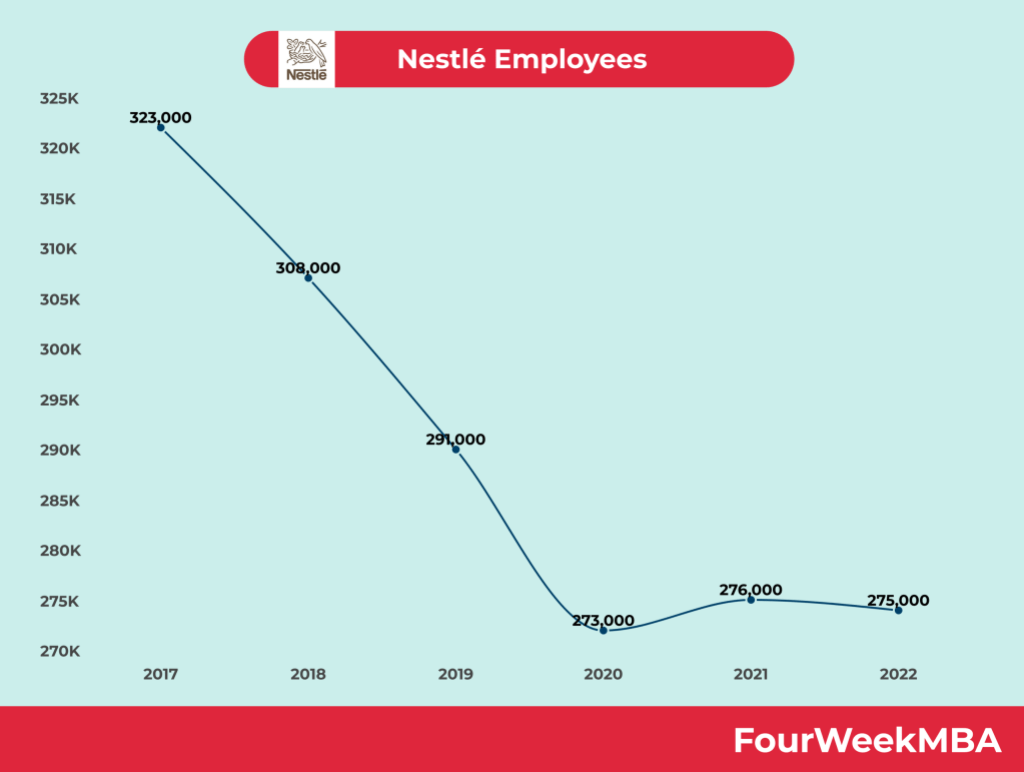
Nestlé had 275,000 employees in 2022, compared to 276,000 in 2021 and 273,000 in 2020.

Nestlé Revenue Per Employee

nestle-revenue-per-employee
Nestlé generated over 340K Swiss Francs per employee in 2022, compared to over 315K in 2021 and over 308K in 2020.

Nespresso Revenue

nespresso-revenue
Nespresso is one of the key brands part of the Nestlé family of consumer brands. Nespresso generated over 6.4 billion Swiss Franc revenue in 2022 (over $7 billion).

Nespresso Profits

nespresso-profits

Read Next: Organizational Structure

Types of Organizational Structures

organizational-structure-types
Organizational Structures

Siloed Organizational Structures

Functional

functional-organizational-structure
In a functional organizational structure, groups and teams are organized based on function. Therefore, this organization follows a top-down structure, where most decision flows from top management to bottom. Thus, the bottom of the organization mostly follows the strategy detailed by the top of the organization.

Divisional

divisional-organizational-structure

Open Organizational Structures

Matrix

matrix-organizational-structure

Flat

flat-organizational-structure
In a flat organizational structure, there is little to no middle management between employees and executives. Therefore it reduces the space between employees and executives to enable an effective communication flow within the organization, thus being faster and leaner.

How AI Is Changing This

Nestle has fundamentally restructured its global operations through AI-driven supply chain — as explored in how AI is restructuring the traditional value chain — optimization, moving from traditional regional silos to integrated, data-centric decision-making units. The company implemented an AI-powered demand forecasting system called “Nestle Digital Supply Chain” that consolidates data from over 400 factories worldwide, enabling real-time production adjustments and inventory management. This technological transformation eliminated multiple layers of regional supply chain management, replacing them with centralized AI analytics teams that work directly with local operations. For example, Nestle’s coffee division now uses machine learning algorithms to predict demand fluctuations across different markets simultaneously, allowing a single AI-enhanced team in Switzerland to coordinate production schedules for factories in Brazil, Vietnam, and Germany. This shift has reduced operational redundancies, accelerated decision-making from weeks to hours, and created new hybrid roles where traditional supply chain managers now work alongside data scientists and AI specialists.

For deeper analysis: The Business Engineer — AI Strategy Intelligence

Connected Business Frameworks

Portfolio Management

project-portfolio-matrix
Project portfolio management (PPM) is a systematic approach to selecting and managing a collection of projects aligned with organizational objectives. That is a business process of managing multiple projects which can be identified, prioritized, and managed within the organization. PPM helps organizations optimize their investments by allocating resources efficiently across all initiatives.

Kotter’s 8-Step Change Model

kotters-8-step-change-model
Harvard Business School professor Dr. John Kotter has been a thought-leader on organizational change, and he developed Kotter’s 8-step change model, which helps business managers deal with organizational change. Kotter created the 8-step model to drive organizational transformation.

Nadler-Tushman Congruence Model

nadler-tushman-congruence-model
The Nadler-Tushman Congruence Model was created by David Nadler and Michael Tushman at Columbia University. The Nadler-Tushman Congruence Model is a diagnostic tool that identifies problem areas within a company. In the context of business, congruence occurs when the goals of different people or interest groups coincide.

McKinsey’s Seven Degrees of Freedom

mckinseys-seven-degrees
McKinsey’s Seven Degrees of Freedom for Growth is a strategy tool. Developed by partners at McKinsey and Company, the tool helps businesses understand which opportunities will contribute to expansion, and therefore it helps to prioritize those initiatives.

Mintzberg’s 5Ps

5ps-of-strategy
Mintzberg’s 5Ps of Strategy is a strategy development model that examines five different perspectives (plan, ploy, pattern, position, perspective) to develop a successful business strategy. A sixth perspective has been developed over the years, called Practice, which was created to help businesses execute their strategies.

COSO Framework

coso-framework
The COSO framework is a means of designing, implementing, and evaluating control within an organization. The COSO framework’s five components are control environment, risk assessment, control activities, information and communication, and monitoring activities. As a fraud risk management tool, businesses can design, implement, and evaluate internal control procedures.

TOWS Matrix

tows-matrix
The TOWS Matrix is an acronym for Threats, Opportunities, Weaknesses, and Strengths. The matrix is a variation on the SWOT Analysis, and it seeks to address criticisms of the SWOT Analysis regarding its inability to show relationships between the various categories.

Lewin’s Change Management

lewins-change-management-model
Lewin’s change management model helps businesses manage the uncertainty and resistance associated with change. Kurt Lewin, one of the first academics to focus his research on group dynamics, developed a three-stage model. He proposed that the behavior of individuals happened as a function of group behavior.

Organizational Structure Case Studies

OpenAI Organizational Structure

openai-organizational-structure
OpenAI is an artificial intelligence research laboratory that transitioned into a for-profit organization in 2019. The corporate structure is organized around two entities: OpenAI, Inc., which is a single-member Delaware LLC controlled by OpenAI non-profit, And OpenAI LP, which is a capped, for-profit organization. The OpenAI LP is governed by the board of OpenAI, Inc (the foundation), which acts as a General Partner. At the same time, Limited Partners comprise employees of the LP, some of the board members, and other investors like Reid Hoffman’s charitable foundation, Khosla Ventures, and Microsoft, the leading investor in the LP.

Airbnb Organizational Structure

airbnb-organizational-structure
Airbnb follows a holacracy model, or a sort of flat organizational structure, where teams are organized for projects, to move quickly and iterate fast, thus keeping a lean and flexible approach. Airbnb also moved to a hybrid model where employees can work from anywhere and meet on a quarterly basis to plan ahead, and connect to each other.

Amazon Organizational Structure

amazon-organizational-structure
The Amazon organizational structure is predominantly hierarchical with elements of function-based structure and geographic divisions. While Amazon started as a lean, flat organization in its early years, it transitioned into a hierarchical organization with its jobs and functions clearly defined as it scaled.

Apple Organizational Structure

apple-organizational-structure
Apple has a traditional hierarchical structure with product-based grouping and some collaboration between divisions.

Coca-Cola Organizational Structure

coca-cola-organizational-structure
The Coca-Cola Company has a somewhat complex matrix organizational structure with geographic divisions, product divisions, business-type units, and functional groups.

Costco Organizational Structure

costco-organizational-structure
Costco has a matrix organizational structure, which can simply be defined as any structure that combines two or more different types. In this case, a predominant functional structure exists with a more secondary divisional structure. Costco’s geographic divisions reflect its strong presence in the United States combined with its expanding global presence. There are six divisions in the country alone to reflect its standing as the source of most company revenue. Compared to competitor Walmart, for example, Costco takes more a decentralized approach to management, decision-making, and autonomy. This allows the company’s stores and divisions to more flexibly respond to local market conditions.

Dell Organizational Structure

dell-organizational-structure
Dell has a functional organizational structure with some degree of decentralization. This means functional departments share information, contribute ideas to the success of the organization and have some degree of decision-making power.

eBay Organizational Structure

ebay-organizational-structure
eBay was until recently a multi-divisional (M-form) organization with semi-autonomous units grouped according to the services they provided. Today, eBay has a single division called Marketplace, which includes eBay and its international iterations.

Facebook Organizational Structure

facebook-organizational-structure
Facebook is characterized by a multi-faceted matrix organizational structure. The company utilizes a flat organizational structure in combination with corporate function-based teams and product-based or geographic divisions. The flat organization structure is organized around the leadership of Mark Zuckerberg, and the key executives around him. On the other hand, the function-based teams are based on the main corporate functions (like HR, product management, investor relations, and so on).

Goldman Sachs’ Organizational Structure

Frequently Asked Questions

Q. Q: What are the main business units in Nestlé's organizational structure?

Nestlé's main business units include Nestlé Waters, Nespresso, Nestlé Health Science, and Purina PetCare. These global units operate alongside geographic zones and product categories within the company's matrix structure.

Q. How does Nestlé's matrix organizational structure work?

Nestlé's matrix structure combines three geographic zones with global business units and functional departments. This allows employees to report to multiple managers across regions, products, and functions for coordinated global operations.

Q. Why does Nestlé use a matrix organizational structure?

Nestlé uses a matrix structure to balance global consistency with local market responsiveness across 186 countries. This enables efficient resource sharing, knowledge transfer, and coordinated decision-making in its diverse multinational operations.

goldman-sacks-organizational-structures
Goldman Sachs has a hierarchical structure with a clear chain of command and defined career advancement process. The structure is also underpinned by business-type divisions and function-based groups.

Google Organizational Structure

google-organizational-structure
Google (Alphabet) has a cross-functional (team-based) organizational structure known as a matrix structure with some degree of flatness. Over the years, as the company scaled and it became a tech giant, its organizational structure is morphing more into a centralized organization.

IBM Organizational Structure

ibm-organizational-structure
IBM has an organizational structure characterized by product-based divisions, enabling its strategy to develop innovative and competitive products in multiple markets. IBM is also characterized by function-based segments that support product development and innovation for each product-based division, which include Global Markets, Integrated Supply Chain, Research, Development, and Intellectual Property.

McDonald’s Organizational Structure

mcdonald-organizational-structure
McDonald’s has a divisional organizational structure where each division – based on geographical location – is assigned operational responsibilities and strategic objectives. The main geographical divisions are the US, internationally operated markets, and international developmental licensed markets. And on the other hand, the hierarchical leadership structure is organized around regional and functional divisions.

McKinsey Organizational Structure

mckinsey-organizational-structure
McKinsey & Company has a decentralized organizational structure with mostly self-managing offices, committees, and employees. There are also functional groups and geographic divisions with proprietary names.

Microsoft Organizational Structure

microsoft-organizational-structure
Microsoft has a product-type divisional organizational structure based on functions and engineering groups. As the company scaled over time it also became more hierarchical, however still keeping its hybrid approach between functions, engineering groups, and management.

Nestlé Organizational Structure

nestle-organizational-structure
Nestlé has a geographical divisional structure with operations segmented into five key regions. For many years, Swiss multinational food and drink company Nestlé had a complex and decentralized matrix organizational structure where its numerous brands and subsidiaries were free to operate autonomously.

Nike Organizational Structure

nike-organizational-structure
Nike has a matrix organizational structure incorporating geographic divisions. Nike’s matrix structure is also present at the regional and sub-regional levels. Managerial responsibility is segmented according to business unit (apparel, footwear, and equipment) and function (human resources, finance, marketing, sales, and operations).

Patagonia Organizational Structure

patagonia-organizational-structure
Patagonia has a particular organizational structure, where its founder, Chouinard, disposed of the company’s ownership in the hands of two non-profits. The Patagonia Purpose Trust, holding 100% of the voting stocks, is in charge of defining the company’s strategic direction. And the Holdfast Collective, a non-profit, holds 100% of non-voting stocks, aiming to re-invest the brand’s dividends into environmental causes.

Samsung Organizational Structure

samsung-organizational-structure (1)
Samsung has a product-type divisional organizational structure where products determine how resources and business operations are categorized. The main resources around which Samsung’s corporate structure is organized are consumer electronics, IT, and device solutions. In addition, Samsung leadership functions are organized around a few career levels grades, based on experience (assistant, professional, senior professional, and principal professional).

Sony Organizational Structure

sony-organizational-structure
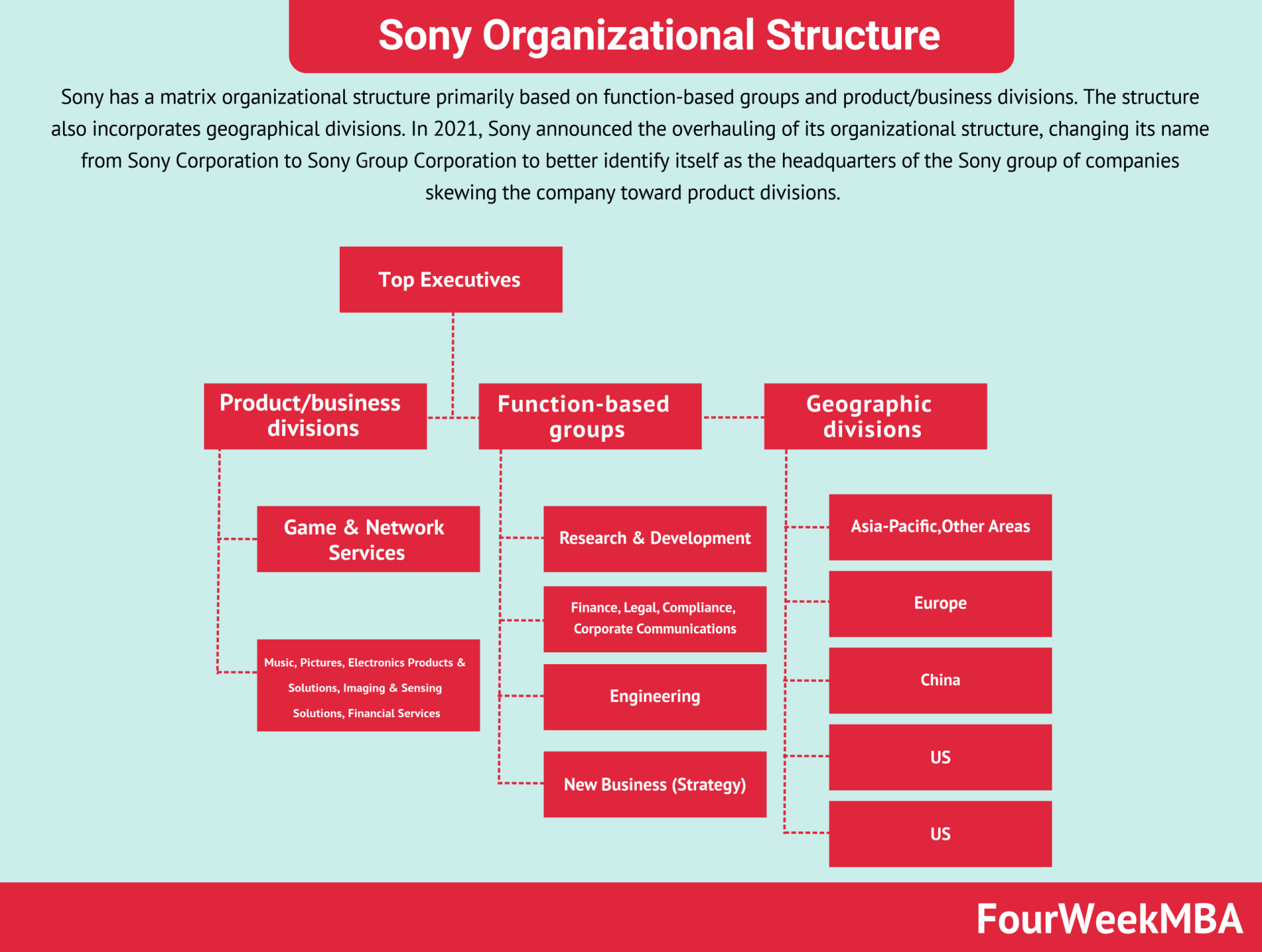
Sony has a matrix organizational structure primarily based on function-based groups and product/business divisions. The structure also incorporates geographical divisions. In 2021, Sony announced the overhauling of its organizational structure, changing its name from Sony Corporation to Sony Group Corporation to better identify itself as the headquarters of the Sony group of companies skewing the company toward product divisions.

Starbucks Organizational Structure

starbucks-organizational-structure
Starbucks follows a matrix organizational structure with a combination of vertical and horizontal structures. It is characterized by multiple, overlapping chains of command and divisions.

Tesla Organizational Structure

tesla-organizational-structure
Tesla is characterized by a functional organizational structure with aspects of a hierarchical structure. Tesla does employ functional centers that cover all business activities, including finance, sales, marketing, technology, engineering, design, and the offices of the CEO and chairperson. Tesla’s headquarters in Austin, Texas, decide the strategic direction of the company, with international operations given little autonomy.

Toyota Organizational Structure

toyota-organizational-structure
Toyota has a divisional organizational structure where business operations are centered around the market, product, and geographic groups. Therefore, Toyota organizes its corporate structure around global hierarchies (most strategic decisions come from Japan’s headquarter), product-based divisions (where the organization is broken down, based on each product line), and geographical divisions (according to the geographical areas under management).

Walmart Organizational Structure

walmart-organizational-structure
Walmart has a hybrid hierarchical-functional organizational structure, otherwise referred to as a matrix structure that combines multiple approaches. On the one hand, Walmart follows a hierarchical structure, where the current CEO Doug McMillon is the only employee without a direct superior, and directives are sent from top-level management. On the other hand, the function-based structure of Walmart is used to categorize employees according to their particular skills and experience.

Main Free Guides: