








To defend against the growing range of AI-accelerated threat actors, organizations need to be able to respond faster to outpace the adversary.
Recently, we announced Google AI Threat Defense, an automated security system designed to help you continuously monitor for and stop AI-powered threats before they can impact your business. Based on Google’s own approach to today’s threats and vulnerability management, it’s centered on a four-step framework: Prepare, scan and prioritize, remediate, and monitor.
Today, we’re sharing more details on how Google Security Operations works in concert with AI Threat Defense to monitor, detect, and respond to threats, particularly from code you do not own or can not patch. The remediation gap represents a critical vulnerability.
According to M-Trends 2026, the exploitation of vulnerabilities has become the most common initial infection vector. Notably, the report also indicates that the mean time to exploit has dropped to an estimated minus seven days, meaning exploitation frequently occurs even before a patch is officially released. Google Security Operations delivers vital operational fabric to autonomously contain active attacks across your entire environment.

Google Security Operations supports AI Threat Defense to monitor, detect, and respond to threats.
Engineered around a comprehensive approach that uses compensating controls with proactive security to strengthen operational resilience, Google Security Operations is built on a strategic, three-part approach to cross-environment visibility across your entire attack surface:
Designed to help you see and respond to threats faster than ever before, we deliver these capabilities at machine-scale and machine-speed. Together with Google AI Threat Defense, we’re able to provide the autonomous platform you need to outpace AI-driven attacks.
While proactive defense can identify vulnerabilities before they can be exploited, there will be applications that you can not patch, as well as potential gaps in the time it takes to remediate vulnerabilities.
The 2026 Verizon Data Breach Investigations Report underscores the magnitude of this challenge. In a study encompassing over 13,000 organizations, only 26% of vulnerabilities identified on the CISA Known Exploited Vulnerabilities (KEV) list had been fully remediated. Moreover, the median duration required to achieve full patching after detection stands at 43 days. Clearly, you still need continuous monitoring to detect threats in your environments.
Detection Engineering agent. Results for illustrative purposes.
The Detection Engineering agent in Google Security Operations can automatically translate new exploitation patterns of unpatched vulnerabilities into custom detections for your specific environment. Available in preview, it analyzes a diverse array of input sources to quickly and effectively recognize malicious activity, so you can uncover novel attack patterns evolving from new and unpatched vulnerabilities.
The agent’s sources include Google Threat Intelligence (such as emerging threat intelligence, new attack patterns curated by Mandiant, offensive tool repositories, red and purple team reports, autonomous malware analysis, open-source detection repositories and blogs), and internal security telemetry.

The workflow of the Detection Engineering agent.
To automatically find and fill coverage gaps tailored to your environment, the agent proactively builds new rules and validates them with synthetic events to help ensure your environment is covered before an exploit hits.
If a threat is detected, you need to immediately and autonomously assess and respond to protect your environment. By bringing together visibility from cloud and enterprise assets, including endpoints, on-premises firewall, identity, network, and custom application logs, your security operations center (SOC) can gain the full context of an attack, and unify disparate signals into a complete, actionable narrative the moment an adversary strikes.
The Triage and Investigation agent in Google Security Operations, generally available, helps analysts drastically reduce time to respond by autonomously investigating alerts, gathering evidence for analysis, and providing verdicts with comprehensive explanations. It can help security analysts automate decision-making, alert closure, and remediation flows, allowing them to spend more time prioritizing high-priority threats instead of false positives.
The agent has already investigated over 5 million alerts, reducing a typical 30-minute manual analysis to 60 seconds with Gemini.
While identifying threats is critical, the ultimate goal is rapid remediation. Agentic automation, available in preview, can help contain attacks by combining dynamic AI agents — which autonomously gather evidence and reason through complex alerts — with deterministic enterprise playbooks.
This hybrid approach ensures that analysts remain in absolute control of critical, high-impact actions while using AI to safely automate decision-making and remediation workflows.
Even with autonomous detections and rapid-response handling of active threats, stealthy adversaries and zero-day exploits can sometimes bypass frontline controls. To achieve operational resilience, security teams must also look backward through their data to uncover hidden compromises.
Strong, effective defensive strategies rely on more than just reacting to alerts. The Threat Hunting agent, available in preview, can help teams proactively hunt for novel attack patterns and stealthy adversary behaviors that bypass traditional defenses.
By scouring petabytes of enterprise telemetry (including historical logs) for subtle anomalies the agent fundamentally shifts the SOC posture from reactive to deeply proactive.
When adversaries can generate unique exploits and command-and-control (C2) infrastructure at zero marginal cost, static indicators like hashes and IPs decay instantly. Defenders must instead detect the behavioral tactics, techniques, and procedures (TTPs) of the attack.
We had the Detection Engineering agent audit our coverage against the recent Axios supply chain attack (UNC1069). The agent mapped the campaign intelligence into behavioral threat detection opportunities (TDOs), simulated the attack chain using high-fidelity synthetic UDM logs, and ran them against active rules.
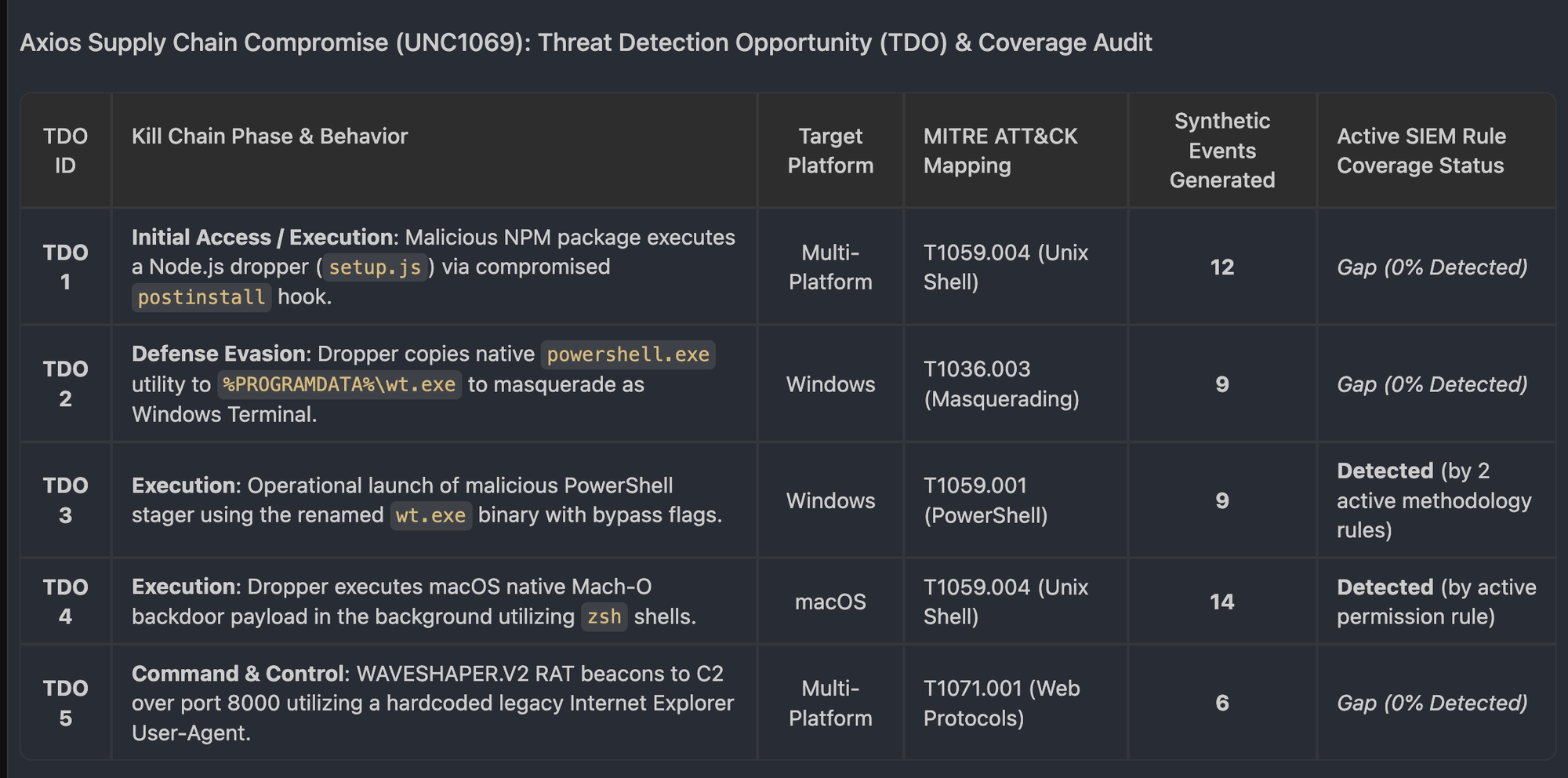
Google Detection Engineering agent output.
We successfully flagged the execution phases in the middle (renamed PowerShell and macOS background shells), but were blind at the initial entry point (NPM postinstall dropper) and the final C2 exit point.
By exposing these blind spots, the agent helped us proactively engineer custom YARA-L rules to close the loop at the first and final steps of the kill chain. You can sign up for the Google Security Operations Detection Engineering agent preview today.
By integrating Google Security Operations Gemini-native specialized agents into your workflow, you can autonomously generate detections, orchestrate containment, and hunt for stealthy threats at machine speed. This allows you to maintain a resilient defense even when primary controls fail, ultimately driving a 70% reduction in both breach risks and costs.
Google AI Threat Defense working alongside Google Security Operations can help you consistently outpace automated adversaries. To learn more about how Google AI Threat Defense and Google Security Operations can help you fight AI with AI, check out our Security Talks online event on June 10.
此内容由惯性聚合(RSS阅读器)自动聚合整理,仅供阅读参考。 原文来自 — 版权归原作者所有。