 Phishing remains the single biggest human-driven threat in most organizations. Yet many security leaders face a familiar problem: the stronger the push to run frequent training and simulations, the louder the employee backlash. Complaints range from “too many tests” to “training interrupts my work,” and that resistance can erode both engagement and security outcomes. The good news: you can lower Phish-prone Percentages without burning out your people by shifting strategy from frequency for frequency’s sake to smarter, less intrusive, and more supportive interventions that change behavior.
Below is a concise, actionable playbook designed for leaders in traditional organizations who must balance risk reduction, employee experience, and operational realities.
Why the usual approach fails:
- Overtraining breeds avoidance - Repeated, high-frequency simulations that feel punitive drive defensive behavior: employees learn how to “pass” the test rather than internalize safer habits, and some will deliberately click or otherwise game the system just to stop the exercise. Studies of security training show training that triggers resentment reduces long-term retention and reporting rates, undermining program goals.
- One-size-fits-all content misses real risks - Generic phishing templates and broad-stroke e-learning fail because they aren’t mapped to the organization’s real workflows; people need contextual examples tied to the apps, vendors, and communications they handle daily. Risk-aligned, role-specific content improves relevance and engagement, producing better transfer of learning to real-world decisions (case study in a large healthcare organization).
- Training that interrupts work lowers perceived value - When learning demands compete with billable hours or pressing deadlines, employees deprioritize it. Short, asynchronous microlearning and minimally intrusive simulations integrate more cleanly with workflows and are perceived as enabling rather than obstructing productivity.
- Metrics-focused programs ignore root causes - Click rate is a useful signal but not a causal explanation. Without follow-up diagnostics like reporting behavior, contextual surveys, or UX reviews, programs misattribute causes and may apply counterproductive remedies. Broader behavioral metrics reveal why clicks happen and where to focus remediation.
The following is a human-centered framework that works (four pillars):
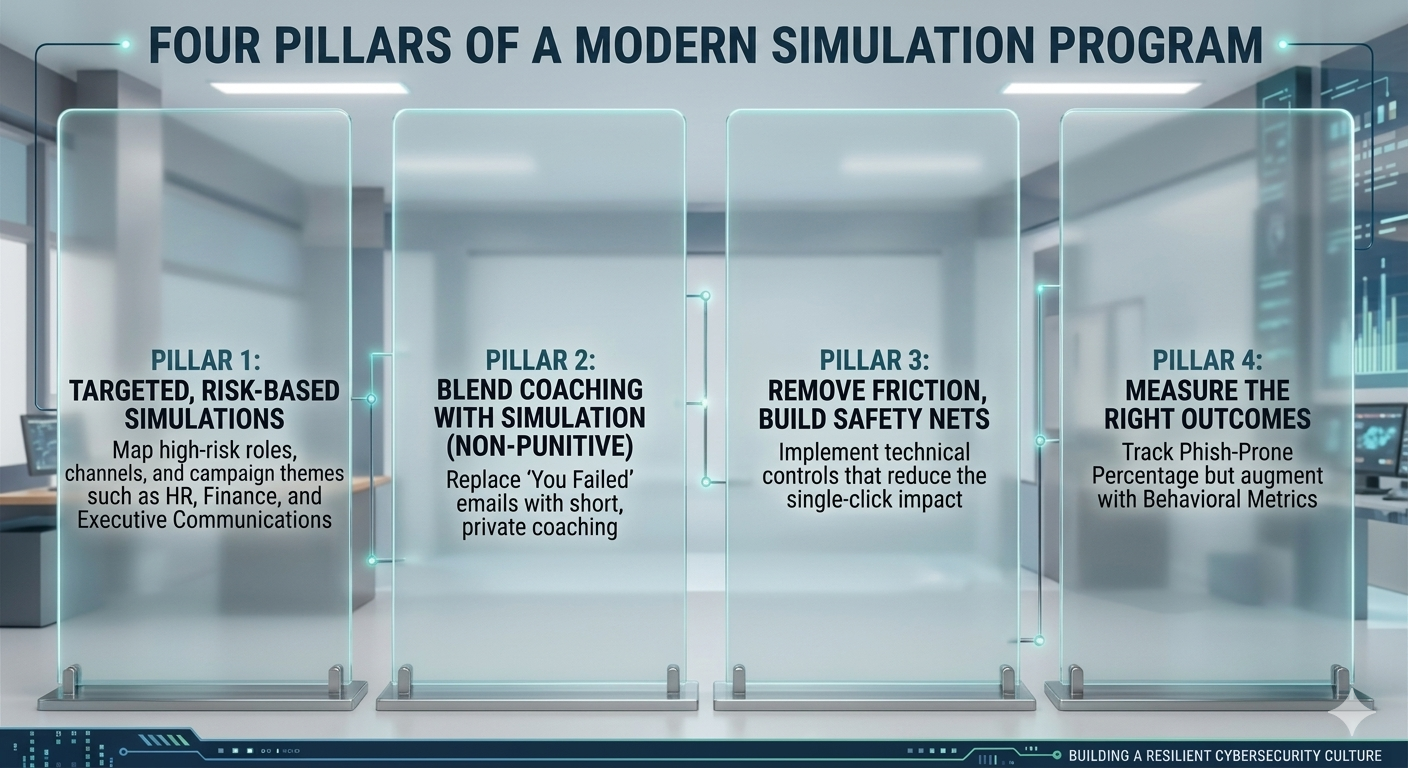
The following are recommended tactics to reduce backlash:
- Ask for less, give more: Short, focused lessons fit into daily workflows and respect time pressures, increasing completion and retention while minimizing resentment.
- Make simulations meaningful: Believability sustains credibility; unrealistic or repeatedly obvious phishes encourage dismissiveness. Spacing reduces habituation and preserves the salience of each simulation.
- Foster a no-blame culture: A blame-free approach encourages reporting and learning; positive reinforcement for reporting behavior builds a culture of collective defense and reduces concealment of mistakes.
- Use incentives carefully: Reward structures that publicly shame low performers damage trust and increase gaming. Public recognition or non-monetary rewards for reporting and helpful behavior are more effective and less corrosive.
For leadership, pivot the messaging to the following for the staff to enforce and incentivize them and transform the culture:
- “We are testing to understand where our controls need to be stronger — not to catch people out.”
- This framing shifts the focus from individual blame to system improvement, aligning staff with the program’s protective intent and reducing defensiveness.
- “If you click, report immediately — it helps everyone.”
- Clear, action-oriented calls to report emphasize the communal benefits of prompt escalation and create a straightforward behavioral norm.
- “Our goal is to make your work safer with as little disruption as possible.”
- Positioning the program as an enabler of safe productivity reassures employees that measures are designed to support their work, not hinder it.
Conclusion
Reducing Phish-prone Percentages in traditional organizations doesn’t require relentless testing; it requires smarter testing, timely coaching, technical backstops, and leadership that frames training as enabling rather than policing. Adopt a targeted, human-centered approach and you’ll lower risk while preserving trust and productivity.



