





On June 4, even as election results unfolded a changed political equation, Rahul Gandhi appeared in an intriguing place: the X account @archivedilfs. Expanding the acronym DILF may be more than this venerable journal can bring itself to do. For those who do not know, it stands for what some people might like to do to a Zaddy, or attractive older man, especially in the queer universe.
The tweet featured one of the videos from the Bharat Jodo Yatra where Rahul, backlit by a sunset, his wrinkles glowing in the golden hour, reaches out to people and people reach out for him. The video was cut to the song, “Daddy’s Back”.
This may not seem like a significant political event, but I would like to argue that Rahul Gandhi’s journey from Pappu to DILF signals a turning point in not only his own evolution, but also in the evolving need for new political frames.
Although Rahul is blessed with movie star good looks, he never seemed to acquire a star’s stature, not even after perceptions of him altered with the Bharat Jodo Yatra. In December 2023, I wrote in this magazine about the very different masculinity Rahul embodies, one which provides an antidote to the more dominating and domineering version idealised over the last decade. This masculinity is softer, more embracing and caring. But I did end with the question of whether Rahul, for all his willingness to rise to the challenges of being on the losing side, could bring a more libidinal force to bear on his work and display a franker appetite for power.
Shedding self-consciousness
The last few weeks of the election campaign certainly showed us a Rahul possessed of an irreverent confidence which was mirrored in the energy and chutzpah of the Congress social media handles. What Rahul seemed to shed was a kind of self-consciousness that has shadowed him in the past. This was evident even in the interviews he did with YouTube channels such as Curly Tales and Unfiltered by Samdish during the Bharat Jodo Yatra, where he found it hard to respond fulsomely to everyday questions or humorous asides. He tended to fall back on logical-sounding, near-technical responses. He hesitated to expand on potent, culturally resonant ideas like tapasya even if he brought them up himself, as if that might sound overblown and dramatic. On questions from China to unemployment, he came across as a little too bookish and nerdy. Knowledgeable yes, but not compelling.
In other words, he was trapped in a political aesthetic particular to liberal elites. Or, to put it more bluntly, an upper caste masculine aesthetic, where the idea of the “rational” dominates as the indicator of superior intellect, one that is cool and distant and rooted in realist, hence legalistic, forms of argument and denouncement. Here, culture must fit political theory rather than yielding new forms of theorising and paths of action. The emotional, the sensory, and the popular are viewed with mild distaste, seen as excessive hence uncontrolled, unreliable, inferior forms.

Students wear Rahul face masks at his 54th birthday celebrations at Gandhi Bhawan in Hyderabad on June 19. | Photo Credit: Tharun Vinny/ ANI
Through the elections, Rahul seemed to slowly and steadily liberate himself from the last of this burden, which some might call the albatross of Lutyens’ Delhi. Over the course of his campaign, his images became gradually more cinematic, exceeding the boundaries of the social media frame. He was not merely transmitting decency and kindness, he was also willing to be a little rude about the other side, to make unambiguous promises, speak an emotive language, utilising every rasa available to a communicator: compassion, sarcasm, humour, assertion, and unabashed emotion.
Also Read | Rahul Gandhi in search of a Bidenesque solution
Love ceased to be a politically pleasant concept and emboldened itself into an iconography of risk. Here was Rahul speaking in the rain. Here he was holding up the Constitution wherever he went. There he was with his family receiving women who brought gifts of ghee and asked his mother when she would arrange his marriage while children played with his dog. Here he was hugging his beloved sister and pulling her cheeks. There he was jumping a barrier to buy Mysore pak for “my brother Stalin”. He promised every woman below the poverty line Rs.1 lakh a year. He ceased to speak about caste and inequality via bureaucratic concepts and began to speak of these things experientially and from a place of faith. As he did so, he communicated more strongly and differently across masses of people than he had in the past.
As he evolved, jauntier and more suggestive memes appeared. The journalist Amrita Madhukalya tweeted: “GenZ twitter is so unserious, they have taken polls to a territory of innuendos and thirst traps”, while sharing a thread of said thirst traps. The emergence of Rahul as a “thirst trap”, a person whose photographs elicit and feed sexual thirst, indicates something libidinal that is unbound in the public when they connect one-to-one with a person and via that persona with an ideological universe. Rahul became, as stars and leaders do, the personification of an idea.

A selfie session during a ride in the Delhi Metro in May 2024. | Photo Credit: ANI
But the thirst that Rahul feeds is not merely a sexual one. We may more rightly describe it as eros. Plato defines eros as a “good composer” of every living thing, every work of art, every idea, “because you cannot give someone else what you don’t have or teach someone what you don’t know yourself”. This eros, of humour and sexual-ness, of connection and co-creation, brought to the surface what had been subterranean and scattered. It is an eros of diverse aspirations, a definition of Indian-ness which has been invalidated by Hindutva, a re-centring of the poor made vulnerable by the development so beloved of elites, and a new, non-technocratic imagination which must be co-created, not handed down; something porous and fluid, not intact and hermetic.
Emerging persona
Through this emerging persona we see Rahul remix several ideas. For one, he reframes the idea of family, as not only the location of inherited privilege but also one of affection, loss, and supportive bonds. He also reframes the idea of a single man as the remote patriarch, the lofty ascetic, to one who exists in a vast network of relationships, of family and extended community. There are his sister and mother. There are moonh-bole (stated) brothers (aka my brother Stalin). There are comrades and partners, like Akhilesh Yadav (the UP ke launde or Uttar Pradesh’s lads). There is the respected older colleague, like Mallikarjun Kharge who holds Rahul’s hand to cut a birthday cake and feeds him a slice. He reframes the idea of touch as being not just sexual, but comradely, comforting, collegial, as he reaches out to people of all ages and genders in gestures of connection. These images of togetherness are potent for a reason.
The dread of unemployment, the obstacles to education, the crushing inflation—the sheer difficulty of life—have left people feeling undefended and alone. This comes on the heels of a long cultural period whose pervasive motto has been each man for himself. Moreover, it follows a time when tragic events around the country have not been met with compassion by the ruling party. In fact, all events have been subsumed into the figure of Narendra Modi, and constantly used to bolster his image. We can think of Manipur, we can think of migrant workers on the long walk home in an abruptly announced lockdown, we can think of deaths due to COVID-19, and deaths due to communal hatred. Compassion, even acknowledgement, has been in short supply. Serving the people has become a long-forgotten formality. In a time of hypercapitalism, we inhabit a transactional culture, politically and personally, and it corrodes our lives, politically and personally.
In this world, which might be encapsulated in the Hindi phrase, “Aisa koi saga nahin, jise humne thaga nahin” (There’s not one relation I did not dupe), Rahul dares to personify the idea of “Sab mere sage hain” (The world is my family).
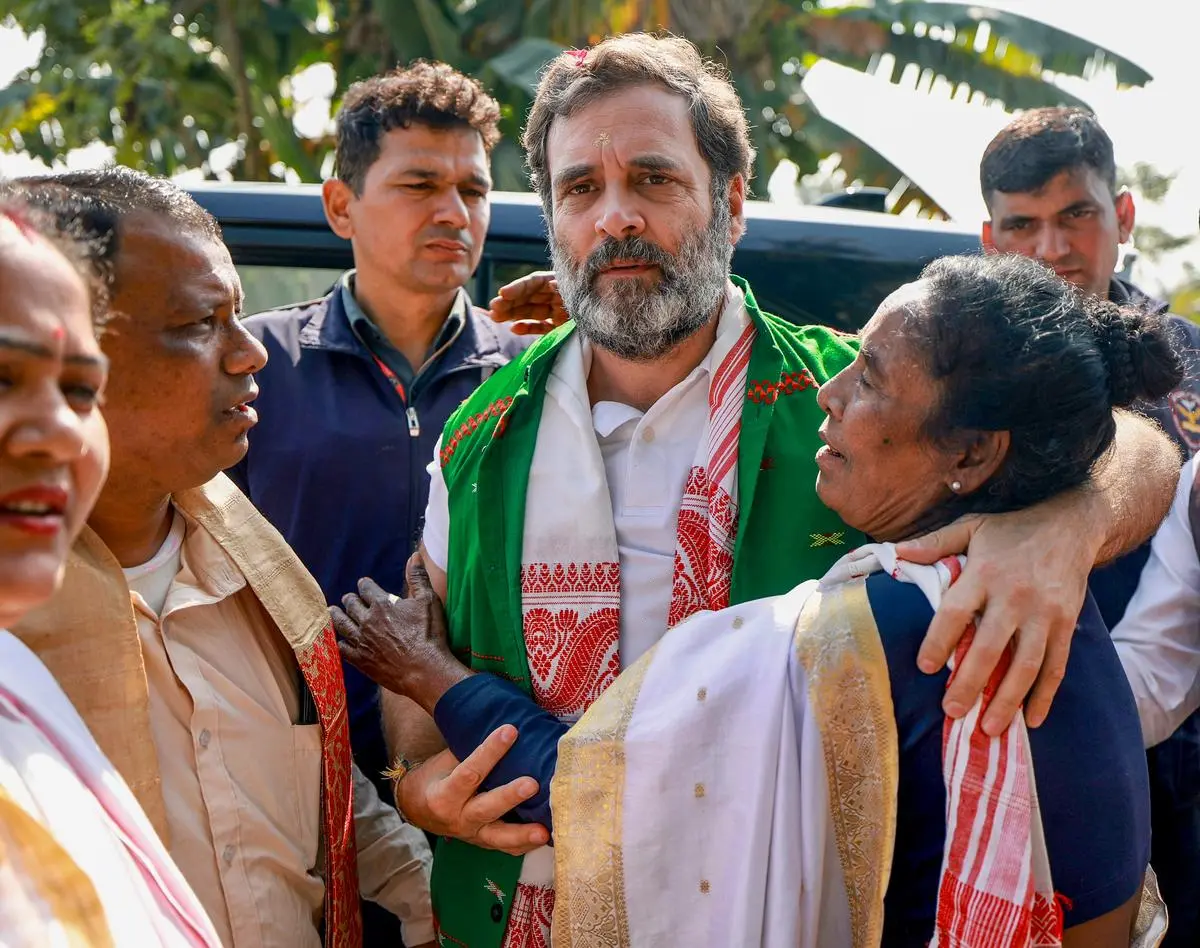
Rahul comforts a woman during the Bharat Jodo Nyay Yatra in January 2024. | Photo Credit: ANI
Equally, Rahul reframes the idea of the hero’s journey—a solitary sojourn to success. We do not see him emerge as a single or singular figure. His journey seems to exist amid other journeys, taken in tandem if not together. The images that emerge of the opposition victories in this election are heterogenous. We see Akhilesh Yadav and Uddhav Thackeray. We see the entry of Priyanka Gandhi, arguably the more charismatic and statesperson-like of the two, competition and collaboration at once. We see Geniben Thakor defeating the BJP in Gujarat. We see Sanjana Jatav dancing when she wins, or, as the X handle of “The Dalit Voice” put it with pithy beauty, “One of the youngest Dalit women to become an MP is enjoying democracy.”
If the last decade saw a paradigm shift in the discourse of politics, where engagement and debate became impossible in the face of totalitarian domination, perhaps this heterogeneity and its accompanying federalism signal a new paradigm shift. If the voter was often seen passively in terms of identity rather than actively as making strategic choices, then in this new paradigm the voter too demands to be looked at and seen. As Revati Laul wrote in a news website, “We are a country of subversives. Even when half of us conform and capitulate, we are in conversation with the half that does not. At various points in our lives as individuals and as a collective, each of us has conformed, capitulated, and then thrown it up in the air because that is who we innately are as a people. And it’s hard to measure, hard to quantify, because by definition it means that most of the time an Indian will not tell you what she really thinks. You have to be very good at reading the subtext and at eking it out of her.” In the mixed results of this election is a conversation that India is having with itself—perhaps an argument even. We cannot say Rahul has architected it, but for a number of reasons, he has come to symbolise it conceptually.
Reframing political success
How, then, should Rahul enjoy democracy?
The answer seems self-evident—through trying to be Prime Minister. And yet, that answer is not so self-evident. Rahul’s own seeming ambivalence on this matter has marked him as a dubious political proposition across the ideological spectrum.
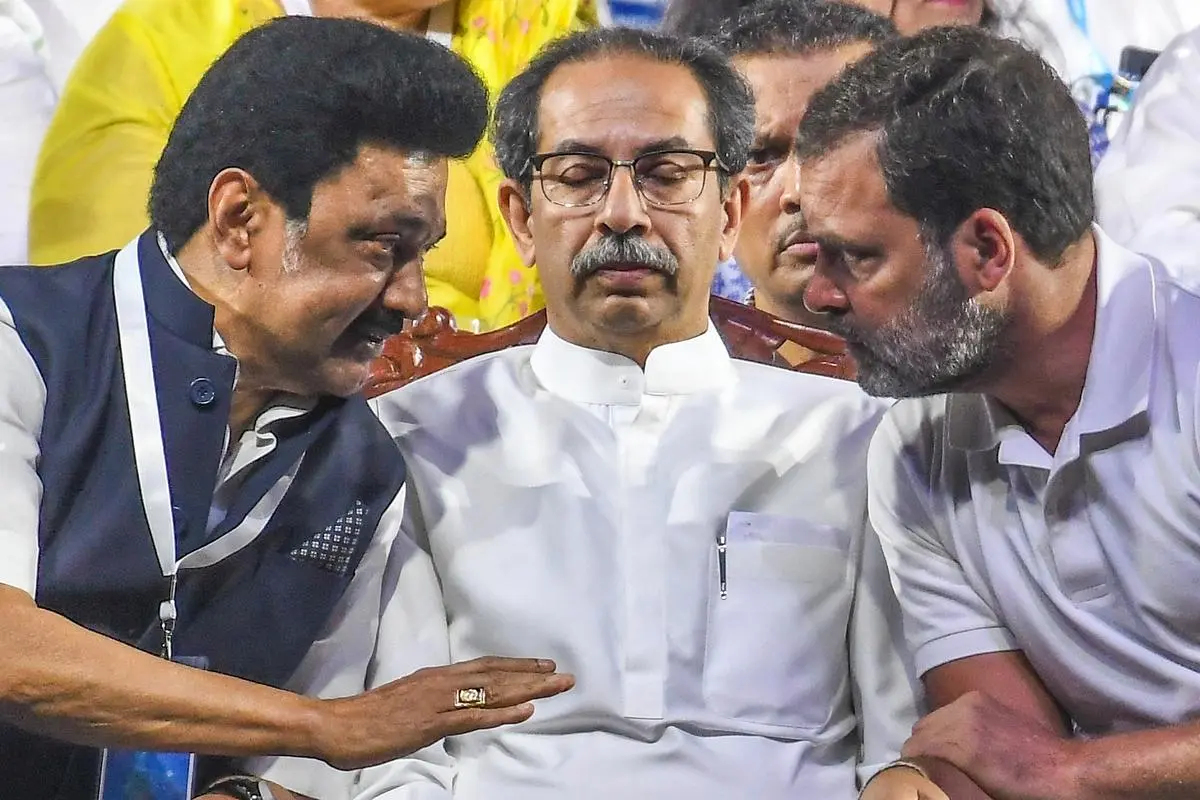
Tamil Nadu Chief Minister M.K. Stalin, Shiv Sena (UBT) chief Uddhav Thackeray and Rahul during an India bloc rally at Shivaji Park in Mumbai in March 2024. Rahul’s journey seems to exist amid other journeys, taken in tandem if not together. | Photo Credit: EMMANUAL YOGINI
Hence, even when Rahul, and the Congress, seem to be having a moment, he cannot catch a break. The commentariat is always dissatisfied. Some suggest he should open a gym. Others complain that he brings up his personal losses and traumas too often. Another acknowledges that there have been some achievements but sets a report card for further progress to be made, or else.
Also Read | Rahul Gandhi, Bharat Jodo Nyay Yatra, and the power of walking
But maybe these reactions say something about how our relationship with politics has become somewhat literal, where winning is the only thing that validates a political idea. There is that fear that Rahul Gandhi is more winsome than winning. And that by liking or supporting him, we show ourselves to be foolish believers. Not rational or critical enough, merely driven by sentiment. Should he be defeated, we too will be humiliated.
Hence, we wait, always, for him to culminate in conventional success before we are willing to grant full approval. But what if a climax is not the journey Rahul proposes for himself, at least not quite yet? Rahul has repeatedly said that he sees this as an ideological fight. It has its electoral dimensions, but his journey seems to be primarily a philosophical one.
Perhaps we might reframe how we see political success. What we see as Rahul’s indecisiveness might also be seen as an open-endedness. Even while crafting a certain personal journey, he seems to generate the idea that multiple journeys might occur in cooperation, and iteratively.
Transparency and sincerity
On June 19, Rahul celebrated his 54th birthday. He ended the day with a reel where he initialled his signature white T-shirt, one that updates the politician’s garb of kurta to an unpretentious, modern, youthful, class-agnostic, and gender-neutral garment, open wide to interpretations.
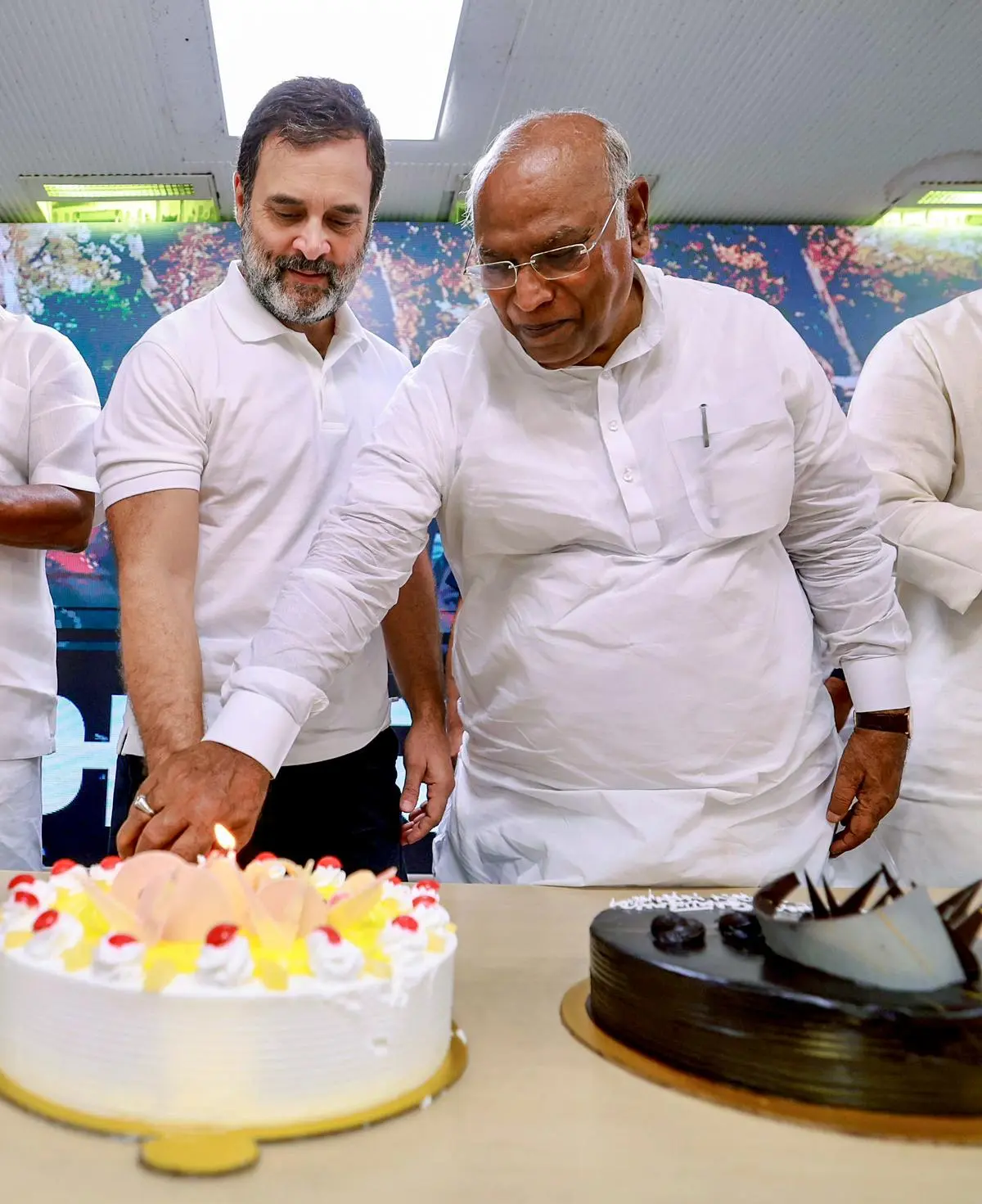
Rahul gives Congress president Mallikarjun Kharge a piece of birthday cake in New Delhi on June 19. | Photo Credit: ANI
“This T-shirt for me symbolizes transparency, simplicity, and perseverance. I am sure you have used these values and fought for these values in your life. Tell me how you have used them, and I’ll send you a white T-shirt in response. Love you all,” he tweeted. It was an offer of co-creation and allyship through a common, inclusive frame, a validation of people’s own political journeys, and at the same time an acceptance of the ideological responsibility he has laid claim to.
For Rahul’s growing following, this transparency and sincerity are real, and they respond to it with growing love, as if he were a favourite cousin. They express a passionate wish that he should be Prime Minister, but even as they do so, they qualify it with the idea that he stands for values they believe in and that they want to see embodied in the system. It is entirely possible that whoever else becomes Prime Minister, in the comradeship of Rahul, they would still earn the public’s love.
Paromita Vohra is a filmmaker, writer, and dedicated Antakshari player. She is also the founder of Agents of Ishq, India’s best-loved digital platform about sex, love, and desire.