







As much as people like talking about eliminating caste, there are no signs that it is going away anytime soon, or even becoming less important, either socially or politically. On August 1, 2023, the Patna High Court, giving its go-ahead to a caste survey in Bihar, noted that “despite attempts to efface it from the social fabric, caste remains a reality and refuses to be swept aside, wished away, or brushed aside nor does it wither away and disperse into thin air”.
Nothing expresses this better than the election results of 2024, where parties across lines reaped rich dividends from formidable caste alliances, not only in the traditional caste cauldrons of Uttar Pradesh and Bihar but also in Maharashtra and Karnataka, where social hierarchies are supposedly less rigid.
The 2014 and 2019 Lok Sabha elections had created the perception that the days of caste assertion or “voting your caste” were a thing of the past. The BJP, espousing a hard-line Hindutva philosophy, had papered over the role of caste identities to consolidate its hold on power. By marginalising the Muslim voice and making Muslims the enemy, the BJP, in the words of a party worker in Bhopal, made the “Hindu-Muslim” binary the basis of the previous two elections.
The verdict from Ayodha
Nothing bears out the shift from religion to caste better than the victory of Awadhesh Prasad, a Dalit leader from the Samajwadi Party (SP), from the general constituency of Faizabad, which is home to Ayodhya and the Ram temple. This was a particularly big setback for the BJP, which was banking heavily on the euphoria generated by the temple not only in Uttar Pradesh but countrywide.
So, 10 years after Prime Minister Narendra Modi steered the BJP to a meteoric rise, crafting for it the kind of single-party majority that only the Congress had so far enjoyed in the early decades after Independence and in 1984 when it won 404 of 514 seats in the wake of Indira Gandhi’s assassination, the political discourse has turned back full circle to caste. The so-called rainbow social coalition that the BJP built assiduously has shown that it can be ruptured, and how.
Also Read | Jan ki baat: How voters humbled Modi by rejecting authoritarianism and embracing inclusive politics
What started as localised protests by Kshatriya groups against the BJP in its bastion State of Gujarat travelled to Uttar Pradesh, where Rajput or Kshatriya villages held mahapanchayats to boycott the BJP, in protest against the lack of representation to Thakurs in ticket distribution and the alleged threat by the BJP’s powerful duo of Prime Minister Modi and Home Minister Amit Shah to Uttar Pradesh Chief Minister Yogi Adityanath and Defence Minister Rajnath Singh, both Thakurs.
But did caste really go away under the BJP? Speaking to Frontline, Ajay Gudavarthy, an associate professor at the Centre for Political Studies, Jawaharlal Nehru University, said: “Caste remained a significant factor all through the 10-year period of Modi’s populist mobilisation. What the BJP-RSS combine managed to do was internally subvert the democratic aspirations of the marginalised castes. They offered them representation without any accompanying social demands. This came under stress in this election.”

SP chief Akhilesh Yadav addressing a public meeting in Muzaffarnagar, a hotbed of communalism, on April 15. The party won the seat this time, defeating the BJP’s Sanjeev Balyan, who won it in 2014 and 2019. | Photo Credit: PTI
In 2019, data from the Centre for the Study of Developing Societies (CSDS) showed that 33 per cent of Dalits and 42 per cent of OBCs voted for the BJP. These numbers are likely to have dropped this time.
Dalit dissatisfaction
While it appears that Dalits moved away from the BJP owing to widespread fears that the party, if given an overwhelming majority, would change the Constitution and end reservation, it is trickier to understand the OBC vote. While dominant sections among Dalits and OBCs, whom Gudavarthy refers to as “mezzanine elites”, might have continued with the BJP because of the question of representation, the lower sections moved away due to the redistributive potential promised by the opposition, especially the Congress. The lower sections were also able to see the big picture better, without an exclusive emphasis on representation.
Gudavarthy said: “We saw a conflict of interest between the dominant castes. For instance, in Uttar Pradesh, tension brewed between Rajputs and Brahmins; in Gujarat, Rajputs were unhappy with the BJP just as the Jats were in Haryana. Hindutva politics is struggling to hold divergent castes together under its resurgent Hindu mobilisation.”
He added: “As the traction for a polarised anti-Muslim mobilisation is ebbing, it is difficult to consolidate a ‘common’ Hindu identity. In turn, the anti-Muslim rhetoric took a beating because of a faltering economy that could not meet the aspirational momentum of the underprivileged castes. The question that should interest us in the long run is what shape caste mobilisation will take without anti-Muslim rhetoric and with a greater redistributive thrust.”
The rising aspirations of the subaltern classes meant that their demand was for more than just foodgrains and freedom from fear, which is ultimately the only thing the BJP appeared to promise, and they switched to an alternative that promised a bigger share in the resource pie.
In Uttar Pradesh in this election, the BJP lost 9 of the 17 seats reserved for SCs. The SP won 7—Robertsganj, Machhlishahr, Lalganj, Kaushambi, Jalaun, Mohanlalganj, and Etawah—dealing a body blow to the BJP, which had won all 17 in 2014 and 14 in 2019. That Modi’s margin of victory came down by more than three lakh votes in Varanasi despite the Bahujan Samaj Party (BSP) trying to make the contest triangular is a telling commentary on the caste consolidation that took place.
Dharmveer Prajapati, a senior Minister in Uttar Pradesh, while speaking to a news channel, blamed “the large-scale influence of caste” as a reason for the BJP’s setback, acknowledging that Dalit and backward caste voters moved away, influenced by the opposition campaign about the BJP’s bid to undo reservation.
In an interview to Frontline, Javed Ali Khan, an SP Rajya Sabha member, said: “The SCs and OBCs sensed a danger to the Constitution. They felt reservation was under threat; a lot of BJP leaders made statements about changes in the Constitution.”
The SP’s success can also be attributed to its formula of fielding Dalit candidates from non-reserved seats where its OBC core ensured the candidate’s victory. For instance, the party fielded a Bhumihar candidate in Ghoshi (Rajeev Rai) and a Nishad candidate in Sant Kabirnagar (Laxmikant Nishad), and clearly benefited by garnering caste votes along with its core Muslim-Yadav votes. Of the SP’s 37 Lok Sabha members, 20 belong to the OBCs, 8 to the SCs, and 4 are Muslim. The party fielded only five Yadav candidates this time, all from Akhilesh Yadav’s family. Thus, many of the OBC leaders are from among the non-Yadavs who had earlier shifted to the BJP. The SP’s candidate selection breached the BJP’s Extremely Backward Class (EBC) votes: in Ghoshi and Sant Kabirnagar, the BJP fielded the sons of Om Prakash Rajbhar and Sanjay Nishad, who head two key NDA allies, the Suheldev Bharatiya Samaj Party and the Nishad Party.
Kshatriyas against BJP
Just before the first phase of polling, there were massive Kshatriya mahapanchayats in western Uttar Pradesh, vowing to eliminate the BJP. The results from constituencies that voted in the first phase show the impact of this. The INDIA bloc won six of the eight seats, including Muzaffarnagar, which has been the laboratory of communal politics since 2013. In the Jat versus Jat contest, Union Minister Sanjeev Balyan lost despite the BJP’s alliance with the Rashtriya Lok Dal, as the SP’s Jat candidate got the combined votes of Muslims and Jats and other OBCs.
In eastern Uttar Pradesh, which went to the polls in the later phases, Prime Minister Narendra Modi’s subaltern Hindutva experiment tottered, as the SP, following the BSP’s 2017 Assembly election formula, fielded several non-Yadav candidates, which lured away traditional BJP supporters such as the Sainthwars (Kurmi) and the Nishads (boatmen) in substantial numbers across seats.

Congress president Mallikarjun Kharge with CPI (ML) Liberation general secretary Dipankar in Patna on May 26. The CPI (ML) Liberation enjoys much support among the Kushwahas and Dalits. | Photo Credit: PTI
Confident of the Muslim-Yadav vote, given the perception of the BSP as a silent BJP ally, Akhilesh Yadav took a calculated risk to widen his party’s reach to the PDA (Pichchda, Dalit, Alpsankhyak), and it paid off, as not only EBCs but even substantial sections of Dalits, disillusioned with the BSP’s softening towards the BJP, moved to the SP-Congress alliance, especially in the latter phases when the opposition pointed out that the BJP would remove reservation if it won 400-plus seats.
How Bihar voted
In Bihar, the caste survey, published in 2023, found that EBCs constitute 36 per cent of the State’s population, while Dalits account for 14.6 per cent. Yadavs account for 14.3 per cent and Muslims 17 per cent, which means an over 30 per cent vote base for the Rashtriya Janata Dal (RJD) at the start.
While Chirag Paswan of the Lok Janshakti Party (Ram Vilas) undoubtedly brings in the Paswan or Dusadh vote, which accounts for 5.3 per cent of the population, there is no monolithic Dalit vote bank in Bihar. The Ravidas community, 5.3 per cent of the population, were traditionally associated with the Congress before the BSP’s rise but had moved from the BSP to the BJP. This time, in the reserved (SC) Sasaram seat, represented in the past by Congress stalwarts such as Jagjivan Ram and Meira Kumar, a relatively unknown Congress candidate named Manoj Kumar defeated the BJP, which won the seat in 2014 and 2019.
RJD leader Tejashwi Yadav campaigned on the BAAP plank (standing for Bahujan, Agda [privileged castes], Aadhi Aabadi [women], and poor). While not as successful as the SP, he did add four seats to the Mahagathbandhan, which overall won nine seats in Bihar, up from the solitary seat in 2019. The Congress bagged three and the CPI(ML) Liberation two.
The RJD fielded a greater number of Kushwaha candidates to breach Nitish Kumar’s “Luv-Kush” strategy of Kurmi-Koeri unity but with mixed success. In Aurangabad, for instance, which is called the “Chittorgarh of Bihar” and has been represented by Kshatriya-Rajputs since 1953, the RJD’s Abhay Kumar Sinha, a Kushwaha, won against the BJP’s sitting Rajput MP Sushil Kumar.
In Karakat, too, the NDA’s key Kushwaha face Upendra Kushwaha lost to the CPI(ML)’s Kushwaha candidate. This breach of the Kushwaha fortress by the opposition alliance will have ramifications for the Assembly election. Kushwahas account for 3.5 per cent of the population and Kurmis 2.9 per cent.
Allying with the Left, particularly the CPI(ML), which has traditionally had a strong base among Kushwahas and Dalits, benefited the INDIA bloc. In the 2020 Assembly election, the CPI(ML) won 12 of the 19 Assembly seats it contested. The arrival of the Left in Bihar elections is a significant marker of the return of Dalits and EBCs, who had moved towards the BJP as it deepened its subaltern Hindutva outreach.
Caste consolidation aids NDA in Karnataka
In Karnataka, the Vokkaliga-Lingayat consolidation was a key reason behind the NDA’s 19 seats: 17 for the BJP and 2 for the Janata Dal (Secular), or JD(S). In the Kalyana Karnataka region (northern part), the Congress won five of nine Lok Sabha seats owing to the strong influence of AHINDA (a Kannada acronym for Alpasankhyataru, or minorities; Hindulidavaru, or backward classes; and Dalitaru, or Dalits) politics perfected by Congress Chief Minister Siddaramaiah over the decades.
Unlike the Congress-JD(S) alliance in the State in 2019, which boomeranged as the two parties were rivals in the Vokkaliga region, the BJP-JD(S) alliance worked as both parties are strong in different regions of the State and their vote transfers complemented each other. Of the Right and Left Dalits, the former had earlier shown some liking for the BJP, but this election saw the Dalit votes consolidating behind the Congress.
Maratha reservation in Maharashtra
In Maharashtra, a major issue in the election campaign was Maratha reservation. This proved to be a double whammy for the BJP, which lost in the Marathwada and the Vidarbha regions. In Marathwada, the epicentre of the Maratha reservation demand, the BJP failed to defend the Latur, Nanded, and Jalna seats. In Vidarbha, there was a visible reaction in the Kunbi community against the State government’s handling of the Maratha reservation demand. This helped the Congress win five seats, while Uddhav Thackeray’s and Sharad Pawar’s parties won one each. The Maratha protest turned the battle in favour of the INDIA bloc in western and northern Maharashtra. In seats such as Solapur, Madha, and Sangli in western Maharashtra and Dhule, South Ahmednagar, Shirdi, Nashik, and Dindori in northern Maharashtra, the table turned in favour of INDIA because of en bloc Maratha votes.
Playing the right cards in Andhra Pradesh
Caste has occupied centre stage in Andhra Pradesh’s electoral politics for a long time, with three groups dominating the discourse: Kammas, Kapus, and Reddys. Violent altercations between these groups around elections are also common. The Kammas have primarily aligned themselves with the Telugu Desam Party (TDP), the Reddys with the Congress, and the Kapus with the JanaSena Party (since its inception).
The NDA’s primary concern over the past few months has been to consolidate votes. While the JanaSena’s Pawan Kalyan failed in his previous two attempts (2014 and 2019) to consolidate Kapu votes, the consolidation and vote transfer worked in his favour this year. His party had a 100 per cent strike rate, winning all 21 Assembly seats and 2 Lok Sabha seats it contested.
According to The Hindu CSDS-Lokniti Post-Poll Survey 2019, the dominant castes preferred the TDP, whereas a majority of Dalit and Adivasi voters sided with the YSR Congress Party. The YSRCP won Araku, the only reserved (ST) Lok Sabha seat. Barring Tirupati, which the YSRCP won, the TDP won the other three reserved (SC) Lok Sabha seats.
This time, the anti-incumbency against Jagan Mohan Reddy was so high (YSRCP won only 11 of 175 seats in the Assembly) that even some Reddy lobbies are said to have worked against him. Sources from the ground confirmed that Reddy loyalists of the Congress campaigned for the TDP. Jagan’s attempt at social engineering by launching “BC corporations” has not benefited him primarily because budget allocations for the targeted schemes were lacking. In the Konaseema belt, where Setti Balijas previously sided with the YSRCP, there appears to have been a split in their votes this time.
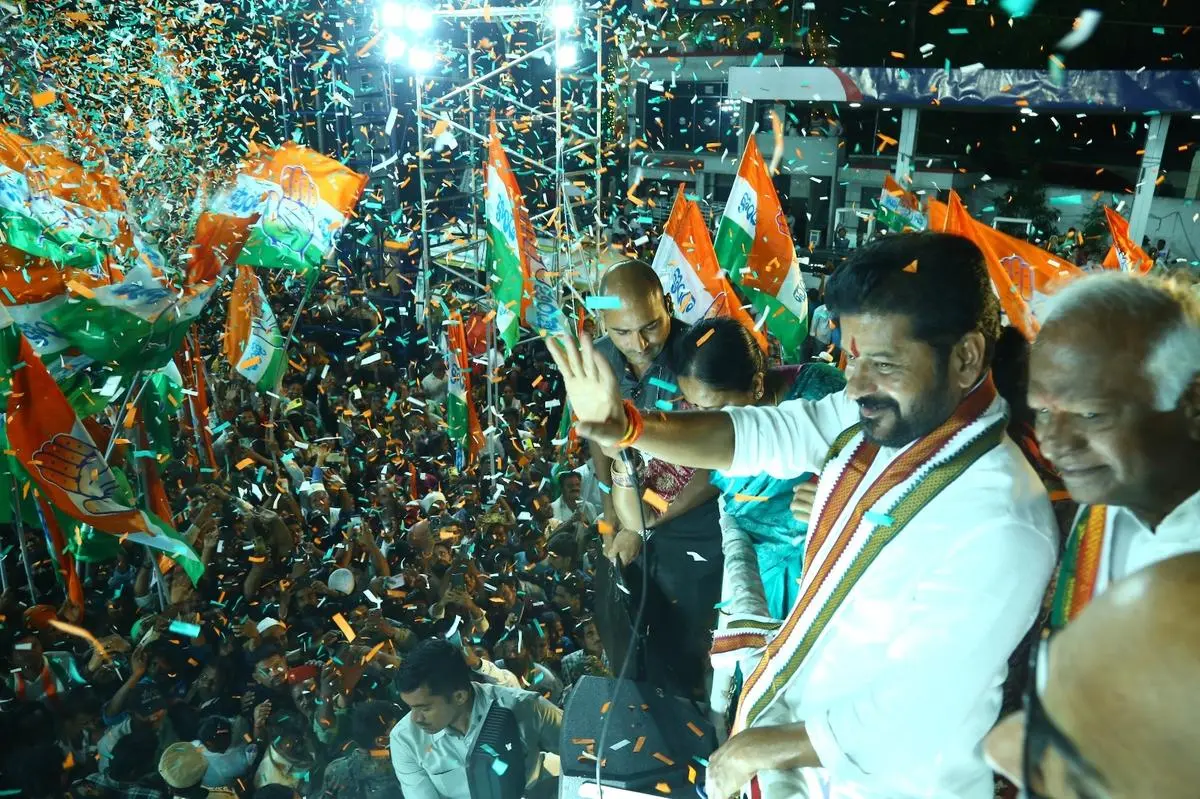
Telangana Chief Minister Revanth Reddy campaigning in the Warangal reserved (SC) seat on May 7. The Congress won the seat by a massive margin of over 2.2 lakh votes and also bagged the two other reserved (SC) seats in the State. | Photo Credit: BY SPECIAL ARRANGEMENT
In Telangana, analysts had flagged early on that the Congress prioritising Reddys over the OBCs would cost it at least a couple of seats, and it proved to be true. Of the seven Reddys the Congress fielded, only three won.
In 2019, polling data showed, the BJP made significant gains among the dominant castes and OBCs in the Lok Sabha election compared with its performance in the 2018 Assembly election. Election observers believe there is a similar pattern in this election, where the BJP’s vote share rose from 19.45 per cent in 2019 to 35.08 per cent. Among the Scheduled Castes in the State, the BJP’s Madiga outreach began ahead of the 2023 Assembly election. An SC sub-caste accounting for nearly 50 per cent of the SC population, Madigas have been angry about being left behind in both political representation and reservation benefits. Modi had even promised them subcategorisation and fielded two Madiga leaders while the Congress did not field any.
Also Read | How women voted
The Congress, however, won all three reserved (SC) seats of Peddapalle, Warangal, and Nagarkurnool. The two reserved (ST) seats were divided between the Adivasi and Lambada communities (there is an ongoing tussle between the two groups over reservation).
The Congress won Mahabubabad, where all the parties fielded Lambada candidates. The BJP won Adilabad, where all the parties fielded Adivasi leaders. The BJP first made inroads into the Adilabad constituency in 2019 by fielding a Congress rebel named Soyam Bapu Rao.
What’s next?
With the breach in the BJP’s grand social coalition experiment, many experts are speculating on the possibility of the Modi government going on to implement the report of the Rohini Commission set up in 2017, which recommended the division of OBCs into four subcategories, holding that OBCs are not a monolithic bloc and that different sub-castes exist at different ladders of development within the group and require separate focussed attention. Nine States and a Union Territory have decategorised OBCs so far. They are Andhra Pradesh, Telangana, Tamil Nadu, Karnataka, Haryana, Jharkhand, West Bengal, Bihar, Maharashtra, and Puducherry.
After a post-election meeting of NDA allies, senior Janata Dal (United) leader K.C. Tyagi reminded everyone that it was Bihar that first published the caste survey results and took pains to emphasise that no party had so far opposed a caste census. It is no secret that the BJP does not favour a caste census, but as Modi 3.0 comes to terms with the challenges of running a coalition government, it will find it hard to sweep caste under the carpet as is its wont. And caste equations will continue to keep the election pot boiling.
With inputs from Amey Tirodkar, Vikhar Ahmed Sayeed, and Ayesha Minhaz from Maharashtra, Karnataka, and Andhra Pradesh and Telangana.