







When a few candidates of the All India Anna Dravida Munnetra Kazhagam (AIADMK), one of the two main Dravidian parties in Tamil Nadu, forfeited their deposits in the Lok Sabha election and the party, which contested 34 seats, suffered a crushing defeat, political doomsayers were quick to herald the beginning of the end of more than 50 years of bipolar Dravidian politics in the State.
The prediction gained currency when the BJP registered a vote share of 11.24 per cent after contesting in 23 seats without being in an alliance with the Dravidian majors. Its vote share until then, in previous outings, was around 5.5 per cent.
The BJP’s 2019 vote share of 3.62 per cent (five seats) was achieved in alliance with the AIADMK, while its previous best performance of 5.56 per cent was in 2014, when it was not in an alliance with the Dravidian parties.
BJP’s dismal performance
Soon, the right-wing grapevine and some political circles got busy speculating whether the BJP could replace the AIADMK as the principal rival to the Dravida Munnetra Kazhagam (DMK) and eventually position itself as a threat to both Dravidian parties. State BJP president K. Annamalai even claimed that the AIADMK would “not be there” after this election.
Also Read | Will BJP’s dogged efforts to enter Tamil Nadu and Kerala yield any results?
What he perhaps did not foresee was the BJP’s performance in the election: its candidates forfeited their deposits in 11 seats, while its ally, the Pattali Makkal Katchi (PMK), saw 6 of its 10 candidates lose their deposits, followed by the Amma Makkal Munnetra Kazhagam (AMMK) in one of the two seats it contested.
Dismissing claims that the BJP might replace the AIADMK in future, the AIADMK’s organising secretary, S. Semmalai, said this was the BJP’s “manufactured perception”. He told Frontline that his party had retained its core vote base with minimal erosion, which he said was “not unusual” for a party engaged in “five decades of active politics successfully”. But the veteran leader conceded that the AIADMK did not get the “neutral” vote this time. “Also, the first-time voters were reluctant, and our anti-DMK votes were possibly frittered away,” he added.
A CSDS-Lokniti post-election survey published in The Hindu said that the BJP “gained mainly through the slight erosion of the bipolarity of the State”. However, in the 234 Assembly segments of the 39 Lok Sabha constituencies, the BJP did not lead even in one.
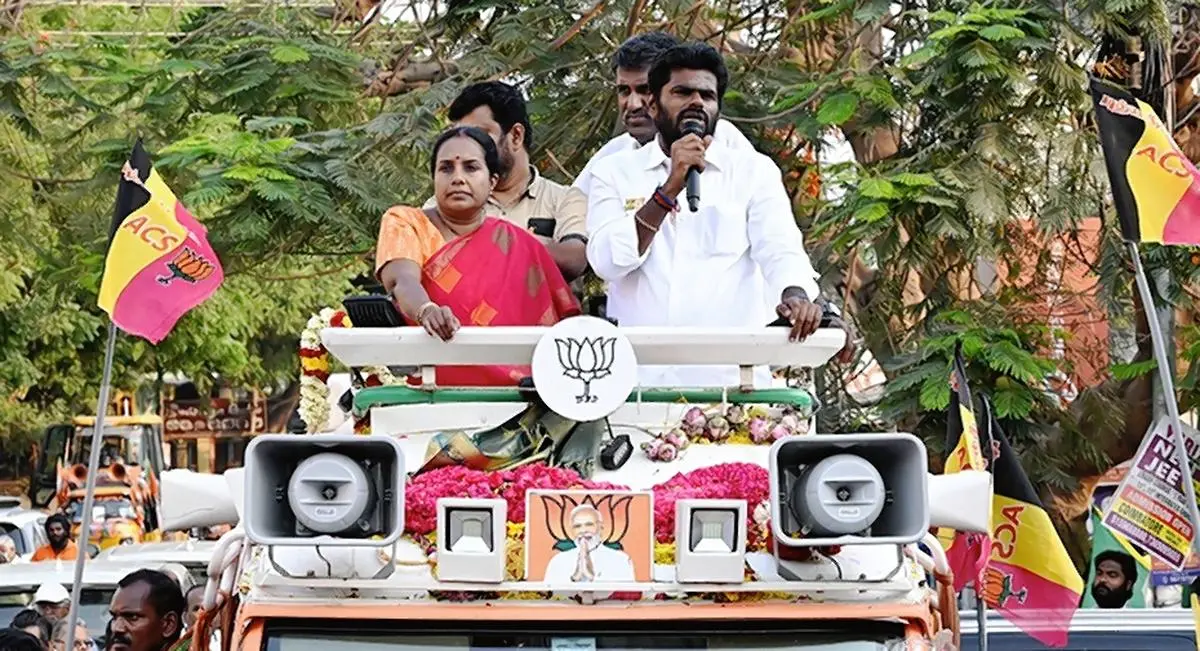
BJP State president K. Annamalai at a campaign rally in Coimbatore on April 17. The BJP lost all the seats it contested, and its candidates lost their deposits in 11 seats. | Photo Credit: M. PERIASAMY
Meanwhile, talk of the BJP’s rise arrived in the mainstream media as well, giving rise to the idea that the BJP, despite losing all 23 seats (19 direct and 4 allies on its symbol), had opened up a political space for itself in the State. With the AIADMK drawing a blank, such narratives gained traction.
Aiding this process was also a dip in the DMK’s vote share despite the alliance mopping up all 39 seats plus Puducherry. The party contested 22 seats directly and got 26.93 per cent of the vote as against 33.52 per cent in 2019 when it contested 24 seats. The DMK polled about 1.17 crore votes against the AIADMK’s 89 lakh votes and the BJP’s 49 lakh votes.
Losing deposits a big blow to AIADMK
But what is most agonising for the AIADMK leadership is that in seven seats its candidates lost their deposits, an embarrassment the party has not faced since its maiden win in the byelection in Dindigul in 1973 (immediately after screen icon M.G. Ramachandran, or MGR, formed the party after breaking away from the DMK in 1972). However, it finished second in 24 seats and polled between 30 and 40 per cent of the vote in 8 other seats.
While there is no reason for the party to press the panic button yet, it cannot afford to remain complacent. Contrary to popular perception, the AIADMK has, in fact, registered a wafer-thin increase in vote share, up from 19.39 per cent in 2019 to 20.46 per cent.
However, in 2019 it was in alliance with the PMK and the BJP. In the 2021 Assembly election, with the same alliance, it got 33.29 per cent of the vote. (Party performance in the 2021 Assembly election is merely of academic interest here as the electoral and social dynamics differ in Assembly and Lok Sabha elections, and they are not generally comparable.)
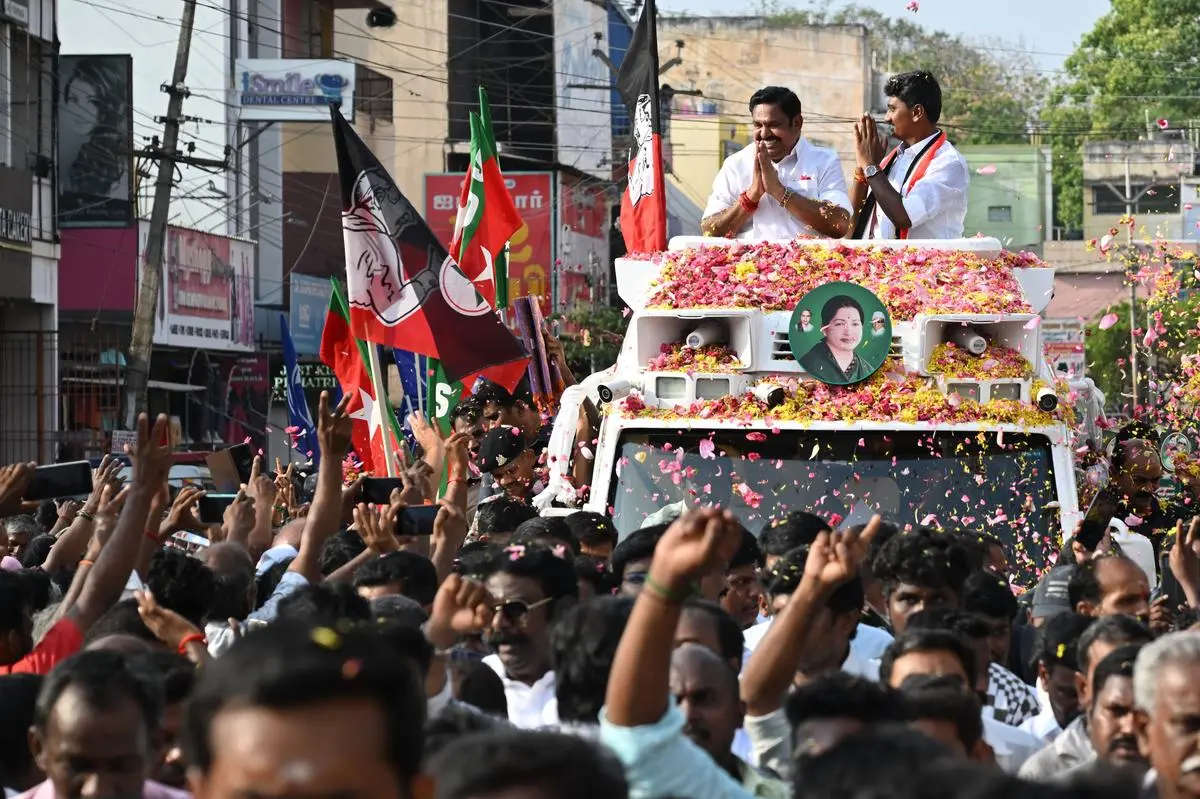
AIADMK general secretary Edappadi K. Palaniswami with the party’s Salem candidate P. Vignesh, at a roadshow on April 17. While it did not win a seat, the AIADMK registered a slight increase in vote share, up from 19.39 per cent in 2019 to 20.46 per cent. | Photo Credit: E. LAKSHMI NARAYANAN
The AIADMK is yet to initiate a critical evaluation of its insipid performance and has chosen to stay away from the Vikravandi Assembly byelection scheduled for July 10. The party polled more than 84,000 votes there in 2021; where those AIADMK votes will go this time remains to be seen.
Analysts, however, said that the 2024 result reflects a 5-7 per cent chunk of “disenchanted voters” who do not want to vote for the Dravidian parties. Besides this, a significant number of Gen X and Z voters could have opted for alternatives. The BJP believes that it has gained part of the traditional anti-DMK vote that would have otherwise gone to the AIADMK, and that it was able to get the support of first-time voters too, mostly from the elite and upper-middle-class sections. The BJP’s strategy of roping in familiar faces and caste leaders as allies boosted its vote share.
NTK rising
The BJP today has a strong contender in S. Seeman’s Naam Tamilar Katchi (NTK) for voters looking for alternatives to the Dravidian majors. This party, founded on the principle of Tamil nationalism, has emerged as a strong competitor in the State’s politics with its steady performance.
And unlike the BJP, it has always fought alone. The NTK was a major gainer in the latest election, with its vote share increasing from 3.8 per cent in 2019 to 8.1 per cent. It is clearly preying mainly on the DMK vote base and looking to lure anti-Dravidian and anti-BJP voters, besides rural youths and gig workers across the spectrum. It is an enviable feat for a party that entered electoral politics only in 2016. The NTK’s adversaries claim that it is a “BJP proxy”, but Seeman has stoutly denied this.
The AIADMK, ever since MGR founded it in 1972, has seen both dismal lows and phoenix-like rises in its five-decade existence in the State’s politics. After winning the Dindigul byelection, the party went on to win Puducherry, then Pondicherry, in 1974 to form its first government. It won Tamil Nadu from the DMK in 1977. The worst debacle it faced was in 1996, when the dream team of the DMK and G.K. Moopanar’s Tamil Maanila Congress devastated it.
Then too, political analysts had prophesied that the party would become history. The AIADMK rebounded to a fairy-tale revival in the next Assembly election in 2001. For the record, when the party was in alliance with the BJP in the 2004 general election, it lost all the 33 seats it contested but polled 29.77 per cent of the vote. In 2009, it won 9 of 23 seats for a share of 22.85 per cent. It has always risen from its defeats, rebuffing all predictions of its extinction.
Semmalai said that the AIADMK was insulated against any corrosion. “It is not an individual-based party. It has survived crises in the past and will do so in future. When MGR was there, a few deserted the party. When Jayalalithaa was the leader, seniors R.M. Veerappan and S.D. Somasundaram raised the banner of revolt. The party suffered a vertical split after MGR’s demise. It has the resilience to overcome any debacle,” he said. But what Semmalai forgot to mention was that during all those comebacks, there were tall leaders at the party’s helm.
Highlights
- Despite losing all seats and forfeiting deposits in seven constituencies in the 2024 Lok Sabha elections, the AIADMK’s core vote base remains largely intact. The party actually saw a slight increase in vote share from 19.39 per cent in 2019 to 20.46 per cent in 2024.
- The BJP has made gains in Tamil Nadu, increasing its vote share to 11.24 per cent while contesting independently. But it still faces significant challenges in establishing itself as a major force in the State’s politics.
- The Naam Tamilar Katchi (NTK) has emerged as a strong alternative, increasing its vote share from 3.8 per cent in 2019 to 8.1 per cent in 2024, potentially attracting voters looking for options beyond the traditional Dravidian parties.
DMK and Congress
The DMK has also faced similar situations. It remained out of power until MGR’s demise in 1987. It won in 1989, but the government was dismissed two years later.
In the aftermath of Rajiv Gandhi’s assassination, the party suffered debilitating defeats in both the Assembly and parliamentary elections in 1991. It won just two seats in the Assembly, and its leader M. Karunanidhi, one of two elected, vacated the seat. But the party bounced back, thanks mainly to its robust structural stability.
On the flip side, the Congress has had a friendly understanding with both Dravidian majors, the DMK now and the AIADMK in the past. It has maintained a steady 10-12 per cent vote share in a few seats in every election since 1989. The Congress also tried to challenge the Dravidian monopoly when Moopanar chose to go it alone in the 1989 Assembly election. Rajiv Gandhi, like Prime Minister Narendra Modi, visited the State several times, but the Congress could win only 26 seats. It reworked its strategy and has since been an ally of one of the Dravidian parties.
It must be galling for a national party like the BJP to constantly be rejected by a State, but one must remember that the State’s politics has been a two-sided battle for more than 50 years now. Despite the BJP’s exhilaration, the fact remains that the space it is earnestly seeking remains elusive.
Also Read | The battle for Kongu Nadu
The allegations that political opportunism and mutual betrayals between the Dravidian majors enabled the BJP to gain a toehold in the State cannot be dismissed. Ironically, it was the AIADMK that first invited the BJP into its fold in the 1998 general election, a move Jayalalithaa later regretted. An outsider until then, the BJP found surprising sponsors in both parties. It was the DMK’s turn in 1999 to embrace it. A political analyst said: “No other State has such a robust political system where the two main rival parties have the same ideology. If the BJP was able to find space, the blame should squarely be on these two.”
The BJP’s interference in the AIADMK’s internal affairs after Jayalalithaa’s demise has become folklore now. The saffron party further weakened the AIADMK by luring into its fold O. Panneerselvam and T.T.V. Dhinakaran, both of whom were engaged in a leadership tussle with Edappadi K. Palaniswami. Their defection hit the party hard in the southern belt, where the caste groups of Kallars and Maravars, to which the two belong to, are dominant. Besides, the northern parts also went against it, as the PMK, which has a significant presence among the dominant Vanniyar caste, went with the BJP.
AIADMK core vote base intact
However, the AIADMK as a whole has not seen a worrying shift in its core vote bank, barring certain substantial constituency-specific erosions. But the party needs to seriously study its weak performance in the seven seats where its candidates lost their deposits. Despite severing ties with the BJP, the AIADMK’s leaders have remained inexplicably tame in their campaign against the saffron party. This, according to political analysts, has been a blunder as the ambiguity kept all the minority communities away from the party.
As Palaniswami emphasised, the AIADMK polled one percentage point more votes than its 2019 tally. “We too have learnt certain lessons from this election,” he said.
Within the BJP, voices of dissent can be heard. Former Telangana Governor and former State party president Tamilisai Soundararajan, who stood second in Chennai South, said that an alliance could have changed the scenario. “Forming an alliance is a strategy. But Annamalai showed no liking for it,” she said. But Annamalai contended that the increase in vote percentage itself was a victory.
It cannot be denied that the saffron party, once confined to certain pockets in Tamil Nadu, has now gained a foothold across the State. For the Dravidian majors, it is a wake-up call that Tamil Nadu politics may not continue to remain bipolar; the field is getting crowded.