








It is a truth universally acknowledged that as soon as the BJP leadership senses trouble on the electoral ground, it falls back on communalism. The BJP entered the 2024 Lok Sabha election buoyed by expectations of winning a third term and even scoring an unprecedented increase in its seat count from its current 303 to over 370 (consider that in 2019, notwithstanding the Balakot drama, the party added only 21 seats to its 2014 tally).
However, no sooner had the first phase of voting taken place on April 19 than the BJP leadership sensed trouble, and out came the big communal guns. Narendra Modi fired the opening shot in Banswara, Rajasthan with false claims that the Congress wanted to redistribute wealth to Muslims. However, it is the form these charges have settled into—that the INDIA bloc will give unconstitutional religion-based reservation to Muslims—that is worth reflecting on.
The reality behind the BJP’s claims is complex and obscure—leading newspapers have been running “explainers” to aid readers. What is clear is that the BJP is trying to align two planks that it previously viewed as being in opposition: first is the “Mandal” plank of reservation for Other Backward Classes (OBCs) (other, that is, than the Scheduled Castes and Scheduled Tribes that have already been given reservation in education and employment in the Constitution) and the second is the Ram temple, which is all about consolidating a Hindu majority. It wants to bring these two into an alignment by communalising the reservation issue.
Also Read | ECI under a cloud for going soft on PM Modi’s communal utterances
The idea is to divert political energies away from supporting reservation for OBCs, particularly when the INDIA bloc supports conducting a caste census with the aim of enumerating these groups more accurately than the current practice of relying on the 1931 Census, the last one to enumerate castes, and offer reservation on a more accurate basis. The BJP’s game plan is to direct this conversation about caste and census towards one that opposes reservation for Muslims. That communalism has taken this form now is not coincidental; the matter goes to the heart of a major, possibly the major, problem that Modi’s BJP faces: its OBC politics are not working.
A new OBC politics
Since the 2014 election, Modi’s BJP has pursued a new OBC politics, different from that which brought the two Vajpayee governments to power with the help of their National Democratic Alliance (NDA) coalition partners between 1998 and 2004.
At that time, after the Ram temple agitations of the late 1980s and early 1990s brought the BJP out of its historic low of 2 seats in 1984 to 85, 120, and 161 in 1989, 1991, and 1996 respectively, the party’s further growth involved it hitching its wagon to the most transformative political force on India’s party-political landscape, the exodus of the dominant- and middle-caste propertied groups from the Congress. It began in the late 1960s and had come to define politics by the 1980s and 1990s.
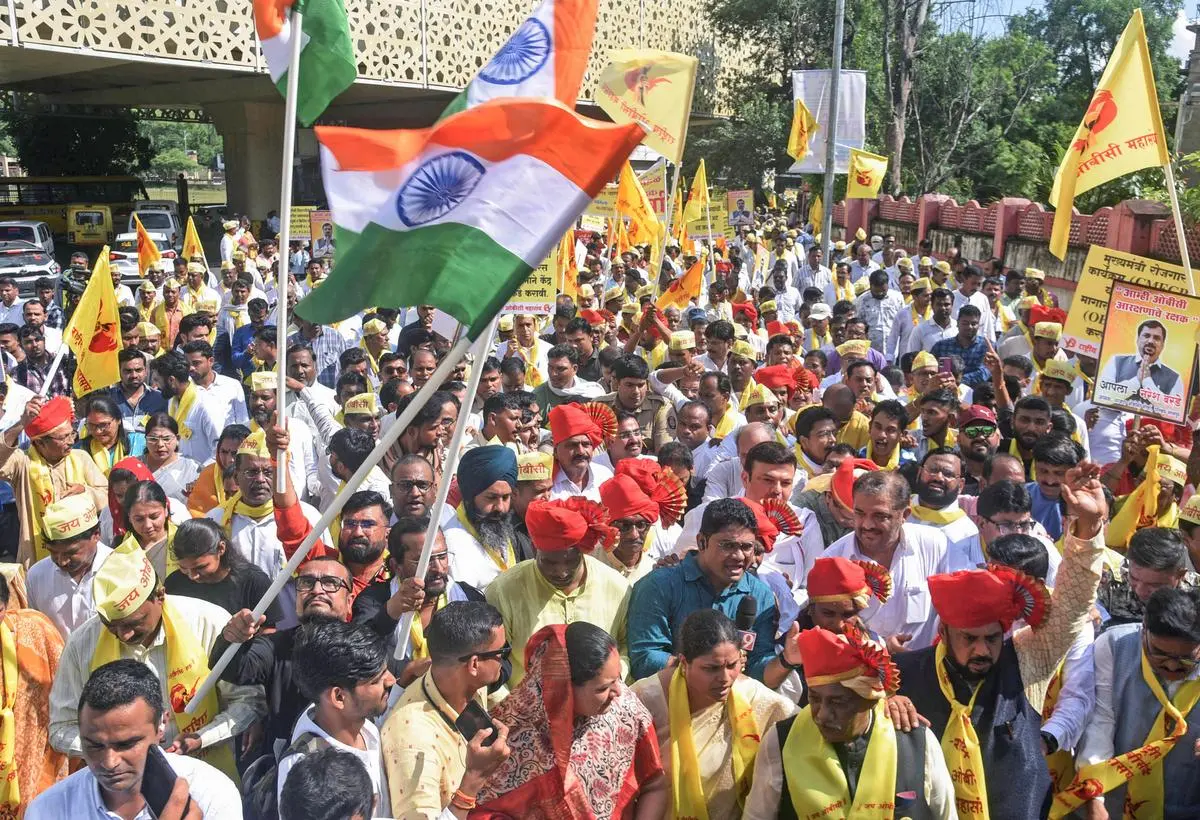
A protest rally by the All Party Kunbi and OBC Community Agitation Committee against the Maratha community’s demand for inclusion as Kunbis for reservation, in Nagpur on September 25, 2023. | Photo Credit: ANI
By the 1990s, the BJP was trying to absorb these groups into itself wherever it could, as with the Patidars and, later, the Kshatriyas in Gujarat. Where it could not, it settled for alliances with the parties they formed, such as the Telugu Desam Party (TDP) in Andhra Pradesh and the Biju Janata Dal in Odisha. These parties are usually called “regional” but are, in fact, parties of what the late K. Balagopal called the “provincial propertied classes”. They were formed around the country as middle- and dominant-caste cultivators became rich farmers and then expanded outside agriculture into various forms of business and vastly expanded the Indian capitalist class.
This two-pronged approach consolidated the dominant- and middle-caste propertied groups within the BJP or the NDA, advancing both the party and the alliance electorally. However, this strategy was able to bring the BJP only to a peak of 23.7 per cent of the popular vote in 1999, with the party losing vote share in 2004 and 2009. In the 2004-14 decade of Congress rule, the BJP was wracked by uncertainties, not only about who would succeed the ageing Vajpayee-Advani duo but also about what strategy would enable it to break that glass ceiling that kept its support to under a quarter of the electorate.
The questions were not solved in any organic fashion, neither through intra-party discussion nor through trial-and-error political or electoral experimentation. Instead, the party was caught up in events not of its own making. In the lead up to the 2014 election, India’s corporate elite was desperate to resolve the “corruption” and “policy paralysis” crisis in its all-important relation with the Union government.
To resolve it, the corporate elite demanded that the BJP appoint as its prime ministerial candidate the then Gujarat Chief Minister Narendra Modi, who had demonstrably combined winning elections with doing the corporate elite’s bidding. In return, of course, it promised munificence. This resolved the first question, but neither then nor now has the second question been resolved, and it is likely to govern the electoral fate of Modi’s BJP.
Modi was able to win in 2014 and increase the BJP’s vote share thanks to a combination of corporate money, which managed to create a mystique around Modi and his alleged “Gujarat Model”; opposition disarray; and the powerful anti-corruption platform originally created by Anna Hazare and the nascent Aam Aadmi Party. Further advance in 2019 was made possible by staging the Balakot strikes to cover up the Pulwama disaster, along with continuing opposition disarray, and even more corporate money that the electoral bonds scheme added to the already deep and wide rivers of corporate funding flowing to the BJP. However, it is hard to find in this any coherent and viable strategy for a stable and secure electoral advance.
Highlights
- In this election, the BJP is trying to align the “Mandal” plank of reservation for Other Backward Classes with that of the Ram temple, which is all about consolidating a Hindu majority.
- In bringing together these two planks that it previously viewed as being in opposition, the BJP’s game plan has been to direct the discourse around caste census towards one that opposes reservation for Muslims.
- This move to communalise reservation also goes to the heart of a major problem that Modi’s BJP faces: its OBC politics is not working.
That strategy must centrally involve OBCs. They form the fat middle of Hindu India’s social structure (which also marks the social structures of other religious communities), below the Savarna castes and above Dalits. The Mandal Commission took them to form about 50 per cent of the population, while the recent Bihar caste census set their numbers at over 63 per cent. This large layer spans the socio-economic spectrum. At one end are the rich dominant- and middle-caste families representing wealth in agriculture, industry, and services and forming part of India’s expanding business and even corporate elite.
Some of the caste groups to which these affluent families belong, such as the Patidars of Gujarat or the Jats of western Uttar Pradesh, are considered as good as Savarna. At the other end are some of the poorest and most marginal farmers and landless labourers. It is the better-off among these caste groups who direct their politics either by directly joining the BJP, as in Gujarat or Rajasthan or Madhya Pradesh, or by forming their own “regional” parties, better considered parties of the provincial propertied classes, in other States.
Where these parties have been successful, they have typically combined advancing the interests of the better-off within these communities with business-friendly policies and at least some meaningful popular measures directed at the less well-off for electoral purposes—N.T. Rama Rao’s Rs.2 a kilo rice scheme is a good example. As a result, these parties are never the easiest of coalition partners for the BJP with its far more elitist policy inclinations. Vajpayee acknowledged this in outlining his “coalition dharma”.
Modi’s approach involves no such “coalition dharma” and has been far less transactional. Consider five elements of his approach to OBC groups and their politics.
“It is telling that the most prominent point about Modi’s OBC politics has been his aggressive posturing as an OBC. In reality, through most of Modi’s life, his caste was not considered OBC.”
It is telling that the most prominent point about Modi’s OBC politics has been his aggressive posturing as an OBC. In reality, through most of Modi’s life, his caste was not considered OBC, and he himself seems to have acknowledged his OBC identity only after becoming Chief Minister of Gujarat, presumably for electoral purposes. Moreover, decades spent as a “karyakarta” in the RSS would have inculcated deep in Modi’s political soul an exaggerated respect for Savarna castes and Brahminism, the opposite of what a politics advancing OBC interests involves.
The purpose of peddling Modi’s tenuous OBC identity so aggressively is simply an invitation to the vast masses of poor OBCs to take symbolic satisfaction in his OBC identity and forget about making any demands for their material advancement. Fortunately for them and unfortunately for posers like Modi, people generally tend to see through such appeals sooner rather than later.
Secondly, there is the issue of the South, with its stronger traditions of anti-Brahminical movements, where the BJP’s attempt to consolidate a Hindu majority against caste politics has failed to make much headway. Although economically more dynamic than the North, with more substantial layers of the propertied middle and dominant castes, the provincial propertied classes have neither joined the BJP directly nor, except in Andhra Pradesh and Karnataka, allied with it. Indeed, in these two States, such alliances have cost the parties concerned electorally. With recent State elections in Karnataka and Telangana turfing out the BJP, the South showed that it remains impregnable to the virus of Hindu majoritarianism.
Caste census
Thirdly, there is the issue of the caste census, which Modi is clearly opposed to for two reasons: it makes the work of consolidating a “Hindu” electoral majority far more complicated, and the BJP’s core constituency of the dominant- and middle-caste propertied is hardly going to be eager to dispense material benefits in the form of reservation to those enumerated as OBCs in any such national exercise. All that Modi’s BJP can do in response is to try to communalise the issue of reservation.
Fourthly, where the BJP has incorporated the dominant- and middle-caste propertied into its previously Savarna social base, the marriage remains rocky. Even in Gujarat, where it is strongest, it has long been rattled periodically by rivalries between dominant-caste and OBC groups such as the Patidars and the Kshatriyas. Moreover, as the recent agitation for reservation among Patidars has shown, the BJP remains unable to fulfil the material aspirations of even its core supporters, with clear political consequences.
Also Read | BJP tones down its anti-minority rhetoric for alliance gains in Andhra Pradesh
Finally, the BJP’s relations with the parties of the provincial propertied classes have become increasingly fraught under Modi. The party has demonstrated a distinct inclination to try to edge out its coalition partners electorally by refusing them their due share of constituencies to contest at election time or ministries thereafter and even splitting the parties. Such treatment would make any party that wishes to retain a political presence wary of joining a BJP-led alliance, and that is also the reason why the INDIA bloc appears to be on more solid ground today than in the past.
Modi’s BJP has also refused to negotiate on issues sensitive to its coalition partners, as with the Shiromani Akali Dal on the new farm laws, since revoked. No wonder that even the parties considered loyal allies have distanced themselves, whether it is Naveen Patnaik in Odisha or Uddhav Thackeray in Maharashtra (who would have thought one might see a break between the Shiv Sena and the BJP?). That is why, apart from Nitish Kumar’s Janata Dal (United) and Eknath Shinde’s “official” Shiv Sena, the BJP has few allies with a sizeable presence in the Lok Sabha.
At the end of campaigning in the third phase, there are more and more signs of panic in the Modi camp and communal messages are being hurled around by Modi, Amit Shah, and their lieutenants with considerable abandon. That the party is choosing to focus on reservation for Muslims and seeking to communalise reservation is precisely because it knows that apart from the entirely symbolic satisfaction of belonging to the same “Hindu” fold as their Savarna superiors, it can give OBCs or their political parties little else, certainly nothing material. If, as seems increasingly likely, the 2024 Lok Sabha election gives the BJP a seat count below its hubristic “400 paar” projection, the difficulties of the BJP with the fat OBC middle of India’s social structure will have had a lot to do with it.
Radhika Desai is Professor, Department of Political Studies, University of Manitoba and Visiting Professor, Department of International Development, London School of Economics.