








The words “election” and “democracy” have become synonymous. It is through elections that citizens, the sovereign in a democracy, transfers their sovereignty to the candidate of their choice. Therefore, to be democratic, elections should comply with essential “democracy principles” of end-to-end verifiability which stipulate that each voter should have the knowledge and capacity to verify that her vote is cast-as-intended, recorded-as-cast, and counted-as-recorded.
Globally, there are five types of voting systems in use: (i) paper ballots (ii) EVM (iii) EVM with voter verifiable paper audit trail (VVPAT) (iv) machine-readable paper ballots (v) Internet-based.
India started with paper ballots, shifted to EVMs, and is now using EVM/VVPATs. The EVM idea was conceived in 1977, and Electronics Corporation of India Ltd, Hyderabad, produced the first prototype in 1979. It went through several stages of trial, demonstration, and evolution before the Representation of the People Act, 1951, was amended in December 1988 and a new section, 61A, was included empowering the Election Commission of India (ECI) to use EVMs. After being used in Assembly elections, they were deployed in all 543 constituencies in the 2004 Lok Sabha election. In 2013, the Conduct of Elections Rules, 1961, were amended to introduce VVPAT machines, which were used in all constituencies in the 2019 Lok Sabha election.
Globally also, many other democracies were using EVMs, whose compliance with “democracy principles” came up for challenge in the German constitutional court in 2009. The German court described the EVM voting system thus:
“The votes were exclusively recorded on an electronic storage medium after the ballot. Neither the voter nor the returning committees, nor the citizens present in the polling station, were able to check whether the votes cast were recorded by the voting machines without falsification. Using the display on the control unit, the returning committees could only recognise whether the voting machines registered a ballot, but not whether the votes were recorded by the voting machines without changing the content in any way. The voting machines did not provide a possibility to record the votes independently of the electronic record on the vote storage module enabling the respective voter to check his or her ballot.
Also Read | Election Commission’s rant against Kharge breaks many standards
“The essential steps in the ascertainment of the results by the voting machines also could not be verified by the public. Since this formed the object of a data processing procedure running inside the voting machines, it was possible for neither the election bodies nor the citizens participating in the ascertainment of the results to verify whether the valid votes cast were correctly allotted to the electoral proposals and the votes accounted for by the individual electoral proposals in total were correctly ascertained. It was not sufficient that the result of the computing process implemented in the voting machine could be taken note of using a summary paper printout or an electronic display. A public examination by means of which the citizen could have reliably verified the ascertainment of the election result himself or herself without prior special technical knowledge was hence ruled out.”
“In a CSDS-Lokniti pre-poll survey, 45 per cent of the respondents suggested the likelihood that EVMs could be manipulated by the ruling party.”
On these grounds, EVM voting was declared unconstitutional, and the whole of Europe went back to the paper ballot. Now, on this very issue, India’s Supreme Court has pronounced a totally opposite judgment saying EVMs ensure “free, fair and transparent elections”. In the writ petition and in the intervention application in the matter, the plea was for upholding of “democracy principles”, that the voting process should have end-to-end verifiability which is possible in the paper ballot system but not possible with EVM, which is a black box. With this in view, the Supreme Court was requested to issue a writ of mandamus or any other appropriate writ, order, or direction to the ECI to arrange for the printout of the VVPAT slips to be handed over to the voter, who should be able to deposit them in the VVPAT ballot box, which must then be counted in full and cross verified by the electronic count in the EVMs.
EVMs diminishing the trustworthiness of the electoral process
The original petition filed in February/March 2023 was almost entirely based on Volume I of the Citizens’ Commission on Elections (CCE) report titled “Is the Indian EVM and VVPAT System Fit for Democratic Elections?”, and the court had sufficient time to go into the matter in detail and pronounce judgment well before the commencement of the polling process for the general election of 2024.

Election officials demonstrate the workings of EVMs on a tram decorated as part of the voter awareness campaign for Lok Sabha polls. April 29, 2024, Kolkata. | Photo Credit: PTI
Instead, the case was taken up casually after the commencement of the electoral process, and the judgment was hurriedly handed out on April 26, the day when 191 constituencies completed polling and 35 per cent of the electorate cast their votes.
The mandamus requested has its moorings in the deposition made by some of the top brains in the world before the CCE, headed by a former Supreme Court judge. Despite being technocrats par excellence, they looked at the issue through the prism of democracy and not technology. They were of the view that the ECI’s excessive reliance on the secrecy of design and the false claim that the machines are tamper-proof would greatly diminish the trustworthiness of the electoral process. And they suggested these changes:
1. EVM design and implementation, as well as the results of both software and hardware verification, should be public and open to full independent review. Reports from independent experts should be made available to the public, and the important vulnerabilities discovered should be addressed as part of a regular public process.
2. A VVPAT should be generated for every EVM in every election. Voters should be allowed to verify the printed VVPAT slip before the vote is cast. VVPAT slips are, however, weaker than paper ballots because paper ballots exactly represent the intended vote, but the VVPAT slip does so only if it is verified by the voter. The Indian VVPAT system does not allow the voter to verify the slip before the vote is cast.
3. A robust, well-designed audit is necessary to provide confidence in the election results.
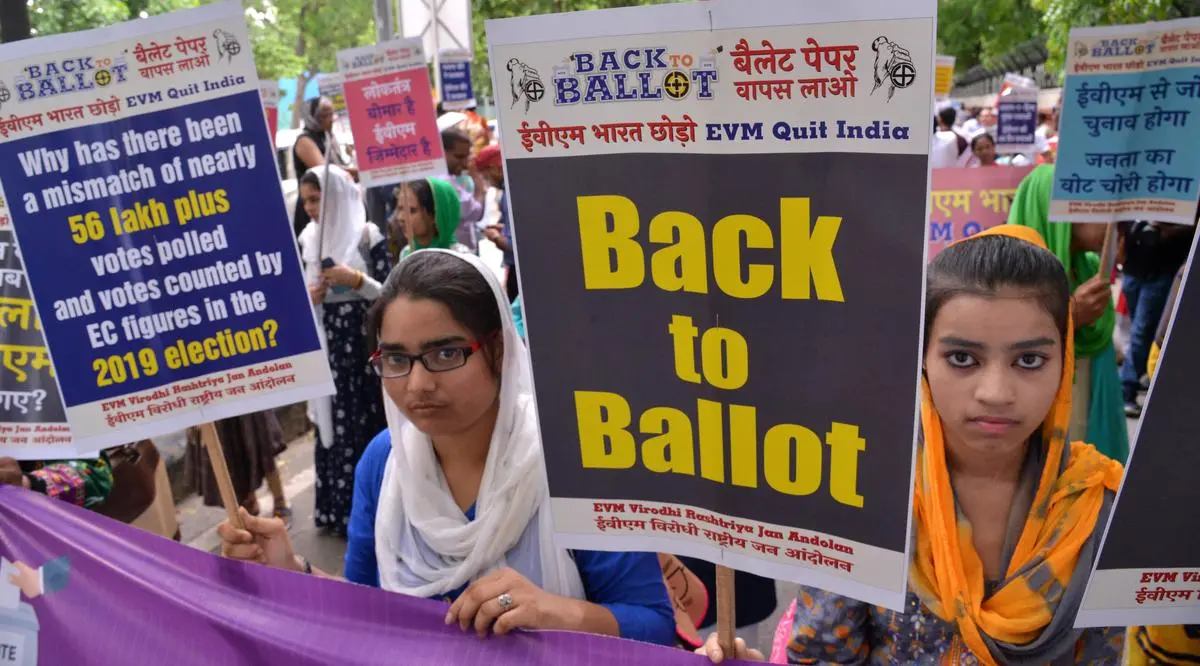
Activists of various organisations participate in a march, EVM Virodhi Rashtriya Jan Andolan, against EVMs, demanding a return to ballot papers. New Delhi, August 9, 2019. | Photo Credit: MOORTHY RV
According to CCE experts, if the above are not complied with, the vulnerabilities of the EVM will continue to pose a serious problem to election integrity, and paper ballots could be preferred.
These inputs were totally ignored. Instead, the court reposed blanket faith in the misleading answers to “Frequently Asked Questions” and submissions made by the ECI: “ECI maintains that the EVMs have been a huge success in ensuring free, fair and transparent elections across the nation in all elections. They restrict human intervention, checkmate electoral fraud and malpractices like stuffing and smudging of votes, and deter the errors and mischiefs faced in manual counting of ballot papers. While earlier it was apprehended that the introduction of EVMs would lead to hardship and disenfranchisement, independent studies showcase that EVMs have led to increase in voter participation.”
Supreme Court’s endorsement of the ECI
By patting it on its back, the Supreme Court has endorsed the ECI’s gross violation of Rule 56(D)(4)(b) of the Conduct of Elections Rules, which provides that the count of VVPATs shall prevail over the count reflected in EVMs. The court has also upheld the ECI’s anti-democratic stance that the purpose of VVPATs is only for voters to see that their vote has been cast as intended and that they do not have the “fundamental” right to know whether the vote has been recorded as cast and counted as recorded. This means VVPATs have been reduced to mere bioscopes!
“The case concerning EVMs was taken up casually after the commencement of the electoral process and the judgment was hurriedly handed out by the Supreme Court on April 26, 2024, the day when 191 constituencies completed polling and 35 per cent of the electorate cast their votes.”
As regards paper ballots, the court has been openly hostile, with one judge questioning the bona fides of the petitioning Association for Democratic Reforms: “We must reject as foible and unsound the submission to return to the ballot paper system. The weakness of the ballot paper system is well known and documented. In the Indian context, keeping in view the vast size of the Indian electorate of nearly 97 crores, the number of candidates who contest the elections, the number of polling booths where voting is held, and the problems faced with ballot papers, we would be undoing the electoral reforms by directing reintroduction of the ballot papers.”
Highlights
- India’s Supreme Court has pronounced a judgment saying EVMs ensure “free, fair and transparent elections”, when EVM voting has been declared unconstitutional in most of Europe
- The court has also upheld the ECI’s anti-democratic stance that the purpose of VVPATs is only for voters to see that their vote has been cast as intended and that they do not have the “fundamental” right to know whether the vote has been recorded as cast and counted as recorded
- While placing “the system” and the ECI on a high pedestal, the Supreme Court has treated public opinion with contempt
This is plain judicial exaggeration. Decades ago, booth capturing and ballot stuffing did take place because surveillance, supervision, security, transportation, and communication systems were primitive. That is no longer the case. Now senior election officials, observers, the police, and flying squads can observe what is happening in the polling booths through CCTV cameras and can intervene instantly in the event of any mischief. Sensitive booths are guarded by armed police with orders to shoot in case of any booth capturing and ballot stuffing. So that era is over. Also, polling in India is held in a highly decentralised manner by 766 District Collectors-cum-Magistrates, with a massive army of Central and State government officials as well as employees of public sector undertakings and banks running into the millions at their disposal. So, the size of the electorate and the number of polling stations do not matter.
Also Read | Election Commission of India: Mala fide or merely incompetent?
Under the ballot paper system, voters can check the accuracy of the candidate’s name/symbol and verify whether it has been correctly marked. This provides knowledge and satisfaction to voters that their sovereignty has been transferred to the candidate of their choice. In case of electoral dispute, physical reconstruction of the vote for authentication is possible. Vote counting is open and transparent. Against the absolute transparency of the paper ballots, there is the total opaqueness of the EVM system where everything is done unseen inside a machine.
Principle of vote verifiability
The judgment concludes by upholding the “whim of the machines” instead of the “will of the people”, which is the foundation of democracy: “In our considered opinion, the EVMs are simple, secure and user-friendly. The voters, candidates and their representatives, and the officials of the ECI are aware of the nitty-gritty of the EVM system. They also check and ensure righteousness and integrity. Moreover, the incorporation of the VVPAT system fortifies the principle of vote verifiability, thereby enhancing the overall accountability of the electoral process.”

Poll officials check EVMs and other election materials before leaving for their respective booths on the eve of the third phase of the Lok Sabha election. Ahmedabad, May 6, 2024. | Photo Credit: Siddharaj Solanki/ ANI
While placing “the system” and the ECI on a high pedestal, the Supreme Court has treated public opinion with contempt by dismissing the Centre for the Study of Developing Societies (CSDS)-Lokniti’s pre-election survey wherein 45 per cent of the respondents suggested the likelihood that EVMs could be manipulated by the ruling party. The survey had also revealed an alarming 58 per cent of the respondents expressing distrust in the ECI, which is hell-bent on conducting elections through EVMs. This is not democracy.
It is unfortunate that the highest court in India has pronounced EVMs, banned as unverifiable and unconstitutional in advanced democracies, as the “gold standard” for elections. Let us see what the National Election Defense Coalition of the US has to say on the matter:
“Durable, voter marked paper ballots are appropriate technology for public elections.
· Hand Counted Paper Ballots are considered the ‘Gold Standard’ of democratic elections
· Only paper ballots provide physical proof of the voter’s intent
· Paper ballots can be safely recounted in case of a contested result
· Counting paper ballots in public provides 100% oversight and transparency
· Unlike computer voting systems:
-paper ballots can’t break down or malfunction
- paper ballots are not programmed secretly by unaccountable private corporations
- paper ballots cannot be hacked or rigged”
Fortuitously, as per Indian election law (the Representation of the People Act), paper ballot continues to be the primary mode of polling (Section 59) while EVM voting is an option (Section 61A) to be adopted according “to the circumstances of each case”. It is because of an ill-conceived technology obsession that EVM voting is being pursued vigorously, casting aside essential “democracy principles”, thereby compromising the integrity of elections. India needs to urgently find an alternative that combines both the systems.
According to election security experts, ideal voting should have voter-hand-marked paper ballots counted by optical scanner voting machines with ballot marking devices for universal accessibility and regular post-election audits of paper ballots to verify the machine count. Only such a system, which combines the best of technology and democratic principles, can truly represent the mandate of the people and usher in a functional democracy.
M.G. Devasahayam is a former Army and IAS officer, coordinator of the CCE, and editor of the book, Electoral Democracy? : An Inquiry into the Fairness and Integrity of Elections in India.