


The tragic deaths of 25 workers in a devastating explosion at a firecracker manufacturing unit in Kattanarpatti village near Sivakasi—the hub of India’s fireworks industry—in Tamil Nadu’s Virudhunagar district on April 19, 2026, serve as a chilling reminder of how corporate greed, systemic safety violations, and regulatory negligence continue to render human lives expendable.
Before that, on April 13, three workers of a cracker unit were killed in an explosion at Thayalpatti in the same region. All those who were killed in the explosions belonged to poor and low-income families, with women constituting the majority of the victims. The incident is yet another addition to the long history of accidents that have plagued the fireworks and safety matches manufacturing industry in Sivakasi, repeatedly claiming the lives of vulnerable people whose subsistence depends almost entirely on this hazardous occupation.
In the arid, rain-fed region of Virudhunagar district, where agriculture is no longer a viable source of sustenance and alternative industries remain scarce, the fireworks sector has become the primary source of livelihood for thousands of families. With limited economic opportunities, generations of workers have been compelled to rely on this perilous industry despite the recurring tragedies.
The industry, which accounts for nearly 90 per cent of the country’s firecracker production through around 1,500 manufacturing units, generates an estimated annual turnover of Rs.6,000 crore and employs nearly six lakh workers, directly and indirectly. It is the economic backbone of the region.
After the explosion—the worst since the 2012 Mudalipatti incident in which 40 workers perished—both the State and Central governments, which oversee the industry, initiated their now ritualistic response: inspections, audits, investigations, arrests, and compensation for the victims’ families.
What lies behind these fatal accidents that recur with regularity in an industry that continues to resist mechanisation and modernisation? Where should accountability rest—with the regulatory agencies, or with the manufacturers who prioritise profit over workers’ lives? Disturbingly, everyone connected with the industry is aware that this is unlikely to be the last such tragedy.
A Frontline study shows the distressing absence of any effective mechanism—either on the part of the authorities or the manufacturers—to prevent any such accidents, which have now become routine in the industry. Despite repeated tragedies and mounting loss of lives, little appears to have changed in terms of safety enforcement, technological upgradation, or structural reform.
The recent accidents lay bare a deep-rooted systemic failure within the fireworks industry, though the safety matches industry is becoming mechanised. But the mechanisation of the firecracker industry is not that easy since hundreds of varieties of crackers and display items are manufactured. Hence, it is, according to manufacturers, impractical to become fully mechanised. “The production involves various stages of process,” said a factory owner.
As a result, to evade inspections and maximise profit margins, the firecracker manufacturing process is often fragmented into multiple stages, including chemical mixing, drying, and packing, and is outsourced. This decentralised production has created a network of unsafe and unregulated operations.
Hence, illegal practices in the manufacturing process are also widely reported. The cracker unit destroyed in the recent explosion belonged to a licensed manufacturer, yet the licensee had violated the law by subleasing the facility—a practice that has become alarmingly common in the industry. Such illegal subleasing often results in the employment of workers far beyond the permitted limit, leading to severe overcrowding and dangerously unsafe working conditions.
Functioning outside the confines of the law, the unauthorised units routinely flout the safety norms, restrictions, and regulatory guidelines prescribed by both the Central and State governments. While pursuing higher production and profits, compliance with basic safety measures is frequently sacrificed, and workers are exposed to catastrophic risks.
Workplace as death trap
A cross section of people, who spoke to Frontline, including workers, activists and labour union leaders, allege that many of these units function in dangerously unsafe sheds, use substandard chemicals, and stockpile explosives far beyond the permissible limits, turning workplaces into potential death traps. The proliferation of such illegal operations in villages surrounding Sivakasi—the hub of the firecracker and safety match industry—enables manufacturers to circumvent regulations and escape scrutiny by enforcement agencies.
Adding to the problem, several stages of the firecracker manufacturing process are also allegedly outsourced to unlicensed and poorly monitored units, in blatant violation of established safety norms. This decentralised and clandestine mode of production not only weakens regulatory mechanisms but also exposes workers, many of them women from economically vulnerable backgrounds, to life-threatening risks daily.
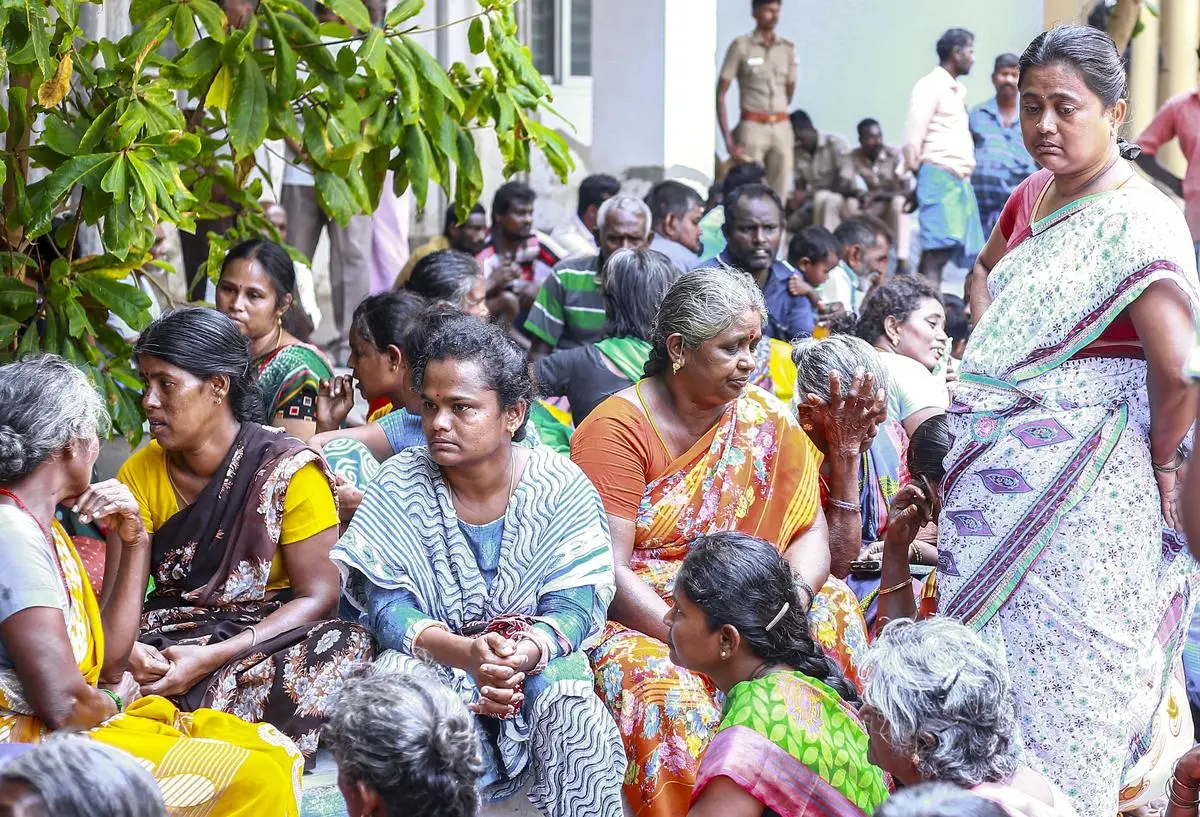
Family members and relatives gather outside a government hospital following the deaths of victims in a firecracker factory explosion, in Virudhunagar, on April 20, 2026. | Photo Credit: PTI
But industry experts point to a range of recurring factors behind explosions in fireworks manufacturing units. The foremost among them is the lack of proper training for workers and supervisors involved at different stages of production. Foremen are supposed to be qualified with at least a degree or diploma in subjects such as chemistry. They have to supervise the mixing of chemicals, considered the most hazardous phase in the manufacturing process. But sadly, it is often carried out with inadequate technical knowledge, safety equipment, or professional supervision, significantly increasing the risk of accidental ignition.
Other major contributors include the excessive stocking of explosive raw materials and finished fireworks within factory premises, overcrowding workers inside cramped sheds, and forcing labourers to work for long hours under intense pressure. The widespread piece-rate wage system further aggravates the danger, as workers are driven to maximise output to earn a living, often at the cost of basic safety precautions. In such conditions, productivity takes precedence with disastrous consequences.
These experts also point out that the hot and dry climatic conditions of Virudhunagar district make it ideally suited for year-round fireworks production. Ironically, the very same climate also heightens the risk of accidental explosions. Excessive heat and dryness can easily trigger combustion while handling volatile chemicals used in firecracker manufacturing. Even the Madurai Bench of Madras High Court, while expressing its anguish over the recurring fatal explosions in the industry, had asked why the units should not be closed for two to three months during the peak summer.
Senior district officials, however, pointed out that it was not possible since the industry was linked to the people’s livelihoods. However, they said that safety regulations prohibit hazardous chemical handling during the hottest part of the day. “Accordingly, work involving explosive substances is permitted only between 6 am and 12 noon,” an official noted. Yet, industry insiders and labour representatives allege that these norms are flouted.
Operating without safety protocols
Workers are frequently denied even basic protective gear while dealing with highly flammable chemicals, and many illegally operated factory sheds function without essential fire safety mechanisms or emergency protocols. A significant number of women workers, drawn from economically vulnerable families, continue to toil in these hazardous environments for meagre wages, say around Rs.400 per day, often with little awareness of the dangers involved. Those who work in big units alone enjoy certain privileges, such as PF and insurance. Many have been working since their childhood.
Disturbingly, many sheds used for mixing chemicals and packing fireworks are located close to residential areas, thereby placing entire communities at risk. There have been persistent allegations of collusion between factory owners and local officials, enabling illegal units to function with impunity despite repeated accidents and mounting loss of lives. This lack of proper infrastructure, inadequate training in handling hazardous materials, and an overriding profit-driven mindset have together intensified the risks.
The recent explosion has once again underscored the urgent need for sweeping reforms in working conditions, labour practices, and technological modernisation in the industry. Although the need to automate hazardous stages of firecracker production was acknowledged years ago, progress has remained painfully slow.
More than a decade ago, Parliament was informed that steps would be taken to introduce automation in dangerous manufacturing processes to minimise human exposure to explosive substances. Yet, the promise has largely remained on official records and policy documents, with little meaningful implementation on the ground. As a result, thousands of workers continue to risk their lives every day in unsafe and outdated production environments.
In the aftermath of the 2012 Mudalipet explosion, which claimed 40 lives and left many others injured, both the State and Central governments announced a series of stringent safety and preventive measures for the fireworks industry. Multiple investigations were conducted into the tragedy, while the National Human Rights Commission also took cognisance of it and registered a case.
Over the years, the National Green Tribunal has repeatedly intervened, issuing directions aimed at strengthening safety compliance and regulating hazardous operations in the industry. Yet, despite these interventions, enforcement has remained weak and inconsistent, with accountability continuing to be elusive.
An inquiry commission appointed by the Central government had submitted a series of important recommendations intended to prevent such disasters in the future, including stricter monitoring, technological modernisation, and improved safety standards. However, much like previous promises of reform, these recommendations have largely remained on paper only. More than a decade later, the industry continues to witness the same pattern of negligence, recurring explosions, and tragic loss of lives.
What data says
The data available on explosions and deaths is depressing. The National Green Tribunal says that at least 134 workers were killed in explosions at fireworks and match factories in the district between 2022 and 2025 in 89 accidents. Informed sources indicate that from 2000 to 2012, there were 170 explosions, resulting in 288 deaths.
In fact, the Petroleum and Explosives Safety Organisation (PESO), the nodal agency of the Central government functioning under the Department for Promotion of Industry and Internal Trade, is entrusted with the responsibility of issuing licenses for big units, regulating explosives and other hazardous materials. It ensures the mixing of chemicals to produce green crackers as per the Supreme Court directions to prevent air pollution. The Virudhunagar district administration issues local, ground-level licenses for smaller units and monitors them.
However, critics argue that PESO’s enforcement mechanism has often been weak and inadequate, leading to serious safety violations. At the same time, the district administration—which bears direct responsibility for field inspections, monitoring, and enforcement of regulations—has frequently been accused of adopting a lackadaisical approach towards safety compliance.
Significantly, a majority of the major accidents in recent years have reportedly occurred in units licensed by PESO, raising serious questions about its regulatory and enforcement effectiveness. According to industry estimates, nearly 1100 bigger fireworks units in Virudhunagar district operate under PESO’s supervision, while the district administration has issued licenses to around 300 smaller units.
The Supreme Court’s 2018 ban on the use of barium nitrate, based on a submission by the Central Pollution Control Board, to reduce the high-decibel crackers and to save the environment, has resulted in a significant decline in firecracker production. A manufacturer told Frontline that the non-availability of the barium compound had led to a rise in illegal manufacturing units, causing more accidents and fatalities. In the Sivakasi region, “illegal” generally refers to the use of prohibited chemicals and the operation of unauthorised manufacturing facilities. Additionally, in 2021, the Supreme Court prohibited the use of antimony, lithium, mercury, arsenic, and lead in firecracker production to help reduce air pollution.
But manufacturers have been found to use these toxic substances that are prohibited by both the Supreme Court and PESO, including barium nitrate and red lead. In fact, a few years ago, a senior office-bearer of the Tamil Nadu Fireworks and Amorces Manufacturers Association (TANFAMA) was reported to have committed multiple violations, including the use of red lead—a banned, highly sensitive chemical—and equipment made of iron. Illegal explosives and banned chemicals are mainly sourced through domestic procurement from unregulated local units. Sivakasi has a significant presence of chemical suppliers, although most of them operate legitimately.

Firemen carry mortal remains after at least two workers were killed in an explosion at a firecracker manufacturing unit near Cumbum in Theni district, Tamil Nadu, on April 25, 2026. | Photo Credit: PTI
Sources within the fireworks industry claim that inspections and raids have succeeded in curbing only about 25 per cent of illegal cracker production, underscoring the vast scale at which unauthorised operations continue to flourish. Despite periodic crackdowns, enforcement agencies appear unable to dismantle the entrenched network of illegal manufacturing and supply chains operating in and around Sivakasi.
In 2024, officials in Virudhunagar district seized nearly 22,000 kg of banned chemical compounds from a unit in Thayilpatti, which was allegedly involved in manufacturing raw materials for firecrackers. During the raid, authorities recovered 455 bags of barium nitrate, a prohibited chemical compound, used in fireworks production.
In another significant seizure during the same year, officials confiscated a large quantity of Chinese firecrackers from a retailer in Sivakasi town, highlighting the growing influx of imported fireworks into Indian markets despite regulatory restrictions. The incident also exposed the presence of an underground trade that threatens not only public safety but also the survival of the domestic industry.
The TANFAMA, however, asserts that none of the specific products banned by the court is being used in their operations. The Centre for Indian Trade Unions (CITU) in Virudhunagar has stated that officials need to inspect firework units regularly to ensure that safety features and precautions are followed. It pointed out that licenses and safety certificates were issued without proper verifications. “The work environment is not conducive to the safety of workers,” said one of its office-bearer.
The fireworks and safety match industries of Tamil Nadu are increasingly facing stiff competition from inexpensive Chinese firecrackers that continue to enter Indian markets through clandestine channels, as well as from the rapid mushrooming of manufacturing units in several other parts of the country. Tamil Nadu Minister for Industries S. Keerthana told the media recently that she would constitute a committee of all stakeholders—manufacturers, workers, the general public and officials—to study the issues that were faced by the industry.
The Sivakasi fireworks industry is the second largest in the world in terms of production volume, next only to China. However, Chinese crackers and display items continue to flood Indian markets, posing a serious threat to the domestic fireworks and match industries, particularly in Tamil Nadu.
However, during the recent consecration ceremony of the Shree Ram Janmabhoomi Temple in Uttar Pradesh, Sivakasi witnessed a sharp 20 to 30 per cent surge in demand for its crackers from North India. Normally, the industry would be busy ramping up production ahead of the annual public festivals of Deepavali and Dussehra.
Despite these mounting existential challenges, Sivakasi’s fireworks industry has remained remarkably resilient. Its long-standing dominance, coupled with the deep cultural and commercial bond it has forged with people across the country over more than half a century, continues to stand as an enduring legacy. Yet, for the industry to sustain itself with dignity and credibility, it must adopt a more holistic and humane approach towards its workers.
Kerala fireworks tragedy
At around 3.30 p.m. on April 21, residents near Mundathikode, about 16 kilometres from Thrissur, heard a loud explosion that many initially mistook for an earthquake. Houses shook, windowpanes shattered, and within minutes, a series of blasts followed from a fireworks unit set amid the Kuttamkulam paddy fields. At least 50 nearby houses were damaged.
“We went home but couldn’t sit there, so came back,” said Rahul and Nikhil, who had joined the rescue efforts. They recalled seeing body parts scattered near the site. Earthmovers had to clear pathways before emergency vehicles could enter. When fire and rescue personnel reached the site nearly an hour later, several sheds were already burning.
The explosion killed at least 16 people, injured more than 24, and left several missing. Police said around 35 to 37 people were believed to have been at the site when it happened. The unit, spread across roughly 2.5 acres, had multiple sheds storing fireworks and explosive materials.
The unit was operated by Mundathikode Satheesh, the licensed fireworks contractor for the Thiruvambady temple, who died in the blast. Thiruvambady and Paramekkavu are the two rival temple committees whose annual fireworks competition is the highlight of Thrissur Pooram, a centuries-old festival held at the Vadakkunnathan temple grounds. The trade ran in Satheesh’s family, his father Mani had done it before him, and the family had been involved in the trade for nearly 45 years. Preparations were under way for the Pooram, which was scheduled for April 26.
Among those who died were Manikandan, Giri, and Abhijith—residents of Kammath and Chelat lanes in Kottappuram, near Thrissur. Their neighbour Sivanandan recalled that wherever there was a fireworks display, the three would be there. Manikandan was a member of the Thiruvambady temple festival committee and Satheesh was a close friend.
Identification of victims was difficult because many bodies were charred beyond recognition. Manikandan, a fitness trainer, was identified by his ear stud and physique. Giri’s severed head was found in the field and identified by his family. Dr. Hithesh Shankar, forensic surgeon at Thrissur Medical College, said, “Identification had to rely on rings, earrings, dental patterns, even medical implants.” Police had recovered 28 body parts from the site, along with unexploded explosives and parts of nearly 10 mobile phones.
V.S. Sunilkumar, former minister and CPI(M) leader from Thrissur, said that many of those present that day had not come for wages. “Rajesh, Vishnu, Manikandan, Hari,” he said, listing the dead. He described fireworks as inseparable from Thrissur’s identity alongside elephants, tiger dancers, and the Pooram itself. “The young men have grown up watching the festival,” he added.
The State government announced compensation of Rs.14 lakh each to the families of those killed. Prime Minister Narendra Modi also announced Rs.2 lakh each to the families of the deceased and Rs.50,000 for those injured.
Investigators found that Satheesh’s unit had been storing well above the permitted limit of 2,000 kilograms per display. Thrissur City Police Commissioner Nakul Rajendra Deshmukh said teams recovered between 200 and 300 kilograms of unexploded materials from the site alone.
R. Venugopal, former Joint Chief Controller of Explosives at Petroleum and Explosives Safety Organisation (PESO), said this was not an isolated failure. Fireworks units were routinely set up in unauthorised premises with no access routes for emergency vehicles. “In many cases, friction caused by impurities like sand can trigger sparks. The intensity of this explosion suggests either excessive storage or even the possible use of prohibited chemicals such as potassium chlorate,” he said.
The Kerala Sasthra Sahithya Parishad, a grassroots People’s Science Movement in Kerala, demanded a complete ban on explosive fireworks. Such accidents, it said in a statement, were not the result of missing laws but of laws being ignored. The Explosives Act, 1884, PESO regulations, and the Noise Pollution Rules, 2000—which prohibit sound-emitting fireworks between 10 p.m. and 6 a.m.—already exist. The organisation said they are rarely followed.
The Mundathikode explosion was not the first of its kind. In 2016, an unauthorised fireworks display at the Puttingal temple in Kollam killed more than 100 people and injured 350 more. Satheesh had lost his licence in the crackdown that followed and was out of work for eight years. He got it back only three years ago.
Edappal panchayat member Vijayan Kodambath, who was at the mortuary to collect the body of one of the workers, questioned how gunpowder, a Chinese invention, had become part of Indian cultural and temple traditions. Fireworks, he said, should be banned.
Thrissur Pooram went ahead on April 26. The Kudamattam, the ceremonial parasol exchange between the two rival temple groups, was cut from an hour to 15 minutes. Investigators had found storage violations at the Paramekkavu unit as well, so there were no fireworks. A crowd of lakhs gathered nevertheless.
Also Read | ‘Epidemic’ of injuries: Report exposes lack of safety measures in auto component makers
Also Read | Blast in Duttapukur illegal firecracker factory exposes West Bengal’s law and order crisis