









The issue of reserving seats for women in the Lok Sabha and the Vidhan Sabhas has had a long, arduous, and eventful journey over the past few decades. Politically a tricky subject, it has always evoked strong sentiments. Every time a piece of legislation to reserve seats for women was taken up by Parliament, it resulted in high drama, with emotions soaring, harsh words getting exchanged, and MPs coming close to blows.
A law providing 33 per cent reservation for women in the Lok Sabha and the Vidhan Sabhas, named Nari Shakti Vandan Adhiniyam, was passed in a special session of Parliament in September 2023, ending the three-decade-long legislative journey of the affirmative measure. It was the first piece of legislation to be taken up in the new Parliament building. However, the reservation was tied to the first census to be held after 2026 and a delimitation of seats based on that census, which effectively meant that it could not be implemented for at least a decade.
Around 30 months after the law was passed, yet another dramatic episode unfolded in the women’s reservation saga when the BJP-led National Democratic Alliance (NDA) government convened a special sitting of the Budget session of Parliament from April 16 to 18 during which it introduced three Bills: the Constitution (131st Amendment) Bill, 2026, the Union Territories Laws (Amendment) Bill, 2026, and the Delimitation Bill, 2026.
The Bills proposed to delink the quota from the 2027 Census and the delimitation that would follow, enhance the size of the Lok Sabha and the Vidhan Sabhas, and conduct a delimitation of the seats in the Lok Sabha and the State Assemblies on the basis of what appeared to be, as per the text of the proposed legislation, the findings of the 2011 Census.
For two days, the Bills were fiercely debated in the Lok Sabha. The government made a strong plea for bipartisan support for the proposed laws that it claimed would, at long last, roll out a quota for women. The opposition came down heavily on the government and unitedly opposed the Bills, claiming that the real motive behind the amendments was to drastically alter the electoral map of the country to benefit the BJP.
That the Bills were in the offing became known only at the fag end of the Budget session of Parliament in March when the idea of increasing the size of the Lok Sabha and the Vidhan Sabhas by 50 per cent as a way to roll out the women’s reservation was first mooted by the government in meetings it held with different parties.
However, the opposition parties were taken by surprise when the dates of the special sitting were announced, and they attacked the government for not making the text of the Bills public or even sharing it with MPs, which was eventually done on the eve of the sitting. They also strongly criticised the government for not holding any public consultation on the Bills and not calling an all-party meeting to discuss the proposed laws, which would have a far-reaching impact on the parliamentary architecture and the electoral map of the country.
There was intense speculation about the political motives behind the Bills. The government emphasised that they were meant to advance the implementation of women’s reservation. It insisted that it had worked out an effective plan to reserve seats for women while assuaging the concerns of male politicians who feared losing their bastions with the promise to enhance the number of seats.
During the special sitting, Prime Minister Narendra Modi and other prominent members of the government insisted that the delimitation of seats that would be conducted to roll out the quota would not result in any injustice to the southern States and denied that it would result in circumventing the caste census.
“No injustice will be done to anyone.... Our “niyat” [intent] is clear.... No State will lose in terms of numbers. Nobody will face a situation where they will lose their seat,” said Modi.
Opposition’s counter
The opposition parties forcefully countered the government’s claims and expressed mistrust over its assurances with regard to delimitation and the caste census.
Speaking in the Lok Sabha, Leader of the Opposition Rahul Gandhi described the Bills as an “anti-national act”. He said: “This is not a women’s Bill. This has nothing to do with the empowerment of women.” He claimed that the government was attempting to bypass the caste census and avoid giving greater representation to Other Backward Classes.
He added: “An equally bad thing, but a very dangerous thing what you are doing, because you are scared of what is happening in the politics of this country, you are scared of the erosion in your strength, you are trying to rejig the Indian political map. You have done it in Assam, you have done it in Jammu and Kashmir.... You are telling the south Indian States, the North-Eastern States, you are telling the small States in India that in order for the BJP to remain in power, we are going to take away representation from you.”
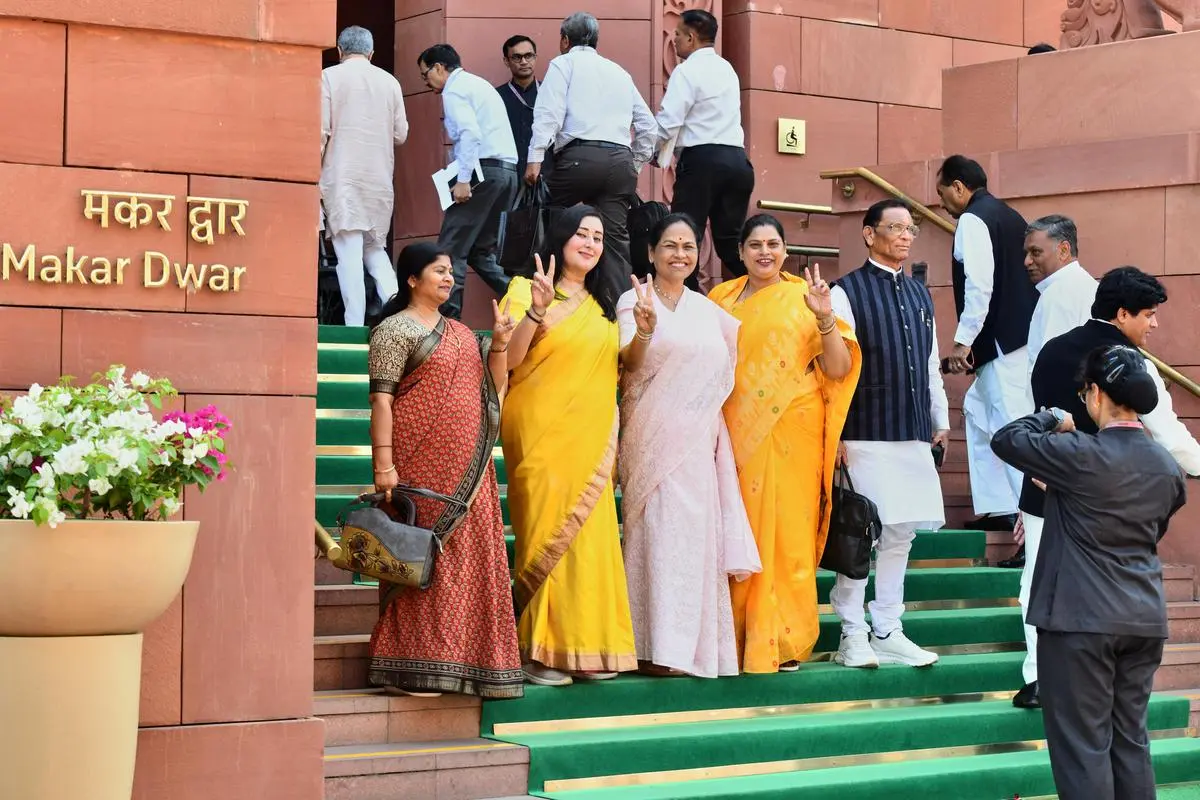
Women MPs pose outside Parliament House before the start of the debate on the women’s reservation Bill, on April 16. | Photo Credit: AP
In the end, with the opposition staying united against the Bills, the government failed to garner the two-thirds support needed in the House. It was a rare legislative defeat for the Modi government.
Meanwhile, the law that was passed in 2023 still stands and was, curiously enough, notified in the Gazette on the evening of April 16, when the discussion on the contentious Bills was under way in the Lok Sabha. It has been a rollercoaster ride for the women’s reservation issue over the past few decades, with a vibrant women’s movement fuelling the demand for a quota and the political milieu of the times determining its fate in Parliament.
History of demand
Women’s groups have highlighted the poor representation of women in legislative bodies to press their demand. The first Lok Sabha in 1952 had only 22 women, and they constituted a little over 4 per cent of the House. As per a report titled “Women’s Political Participation and Representation in India”, brought out by the Association for Democratic Reforms in March 2026, there are 74 women MPs in the current Lok Sabha, or 14 per cent of the House, and among 4,123 MLAs across the country, only 390, or 9 per cent, are women.
Since 1996, the Bill for women’s reservation was unsuccessfully introduced in Parliament on five occasions before it was finally passed and became a law on the sixth attempt in 2023. It is widely believed that the main hurdle was the unease of male MPs, across party lines, with regard to losing their seats.
The Hindi heartland parties such as the Samajwadi Party (SP) and the Rashtriya Janata Dal (RJD) were more upfront about their opposition to the Bill, claiming that only women belonging to the privileged castes and classes would gain from the reservation. Janata Dal (United) leader Sharad Yadav had famously declared that he would rather drink poison than allow the Bill to be passed. When the Atal Bihari Vajpayee government introduced the Bill in the Lok Sabha in 1998, RJD MP Surendra Prasad Yadav snatched it from the hands of the then Home Minister, L.K. Advani, and tore it up.
On March 9, 2010, during the term of the second United Progressive Alliance (UPA) government, the Bill was passed by the Rajya Sabha amid uproarious scenes. In a rare occurrence in the Upper House, marshals were called in to maintain order, and several MPs were suspended.
When the Bill was brought to the Rajya Sabha by the first UPA government in 2008, Congress MP Renuka Chowdhury, who was then a Union Minister, pushed away an SP member when he tried to snatch the Bill from Union Law Minister H.R. Bhardwaj as he introduced it in the House. As a precautionary measure, Bhardwaj was seated between two women Ministers, and women MPs from the ruling Congress formed a wall around him.
After the Bill was passed, the then Congress president, Sonia Gandhi, BJP leader Sushma Swaraj, and Brinda Karat of the CPI(M) had posed together for the cameras with broad smiles on their faces. The moment symbolised the melting away of ideological differences for the women leaders as they joined forces for a common cause. The Bill, however, lapsed with the dissolution of the Lok Sabha in 2014.
Scenes of jubilation were also witnessed in 2023 when the Bill was finally passed by both Houses of Parliament. Modi posed for photographs with women MPs of the ruling alliance outside Parliament, many of them holding boxes of sweets and displaying the victory sign.
This year, high drama marked the April 16–18 sitting too. Women guests from different parts of the country—invitees of BJP MPs—watched from the visitors’ gallery as heated exchanges took place between the government and the opposition. After the Bills were defeated, women members from the ruling alliance staged a protest outside Parliament, holding placards and raising slogans against the opposition.
In the midst of the political din over who was for women and who was anti-women, women’s rights activists, who viewed the issue from the perspective of the decades-long women’s movement for reservation, expressed deep disappointment over the latest developments.
Expert opinion
They said that while the demand for implementing the quota remains unfulfilled, the issue has now been weaponised politically. They demanded that the government immediately roll out the quota by delinking it from the 2027 Census and the subsequent delimitation.
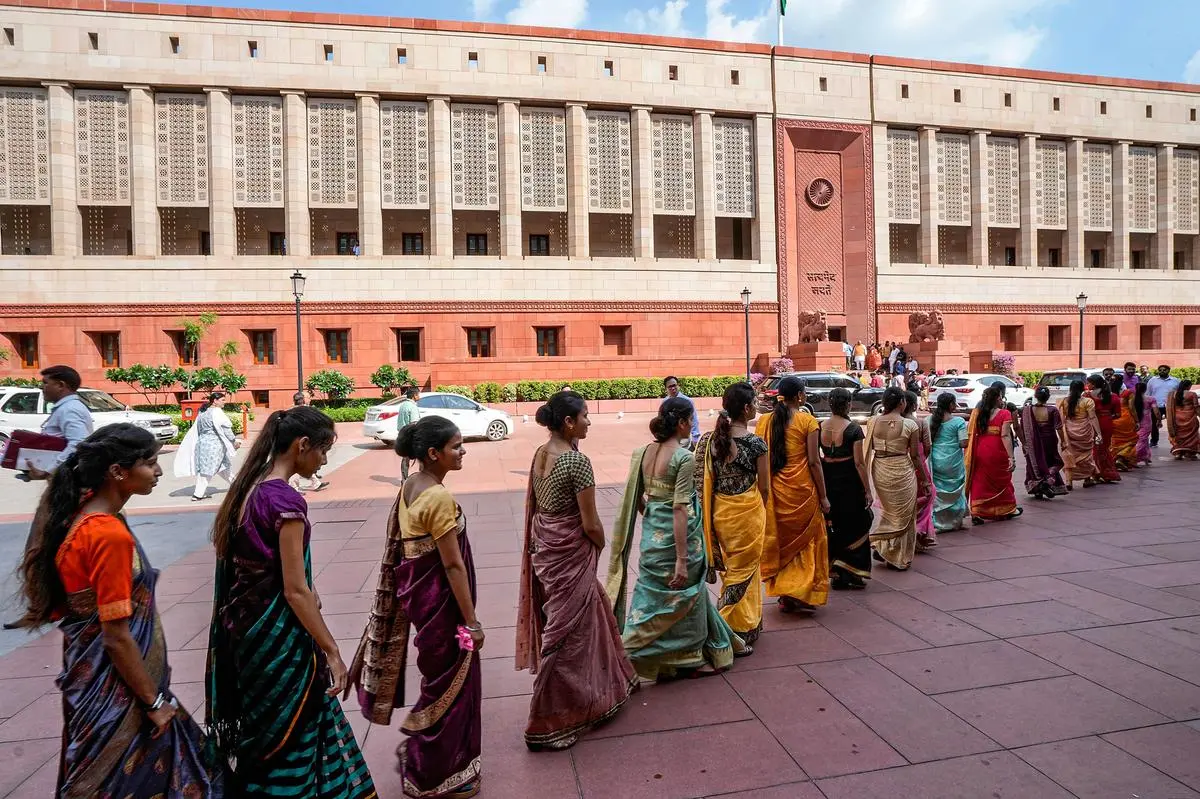
Women visitors enter Parliament House on the day of a debate on the women’s reservation Bill, during a special session on September 20, 2023. | Photo Credit: MANVENDER VASHIST LAV/PTI
Senior CPI leader Annie Raja, who has long been associated with the movement demanding women’s reservation, said: “If the Modi government was sincere about implementing women’s reservation, there would have been no conditions attached, such as census and delimitation. As things stand, there is no guarantee on when it will be implemented. The attitude of the government towards the issue is a deadly mix of patriarchy and ‘Manuvad’.”
She recalled that when the NDA had come to power in 2014, she had met the Prime Minister as a part of a delegation of the National Federation of Indian Women (NFIW) to demand that the women’s reservation Bill be passed immediately.
“From 2014 to 2023, the Prime Minister did not utter a word about women’s reservation. Suddenly, in 2023, a special session of Parliament was convened to pass the Bill. The real reason behind the government bringing the Bill in 2023 was that the Supreme Court had made strong observations against the government while hearing a petition filed by the NFIW seeking women’s reservation and indicated it could pass an order in the matter,” she said.
BJP’s ‘nari shakti’ plank
Meanwhile, women’s reservation already dominates the electoral discourse. It is expected to be the BJP’s main plank in the coming electoral cycle, including the crucial Uttar Pradesh Assembly election in 2027 and the Lok Sabha election in 2029.
A day after the Bills were defeated in the Lok Sabha, Modi addressed the nation. Launching a blistering attack on the opposition, especially the Congress, he said: “Parties like the Congress, DMK, TMC, and the Samajwadi Party have committed ‘bhrun-hatya’ [foeticide] by defeating the Bill on women’s reservation.”
In an apparent reference to women voters, Modi said: “A woman forgets everything but not her insult. This insult by the Congress and its allies will always remain in every woman’s heart... the women of our country will give a befitting reply to the Congress and its allies.”
According to Manindra Nath Thakur, an associate professor, Centre for Political Studies at Jawaharlal Nehru University, it is now clear that for Modi and the BJP, “nari shakti” will be the main election plank for the coming elections. He said: “Modi has taken a leaf from Nitish Kumar’s book, and wants to ensure the support of women in the Lok Sabha election in 2029. The Bills and the special session were all in preparation for that. The BJP has already reached out to women voters in recent years through its slew of welfare measures and cash transfer schemes.”
Thakur also said that the BJP has prepared a social base among women and groomed a leadership of women at the grassroots level. “They have learned from elections in recent years that they can mobilise women. In most States, women have emerged as a formidable voting bloc and have their own agency. Also, we can expect the BJP to field a greater number of women candidates in the next Lok Sabha election to bolster the ‘nari shakti’ slogan,” he added.
Political observers also believe that the Modi government was well aware that the Bills could not be passed. The main effort of the government, according to them, was to paint the opposition into a corner: if they supported the Bills, the Modi government would run away with the credit, and if they did not, the BJP could then describe them as “anti-women”. The political analyst Rasheed Kidwai said: “Modi is a clever politician. He knew that the opposition would never support the Bills. Clearly, there was a well-thought-out strategy behind the move. It was meant to corner the opposition, especially the Congress. The BJP is now calling the Congress anti-women. In the Hindi heartland States, it will tell the voters that the party did not allow an increase in seats for those States by opposing delimitation.”
Kidwai, who co-authored Missing from the House: Muslim Women in the Lok Sabha with Ambar Kumar Ghosh, said: “The Modi government’s own sincerity with regard to the women’s reservation issue can very well be questioned by critics, and the Bills that were brought in the special session can be analysed by us threadbare. But at the heart of the matter is the messaging for the woman constituency, whose growth has been tracked by many studies and which is playing a decisive part in elections.”
The messaging has already begun, but there is silence on when the reservation will finally be rolled out.
Also Read | When majoritarian march meets its first hard stop
Also Read | Coming up, a ‘Modi-fied’ republic