


The Central Bureau of Investigation’s latest response to former Delhi Chief Minister Arvind Kejriwal’s additional affidavit, filed in support of his plea seeking Justice Swarana Kanta Sharma’s recusal from hearing the CBI’s challenge to the trial court’s discharge of him and 22 others in the Delhi liquor policy case, contains a mistake.
And it is not a minor one.
In trying to dismiss Kejriwal’s argument as absurd, the CBI may well have ended up admitting to something far more damning about the state of India’s judicial culture.
For over a month now, the dischargees have sought Justice Sharma’s recusal from hearing the matter, advancing more than 10 grounds in its support. These range from the tone and tenor of her past orders involving AAP leaders, to her attendance at events associated with the RSS’ lawyer unit, Adhivakta Parishad, to concerns about her tearing urgency and unusual interest in this politically sensitive case when compared to her broader pattern of hearing.
This author’s March 2026 “Case In Point” column analysing 165 cases and Justice Sharma’s handling of her batch of similar matters, too, found mention among the materials relied upon by Kejriwal and others in support of recusal.
The latest controversy arose after a formal recusal application against Justice Sharma first came up on April 6, when she issued notice and permitted the CBI to file its response, if willing. On April 13, Kejriwal argued the matter in person. The next day, he filed an additional affidavit raising fresh grounds, one of them concerning the empanelment of Justice Sharma’s son and daughter on several Union government counsel panels, based on an exclusive report by this author on X.
Justice Sharma took that affidavit on record on April 16. On the same day, the CBI filed its counter written submissions.
The conflict-of-interest
On April 9, this author had reported, on the basis of RTI responses and public records, that Justice Sharma’s two children—Ishaan Sharma and Shambhavi Sharma—had been appointed by the Union government to multiple counsel panels, including, at various points, for the Supreme Court, the Delhi High Court, the Delhi Development Authority, and the Delhi State Legal Services Authority.
The post further noted that despite the daughter having only four years of enrolment as an advocate, she had already secured positions on the Union’s Group C panel for Supreme Court and Government Pleader panel for Delhi High Court. There are no transparent, fixed criteria for such empanelment—many lawyers with longer and stronger years of practice struggle to gain similar entry, that too with such a short career as lawyer.
The post also highlighted, on the basis of RTI responses from the Union Ministry of Law, that a substantial volume of government cases has been allocated to Ishaan Sharma over the past three years. The most senior law officers of the Union government, who are responsible for the allotment of such work, are the very law officers appearing before Justice Sharma in this politically sensitive liquor policy case.
The post stated that the issue was no longer confined to the courtroom and that, at the very least, there was a serious appearance problem and conflict of interest. That post, and Kejriwal’s subsequent reliance on it in his latest additional affidavit, have since become part of the public controversy around the recusal plea.
It is in response to this that the CBI has now made its extraordinary submission. It argues that if Kejriwal’s logic were to be accepted, then judges across the country whose relatives sit on government panels would stand disqualified from hearing cases involving those very governments or political leaders.
The CBI presents this as an absurd situation. But is that not precisely what ought to happen in a constitutional democracy?
A normalised culture
What is truly absurd is not the possibility of such recusals across the country. What is absurd is that such conflict of interest is so widespread that it has been normalised. That cannot serve as a defence in the present instance but is rather an indictment of it—and a deeply disturbing one at that.
If the CBI is, in effect, admitting that this pattern exists far and wide across the country, then it is a devastating confession about the state of our judicial culture.
For years now, the Indian legal system has normalised a culture in which overlapping professional relationships are treated as harmless background noise until an inconvenient litigant, lawyer, or journalist points it out. Only then does the system suddenly discover a vocabulary of institutional sanctity. There are, of course, honourable exceptions. But the broader culture has long been one of accommodation, silence, and later defensiveness.
That is what makes the CBI’s submission so revealing. What it frames as a threat to the judiciary may, in fact, be one of those accidental Freudian slips that lays bare the real scale of the problem and the urgent need for ethics and judicial reform.
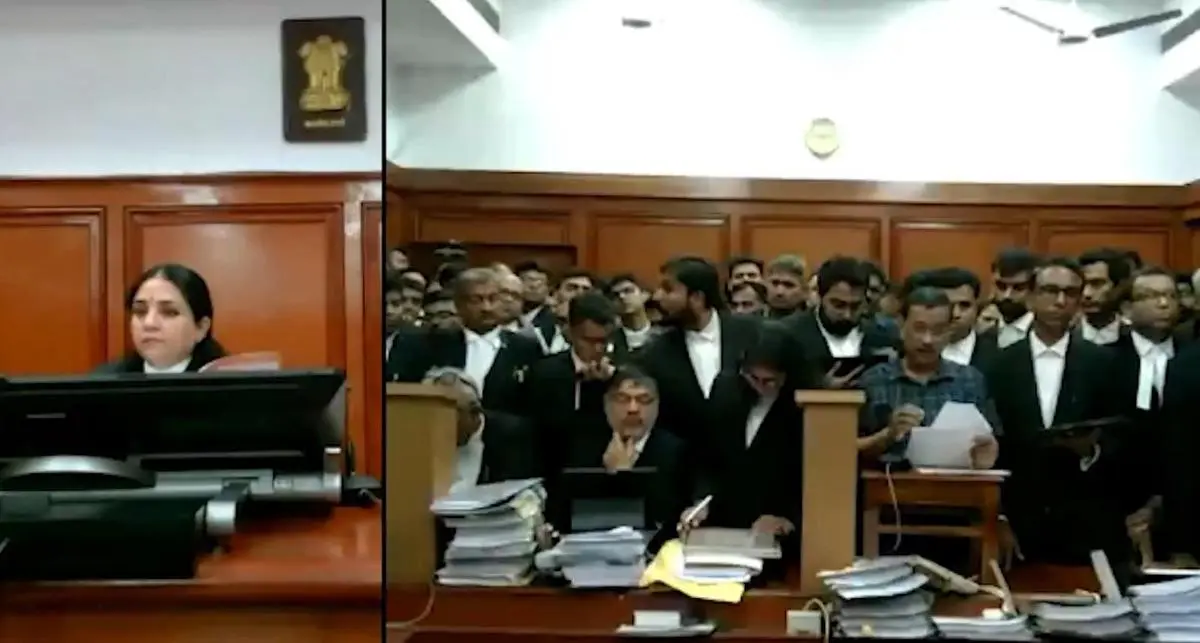
Arvind Kejriwal argues his case before Justice Swarana Kanta Sharma in the Delhi High Court on April 13, 2026. | Photo Credit: X-@SanjayAzadSln
The actual question is not complicated. It is whether Justice Sharma ought to have proactively disclosed, at the very outset, that both her children hold or have held several government panels and work within the same legal ecosystem whose top law officers are appearing before her in this case. Had that path of disclosure been adopted early, it might well have spared the judiciary this controversy altogether.
But that path was not taken. And, unfortunately at the cost of the institution’s image, the controversy has brought strong sunlight to shine on the well-kept secret.
Instead of disclosure, both Justice Sharma and the CBI appear to have chosen maximal resistance in a matter where the standards of perceived fairness ought to have been especially high.
In politically sensitive, hotly contested cases watched closely by millions in the public, the judiciary cannot be happy with mere subjective confidence in its own impartiality. It must also satisfy the obvious and objective standard of appearing to be detached to a case.
Need for urgent reform and for code of ethics
The issue, then, is not that every lawyer-relative automatically creates disqualification in every government case. Nor is it whether Justice Sharma’s children appeared in this very case—the CBI’s reply repeatedly suggests that they did not. The issue is narrower and more serious: whether the continuing and live professional engagements of a judge’s immediate family within the same broad legal structure of the government, held entirely at the pleasure of the government, require either prompt disclosure or withdrawal as soon as a case comes up before them.
That is the appearance question. And appearance, in law, matters because justice must not only be done, but be seen to be done.
This is precisely why the present controversy ought to force a larger institutional reckoning. The judiciary urgently needs a clear and enforceable code of ethics requiring judges to disclose any past or present personal, familial, or professional linkages, whether of their own or of their immediate relatives, to any government, authority, agency, or party appearing before them.
Such a code cannot be left to private conscience, informal convention, or selective sensitivity. It has to be structured, written, and mandatory. The present code of ethics titled “Restatement of Values of Judicial Life” adopted by the Supreme Court in 1997, requires a judge, at point number 7, to “not hear and decide a matter in which a member of his family, a close relation, or a friend is concerned.” This code ought to be revisited and expanded.
The new code need not require immediate and automatic recusal in every such case as Justice Sharma’s. That would be both impractical and overbroad. But it must, at the very least, require disclosure at the very first hearing. The judge should place the relevant facts on record, inform the parties openly in court, and permit them to indicate whether they would seek recusal on that basis. The decision thereafter can be taken in accordance with settled legal principles, but the first obligation must be transparency.
For instance, if Justice ABC’s son is a current empanelled counsel for the DDA, and the DDA appears as a party in a matter before that judge, Justice ABC ought to disclose that fact at the outset. If one or more parties express discomfort and seek recusal, that request must either be immediately accepted or be considered in a fair hearing with the seriousness that appearance-based justice demands.
This is not an extreme standard. It is the bare minimum expected of a judiciary. It is what Justice Sharma ought to have done the moment the CBI’s challenge came up before her. What is rather remarkable, sadly, is that such a basic norm has to be argued for.
In the end, this is not a story about whether one tweet changed a case but a story about what happens when public records shine a bright light on the informal architecture of power.
The CBI’s admission that Justice Sharma’s children routinely hold government work while politically charged matters involving the government are heard by her as though such overlap is of no consequence, more so when the children’s employer arrives before the parent, is concerning. It lies in the fact that the agency’s answer to that possibility is not transparency, but theatrical insinuation of what it calls an “online vitriolic campaign” against Justice Sharma.
But one ought to thank the CBI for perhaps admitting that this Judge-Relative-Government Panel business is not isolated to the Kejriwal case but is actually a structural flaw that the judiciary needs to address immediately with an enforceable code of ethics and voluntary disclosures.
In that sense, the CBI’s counter is right in one aspect: this recusal case is indeed a “test case”. Just not in the way the CBI intends it to be.
Saurav Das is an investigative journalist writing on law, judiciary, crime, and policy.
Also Read | My DNA is against the BJP: Kalvakuntla Kavitha
Also Read | The scam story: When proof rests in the polls