


惯性聚合 高效追踪和阅读你感兴趣的博客、新闻、科技资讯
阅读原文 在惯性聚合中打开

推荐订阅源

Simon Willison's Weblog
T
Troy Hunt's Blog
L
Lohrmann on Cybersecurity
S
Schneier on Security
Spread Privacy
Spread Privacy
WordPress大学
WordPress大学
阮一峰的网络日志
阮一峰的网络日志
freeCodeCamp Programming Tutorials: Python, JavaScript, Git & More
让小产品的独立变现更简单 - ezindie.com
G
GRAHAM CLULEY
博客园 - 【当耐特】
有赞技术团队
有赞技术团队
SecWiki News
SecWiki News
博客园 - 叶小钗
博客园 - Franky
V
Vulnerabilities – Threatpost
奇客Solidot–传递最新科技情报
奇客Solidot–传递最新科技情报
O
OpenAI News
小众软件
小众软件
V
V2EX
N
News and Events Feed by Topic
T
The Exploit Database - CXSecurity.com
博客园 - 三生石上(FineUI控件)
The Hacker News
The Hacker News
Project Zero
Project Zero
The Last Watchdog
The Last Watchdog
雷峰网
雷峰网
Google Online Security Blog
T
Tailwind CSS Blog
C
Cyber Attacks, Cyber Crime and Cyber Security
Exploit-DB.com RSS Feed
量子位
D
Docker
Recent Announcements
T
Threat Research - Cisco Blogs
P
Privacy International News Feed
爱范儿
爱范儿
PCI Perspectives
PCI Perspectives
Jina AI
Jina AI
博客园 - 司徒正美
云风的 BLOG
云风的 BLOG
大猫的无限游戏
大猫的无限游戏
V2EX - 技术
V2EX - 技术
H
Hackread – Cybersecurity News, Data Breaches, AI and More
The Register - Security
T
The Blog of Author Tim Ferriss
博客园 - 聂微东
Cloudbric
Cloudbric
S
Security Affairs
F
Fortinet All Blogs

Latest Politics News | Frontline | Frontline

BJP turns Women’s Reservation Defeat into a New Campaign Plank in Uttar Pradesh Dantewada Cricket Event and India’s “Post-Maoist” Claim Maharashtra’s Sugar Mills Face a Deepening Economic Crisis Election Commission Bias in West Bengal Polls 2026? Tamil Nadu election 2026: Cash-For-Votes and Missing Voters One Year After Pahalgam: Violence, State Response, and Kashmir Narrative Tamil Nadu Assembly Election 2026: Why the Unattached Urban Voter Holds the Key in a Waveless Contest West Bengal Election 2026: Kudmi, Adivasi, Matua Identity Politics Explained When majoritarian march meets its first hard stop Will Didi prevail over Delhi? What Nithin Raj’s death says about caste in Kerala’s private colleges West Bengal election 2026: Identity politics, vote banks, and the BJP vs Trinamool battle Exclusive interview | Tamil Nadu Chief Minister M.K. Stalin talks about Assembly election 2026, fiscal authoritarianism, and the fight for federalism Women’s Reservation Bill 2026: Modi’s Delimitation Trap Exposed What was wrong with BJP's so-called Women Reservation Bill J&K liquor controversy explained: Tourism, revenue, and politics | The Kashmir Notebook Ep 13 Delhi Pink Saheli Card 2026: Domicile Rule Hurts Women Manipur’s Rumour Economy: How Disinformation Fuels Mob Violence Punishing the South: Modi’s Delimitation Plan and the Politics of Control The Vijay Factor AIADMK Delta Strategy: Can Leema Rose Win? Maharashtra Shows Why Women’s Reservation May Aid Elites CBI Reply in Kejriwal Case Exposes Judicial Conflict Norms Tamil Nadu Election 2026: Social Media Narratives, War Rooms, and Players Modi’s Roadshow and BJP’s High-Stakes Push in South Tamil Nadu SIR West Bengal Voter Exclusion Case 2026 TN Assembly Polls 2026: Senthil Balaji and SP Velumani Clash for Western Belt Supremacy Women’s Reservation Act Amendments Raise Delimitation Fears Partha Chatterjee’s For a Just Republic and the Limits of the People-Nation Hungary Election 2026: Orbán Defeated, Magyar Wins Big Free Speech Crackdown in India: Is Dissent Under Threat? Ambedkar Jayanti and the New Publicness of Protest Politics Implementing Women’s Reservation: Why a Hybrid 651-Seat Lok Sabha Model Outperforms Mass Expansion Ambedkar and Free Speech: Who Controls Dissent in 2026? Reforming Tamil Nadu's Local Governance: Why MLAs Aren't Fixers in 2026 West Bengal voter list controversy explained | Why names are being deleted Will Vijay’s TVK disrupt DMK and AIADMK? | Tamil Nadu election 2026 Constitutional Morality vs Social Morality in India 2026 Amit Shah’s Anti-Conversion Promise Opens a New Faultline in Punjab Politics Why Indian Shias Protest for Iran: History of Solidarity (2026) West Bengal Voter List Row 2026: “Votercide” Debate From Grief to Politics: Porkodi Armstrong and the Battle for Dalit Power in North Chennai West Bengal election 2026: Will Babri Masjid split the Muslim vote? West Bengal Communal Politics and the 2026 Election Battle Raghav Chadha-AAP Rift Explained: Rise to Fallout (2026) Why India Is Not Energy-Secure Amid Global Oil Shocks India IT Rules 2026: Threat to Free Speech? Iran War Ceasefire Signals a Shift Toward Multipolar Deterrence 2026 Assembly Polls: Congress vs BJP Power Test Kerala Assembly Election 2026: LDF Anti-Incumbency vs UDF Momentum Gujarat Local Polls: AAP Rise Deepens Congress Crisis SIR controversy deepens fear of Muslim disenfranchisement in Bengal Kerala Election 2026: LDF, UDF, and the BJP “B Team” Charge Who will win Kerala Assembly Election 2026? LDF or UDF? Assam Polls: Cash Transfers Mask Stagnant Incomes and Job Distress Jaishankar and India's Diplomacy Crisis After Nitish Kumar, Bihar BJP faces its biggest test: caste coalition without a ‘Mr Clean’ Actor Vijay and Politics: An Emerging Landscape N Rangasamy’s 2026 Puducherry Poll Strategy and Power Play Kashmir Encounter Killing Sparks AFSPA Debate 2026 GST Federalism Crisis 2026: How States Lost Fiscal Power US-Iran War 2026: Petrodollar Stakes Behind Hormuz Clash White Savior Complex in Arab Regimes Drives Ukraine Deals Not Self Reliance UPA Corruption Narrative vs Court Verdicts 2026 Mathur Sathya Case Exposes Patriarchy in Progressive Politics India Needs a New Economic Model Beyond Neoliberalism Why J&K MLAs Are Fighting the Lieutenant Governor Over Security Puducherry election 2026: Can Congress return to power? | V. Narayanasamy explains Pawar Family Rivalries Stall NCP Factions Merger in Maharashtra How Foreign Thinkers Shaped Hindutva’s Rise Naxalism’s Shift: Armed Struggle to Ideological Influence G. Haragopal on Tribal Resistance, Maoist Surrenders, and Politics DMK manifesto 2026: Key promises, alliances, & welfare politics Rajya Sabha Polls Expose India’s Open Secret: Cross-Voting and Poaching State Assembly Elections 2026: How Voter Dynamics Are Shaping India DMK Seat-Sharing Deal Reveals a Tougher M.K. Stalin What Iran Means to Kashmir | War, Identity, and 5000 Years of History Thirumavalavan Signals Shift in Tamil Nadu Politics Golgappa diplomacy and the fragile reset in India-Bangladesh ties Tamil Nadu election 2026: DMK vs AIADMK, alliances, and Vijay’s entry Is Indian Cinema Losing its Moral Voice? How the BJP’s strategic pivot on delimitation and women’s quota will reshape the 2029 electoral landscape Why INDIA Bloc Collapsed in Puducherry | DMK, Congress & VCK Rift Explained West Bengal 2026 Assembly Elections: Candidate Controversies Stir Party Rebellions Tamil Nadu Elections: CPI(M) on DMK Alliance & BJP Fight Ashok Kharat Scandal Exposes Maharashtra’s Godman–Power Nexus India Migration Crisis: Gulf Conflict Exposes Gaps 2011 Election Petition Against Stalin Returns Ahead of Tamil Nadu Election Delhi Budget 2026: Growth Claims and Welfare Gaps Tamil Nadu NDA Deal Reveals AIADMK’s Upper Hand Inside AIADMK Strategy: EPS Leadership, BJP Alliance, and TVK Challenge Vijay Politics: Can TVK Break Tamil Nadu's DMK AIADMK Duopoly? How Eid went under siege in Uttam Nagar Assam Elections 2026: BJP Faces Tribal Backlash Over Evictions in Karbi Anglong First Impeachment Notice Against India’s CEC Shakes Politics 2026 Hindu Rashtra Debate: 2026 State Elections Test Secular India Tamil Nadu Election 2026: How Gender and Gen Z Voters are Reshaping the Dravidian Power Struggle Maharashtra’s Anti-Conversion Bill and the Politics of 'Love Jihad' Post-Colonial Nationalism and the Western Far Right: Why the Comparison Fails Gujarat's proposed marriage registration amendment 2026 polices choice
West Bengal Tribals and BJP’s Sweep: The SIR Factor (2026)
2026-05-05 · via Latest Politics News | Frontline | Frontline

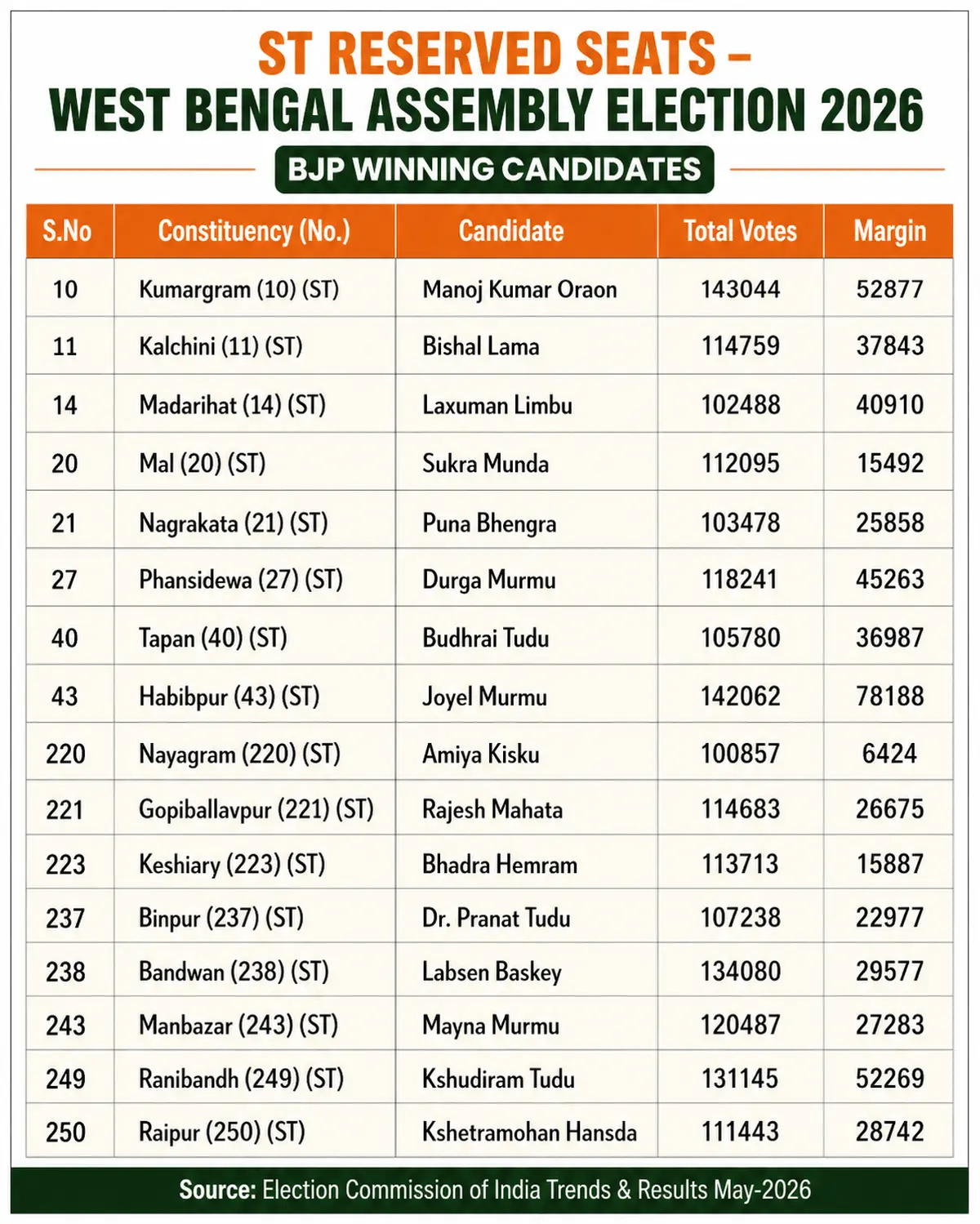
In a year coinciding with the 125th birth anniversary of Shyama Prasad Mukherjee, West Bengal has witnessed a historic realignment of its political map. After 15 years, Mamata Banerjee’s tenure came to an end and the focal point for the saffron storm was not merely the urban centres, but also the thick Sal forests of the 16 Scheduled Tribe reserved seats. At first glance, the BJP’s 100 per cent victory in these seats appears to be emblematic of a major shift from welfare politics to the dominance of administrative and identity issues. Even more importantly, it seems indicative of a change in the position of tribal communities from beneficiaries of welfare politics to politically minded actors.

One important reason for the election result is what can be described as the “27 lakh population paradox”. Although the 2011 Census counted some 5.2 million Scheduled Tribes, the latest administrative figure showed about 8 million tribes only, which amounts to a disparity of nearly 2.7 million tribes. Tribal groups read the situation as an attempt to weaken the community’s ST status through the issuing of fake certificates, which caused anxiety about identity security and led to strong demands for certificate verification, particularly among young people in Bankura and Paschim Medinipur.

The suspicion that the government’s administrative machinery was facilitating this process for vote-bank considerations added further to the mistrust. Against this backdrop, the BJP’s offer of a Special Intensive Revision (SIR) scheme to “detect and delete” such false entries offered voters an institutional solution to what they saw as a life-and-death issue of identity protection.

There were also some internal changes that took place in tribal politics, which impacted the results. With the emergence of leaders like Ajit Prasad Mahato and the formation of equidistant politics, the idea of tribal loyalty in Junglemahal began to decline. For instance, in constituencies like Gopiballavpur and Manbazar, the fragmentation process helped voters transcend old affiliations. At the same time, changing relations between the Kurmi and the Santhal altered political ground realities.

The change in voter preference was evident in the election results in Binpur, in which Pranat Tudu triumphed over Birbaha Hansda. This signified that there was a move away from mere symbolism (the question of recognition to the Sarna Code) to more concrete issues related to identity such as employment opportunities, education, and legitimate ST status.

In parallel, the deterioration in educational facilities became another structural pressure factor. There was a reported fall in the number of tribal hostels from 1,000 to 300, limiting access to schooling for first-time students in far-off locations. Further, the Utsashree scheme worsened the situation by facilitating the relocation of teachers to cities, leaving so-called “teacherless villages” behind. This gave rise to a generational revolt: tribal youth, especially those aspiring to join secondary education institutions and colleges, emerged as a political mobilising force. Gradually, they came to realise that welfare schemes such as Lakshmi Bhandar were merely stop-gap arrangements that provide relief but were not adequate for empowerment, which includes effective schools, hostels, and efficient teaching systems.

The dignity issue

The issue surrounding President Droupadi Murmu’s protocol that played out in March turned out to be a critical emotional juncture that moved the electoral debate away from issues of welfare to those of dignity and representation.

The controversy erupted when the venue of the presidential visit was switched from Bidhannagar to Gossainpur, which is more distant than the first location. Moreover, Murmu’s statement: “Is Mamata (my younger sister) angry with me?” coupled with the fact that no high-ranking State government representatives were there to officially welcome Murmu made the situation even more serious.
What made it a political issue was not only the State versus Centre conflict, but also the “national versus regional” dignity issue. Indeed, for the tribes, Droupadi Murmu is a “daughter of the soil”, not just a constitutional office holder. In the case of the Santhal, Oraon, and Munda, in particular, it resulted in creating an “identity dignity response”.

The outsider-insider question

The BJP campaign saw a deliberate change in positioning from being labeled as a “party of North India” to positioning the party within the local culture and politics of West Bengal. The BJP’s leaders were seen interacting with the local culture by visiting Thanthania Kalibari, showing a willingness to connect with Bengali culture and religion instead of projecting an outsider image. At the same time, the positioning of Suvendu Adhikari in the region proved to be effective in overcoming the outsider-insider dilemma.

SIR and high turnout

With regard to the electoral rolls, the Special Intensive Revision (SIR), which marked out over 9.1 million names, turned out to be a mobilisation driver, especially in the tribal constituencies.

Here, the SIR was not seen as a mere administrative function; rather, it was seen as a form of “purification mechanism” linked closely with identity protection. The threat of exclusion along with the worry regarding “fake” entries led to a process that can be referred to as reverse-polarisation mobilisation. This led to tribal migrants coming back to their constituencies to protect their electoral identity, resulting in a remarkable turnout rate of 92.47 per cent.

National implications

The victory in Bengal has wider ramifications than State politics alone, with significant geopolitical and ideological implications. From a geopolitical point of view, the BJP win will fortify India’s eastern corridor of governance, running right up to the border of Bangladesh via the Siliguri Corridor (also known as “the Chicken’s Neck”). This will increase connectivity between mainland India and its northeastern States while at the same time including tribal-majority areas within the governance structure of the nation. Ideologically, the Bengal victory takes on special significance in light of the 125th birth year of Shyama Prasad Mukherjee, for which the Ministry of Culture has launched a two-year commemoration.

The mandate in this belt signifies a paradigm shift in the tribal political mindset. It appears to have been motivated not only by charismatic leadership or ideological compatibility, but rather by the convergence of three factors:

• Cultural recognition (illustrated by the Murmu incident)

• Security of identity (fake tribal certificates, SIR)

• Empowerment issues (schools, dormitories, teachers)

It seems to indicate that tribal voters might have ceased to see themselves as only recipients of welfare programmes and more as stakeholders seeking recognition, participation, and development.

Vishal Tiwari is a senior research fellow at Dr Harisingh Gour Central University, Madhya Pradesh.

Also Read | For the ECI, why are some States more equal than others?