





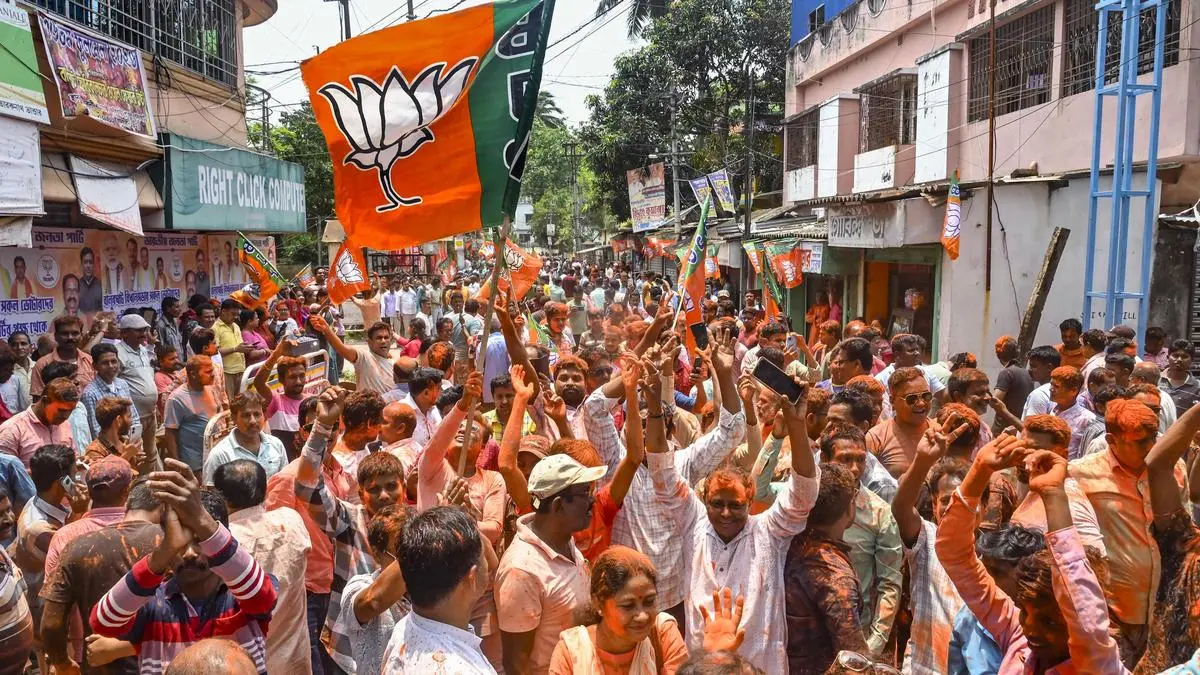
The BJP’s landslide victory in West Bengal has surprised many. While a section did believe that the party would win, what seems to have surprised several others is the extent of the victory—207 seats with a 45.8 per cent vote share. The landslide victory, however, should not be a surprise. Since the 1972 Assembly election, Bengal has had a history of giving landslide victories to the winning party, barring a few exceptions.
The winning party has always won by a substantial margin both in terms of seats and vote share. If we look at Assembly election data since 1972, we see that the proportion of seats won by the ruling party has mostly been above 50 per cent, barring the 2001 election when the Communist Party of India (Marxist), or CPI(M), won 49 per cent of the seats.
The 1972 election, which was held for 280 seats, saw the highest percentage of seats won by the Congress at 77 per cent (Table 1). Since then, the victory sweep was in the 50-60 per cent range until the 2016 Assembly election. Since 2016, the percentage of seats won has been in the 70 per cent range, with 72 per cent in 2016 and 73 per cent in 2021, both won by the All India Trinamool Congress. Now, we have the BJP with 70 per cent seats in the 2026 Assembly election. The pattern points to a long-standing tendency in Bengal’s politics towards decisive electoral mandates.

How did the BJP manage to secure such a massive victory and nearly match the previous government in terms of the proportion of seats won? There has been talk about the deletion of names from the voters list after the Special Intensive Revision (SIR) having played a role in the BJP’s big win. Others believe that a strong anti-incumbency attributed to the Trinamool’s mis-governance as one of the main reasons. Some others believe that the poor law and order situation was a reason behind the Trinamool losing women’s votes.
A glimpse at how political parties campaigned makes it clear that the parties picked up various issues to mobile voters towards their fold, but the big narrative on which the Trinamool contested was the issue of “Bengali identity”, while the BJP pitched the election on “development and parivartan (change)”. Data from Pollsmap, an independent polling, survey and research firm, suggest that the issue of development caught the attention of voters much more than the issue of Bengali identity.

Evidence suggests that for nearly 50 per cent of the people, development was the bigger issue compared to identity. Only around 15 per cent identified Bengali identity as a main issue, while about a quarter said both issues mattered equally (Table 2). For much of the campaign, Trinamool leader Mamata Banerjee portrayed the election as a fight to safeguard Bengal’s cultural identity and culture from the “outsider” BJP. However, this narrative did not resonate strongly enough. The evidence suggests that development was instead the important factor, with 53 per cent of respondents indicating that development of Bengal was their prime concern.

Voters from the poorer and lower economic classes were found slightly more likely to say that protecting Bengali identity resonated (Table 3). In contrast, the issue of development found support across all sections of society, with the strongest support from voters belonging to the more affluent classes.
Education levels also shaped preferences on this issue. Less educated voters were more likely to consider Bengali identity as more important than development (Table 4). While nearly three in 10 non-literate voters said that protecting Bengali identity mattered more, the figure sharply declined with higher levels of education, falling to around 12 per cent among college-educated voters. In contrast, support for development over Bengali identity showed a reverse trend, becoming more important as education levels increased.

Across age, gender and locality, development was consistently preferred by voters, with high levels of agreement across groups. In contrast, there were no significant differences in the importance assigned to Bengali identity across these categories. Bengali identity has long been projected by the Trinamool as central to Bengal’s politics, but this time, voters appeared to place greater importance on development and governance.
Sanjay Kumar is an election analyst and psephologist.
Vibha Attri and Arindam Kabir are researchers with Lokniti-CSDS.
The views expressed by the authors are their individual views and do not reflect the views of any institution.
Also Read | Bengal’s violent transition into a new political era
Also Read | A closer look at Bengal’s tribal mandate