


The outgoing Chief Minister of Tamil Nadu, Thiru Mu.Ka. Stalin, is furious—as much at the Narendra Modi government’s inability to understand the south as at the Prime Minister’s gross betrayal of recent promises. This is principally because the BJP is politically dominant only in the populous north and west; it is scattered or ineffective in pockets in the south, east, and far north—Punjab, Himachal Pradesh, and Kashmir—and shaky in the ethnically/religiously diverse north-eastern States.
More than even than the BJP/Modi obsession with the heartland of Hindutva, what has infuriated the Tamil Nadu Chief Minister is the betrayal by the Prime Minister of his Home Minister’s much-touted assurance that expansion and delimitation of seats in Parliament would not diminish the ratio of southern seats to northern seats.
This assurance is signally absent from the constitutional amendment moved by the Central government. It indicates that population alone will be the single criterion. This, as Stalin points out, amounts to punishing States that have contributed to the national good and rewarding with disproportionate political power those States that have dragged the metrics down.
Why such mischief that threatens national unity and emotional integration? Only because the States where the BJP has established a vice-like grip are those in which caste and religion, and not development and social justice, drive politics. To illustrate this, see the map which paints in red those States that are poor and suffer slow growth. You will notice that the States in red are principally those where the BJP and Hindutva dominate.
The map is based on the findings of the Empowered Action Group (EAG) to reveal the growing regional gaps in economic growth and social development. The States in red are called EAG States as their backward status has been certified by the EAG.
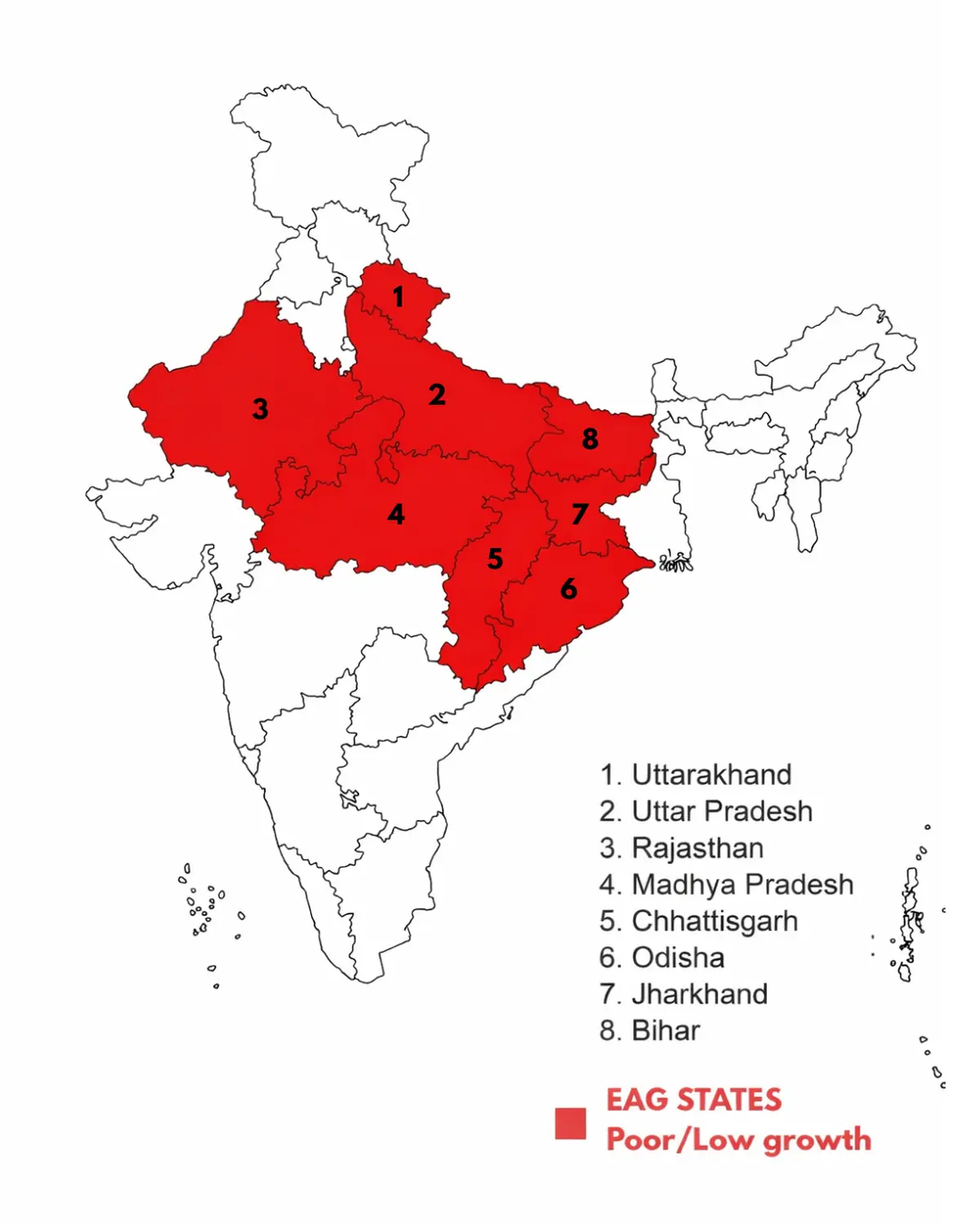
A map of EAG States | Photo Credit: Rumaan Mecci
The non-EAG states, left white, are those that have performed well on indices of both development and social equity. Led by Tamil Nadu, closely followed by Karnataka, Kerala, Andhra Pradesh, and Telangana, their growth model has been based on human development indicators like education and health and a sound panchayat raj, leading to fast and inclusive growth through inclusive governance and not on the politics of caste and religious identity, as in the EAG States.
Maharashtra is the outlier because it has grown fast despite being a bastion of Hindutva, but that is principally because Mumbai has historically been the powerhouse while the rest of the State, with some exceptions, lags. The Gujarat model has been sullied by extreme communal discord.
Of course, the non-EAG States wrestled in the past with questions of caste and, to a much lesser extent, with questions of religious identity. But, after the struggle, they put old questions behind them and embarked on the exciting new venture of ending poverty, ushering in human development, and promoting high rates of economic growth, while the EAG States have floundered in the mire of the divisive politics of caste discrimination and the propagation of communal discord.
How Tamil Nadu stands out
Tamil Nadu is an outstanding example of leaving behind the politics of caste and creed: they even elected me three times despite my surname. It has focused on human development as the foundation of fast growth with social justice. The non-EAG States are the States of the 21st century. The EAG States are mired in a dead past. That is the root cause for the south generally being so far ahead of the north.
Tamil Nadu’s State GDP growth at 11-12 per cent per year is double the national average and several multiples above Uttar Pradesh and Bihar. That is changing but it will be at least two decades before the Ganga and Narmada basins catch up with the basins of the Krishna-Godavari-Tungabhadra and the Cauvery-Vaigai basins. Indeed, while the southern basins soar to heights that rival the Asian Tigers of South-East Asia, the northern basins languish at sub-Saharan levels. Tamil Nadu might even rival China in the not-too-distant future. Yet, it has thrown in its lot with India that is Bharat. That link is being severely strained by the census and delimitation policies of the Modi government.
Apart from identity politics, what is it that distinguishes the south, broadly speaking, from the north? Undoubtedly the growth models adopted by the two regions over the past half century and more. The south began with human development—voluntary population control backed by education, incentivised through mid-day meals and now breakfast for schoolchildren, to impart literacy, education, skills and forward-looking attitudes to its children and youth, without discrimination of gender, caste or creed, to every child and young person. They broke past caste barriers and never wasted time or breath on religion-based quarrels.
They then ensured a smooth transition from the field to the factory, using renewable energy, particularly wind power, to fuel the transition. In consequence, there was little social disruption or environmental damage as Tamil Nadu became one of the country’s most advanced States. Above all, there was remarkable political stability and policy continuity despite democratic changes of government. Moreover, while political battles were fierce, the economic, social, and cultural life was stable. State pride in regional history, language, and culture was promoted as good in itself, not in opposition to rival faiths, rival languages, rival cultures, nor as a quest for dominance that animated the EAG States.
Thus, Tamil Nadu has transformed itself from being merely the rice bowl of the south into a throbbing centre of manufacture and information technology (IT). Its automobile industry is so advanced and export-oriented that its capital Chennai has been labelled the Detroit of India. A car of any international make, driven in New York, Paris or London, is more likely than not to have been manufactured, and not merely assembled, in Tamil Nadu. Electronic items like cell phones are as likely to have originated from Tamil Nadu as from Guangzhou in China.
An IT wizard, whether based in the Silicon Valley or India, is likely to be from Chennai, Bengaluru, Hyderabad or someplace else in the south. Southern labour, trained, skilled, and properly oriented, whether in south India or the Gulf or Singapore or anywhere else in the world, is efficient and disciplined.
Export orientation has been assured by industrial hubs, export parks and railway lines, expressways, and communication links connecting manufacturing centres to seaports and airports. Efficiency of delivery that matches the highest international standards is assured to ensure lower transport costs by lowering turnaround times and connecting by sea and air to destinations in Asia, Australasia, Africa, Europe or North and South America.
That is the outcome of laying human development as the foundation of economic diversification and growth: a skilled, trained workforce of men and, above all, women who take to modern technology like fish to water. The last four decades of spectacular economic performance grew out of the previous three decades of patient building of human capital.
Hindutva threat
Yet today, New Delhi is posing a fearful threat to Chennai and other growth capitals: either allow Hindutva to continue in political power or face progressive exclusion from national decision-making. This is truly a make-or-break moment. Is there any hope of Narendra Modi matching up to the occasion—or will he continue being a divisive, disintegrative force, bullying his opponents to hang on to personal power?
His principal challenger, Mu.Ka. Stalin, has made him a peace offer: amend the Constitution to make it more federal. Modi has responded by further drifting from cooperative federalism to strengthening the Union’s role at the expense of State rights. Will Modiji unite the country by making it more federal or will he concentrate more and more power in his own hands like his fellow megalomaniacs, Donald Trump and Benjamin ‘Bibi’ Netanyahu? That is the question.
Mani Shankar Aiyar served 26 years in the Indian Foreign Service, is a four-time MP with over two decades in Parliament, and was a Cabinet Minister from 2004 to 2009.
Also Read | Tamil Nadu is BJP’s toughest test against cultural uniformity
Also Read | Coming up, a ‘Modi-fied’ republic