








The Indian Foreign Service (IFS), which is mandated to handle all aspects of India’s external relations, will mark 80 years of its establishment on October 9 this year. The Ministry of External Affairs’ (MEA) official website currently notes this about the IFS’ creation and the ministry’s formation:
“In September 1946, on the eve of India’s independence, the Government of India decided to create a service called the Indian Foreign Service for India’s diplomatic, consular and commercial representation overseas. In 1947, there was a near seamless transformation of the Foreign and Political department of the erstwhile Indian government into what then became the new Ministry of External Affairs and Commonwealth Relations and in 1948 the first batch recruited under the combined Civil service examination system of the Union Public Service Commission joined the service. This system of entry has remained the staple mode of intake into the IFS to this day.”
These lines were originally the concluding paragraphs of a seven-paragraph “backgrounder” that was available on the website. On the morning of April 27, the first five paragraphs preceding them were dropped. What did the deleted paragraphs contain?
The opening sentence had asserted that the IFS’ origin “can be traced back to the British rule when the Foreign Department was created”. It had attributed this decision to 1783, with the reason being to “relieve the pressure” on Governor General Warren Hastings’ administration in conducting its “secret and political business”. The Foreign Department was later renamed the Indian Foreign Department. In 1843, Governor General Ellenborough organised the Secretariat into four departments, one of which was the Foreign Department. The Foreign Department Secretary was entrusted “with all the correspondence belonging to the external and internal foreign relations of the government”.
The backgrounder then jumped almost a hundred years to the situation after 1935 when the department’s political and foreign wings were bifurcated and an “External Affairs Department was set up separately under the direct charge of the Governor-General”.
Why were these paragraphs on the MEA website describing the apparent origins of the IFS abruptly dropped? Any material uploaded on the ministry’s website is carefully vetted. Should it be concluded, then, that the MEA’s political and diplomatic leadership had earlier been of the view that the IFS’ origin lays in the administrative structures of the East India Company and later the British Raj? If that had been its considered opinion, why did it not hold on to it? These are questions the MEA’s political head should answer, especially because he was himself a distinguished IFS officer who rose to be Foreign Secretary.
There is a section of IFS members who believe its origin goes back to the East India Company and the British Raj. This is not my view. I also believe that this view is not subscribed to by a majority of IFS members, retired and serving. According to the latter section of officers, the IFS was established in 1946, conceived as Independent India’s diplomatic instrument. There had been no service or administrative structure of the Company or the Raj that performed the diplomatic functions the IFS was mandated to do. Hence, to seek its origin in 1783 is incorrect.
What did the Foreign Department in its various iterations handle? Until 1935, it carried out three separate categories of work: (i) indirect control of the Indian princely states through Residents, (ii) direct administration of the North-West Frontier, and (iii), as noted by Terence Creagh Coen in his book The Indian Political Service, it “provided the quasi-diplomatic and consular representatives of the Government of India… certain posts in countries outside India”.
The princely states were integrated into the Union under the leadership of Sardar Vallabhbhai Patel after Independence. With this, residual matters relating to them naturally came within the domain of Independent India’s domestic services and administrative structure: initially, the Ministry of States and, from 1955, the Home Ministry. The IFS had nothing to do with these matters or with the other task the department had handled: administering British India’s North-West Frontier. The only functions where the IFS and the Foreign Department can be said to have a tenuous connection is in the latter’s role in manning British India’s quasi-diplomatic and consular posts “outside India”.
Such posts had been in both British India’s peripheries and in distant lands. Towards the west, they stretched from Aden on the mouth of the Bab-El Mandab to the Trucial States to Iran and Iraq. In the north and north-west, they were in Afghanistan and in Xinjiang. Besides, they were also in the Himalayan principalities and in Tibet.
In the 1940s, Agents-General were appointed in the US and China, with the latter having an officer of the External Affairs Department but not the former. These quasi-diplomats were appointed as a mark of greater devolution of authority to Indian hands.
The demands on the quasi-diplomatic officers posted in the western neighbouring states were largely to safeguard British interests along the land routes leading to India and also concerned issues such as slavery abolition and piracy. Officers who dealt with Tibet and China in the late 19th and early 20th centuries also managed India’s border with Tibet. The legacy of their decisions has been felt by Indian diplomats since Independence. However, this cannot lead to the conclusion that the IFS’ origin traces back to 1783! Indeed, as Coen perceptively notes, the work of the officials was “far removed from mere diplomacy”.
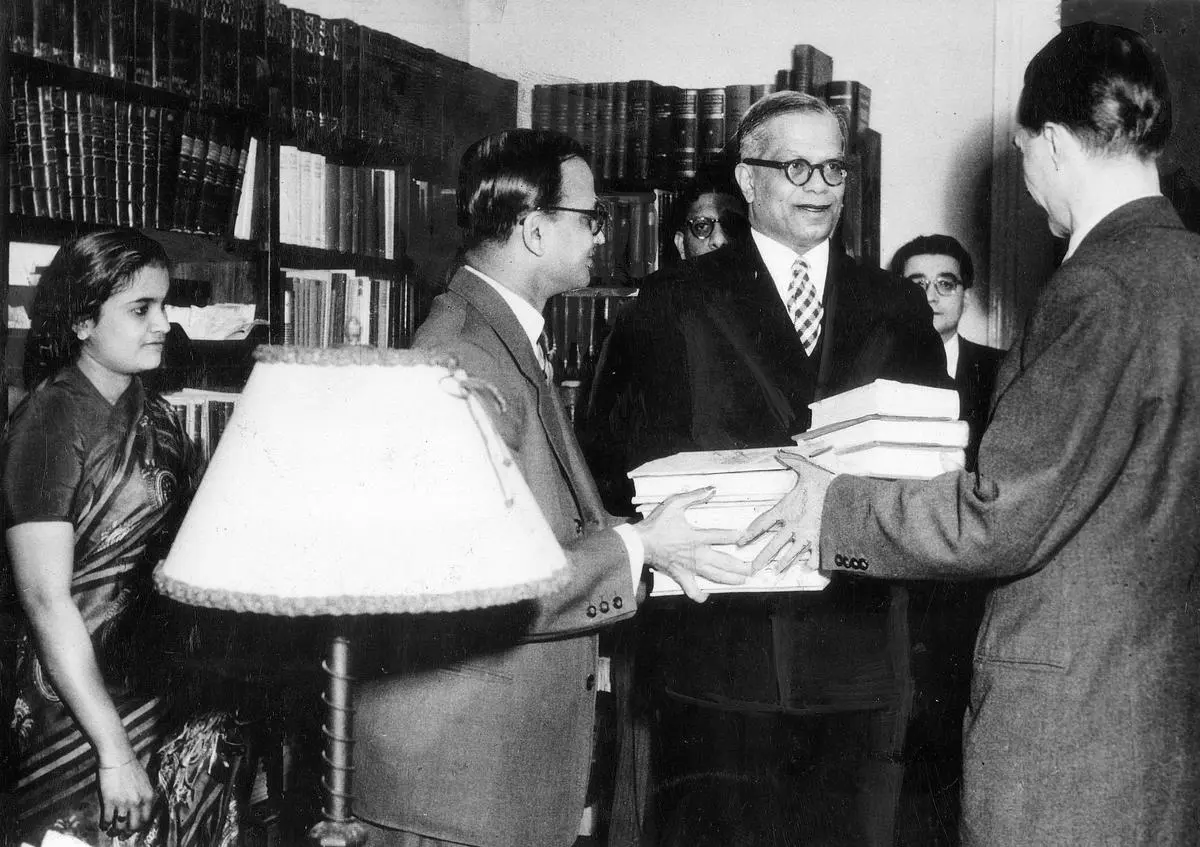
April 1, 1954: K.P.S. Menon, Indian Ambassador to the Soviet Union who was concurrently accredited to Poland and Hungary, presenting six volumes on the life of Mahatma Gandhi on behalf of the Mahatma Gandhi Memorial Trust to the National Library at Budapest. | Photo Credit: The Hindu Archives
The structure of a diplomatic and administrative unit is only a skeleton. The “coursing blood” is provided by the staff and their skills. Hence, it is the department’s general staffing and the issues the quasi-diplomatic and consular officers dealt with that we now address.
The three functions of the Foreign Department—both when it was singular and later when its “political” function came under a separate department—were manned by a body of men from the British Indian Army, the Indian Civil Service (ICS), and some from the Indian Police. These officers were put on “permanent secondment”.
According to Coen, they “... were freely transferred from one area [of duties] to another”. In 1937, the term “Indian Political Service” was “coined” to embrace all these officers. A “service” has to be an integrated body of officers in one unified stream, even if their recruitment systems aredifferent. This was never so with the Indian Political Service. As Coen notes: “... it would not be inaccurate to say that the Indian Political Service was neither Indian, nor Political, nor a Service”.
The inception of the IFS
The IFS, however, was established as an integrated cadre of full-fledged diplomats. At its inception, the issue confronting its architect, India’s first Prime Minister Jawaharlal Nehru, was its composition. The ultimate aim was to have a unified and professional service coming through the Union Public Service Commission (UPSC) examination system. The diplomats would serve in missions and posts abroad and at MEA headquarters. However, the positions had to be filled quickly to enable India to expand its diplomatic footprint in the world. Hence, in the initial phase, the IFS recruited people from different backgrounds: the ICS, academics, the armed forces, professionals, even princelings. Among these, the ICS officers became a dominant subgroup occupying the senior-most rungs of the service. Significantly, only very few of the ICS officers had an Indian Political Service background.
The last ICS officer to become Foreign Secretary retired in 1976 when the first IFS officer, albeit a special recruit, succeeded him. The first UPSC recruit was appointed to the IFS in 1982, when the IFS matured into a diplomatic service. Formed in 1946, it was an entirely independent India entity.
It was one Foreign Secretary who clearly believed that the origin of the IFS went back to the Raj and who yearned for imperial grandeur, who had decided to put up boards with the names of Secretaries of the Foreign Department of the Company and the Raj in the anteroom to his chamber in the South Block where the IFS was headquartered. This was in addition to the board with names of post-Independence Secretaries General and Foreign Secretaries. The two boards continued through the 1990s, when a Foreign Secretary finally consigned them to an obscure corner of a room occupied by his staff.
Strangely, around four years ago, another Foreign Secretary placed similar boards in the anteroom. The current Foreign Secretary, to his credit, removed these British-era boards when he left his South Block office recently. While boards going up and down reflect the attitudes of those who lead the service, mercifully, IFS probationers are not taught to trace the service’s origins to British times. India’s diplomats do not have to look for inspiration to structures of the Raj but to India’s freedom movement and to its leaders.
The IFS is different from the domestic services that were established at Independence. The revolutionary freedom movement under Mahatma Gandhi’s leadership had sought a radical social, economic, and political transformation of India. It had also desired that free India should gain its due stature in the comity of nations.
However, as freedom approached, the stability of the state became of paramount importance. For this purpose, an orderly transfer of power from Britain to free India became necessary. Hence, the leaders of the freedom movement accepted on August 15, 1947, the transition from a British colony to a self-governing British dominion. As such, the British monarch continued as Head of State. However, unlike other similar self-governing dominions, India opted for a flag unrelated to Britain and abandoned the British anthem. “Jana Gana Mana” was adopted as the official national anthem in January 1950; until then it was the unofficial one.
The administrative structures of British India were also continued, with Indian members of the ICS and the imperial police. This gave the new state stability amidst the great dislocations and violence caused by Partition. It was a wise decision pushed by Sardar Vallabhbhai Patel even when some wanted the existing civil servants to be disbanded. Then, new domestic civil services like the Indian Administrative Service (IAS) were established, with recruitments through the UPSC examination and, in the initial years, through special recruitments.
Many IAS officers consider their service’s origin to lie in the ICS. Indeed, the Baswan Committee report states that the IAS and the Indian Political Service were established “on the lines of the pre-independence Indian Civil Service (ICS) and Indian Police (IP)”.
Nehru, however, wanted a true and integrated Foreign Service cadre dedicated to the interests of sovereign India and with no links to British institutions. He would not have been amused had he seen the MEA locating its origins in 1783. And he would have been enraged at some Foreign Secretaries believing their official ancestors were the likes of Mortimer Durand!
Vivek Katju is a retired IFS officer. He served as India’s Ambassador to Afghanistan from March 2002 to January 2005.
Also Read | The desi hands that shaped India’s foreign policy
Also Read | The life and times of Asaf Ali