


The stunning success of actor-turned-politician Vijay, whose Tamilaga Vettri Kazhagam (TVK) has emerged as the largest party in its debut election in Tamil Nadu with 108 seats, bears resemblance to the AAP’s giant-killer act in Delhi in 2015, when it won 67 of 70 seats, limiting the BJP to just three seats and the Congress to zero. The Congress’ Sheila Dikshit, who had been Delhi Chief Minister for 15 years, lost her seat to AAP founder Arvind Kejriwal. Similarly, Tamil Nadu Chief Minister M.K. Stalin, too, fell to the Vijay sweep, losing to V.S. Babu, a former DMK man.
After nearly a decade of its victory in Delhi, the AAP went on to win in Punjab as well, in 2022. However, the party’s success has been short-lived. The party has begun to unravel. After a series of face-offs with the Delhi Lieutenant-Governor, whose office steadily eroded the elected government’s powers, the party and its leaders began to face regular investigations by Central agencies, with the liquor excise policy case becoming a headline scandal.
Kejriwal was jailed just ahead of the 2025 Delhi Assembly election, which hit his campaign directly. The AAP lost and the BJP took over the reins of government in the National Capital Region. Earlier this year, Kejriwal was discharged in the excise policy case owing to a lack of evidence.
However, the AAP’s cup of woes continues to overflow. In late April, seven of the 10 AAP Rajya Sabha members (six of them representing Punjab) joined the BJP. These MPs might influence party MLAs, and observers believe the poaching of them would mark the start of the BJP’s broader strategy to weaken the AAP in Punjab before next year’s polls.
The AAP’s political trajectory reflects the difficulties that new parties face as they challenge the dominance of established political players. Often, the structural and historical barriers run so deep that they leave the challengers fighting for survival and kill the aspirations of any emerging political outfits.
For instance, Prashant Kishor, celebrated by some as master strategist and kingmaker, launched the Jan Suraaj party ahead of the 2025 Bihar Assembly election. While there was a lot of hype surrounding his entry into active politics, his party finally ended up securing no seats at all. This was despite sigannificant media coverage, large public rallies, and the word “parivartan” or change being tossed about by sections of the electorate frequently.
The Jan Suraaj experiment
Jan Suraaj lost its deposit in 98 per cent of the seats it contested, or 236 of 238, and polled fewer votes than the NOTA option in 54 seats. Kishor covered Bihar extensively through padayatras and earned a lot of goodwill but won zero seats. Notable Jan Suraaj losers included Prof. K.C. Sinha, who had previously served as vice chancellor of several universities in Bihar. He represented the “thinking candidate” that Kishor sought for his party.
In October 2024, when Kishor’s party contested the Bihar Assembly byelection, one of his four candidates was former Vice Chief of Army Staff Lt Gen. Krishna Singh from Tarari. Kishor highlighted Singh’s candidacy as a matter of pride for Bihar, more so because Singh is one of only two Vice Chiefs who hail from Bihar. Singh, however, lost the seat.
Across Bihar constituencies, this reporter found a common view ahead of the 2025 election: people agreed that Kishor addressed real issues but doubted whether a new party led by political outsiders could govern Bihar. Some joked with an analogy, asking if a teacher who runs an IAS coaching centre could become an IAS officer.
The failure of Jan Suraaj in Bihar was especially surprising given the State’s past record of electing caste-agnostic and non-Bihari leaders such as the Karnataka-born George Fernandes (who won five times from Muzaffarpur between 1977 and 2004); Maharashtra-born socialist Madhu Limaye (who won four Lok Sabha terms from Munger and Banka between 1964 and 1979); and Madhya Pradesh-born Sharad Yadav (who represented Madhepura for 17 years). Perhaps what worked in their favour was that even though they did not belong to Bihar or to any particular caste vote-bank, they were dyed-in-the-wool politicians who had been in politics for years.
Another failed launch in Bihar
In Bihar again, on March 8, 2020, Pushpam Priya Choudhary, a London School of Economics alumna, launched the Plurals Party. It gained traction ahead of the Assembly election that year as the State’s first party led by a woman.
The party said that its aim was to transcend traditional caste and religious politics in Bihar and focus on development, education, and health. Its campaign theme was “Let’s Open Bihar”. Choudhary sought to stand apart from the traditional male politicians by campaigning in all-black attire and giving half of her party’s tickets to women in deeply patriarchal Bihar. Like Kishor, she too crafted her poll narrative to transcend the omnipresent religious and caste lines.
However, the party failed to win a single seat of the 243 it contested. The nominations of 38 candidates were rejected; the other candidates failed to convince the voters. This included Choudhary, who contested from two seats.
In neighbouring Jharkhand, a new party called Jharkhand Loktantrik Krantikari Morcha (JLKM), led by Jairam Mahato and focused on regional identity issues, made its debut during the May 2024 Lok Sabha election. In the Assembly election later that year, the party contested 68 seats, with only Mahato winning and three others finishing second.
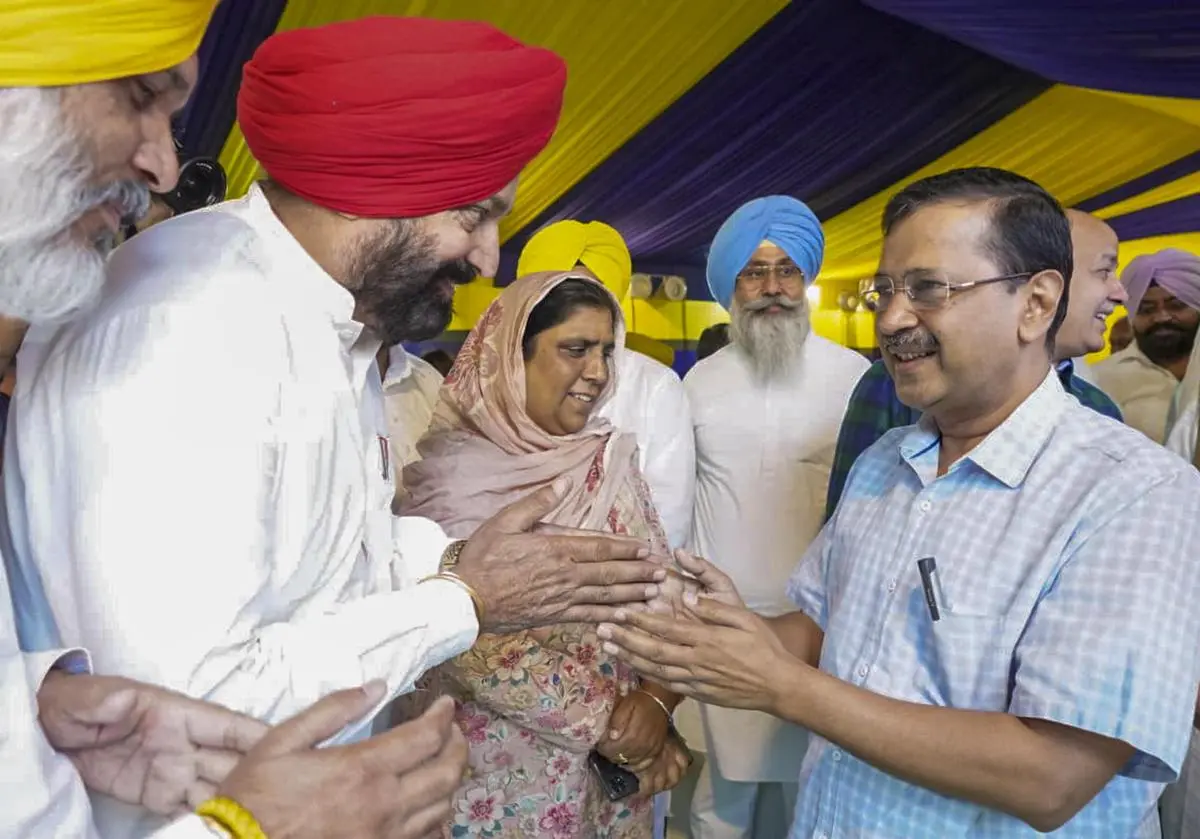
AAP convenor Arvind Kejriwal (right) interacts with Punjab party leaders during a meeting, in New Delhi, on May 5. | Photo Credit: PTI
Apart from six national parties and 60 State parties, there are over 2,000 parties registered with the Election Commission of India (ECI). Hundreds of new Registered Unrecognised Political Parties (RUPPs) join the list each election season. Many are one-time entities. In 2025, the ECI delisted 335 inactive or non-compliant RUPPs (334 in August and 474 in September) for failing to contest elections for six years.
Little support for breakaway parties
The trend of launching parties with fleeting lives is not limited to new entrants; it has also attracted well-known political leaders. However, despite the public profiles of their founders, many such parties fade away or are absorbed by larger formations. For instance, when former Madhya Pradesh Chief Minister Uma Bharti walked out of the BJP, she formed the Bharatiya Janshakti Party in 2006. But it failed to take off, despite Bharti being at the peak of her popularity at that time. Then, after a few unsuccessful electoral attempts, she merged the party into the BJP in 2011.
The Hindutva hero of the Ram Janambhoomi/Babri Masjid row, Kalyan Singh, left the BJP two times, each time to form a political party—the Rashtriya Kranti Party in 1999 and the Jan Kranti Party in 2010. Both bombed at the electoral box office. And Singh unceremoniously rejoined the BJP in 2013.
In Tamil Nadu, G.K. Moopanar broke away from the Congress to found the Tamil Maanila Congress (Moopanar) in 1996, along with former Union Finance Minister P. Chidambaram. The party merged with the Congress a few years later. The party was relaunched in 2014 and is still alive, helmed by Moopanar’s son, G.K. Vasan. It has been in alliance with the AIADMK at the State level and with the NDA at the Centre since 2019. It fought five seats in this Assembly election on the lotus symbol, but won none. Chidambaram once again diverged from the Congress to form the Congress Jananayaka Peravai and win the Sivaganga Lok Sabha seat in 2004. But he was soon persuaded to remerge with the mother unit.
Pranab Mukherjee’s Rashtriya Samajwadi Congress, formed in 1986, was equally short-lived, with Mukherjee rejoining the Congress in 1989.
The celebrated film star Kamal Haasan’s Makkal Needhi Maiam, formed in 2018, has similarly failed to make much of an impression politically, choosing to remain a minor alliance partner in the DMK bloc.
In Chhattisgarh, Ajit Jogi set up the Janta Congress with his son after being expelled from the Congress in 2016, but it failed to take off despite Jogi once being the State’s tallest Congress leader.
In Punjab, Captain Amarinder Singh’s parties have suffered a similar fate. First, Amarinder broke away from the Akali Dal and formed Akali Dal (Panthic) in 1992; then he broke away from the Congress and formed the Punjab Lok Congress in 2021. A year later, Singh joined the BJP and merged his new party with it. Although a very popular leader, it was obvious that Singh could get to the top only when he was within the fold of one of the traditional mainstream parties in Punjab.
Mixed response for new entrants
Other new parties formed in Punjab have followed a similar pattern. Sanyukt Samaj Morcha (SSM), a farmers’ party, was launched in December 2021 by 22 farmer groups after the farmer agitations succeeded in forcing the BJP to withdraw the three contentious farming laws. Despite the effective and highly visible agitation, the party, led by senior farm union leader and politician Balbir Singh Rajewal, failed to win a single seat in the 2022 Punjab Assembly election.
Kerala saw a similar ambitious agenda set by the Twenty 20 party formed by industrialist Sabu M. Jacob, head of the Kitex Group. The fledgling party, which promised much, ultimately tied up with the NDA.
It is not just the harsh realities of every-day politics that make new parties fold up or silence their leaders. For instance, in 2023, the leader of the Greater Cooch Behar Democracy Party, Anant Rai (aka Anant Maharaj), was nominated by the BJP to the Rajya Sabha. Anant has been silent since then on the demand for Greater Cooch Behar, pretty much negating the party’s existence.
In fact, some regional parties are formed only to help one of the major parties form a government without falling foul of the anti-defection law. For instance, three months after leaving the Congress, former Arunachal Pradesh Chief Minister Pema Khandu and his supporter MLAs joined the People’s Party of Arunachal Pradesh (PPA) in September 2016. Then, Khandu and 32 PPA MLAs merged with the BJP in December of the same year.
Despite the mixed reception that new political parties have received across the country over the years, Vijay’s victory in Tamil Nadu has turned the spotlight back on spectacular political debuts. The TVK is widely seen as having come to power on an overwhelming youth and women’s vote, and its promises are ambitious.
The bigger question, however, remains: how sustainable will the TVK be in the long run? While Vijay can take comfort from the many successes that actor-turned-politicians like M.G. Ramachandran and Jayalalithaa have enjoyed in Tamil Nadu, his party’s lifespan will be watched with interest.
Also Read | Vijay factor might hit AIADMK more than DMK
Also Read | All eyes on the unattached urban voter