




惯性聚合 高效追踪和阅读你感兴趣的博客、新闻、科技资讯
阅读原文 在惯性聚合中打开

推荐订阅源

cs.CV updates on arXiv.org
小众软件
小众软件
博客园_首页
博客园 - 聂微东
V
V2EX
WordPress大学
WordPress大学
freeCodeCamp Programming Tutorials: Python, JavaScript, Git & More
OSCHINA 社区最新新闻
OSCHINA 社区最新新闻
罗磊的独立博客
酷 壳 – CoolShell
酷 壳 – CoolShell
博客园 - 司徒正美
博客园 - 三生石上(FineUI控件)
奇客Solidot–传递最新科技情报
奇客Solidot–传递最新科技情报
S
SegmentFault 最新的问题
J
Java Code Geeks
Last Week in AI
Last Week in AI
The Cloudflare Blog
月光博客
月光博客
雷峰网
雷峰网
宝玉的分享
宝玉的分享
钛媒体:引领未来商业与生活新知
钛媒体:引领未来商业与生活新知
Hugging Face - Blog
Hugging Face - Blog
让小产品的独立变现更简单 - ezindie.com
有赞技术团队
有赞技术团队
人人都是产品经理
人人都是产品经理
博客园 - Franky
腾讯CDC
Jina AI
Jina AI
博客园 - 叶小钗
大猫的无限游戏
大猫的无限游戏
阮一峰的网络日志
阮一峰的网络日志
量子位
爱范儿
爱范儿
美团技术团队
T
Tailwind CSS Blog
博客园 - 【当耐特】
D
Docker
IT之家
IT之家
V
Visual Studio Blog
P
Proofpoint News Feed
L
LangChain Blog
Engineering at Meta
Engineering at Meta
C
Check Point Blog
G
Google Developers Blog
Google DeepMind News
云风的 BLOG
云风的 BLOG
Cyber Security Advisories - MS-ISAC
Microsoft Azure Blog
B
Blog RSS Feed
Recorded Future
Recorded Future

Latest Politics News | Frontline | Frontline

BJP turns Women’s Reservation Defeat into a New Campaign Plank in Uttar Pradesh Dantewada Cricket Event and India’s “Post-Maoist” Claim Maharashtra’s Sugar Mills Face a Deepening Economic Crisis Election Commission Bias in West Bengal Polls 2026? Tamil Nadu election 2026: Cash-For-Votes and Missing Voters One Year After Pahalgam: Violence, State Response, and Kashmir Narrative Tamil Nadu Assembly Election 2026: Why the Unattached Urban Voter Holds the Key in a Waveless Contest West Bengal Election 2026: Kudmi, Adivasi, Matua Identity Politics Explained When majoritarian march meets its first hard stop Will Didi prevail over Delhi? What Nithin Raj’s death says about caste in Kerala’s private colleges West Bengal election 2026: Identity politics, vote banks, and the BJP vs Trinamool battle Exclusive interview | Tamil Nadu Chief Minister M.K. Stalin talks about Assembly election 2026, fiscal authoritarianism, and the fight for federalism Women’s Reservation Bill 2026: Modi’s Delimitation Trap Exposed What was wrong with BJP's so-called Women Reservation Bill J&K liquor controversy explained: Tourism, revenue, and politics | The Kashmir Notebook Ep 13 Delhi Pink Saheli Card 2026: Domicile Rule Hurts Women Manipur’s Rumour Economy: How Disinformation Fuels Mob Violence Punishing the South: Modi’s Delimitation Plan and the Politics of Control The Vijay Factor AIADMK Delta Strategy: Can Leema Rose Win? Maharashtra Shows Why Women’s Reservation May Aid Elites CBI Reply in Kejriwal Case Exposes Judicial Conflict Norms Tamil Nadu Election 2026: Social Media Narratives, War Rooms, and Players Modi’s Roadshow and BJP’s High-Stakes Push in South Tamil Nadu SIR West Bengal Voter Exclusion Case 2026 TN Assembly Polls 2026: Senthil Balaji and SP Velumani Clash for Western Belt Supremacy Women’s Reservation Act Amendments Raise Delimitation Fears Partha Chatterjee’s For a Just Republic and the Limits of the People-Nation Hungary Election 2026: Orbán Defeated, Magyar Wins Big Free Speech Crackdown in India: Is Dissent Under Threat? Ambedkar Jayanti and the New Publicness of Protest Politics Implementing Women’s Reservation: Why a Hybrid 651-Seat Lok Sabha Model Outperforms Mass Expansion Ambedkar and Free Speech: Who Controls Dissent in 2026? Reforming Tamil Nadu's Local Governance: Why MLAs Aren't Fixers in 2026 West Bengal voter list controversy explained | Why names are being deleted Will Vijay’s TVK disrupt DMK and AIADMK? | Tamil Nadu election 2026 Constitutional Morality vs Social Morality in India 2026 Amit Shah’s Anti-Conversion Promise Opens a New Faultline in Punjab Politics Why Indian Shias Protest for Iran: History of Solidarity (2026) West Bengal Voter List Row 2026: “Votercide” Debate From Grief to Politics: Porkodi Armstrong and the Battle for Dalit Power in North Chennai West Bengal election 2026: Will Babri Masjid split the Muslim vote? West Bengal Communal Politics and the 2026 Election Battle Raghav Chadha-AAP Rift Explained: Rise to Fallout (2026) Why India Is Not Energy-Secure Amid Global Oil Shocks India IT Rules 2026: Threat to Free Speech? Iran War Ceasefire Signals a Shift Toward Multipolar Deterrence 2026 Assembly Polls: Congress vs BJP Power Test Kerala Assembly Election 2026: LDF Anti-Incumbency vs UDF Momentum Gujarat Local Polls: AAP Rise Deepens Congress Crisis SIR controversy deepens fear of Muslim disenfranchisement in Bengal Kerala Election 2026: LDF, UDF, and the BJP “B Team” Charge Who will win Kerala Assembly Election 2026? LDF or UDF? Assam Polls: Cash Transfers Mask Stagnant Incomes and Job Distress Jaishankar and India's Diplomacy Crisis After Nitish Kumar, Bihar BJP faces its biggest test: caste coalition without a ‘Mr Clean’ Actor Vijay and Politics: An Emerging Landscape N Rangasamy’s 2026 Puducherry Poll Strategy and Power Play Kashmir Encounter Killing Sparks AFSPA Debate 2026 GST Federalism Crisis 2026: How States Lost Fiscal Power US-Iran War 2026: Petrodollar Stakes Behind Hormuz Clash White Savior Complex in Arab Regimes Drives Ukraine Deals Not Self Reliance UPA Corruption Narrative vs Court Verdicts 2026 Mathur Sathya Case Exposes Patriarchy in Progressive Politics India Needs a New Economic Model Beyond Neoliberalism Why J&K MLAs Are Fighting the Lieutenant Governor Over Security Puducherry election 2026: Can Congress return to power? | V. Narayanasamy explains Pawar Family Rivalries Stall NCP Factions Merger in Maharashtra How Foreign Thinkers Shaped Hindutva’s Rise Naxalism’s Shift: Armed Struggle to Ideological Influence G. Haragopal on Tribal Resistance, Maoist Surrenders, and Politics DMK manifesto 2026: Key promises, alliances, & welfare politics Rajya Sabha Polls Expose India’s Open Secret: Cross-Voting and Poaching State Assembly Elections 2026: How Voter Dynamics Are Shaping India DMK Seat-Sharing Deal Reveals a Tougher M.K. Stalin What Iran Means to Kashmir | War, Identity, and 5000 Years of History Thirumavalavan Signals Shift in Tamil Nadu Politics Golgappa diplomacy and the fragile reset in India-Bangladesh ties Tamil Nadu election 2026: DMK vs AIADMK, alliances, and Vijay’s entry Is Indian Cinema Losing its Moral Voice? How the BJP’s strategic pivot on delimitation and women’s quota will reshape the 2029 electoral landscape Why INDIA Bloc Collapsed in Puducherry | DMK, Congress & VCK Rift Explained West Bengal 2026 Assembly Elections: Candidate Controversies Stir Party Rebellions Tamil Nadu Elections: CPI(M) on DMK Alliance & BJP Fight Ashok Kharat Scandal Exposes Maharashtra’s Godman–Power Nexus India Migration Crisis: Gulf Conflict Exposes Gaps 2011 Election Petition Against Stalin Returns Ahead of Tamil Nadu Election Delhi Budget 2026: Growth Claims and Welfare Gaps Tamil Nadu NDA Deal Reveals AIADMK’s Upper Hand Inside AIADMK Strategy: EPS Leadership, BJP Alliance, and TVK Challenge Vijay Politics: Can TVK Break Tamil Nadu's DMK AIADMK Duopoly? How Eid went under siege in Uttam Nagar Assam Elections 2026: BJP Faces Tribal Backlash Over Evictions in Karbi Anglong First Impeachment Notice Against India’s CEC Shakes Politics 2026 Hindu Rashtra Debate: 2026 State Elections Test Secular India Tamil Nadu Election 2026: How Gender and Gen Z Voters are Reshaping the Dravidian Power Struggle Maharashtra’s Anti-Conversion Bill and the Politics of 'Love Jihad' Post-Colonial Nationalism and the Western Far Right: Why the Comparison Fails Gujarat's proposed marriage registration amendment 2026 polices choice
Supreme Court’s Bengal Turnout Praise Masks Voter Disenfranchisement
2026-04-27 · via Latest Politics News | Frontline | Frontline
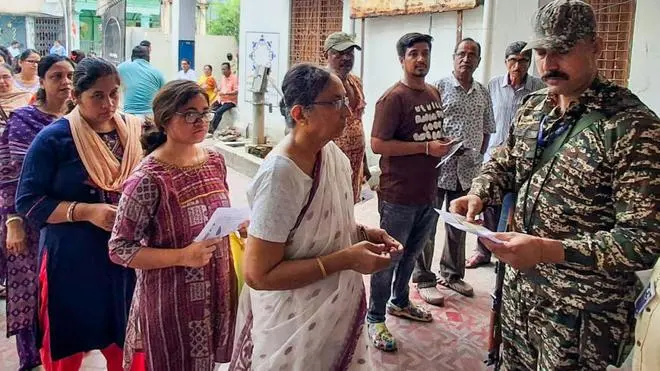
Voters wait in a queue at polling booths in Baharampur and Lalbag areas of Murshidabad during the West Bengal Assembly election on April 23, 2026. As West Bengal recorded one of its highest-ever turnouts, the Supreme Court cited the absence of violence and urged faith in the democratic process.

Voters wait in a queue at polling booths in Baharampur and Lalbag areas of Murshidabad during the West Bengal Assembly election on April 23, 2026. As West Bengal recorded one of its highest-ever turnouts, the Supreme Court cited the absence of violence and urged faith in the democratic process. | Photo Credit: ANI

The Supreme Court has, in a patronising manner, lauded the people of West Bengal for the record voter turnout in the first phase of the 2026 Assembly election. The Chief Justice said that, as a citizen, the high voter turnout made him proud. In his view, the people must participate in the electoral process; if people realise the power of their vote within a democracy and follow the rule of law, they will shun violence. This participation is framed as a testament to their faith in the democratic system.

Justice Joymalya Bagchi, sitting alongside the Chief Justice on the bench, noted another positive aspect of the election: the absence of violence. Then, offering proof of his Bengali roots, he recited a proverb: “Raja raja-ye juddho hoy, ulukhagrar pran jay” (When kings go to war, the ulukhagra grass is trampled). The ulukhagra is a mere plant, crushed underfoot during the battles of monarchs. The proverb means the powerful fight the wars, while the poor are caught in the middle and killed. Justice Bagchi views this election as a war between “kings” in which the hapless, passive voter is crushed like that blade of grass.

This is how our judges perceive electoral competition in a democracy. They view voters as inert grass to be trampled under the feet of clashing elephants. Our eminent judges believe they have been granted the right and the responsibility to protect these “helpless” voters. According to their logic, this citizenry can neither think for itself nor make its own decisions.

In the first phase of the 2026 West Bengal Assembly election, about 92 per cent of the electorate cast their ballots. This figure has astonished our justices.

It would have been more honest if, rather than lecturing the people of Bengal on the right to vote and its significance, our courts had reflected on their own role in preventing eligible voters from exercising their franchise. After all, it was these very justices who, while refusing to grant interim relief to deleted voters, indicated that missing one election was not a matter of great consequence. Was this not the view of the same justices who are today congratulating the people of Bengal for understanding the value of their franchise?

Twenty-seven lakh voters of Bengal had approached these very judges with the plea that they were alive, they were citizens of India, and yet their names had been purged from the electoral rolls. They sought a court directive to the Election Commission to restore their names. At that time, the court said that the question of allowing them to vote did not arise while their appeals were pending. Verifying these petitions would take time, the judges argued, and it was possible the names might not be added in time for this round. But what great calamity would that cause?

It is deeply ironic that while they were praising the people of Bengal for voting, they were simultaneously refusing to hear the petitions of 65 Bengalis who pleaded for their names to be restored to the rolls. These were no ordinary citizens; they were polling officers—individuals deputed by the Election Commission itself for election duty. There can be no greater irony than the fact that those responsible for conducting the vote found their own names missing from the voter list. Yet this did not disturb our judges. They directed the petitioners to approach an appellate tribunal, suggesting that if they could prove their case was “urgent,” they might be heard. They added that since time was short, the names might not be added this time, but the “real thing” was getting the name on the list eventually.

A voter stands before the court with folded hands: they have voted in every election, yet this time the Election Commission has struck off their name, citing a “logical discrepancy” in their claim. Justice Bagchi himself expressed surprise at this “logical discrepancy” test, noting that it had not been applied in any other State. He pointed out that the Election Commission had deviated from its own stance in the Bihar SIR, where voters mapped to the 2002 electoral roll were not required to upload documents.

Yet the court did not order the Election Commission to restore the names removed through this route. The judges insisted that the appellate tribunals would investigate each claim. That would take time. The elections would be over by then. But our lordships remained unconcerned that this delay would mean these individuals could not vote this time. The franchise of the people of Bengal is being snatched away through an absurd logic. The court understands this; it finds the logic of the Election Commission flawed; yet it shows no urgency in restoring the people’s right to vote.

Why Bengal is ‘political’

If both judges possessed the ability and inclination to speak the truth, they would say they are deeply amazed that for the people of Bengal, nothing is more important than voting. They abandon all work and endure the crush of trains to reach their villages and homes. Why, after all, is “politics” a matter of life and death for them?

The justices ought to have asked whether abandoning work for a fortnight or a month to cast a single vote adversely affects the national economy. Is economic progress more vital, or is politics? They should have asked why the people of Bengal are so “political.”

When the disenfranchised voters of West Bengal approached the court to get their voting rights restored, the bench was irritated. It was perturbed that everyone in Bengal speaks in a “political language.” The Chief Justice had also said that West Bengal was the most politically polarised State in the country.

To speak in a political language is a sign of an active democratic consciousness. This should be cause for celebration, yet our judges were worried by Bengal’s intense political sensibility. Political polarisation also signifies that people are serious about their political choices. This is not the negative trait our judges think it to be.

Upon hearing the news of the 92 per cent turnout, the judges ought to engage in serious self-reflection. They should publicly repent for having, in tandem with the Election Commission, suspended the franchise of 27 lakh Bengali voters. The court owes an apology to these millions for failing to be as vigilant about democratic rights as these voters themselves are, and for failing to protect voters from the cruelty of the Election Commission.

The 92 per cent turnout in West Bengal is a mirror in which the true face of the Supreme Court is reflected. That would not be a pleasant sight for our lordships.

Apoorvanand teaches Hindi at Delhi University and writes literary and cultural criticism.

Also Read | Mamata versus Suvendu in Bhabanipur

Also Read | SIR: BJP’s hope, Mamata’s worry