
惯性聚合 高效追踪和阅读你感兴趣的博客、新闻、科技资讯
阅读原文 在惯性聚合中打开

推荐订阅源

Threat Intelligence Blog | Flashpoint
Microsoft Azure Blog
Cloudbric
Cloudbric
I
InfoQ
V
V2EX
博客园_首页
The Register - Security
cs.CV updates on arXiv.org
S
Secure Thoughts
Vercel News
Vercel News
Forbes - Security
Forbes - Security
云风的 BLOG
云风的 BLOG
PCI Perspectives
PCI Perspectives
L
LINUX DO - 最新话题
D
DataBreaches.Net
H
Hacker News: Front Page
Application and Cybersecurity Blog
B
Blog RSS Feed
A
About on SuperTechFans
N
News and Events Feed by Topic
Apple Machine Learning Research
Help Net Security
Help Net Security
Attack and Defense Labs
N
Netflix TechBlog - Medium
Spread Privacy
Spread Privacy
F
Full Disclosure
Recorded Future
Recorded Future
AWS News Blog
AWS News Blog
博客园 - 【当耐特】
The Cloudflare Blog
T
Threatpost
T
Tor Project blog
Google DeepMind News
C
CXSECURITY Database RSS Feed - CXSecurity.com
CTFtime.org: upcoming CTF events
Recent Announcements
M
MIT News - Artificial intelligence
A
Arctic Wolf
C
Check Point Blog
Stack Overflow Blog
Stack Overflow Blog
T
Threat Research - Cisco Blogs
Security Archives - TechRepublic
Hacker News - Newest:
Hacker News - Newest: "LLM"
WordPress大学
WordPress大学
Cyberwarzone
Cyberwarzone
小众软件
小众软件
C
Cyber Attacks, Cyber Crime and Cyber Security
P
Proofpoint News Feed
Security Latest
Security Latest
The Last Watchdog
The Last Watchdog

Latest Politics News | Frontline | Frontline

West Bengal election: How ethnic identities are reshaping the TMC-BJP contest BJP turns Women’s Reservation Defeat into a New Campaign Plank in Uttar Pradesh Dantewada Cricket Event and India’s “Post-Maoist” Claim Maharashtra’s Sugar Mills Face a Deepening Economic Crisis Election Commission Bias in West Bengal Polls 2026? Tamil Nadu election 2026: Cash-For-Votes and Missing Voters One Year After Pahalgam: Violence, State Response, and Kashmir Narrative Tamil Nadu Assembly Election 2026: Why the Unattached Urban Voter Holds the Key in a Waveless Contest West Bengal Election 2026: Kudmi, Adivasi, Matua Identity Politics Explained When majoritarian march meets its first hard stop Will Didi prevail over Delhi? What Nithin Raj’s death says about caste in Kerala’s private colleges West Bengal election 2026: Identity politics, vote banks, and the BJP vs Trinamool battle Exclusive interview | Tamil Nadu Chief Minister M.K. Stalin talks about Assembly election 2026, fiscal authoritarianism, and the fight for federalism What was wrong with BJP's so-called Women Reservation Bill J&K liquor controversy explained: Tourism, revenue, and politics | The Kashmir Notebook Ep 13 Delhi Pink Saheli Card 2026: Domicile Rule Hurts Women Manipur’s Rumour Economy: How Disinformation Fuels Mob Violence Punishing the South: Modi’s Delimitation Plan and the Politics of Control The Vijay Factor AIADMK Delta Strategy: Can Leema Rose Win? Maharashtra Shows Why Women’s Reservation May Aid Elites CBI Reply in Kejriwal Case Exposes Judicial Conflict Norms Tamil Nadu Election 2026: Social Media Narratives, War Rooms, and Players Modi’s Roadshow and BJP’s High-Stakes Push in South Tamil Nadu SIR West Bengal Voter Exclusion Case 2026 TN Assembly Polls 2026: Senthil Balaji and SP Velumani Clash for Western Belt Supremacy Women’s Reservation Act Amendments Raise Delimitation Fears Partha Chatterjee’s For a Just Republic and the Limits of the People-Nation Hungary Election 2026: Orbán Defeated, Magyar Wins Big Free Speech Crackdown in India: Is Dissent Under Threat? Ambedkar Jayanti and the New Publicness of Protest Politics Implementing Women’s Reservation: Why a Hybrid 651-Seat Lok Sabha Model Outperforms Mass Expansion Ambedkar and Free Speech: Who Controls Dissent in 2026? Reforming Tamil Nadu's Local Governance: Why MLAs Aren't Fixers in 2026 West Bengal voter list controversy explained | Why names are being deleted Will Vijay’s TVK disrupt DMK and AIADMK? | Tamil Nadu election 2026 Constitutional Morality vs Social Morality in India 2026 Amit Shah’s Anti-Conversion Promise Opens a New Faultline in Punjab Politics Why Indian Shias Protest for Iran: History of Solidarity (2026) West Bengal Voter List Row 2026: “Votercide” Debate From Grief to Politics: Porkodi Armstrong and the Battle for Dalit Power in North Chennai West Bengal election 2026: Will Babri Masjid split the Muslim vote? West Bengal Communal Politics and the 2026 Election Battle Raghav Chadha-AAP Rift Explained: Rise to Fallout (2026) Why India Is Not Energy-Secure Amid Global Oil Shocks India IT Rules 2026: Threat to Free Speech? Iran War Ceasefire Signals a Shift Toward Multipolar Deterrence 2026 Assembly Polls: Congress vs BJP Power Test Kerala Assembly Election 2026: LDF Anti-Incumbency vs UDF Momentum Gujarat Local Polls: AAP Rise Deepens Congress Crisis SIR controversy deepens fear of Muslim disenfranchisement in Bengal Kerala Election 2026: LDF, UDF, and the BJP “B Team” Charge Who will win Kerala Assembly Election 2026? LDF or UDF? Assam Polls: Cash Transfers Mask Stagnant Incomes and Job Distress Jaishankar and India's Diplomacy Crisis After Nitish Kumar, Bihar BJP faces its biggest test: caste coalition without a ‘Mr Clean’ Actor Vijay and Politics: An Emerging Landscape N Rangasamy’s 2026 Puducherry Poll Strategy and Power Play Kashmir Encounter Killing Sparks AFSPA Debate 2026 GST Federalism Crisis 2026: How States Lost Fiscal Power US-Iran War 2026: Petrodollar Stakes Behind Hormuz Clash White Savior Complex in Arab Regimes Drives Ukraine Deals Not Self Reliance UPA Corruption Narrative vs Court Verdicts 2026 Mathur Sathya Case Exposes Patriarchy in Progressive Politics India Needs a New Economic Model Beyond Neoliberalism Why J&K MLAs Are Fighting the Lieutenant Governor Over Security Puducherry election 2026: Can Congress return to power? | V. Narayanasamy explains Pawar Family Rivalries Stall NCP Factions Merger in Maharashtra How Foreign Thinkers Shaped Hindutva’s Rise Naxalism’s Shift: Armed Struggle to Ideological Influence G. Haragopal on Tribal Resistance, Maoist Surrenders, and Politics DMK manifesto 2026: Key promises, alliances, & welfare politics Rajya Sabha Polls Expose India’s Open Secret: Cross-Voting and Poaching State Assembly Elections 2026: How Voter Dynamics Are Shaping India DMK Seat-Sharing Deal Reveals a Tougher M.K. Stalin What Iran Means to Kashmir | War, Identity, and 5000 Years of History Thirumavalavan Signals Shift in Tamil Nadu Politics Golgappa diplomacy and the fragile reset in India-Bangladesh ties Tamil Nadu election 2026: DMK vs AIADMK, alliances, and Vijay’s entry Is Indian Cinema Losing its Moral Voice? How the BJP’s strategic pivot on delimitation and women’s quota will reshape the 2029 electoral landscape Why INDIA Bloc Collapsed in Puducherry | DMK, Congress & VCK Rift Explained West Bengal 2026 Assembly Elections: Candidate Controversies Stir Party Rebellions Tamil Nadu Elections: CPI(M) on DMK Alliance & BJP Fight Ashok Kharat Scandal Exposes Maharashtra’s Godman–Power Nexus India Migration Crisis: Gulf Conflict Exposes Gaps 2011 Election Petition Against Stalin Returns Ahead of Tamil Nadu Election Delhi Budget 2026: Growth Claims and Welfare Gaps Tamil Nadu NDA Deal Reveals AIADMK’s Upper Hand Inside AIADMK Strategy: EPS Leadership, BJP Alliance, and TVK Challenge Vijay Politics: Can TVK Break Tamil Nadu's DMK AIADMK Duopoly? How Eid went under siege in Uttam Nagar Assam Elections 2026: BJP Faces Tribal Backlash Over Evictions in Karbi Anglong First Impeachment Notice Against India’s CEC Shakes Politics 2026 Hindu Rashtra Debate: 2026 State Elections Test Secular India Tamil Nadu Election 2026: How Gender and Gen Z Voters are Reshaping the Dravidian Power Struggle Maharashtra’s Anti-Conversion Bill and the Politics of 'Love Jihad' Post-Colonial Nationalism and the Western Far Right: Why the Comparison Fails Gujarat's proposed marriage registration amendment 2026 polices choice
Women’s Reservation Bill 2026: Modi’s Delimitation Trap Exposed
2026-04-20 · via Latest Politics News | Frontline | Frontline
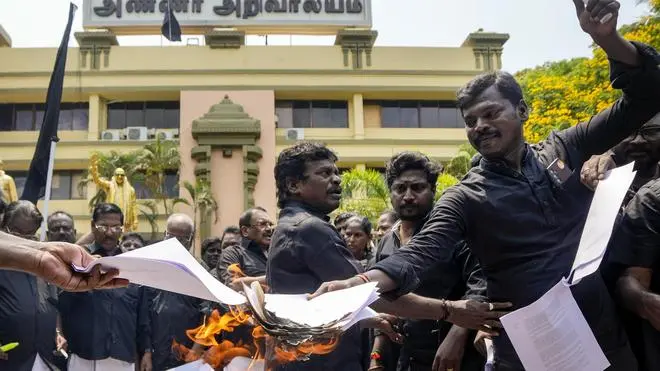
DMK workers burn copies of the proposed delimitation Bill during a protest at the party office, in Chennai, on April 16, 2026.

DMK workers burn copies of the proposed delimitation Bill during a protest at the party office, in Chennai, on April 16, 2026. | Photo Credit: R. SENTHILKUMAR/PTI

April 17, 2026, will be recorded as one of the most consequential dates in the history of Indian democracy. On this day, the opposition parties demonstrated a collective awareness of the threat to the democratic structure that had been absent in 2019—when the Citizenship Amendment Bill was passed or when Article 370 was abrogated. This time, they stood together and defeated the government’s attempt to alter the structure and composition of Parliament.

This defeat was essential for the survival of Indian democracy. This is not only a defaet for the government, it should be seen as a victory for the opposition. It has restored confidence in the opposition. Among the public, too, there is a growing curiosity about the opposition’s perspective. Citizens observed and listened to the parliamentary debates this time with heightened attention. They are looking beyond the “mainstream” media to understand where and how the government deploys deception. The public, it appears, is unlikely to accept the government’s claim that it was merely bringing in a law for women’s representation and had been blocked by a “misogynistic” opposition.

The public today is more receptive to the opposition’s counterargument: if the government is so concerned about the representation of women in legislatures, why has it not yet implemented the Women’s Reservation Act that was passed unanimously by Parliament in September 2023? Why did it not notify the Act until April 16, 2026—the very eve of the vote on the Constitution Amendment Bill? Can women’s reservation not be applied within the existing strength of 543 members? Why is an expansion of the House necessary to grant 33 per cent reservation to women?

Commentators like Siddharth Varadarajan have rightly observed that the government’s true intent was not to increase women’s representation but to preserve male dominance in the legislatures. Opposition parties have also correctly alleged that the real motive, concealed behind the rhetoric of women’s empowerment, is a redistribution of parliamentary seats that would most severely disadvantage the non-Hindi-speaking States, cementing the hegemony of the Hindi heartland.

The government’s hollow defence

The government’s defence is pathetically flimsy. It claims that had the opposition agreed, it would have added a clause to increase seat numbers by 50 per cent across the board. If this was indeed so, why was it not part of the text of the Bill itself, as opposition parties pointed out?

The government, rather amusingly, is aggrieved that the opposition is so “uncivilised” that it refuses to trust even the Prime Minister’s assurance. It is not as if the government has shown it can be trusted; and governments and courts function on the written word, not on faith or verbal assurances.

Priyanka Gandhi is right to assert that this Prime Minister and his government cannot be taken at their word. A government that systematically erodes every constitutional process cannot demand trust. Narendra Modi and his Ministers are incapable of speaking the truth. Even supporters of the government concede that it has shown itself to be a master of falsehood and deceit—they take pride in the fact that its lies have consistently been accepted as truth. They call it being “shrewd”.

Why does the public accept these lies? Largely because the media broadcasts them as established fact. Even now, the media went to town claiming that the opposition had “toppled” the Women’s Reservation Bill. This is a lie. The truth is that the opposition defeated a government attempt to alter the structure and fabric of Parliament and State Legislatures under the pretext of women’s reservation. If that is not the case, why was the delimitation of constituencies linked to women’s reservation? The objective was not to expand space for women but to use them as a pretext to redraw India’s electoral map. The conspiracy to marginalise and render ineffective the representation of States in the south and the northeast is not difficult to discern. We have already seen how the delimitation process in Assam and Jammu & Kashmir was used to politically disempower Muslims. Why is delimitation necessary simply to give women their due?

This is the simplest question the media should be asking, but it remains silent. Instead, it stirs up a storm of government propaganda to blind people to what is actually being done. A tribe of analysts is now busily interpreting the entire episode as another “masterstroke” by Narendra Modi. This lot claims the government knew the Bill would fail but introduced it anyway to paint the opposition as anti-woman. Now, they say, the opposition must disprove this.

This logic is hollow. The government is not so prescient as to have known beforehand that it would fail to fracture the opposition this time. It tried. But the collective injustice of the large-scale deletion of voters’ names during the SIR process in Bihar, Bengal, and elsewhere had already sharpened the opposition’s vigilance. They have recognised that this government uses every available device to ensure its permanence. It is this democratic alertness that kept the opposition steadfast in its refusal to take the government’s bait.

Having lost in Parliament, the government has now taken to the streets—as if it were itself the opposition—to campaign for women’s reservation. A Bill that was already passed in 2023! To conceal the sting of a decisive defeat, it has resorted to old tactics, but they are only spreading the realisation that Narendra Modi—who projects himself as invincible—can indeed be defeated.

The Prime Minister used the sanctity of an address to the nation on Doordarshan to attack the opposition for the Bill’s failure. Modi specifically targeted the Congress, the Trinamool, and the DMK—all three parties with a stake in the upcoming Tamil Nadu and Bengal elections. This government is known for its petty and unethical politics, but such an address on the eve of elections is unacceptable. The Election Commission should have issued a notice and barred Modi from campaigning. But we know that the Election Commission now functions as a wing of the BJP, whose purpose is to convert the BJP’s electoral defeats into victories.

It will be interesting to see how many newspapers and television channels criticise this unethical act by the Prime Minister. It will reveal who in this country actually cares for the survival of democracy.

Whether the media or anyone else cares for democracy or not, we the people must. Just as the workers of Noida and Panipat or the Adivasis of Odisha are fighting to protect their rights, we must all unite with the opposition to safeguard our democratic freedoms. This could be the moment of democracy’s homecoming, or we could lose it forever through our own negligence. The choice is ours.

Apoorvanand teaches Hindi at Delhi University and writes literary and cultural criticism.

Also Read | Timing and intent of women’s reservation Bill suspect: John Brittas

Also Read | The only answer is to decentralise: Nilakantan R.S.