
惯性聚合 高效追踪和阅读你感兴趣的博客、新闻、科技资讯
阅读原文 在惯性聚合中打开

推荐订阅源

P
Proofpoint News Feed
C
CERT Recently Published Vulnerability Notes
O
OpenAI News
V
Vulnerabilities – Threatpost
C
Cybersecurity and Infrastructure Security Agency CISA
S
Schneier on Security
Latest news
Latest news
F
Full Disclosure
T
Tenable Blog
T
Troy Hunt's Blog
The Last Watchdog
The Last Watchdog
S
Secure Thoughts
L
LangChain Blog
有赞技术团队
有赞技术团队
Project Zero
Project Zero
Cloudbric
Cloudbric
爱范儿
爱范儿
GbyAI
GbyAI
C
CXSECURITY Database RSS Feed - CXSecurity.com
T
The Exploit Database - CXSecurity.com
S
Security @ Cisco Blogs
Hugging Face - Blog
Hugging Face - Blog
Recorded Future
Recorded Future
大猫的无限游戏
大猫的无限游戏
Last Week in AI
Last Week in AI
C
Cisco Blogs
WordPress大学
WordPress大学
Apple Machine Learning Research
小众软件
小众软件
Cyber Security Advisories - MS-ISAC
V2EX - 技术
V2EX - 技术
Engineering at Meta
Engineering at Meta
Spread Privacy
Spread Privacy
cs.CL updates on arXiv.org
Hacker News: Ask HN
Hacker News: Ask HN
Recent Commits to openclaw:main
Schneier on Security
T
Threat Research - Cisco Blogs
M
MIT News - Artificial intelligence
让小产品的独立变现更简单 - ezindie.com
K
Kaspersky official blog
The Hacker News
The Hacker News
V
V2EX
F
Fortinet All Blogs
L
LINUX DO - 最新话题
Cisco Talos Blog
Cisco Talos Blog
钛媒体:引领未来商业与生活新知
钛媒体:引领未来商业与生活新知
N
News | PayPal Newsroom
博客园 - 三生石上(FineUI控件)
cs.CV updates on arXiv.org

Latest Politics News | Frontline | Frontline

BJP turns Women’s Reservation Defeat into a New Campaign Plank in Uttar Pradesh Dantewada Cricket Event and India’s “Post-Maoist” Claim Maharashtra’s Sugar Mills Face a Deepening Economic Crisis Election Commission Bias in West Bengal Polls 2026? Tamil Nadu election 2026: Cash-For-Votes and Missing Voters One Year After Pahalgam: Violence, State Response, and Kashmir Narrative Tamil Nadu Assembly Election 2026: Why the Unattached Urban Voter Holds the Key in a Waveless Contest West Bengal Election 2026: Kudmi, Adivasi, Matua Identity Politics Explained When majoritarian march meets its first hard stop Will Didi prevail over Delhi? What Nithin Raj’s death says about caste in Kerala’s private colleges West Bengal election 2026: Identity politics, vote banks, and the BJP vs Trinamool battle Exclusive interview | Tamil Nadu Chief Minister M.K. Stalin talks about Assembly election 2026, fiscal authoritarianism, and the fight for federalism Women’s Reservation Bill 2026: Modi’s Delimitation Trap Exposed What was wrong with BJP's so-called Women Reservation Bill J&K liquor controversy explained: Tourism, revenue, and politics | The Kashmir Notebook Ep 13 Delhi Pink Saheli Card 2026: Domicile Rule Hurts Women Manipur’s Rumour Economy: How Disinformation Fuels Mob Violence Punishing the South: Modi’s Delimitation Plan and the Politics of Control The Vijay Factor AIADMK Delta Strategy: Can Leema Rose Win? Maharashtra Shows Why Women’s Reservation May Aid Elites CBI Reply in Kejriwal Case Exposes Judicial Conflict Norms Tamil Nadu Election 2026: Social Media Narratives, War Rooms, and Players Modi’s Roadshow and BJP’s High-Stakes Push in South Tamil Nadu SIR West Bengal Voter Exclusion Case 2026 TN Assembly Polls 2026: Senthil Balaji and SP Velumani Clash for Western Belt Supremacy Women’s Reservation Act Amendments Raise Delimitation Fears Partha Chatterjee’s For a Just Republic and the Limits of the People-Nation Hungary Election 2026: Orbán Defeated, Magyar Wins Big Free Speech Crackdown in India: Is Dissent Under Threat? Ambedkar Jayanti and the New Publicness of Protest Politics Implementing Women’s Reservation: Why a Hybrid 651-Seat Lok Sabha Model Outperforms Mass Expansion Ambedkar and Free Speech: Who Controls Dissent in 2026? Reforming Tamil Nadu's Local Governance: Why MLAs Aren't Fixers in 2026 West Bengal voter list controversy explained | Why names are being deleted Will Vijay’s TVK disrupt DMK and AIADMK? | Tamil Nadu election 2026 Constitutional Morality vs Social Morality in India 2026 Amit Shah’s Anti-Conversion Promise Opens a New Faultline in Punjab Politics Why Indian Shias Protest for Iran: History of Solidarity (2026) West Bengal Voter List Row 2026: “Votercide” Debate From Grief to Politics: Porkodi Armstrong and the Battle for Dalit Power in North Chennai West Bengal election 2026: Will Babri Masjid split the Muslim vote? West Bengal Communal Politics and the 2026 Election Battle Raghav Chadha-AAP Rift Explained: Rise to Fallout (2026) Why India Is Not Energy-Secure Amid Global Oil Shocks India IT Rules 2026: Threat to Free Speech? Iran War Ceasefire Signals a Shift Toward Multipolar Deterrence 2026 Assembly Polls: Congress vs BJP Power Test Kerala Assembly Election 2026: LDF Anti-Incumbency vs UDF Momentum Gujarat Local Polls: AAP Rise Deepens Congress Crisis SIR controversy deepens fear of Muslim disenfranchisement in Bengal Kerala Election 2026: LDF, UDF, and the BJP “B Team” Charge Who will win Kerala Assembly Election 2026? LDF or UDF? Assam Polls: Cash Transfers Mask Stagnant Incomes and Job Distress Jaishankar and India's Diplomacy Crisis After Nitish Kumar, Bihar BJP faces its biggest test: caste coalition without a ‘Mr Clean’ Actor Vijay and Politics: An Emerging Landscape N Rangasamy’s 2026 Puducherry Poll Strategy and Power Play Kashmir Encounter Killing Sparks AFSPA Debate 2026 GST Federalism Crisis 2026: How States Lost Fiscal Power US-Iran War 2026: Petrodollar Stakes Behind Hormuz Clash White Savior Complex in Arab Regimes Drives Ukraine Deals Not Self Reliance UPA Corruption Narrative vs Court Verdicts 2026 Mathur Sathya Case Exposes Patriarchy in Progressive Politics India Needs a New Economic Model Beyond Neoliberalism Why J&K MLAs Are Fighting the Lieutenant Governor Over Security Puducherry election 2026: Can Congress return to power? | V. Narayanasamy explains Pawar Family Rivalries Stall NCP Factions Merger in Maharashtra How Foreign Thinkers Shaped Hindutva’s Rise Naxalism’s Shift: Armed Struggle to Ideological Influence G. Haragopal on Tribal Resistance, Maoist Surrenders, and Politics DMK manifesto 2026: Key promises, alliances, & welfare politics Rajya Sabha Polls Expose India’s Open Secret: Cross-Voting and Poaching State Assembly Elections 2026: How Voter Dynamics Are Shaping India DMK Seat-Sharing Deal Reveals a Tougher M.K. Stalin What Iran Means to Kashmir | War, Identity, and 5000 Years of History Thirumavalavan Signals Shift in Tamil Nadu Politics Golgappa diplomacy and the fragile reset in India-Bangladesh ties Tamil Nadu election 2026: DMK vs AIADMK, alliances, and Vijay’s entry Is Indian Cinema Losing its Moral Voice? How the BJP’s strategic pivot on delimitation and women’s quota will reshape the 2029 electoral landscape Why INDIA Bloc Collapsed in Puducherry | DMK, Congress & VCK Rift Explained West Bengal 2026 Assembly Elections: Candidate Controversies Stir Party Rebellions Tamil Nadu Elections: CPI(M) on DMK Alliance & BJP Fight Ashok Kharat Scandal Exposes Maharashtra’s Godman–Power Nexus India Migration Crisis: Gulf Conflict Exposes Gaps 2011 Election Petition Against Stalin Returns Ahead of Tamil Nadu Election Delhi Budget 2026: Growth Claims and Welfare Gaps Tamil Nadu NDA Deal Reveals AIADMK’s Upper Hand Inside AIADMK Strategy: EPS Leadership, BJP Alliance, and TVK Challenge Vijay Politics: Can TVK Break Tamil Nadu's DMK AIADMK Duopoly? How Eid went under siege in Uttam Nagar Assam Elections 2026: BJP Faces Tribal Backlash Over Evictions in Karbi Anglong First Impeachment Notice Against India’s CEC Shakes Politics 2026 Hindu Rashtra Debate: 2026 State Elections Test Secular India Tamil Nadu Election 2026: How Gender and Gen Z Voters are Reshaping the Dravidian Power Struggle Maharashtra’s Anti-Conversion Bill and the Politics of 'Love Jihad' Post-Colonial Nationalism and the Western Far Right: Why the Comparison Fails Gujarat's proposed marriage registration amendment 2026 polices choice
Why UP Education Minister Yogendra Upadhyay wants Rain Rain Go Away removed from school textbooks
Ajay K. Singh,Amisha Thakur,Khalid Ansari,Nalin Verma · 2026-05-11 · via Latest Politics News | Frontline | Frontline
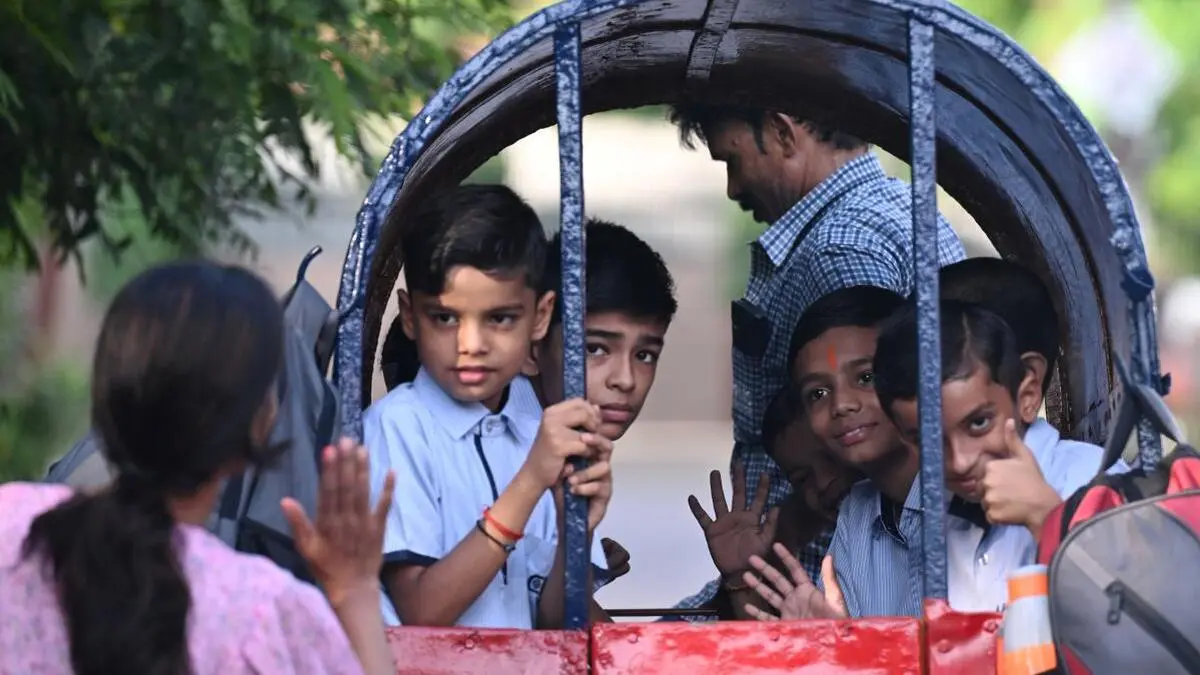
Uttar Pradesh Education Minister Yogendra Upadhyay has called for removing “Rain Rain Go Away” and “Johny Johny Yes Papa” from school syllabi, arguing that they teach selfishness and dishonesty contrary to Indian values. In this photo, a group of children head to school in Lucknow on July 1, 2025.

Uttar Pradesh Education Minister Yogendra Upadhyay has called for removing “Rain Rain Go Away” and “Johny Johny Yes Papa” from school syllabi, arguing that they teach selfishness and dishonesty contrary to Indian values. In this photo, a group of children head to school in Lucknow on July 1, 2025. | Photo Credit: Sandeep Saxena

“Rain, Rain, Go Away, Little Johnny Wants to Play”—this nursery rhyme has upset the Higher Education Minister of Uttar Pradesh, Yogendra Upadhyay. It ought to be removed from school textbooks, he believes, because it runs contrary to Indian culture. The poem asks the rain to go away so that little Johnny may play. Imagine that: rain—which nourishes all, which sustains agriculture, which is indispensable to life—is being asked to depart for the sake of one child’s amusement!

According to the Minister, the rhyme teaches selfishness. It is written in the spirit of “svāntah sukhāya”—for one’s own pleasure. And, he insists, “svāntah sukhāya” is not Indian culture. Indian culture, he tells us, is “Sarvajan Hitaya, Sarvajan Sukhaya”—the welfare and happiness of all. Therefore, a poem that asks the life-giving rain to disappear merely so that one Johnny can play has no place in schoolbooks, because it imparts false values to children.

Incidentally, “svāntah sukhāya” itself is an Indian expression; it was not borrowed from Thomas Hobbes. And the greatest poet of today’s Indian traditionalists had himself declared that he composed the gatha of Raghunath for the pleasure of his own soul: “svāntah sukhāya”!

This was not a one-off. Earlier too, while addressing a gathering to felicitate Shiksha Mitras in Kanpur, the Minister had objected to another nursery rhyme: “Johny Johny, Yes Papa, Eating Sugar? No, Papa.” In this poem, Johnny lies to his father after eating sugar. Such verses, according to the Minister, teach children dishonesty, something wholly opposed to Indian culture. They plant the wrong values in young minds.

One should not assume that the Minister was merely carried away in the excitement of addressing teachers. After the gathering, he patiently explained to journalists as well why a poem that asks the rain to leave for Johnny’s sake violates Indian values.

People, listening to the Minister’s grave reflections, are left astonished at how far foolishness can travel. Others remark that such a public exhibition of one’s idiocy requires considerable self-confidence.

Foolishness wears academic robes

There are also the generous souls who advise us not to take such statements seriously. Ministers are politicians after all, they say; politicians speak absurd things to please their audience. What truly matters in the Minister’s words, these charitable interpreters suggest, is his advocacy of “Sarvajan Hitaya, Sarvajan Sukhaya” and Indian values. We should retain the essence and discard the chaff.

But I wish to insist that the Minister is not alone in this absurdity, and it deserves to be taken with the seriousness with which he condemns these “un-Indian” English rhymes. Some years ago, at the India International Centre in Delhi, I heard almost the same argument from Anu Singh Lather, the Vice Chancellor of Dr B.R. Ambedkar University Delhi. At a seminar organised under the banner of an intellectual campaign against coloniality, the Vice Chancellor recited a nursery rhyme, much like the Minister: “Jack and Jill went up the hill to fetch a pail of water.” Then she asked: why should anyone go uphill to fetch water? Water is found below, not on higher ground. The rhyme is anti-scientific and irrational. That, she explained, is why Jack broke his head!

According to the Vice Chancellor, the poem communicates falsehood and irrationality. By teaching such rhymes to generations of Indians, the English colonised their minds. We must free ourselves from this by returning to Indian nursery rhymes. Replacing Jack and Jill, she urged us to remember: “Machhli jal ki rani hai, jeevan uska pani hai” (Fish is the queen of water; water is her life). Here, she said, you find sensitivity toward the environment and compassion toward living beings.

The Minister, too, had recommended replacing “Rain Rain Go Away” with rhymes such as “Kale megha pani de, pani de” (O dark clouds, give us water). There, rain is not driven away; it is invited.

What, then, is the difference between the Minister’s “foolishness” and the Vice Chancellor’s “wisdom”? When I spoke to a friend about these two episodes and expressed my amazement that both should say equally ridiculous things about English nursery rhymes, he replied: how could you forget that both are saplings nurtured in the same nursery called the Rashtriya Swayamsevak Sangh?

Can we afford to laugh this off? We must remember that a Minister’s whim determines the syllabus, and a Vice Chancellor’s logic shapes university life. Their absurdity has the power to institutionalise idiocy.

Listening to the press conference of the Uttar Pradesh Higher Education Minister and the presidential address of the Vice Chancellor of Ambedkar University, one is reminded of Jawaharlal Nehru’s observation that communalism narrows minds. It has a direct relationship with stupidity.

In the Minister’s statement, this bond between communalism and stupidity was perhaps not immediately visible. But the Vice Chancellor, extending her argument further, made it unmistakably clear that such foolishness flourishes only within a communal mind. After her “rational” critique of English nursery rhymes, she went on to explain that colonialism in India began long before the British, when the Mughals conquered Hindustan by the sword. This is a communal interpretation of colonialism, and any serious scholar would hesitate a thousand times before uttering it in an academic gathering. But the Vice Chancellor possessed two qualities in abundance: the confidence born of foolishness, and the authority bestowed by communal power.

In any case, the teachers whom the Minister was exhorting to fill children with Indian values were also informed that their monthly stipend would be raised from Rs.10,000 to Rs.18,000. It is with this Rs.18,000 that the teacher must now also disseminate this Indian nationalist foolishness among children.

Apoorvanand teaches Hindi at Delhi University and writes literary and cultural criticism.

Also Read | Gramsci stays, Iqbal goes

Also Read | What NCERT’s new textbook cuts from history, and why it matters