


The results of Assembly elections across four States and one Union Territory were declared on May 4.
In West Bengal, the BJP crossed the halfway mark, maintaining a substantial lead over the incumbent Trinamool. Voter participation was exceptionally high: the State recorded an overall turnout of approximately 92.93 per cent across two phases—93.19 per cent in the first phase on April 23 and 91.66 per cent in the second on April 29—the highest recorded in the State since Independence. The election was also marked by controversy over the Election Commission of India’s Special Intensive Revision (SIR) of electoral rolls, conducted ahead of the polls, which removed approximately 91 lakh voters from the revised list. The Trinamool argued the exercise risked disenfranchising genuine voters; the BJP defended it as a correction of bogus entries and entries linked to undocumented migrants. The matter remained under judicial scrutiny during the campaign.
In Tamil Nadu, actor-turned-politician C. Joseph Vijay’s Tamilaga Vettri Kazhagam (TVK), contesting its first Assembly election, was ahead in 110 of the 234 constituencies as of the latest trends. The AIADMK-led alliance was leading in 62 seats, while the ruling DMK alliance, which had won 159 seats in 2021, was ahead in 61. Vijay contested from two constituencies—Perambur and Tiruchirappalli East—and was leading in both. His party’s performance cut across urban centres and rural constituencies, including traditional DMK strongholds.
Tamil Nadu
TVK workers began celebrating outside the party’s headquarters in Chennai as trends placed the party as the single-largest in the Assembly. According to the latest data from the Election Commission of India, the TVK was leading in 110 seats, with the AIADMK ahead in 62 and the DMK in 61.
Vijay was leading in the Tiruchirappalli East constituency by a margin of 6,499 votes at the end of the first round of counting.
The TVK had promised a monthly assistance of Rs.2,500 for women under 60 years of age, excluding beneficiaries of similar existing schemes, along with eight grams of gold and a silk saree for brides from low-income families. The party’s manifesto also included five lakh new government jobs, five lakh paid internships for students, a monthly stipend of Rs.4,000 for unemployed graduates, and education loans of up to Rs.20 lakh for higher studies.
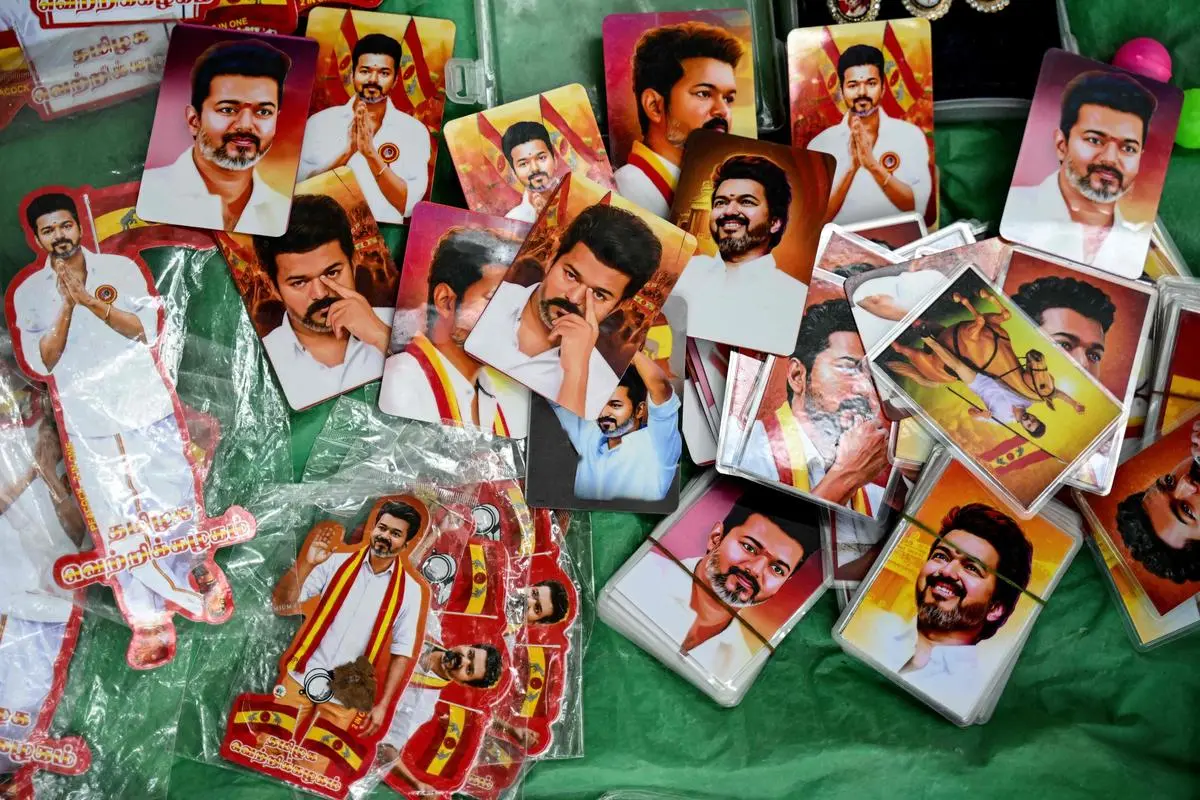
A vendor selling pictures of Indian actor and Tamilaga Vettri Kazhagam leader C. Joseph Vijay during the vote counting for the Tamil Nadu Legislative Assembly elections at the party headquarters, in Chennai, on May 4, 2026. | Photo Credit: R. SATISH BABU/AFP
The DMK’s bastion of Madurai city—comprising north, east, west, central, and south segments—saw strong TVK leads. The party made a significant impact in southern districts including Madurai, Dindigul, Theni, Virudhunagar, Sivaganga, Ramanathapuram, Thoothukudi, Tirunelveli, and Tenkasi. TVK candidates were also leading in several constituencies in the delta districts of Thiruvarur, Nagapattinam, and Mayiladuthurai, as well as parts of Salem. In Kanyakumari, traditionally a Congress stronghold, TVK candidates were ahead in several seats.
Kerala
The UDF rode anti-incumbency to storm several LDF strongholds, leading in 104 seats in Kerala’s 140-member Assembly, well past the majority mark of 71. The Congress was ahead in 62 seats, the IUML in 22, and the Kerala Congress (E) in seven, according to ECI data.
The BJP secured victories in Nemom and Chathannoor. In Nemom, BJP State president Rajeev Chandrasekhar won by a margin of 4,165 votes against LDF minister V. Sivankutty. In Chathannoor, B.B. Gopakumar won by a margin of 4,402 votes. V. Muraleedharan secured Kazhakoottam after a narrow contest.
The ECI declared a win for senior Congress leader Ramesh Chennithala from the Haripad constituency, with a margin of 23,377 votes against CPI candidate T.T. Jismon. Chandy Oommen, son of former Chief Minister Oommen Chandy, won the Puthuppally constituency by a margin of 52,907 votes against CPI(M) candidate K.M. Radhakrishnan, per ECI data.
Chief Minister Pinarayi Vijayan was trailing in Dharmadam in the early rounds, with Congress candidate V.P. Abdul Rasheed leading by over 2,000 votes. In the seventh round, Vijayan gained a lead of over 1,500 votes. LDF minister V. Sivankutty was trailing in Nemom.
Several senior ministers were trailing as counting progressed, including Health Minister Veena George in Aranmula, Cooperation Minister V.N. Vasavan in Ettumanoor, and Industries Minister P. Rajeev in Kalamassery.
Based on the latest data from the Election Commission (as of the afternoon of May 4, 2026), here is the detailed breakdown of seat numbers for the key parties and others across the five States and Union Territories.
| State / UT | Total | Majority | Leading Party / Alliance | Main Opposition | Others / Small Parties |
| West Bengal | 294 | 148 | BJP+: 194 | TMC: 95 | INC: 2, Left/ISF: 3 |
| Tamil Nadu | 234 | 118 | TVK (Vijay): 110 | AIADMK: 67 | DMK+: 51, BJP: 1, NTK/Others: 5 |
| Kerala | 140 | 71 | UDF (Congress+): 103 | LDF (CPI-M+): 35 | NDA/BJP: 2 |
| Assam | 126 | 64 | NDA (BJP+): 100 | INDIA (INC+): 25 | AIUDF/Others: 1 |
| Puducherry | 30 | 16 | NDA (AINRC+): 13 | INC+DMK: 2 | Ind/TVK/Others: 15 |
Specific Party Performance
West Bengal (Tectonic Shift): The BJP has secured a historic mandate, crossing the 190-mark and effectively ending the TMC’s 15-year tenure. The Congress managed to open its account with 2 seats, while the Left Front remains a marginal presence.
Tamil Nadu (The “Vijay” Factor): Actor Vijay’s TVK has upended decades of Dravidian duopoly. While falling just short of the 118-seat majority mark on its own, it has relegated the DMK to third place, a massive upset for the ruling alliance.
Kerala (UDF Wave): Breaking the LDF’s “continuity” narrative, the UDF led by the Congress has swept nearly 100 seats. The BJP maintained its presence with 2 seats (including a strong showing in Nemom).
Assam (Consolidation): The NDA has strengthened its grip further, reaching the 100-seat mark, leaving the INDIA bloc far behind with just 25 seats.
Puducherry (Complex Trends): While the NDA (AINRC and BJP) leads the tally, a significant number of Independents and the debutant TVK have made the race for the majority mark tight.
Early trends had projected the Congress-led alliance leading in 95 constituencies around 1 pm, while the LDF was trailing with leads in just 36 seats. Although anti-incumbency against the ten-year-old LDF government was widely anticipated, the scale of the UDF lead drew attention. The alliance had already shown momentum in recent local body polls and the 2019 and 2024 Lok Sabha elections. In 2021, despite widespread predictions of a UDF return, the LDF managed an unexpected consecutive victory. This time, public dissatisfaction—including controversy over the Sabarimala gold theft case—contributed to the swing, according to political observers.
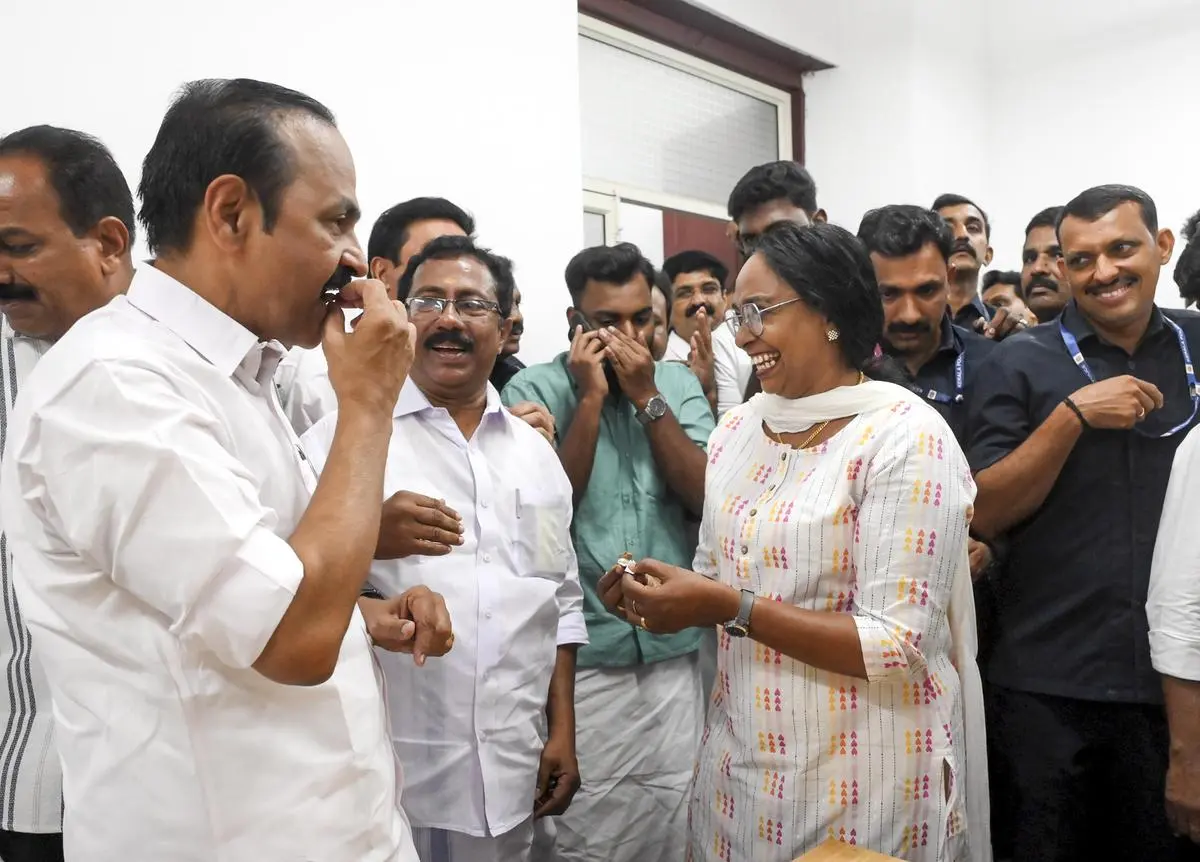
Kerala Assembly LoP V.D. Satheesan celebrating with party workers on the election results day at Cantonment House, in Thiruvananthapuram, on May 4, 2026. | Photo Credit: PTI
In the 2016 Kerala Assembly election, the LDF, led by Pinarayi Vijayan of the CPI(M), won 91 seats, including 58 for the CPI(M) and 19 for the CPI. The UDF won 47 seats, with Congress taking 22 and the IUML 18. The BJP opened its account in the State with one seat. In 2021, the LDF expanded its tally to 99 seats—a historic consecutive re-election. The UDF’s performance declined to 41 seats. A UDF victory this time would also mark a generational shift within the alliance, with leadership now centred around figures such as V.D. Satheesan, who led the opposition in the outgoing assembly.
Assam
In Assam, the BJP was on course for a third consecutive term. The Himanta Biswa Sarma-led BJP crossed the majority mark, leading in 99 seats, while the Congress was ahead in 24 seats. The NDA secured over 50 per cent of votes. The majority mark in the 126-seat House is 64.
BJP’s Hitendranath Goswami defeated Assam Congress president Gaurav Gogoi in the Jorhat seat by a margin of 23,182 votes. Minister Ranoj Pegu won the Dhemaji seat by over 32,229 votes. Cabinet Minister and BPF leader Charan Boro retained the Mazbat constituency by over 55,000 votes. Chief Minister Himanta Biswa Sarma was leading from the Jalukbari constituency by a substantial margin in early rounds of counting.
The BJP’s ally Asom Gana Parishad (AGP) was leading in nine constituencies. The AIUDF, led by Badruddin Ajmal, and the Raijor Dal, led by Akhil Gogoi, were ahead in two constituencies each.
In 2021, the NDA had won 75 of Assam’s 126 seats, with the BJP taking 60.
West Bengal
The BJP was leading in 193 Assembly seats against the TMC’s 92 as counting progressed, according to Election Commission data. The majority mark in the 294-member House is 148.
The BJP’s vote share rose to around 44.8 per cent, while the TMC’s stood at approximately 41.7 per cent. For a party that has held uninterrupted power since 2011, the current trends represent a significant reversal. The BJP was maintaining leads in constituencies where voter deletions during the SIR had exceeded previous victory margins, as well as making inroads into segments the TMC had previously dominated.
West Bengal Leader of the Opposition Suvendu Adhikari, contesting from Nandigram and Bhabanipur, told reporters, “BJP is forming the government,” attributing the party’s performance to anti-incumbency and consolidation of Hindu votes, and also pointing to a division in minority voting patterns in districts such as Malda, Murshidabad.
Puducherry
Puducherry Chief Minister and All India N.R. Congress (AINRC) leader N. Rangasamy won the Thattanchavady constituency by a margin of 4,441 votes, according to the ECI. By 1 pm, the AINRC had won four seats and was leading in nine. Its NDA ally, the BJP, had won one seat and was ahead in two. The Puducherry House has 30 elected seats, with 16 needed for a majority. The AIADMK was leading in one seat, the Congress in one, and the DMK in two.
With inputs from multiple agencies.
Also Read | No country for citizens: Lakhs of voters in limbo after Bengal SIR
Also Read | Vijay’s political signals are suggestive but not fully articulated: Selvaraj Velayutham