








When Chief Election Commissioner (CEC) Gyanesh Kumar announced the schedule for the Assembly elections in West Bengal, Tamil Nadu, Kerala, Assam, and Puducherry at a press conference in New Delhi on March 15, the announcement arrived in the shadow of an unprecedented move by the opposition parties: they had submitted an impeachment notice against him two days earlier.
Kumar is the first Chief Election Commissioner in India’s history against whom such a notice has been formally submitted. The move came after a series of confrontations between the poll body and non-BJP parties, and it represents the strongest expression yet of their mistrust in his ability to conduct free and fair elections.
The Election Commission has faced political crosshairs before. T.N. Seshan’s tenure as the Chief Election Commissioner in the early 1990s saw repeated clashes with both the government and the opposition. In 1992, the Left parties called for impeachment proceedings against him, but the effort did not proceed to a formal motion. Seshan is credited with significant electoral reforms, but his combative style earned him adversaries across the political spectrum.
In a separate episode in 2006, the National Democratic Alliance (NDA), then in the opposition, submitted a memorandum to President A.P.J. Abdul Kalam, signed by over 200 MPs, seeking the removal of Navin Chawla as Election Commissioner. The NDA alleged that Chawla was close to the ruling Congress and questioned his impartiality. (The demand was for the removal of an Election Commissioner, not the Chief Election Commissioner.)
Neither effort resulted in a formal removal. Kumar’s case marks the first time the impeachment mechanism has been formally activated against a sitting Chief Election Commissioner.
On March 13, a 10-page notice was submitted by the opposition in both Houses of Parliament, signed by 130 Lok Sabha MPs and 63 members of the Rajya Sabha, seeking Kumar’s removal. The charges listed in the notice include “partisan and discriminatory” conduct, “mass disenfranchisement” through the ongoing Special Intensive Revision (SIR) of electoral rolls, “proven misbehaviour”, actions that “undermine public confidence”, “partisan exercise” of Constitutional functions in favour of one party, and “deliberate obstruction” of investigations into complaints of “electoral fraud”.
The opposition first considered an impeachment move against Kumar in August 2025, during the SIR in Bihar. It has gone ahead with the notice in the wake of Phase II of the SIR, which covered poll-bound States including West Bengal, Tamil Nadu, and Kerala.
West Bengal at the centre
The SIR in West Bengal has been at the centre of the political storm. The ruling Trinamool Congress accused the Election Commission of deleting its voters under the guise of cleansing the rolls, allegedly to benefit the BJP, which has been keen to wrest the State. Chief Minister Mamata Banerjee argued her State’s challenge to the SIR in the Supreme Court and staged a dharna against the revision.
The Trinamool Congress took the lead on the impeachment notice. It is learnt that the party signed on to a no-confidence motion against Lok Sabha Speaker Om Birla only after the Congress conveyed its readiness to collaborate on the initiative against Kumar.
The process for removing a Chief Election Commissioner mirrors that for a Supreme Court judge: removal can take place only on grounds of proved misbehaviour or incapacity. After the notice is submitted, the presiding officer of either House—the Speaker of the Lok Sabha or the Chairman of the Rajya Sabha—can admit or reject it. If admitted, a three-member investigation committee is constituted, comprising a Supreme Court judge, a Chief Justice of a High Court, and a distinguished jurist. If the committee finds the charges proved, the motion for removal is taken up for voting in Parliament. It requires the votes of a majority of the total membership of each House, and a two-thirds majority of members present and voting.
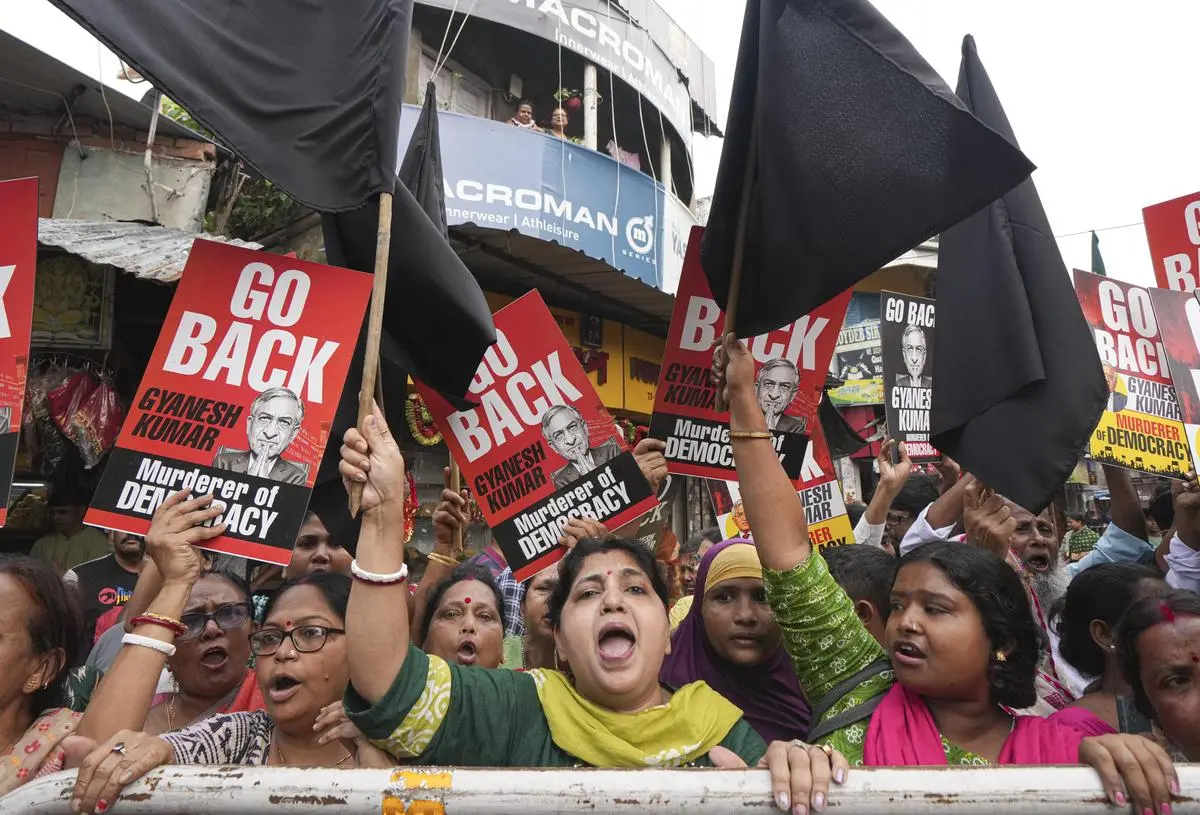
People raising slogans against Chief Election Commissioner Gyanesh Kumar during his visit to the Kalighat Kali Temple, in Kolkata, on March 9, 2026. | Photo Credit: Swapan Mahapatra/PTI
The opposition does not have the numbers to carry the motion. But that, opposition leaders insist, is beside the point. Like the no-confidence motion against the Speaker, which was defeated on the floor of the House, the impeachment notice is intended as a political statement—a formal record of the opposition’s lack of trust in the Chief Election Commissioner. Unlike the Speaker’s case, which was taken up quickly, any proceedings against Kumar would be prolonged and depend entirely on whether either presiding officer admits the notice.
“In 2020, the opposition moved a no-confidence motion against the Deputy Chairman of the Rajya Sabha, Harivansh. In 2024, it moved an impeachment notice against then Vice President and Chairman of the Rajya Sabha Jagdeep Dhankhar. We expressed our no-confidence against the Speaker recently, and now the impeachment notice against the CEC,” said a Congress leader. “For the opposition to move against Constitutional figures in such a short period goes to show that the institutional integrity of these posts has been so badly compromised that the opposition is forced to take extreme steps.”
The appointment and its fallout
Kumar, a 1988-batch IAS officer of the Kerala cadre, was appointed Election Commissioner on March 15, 2024. From the outset, the opposition viewed him with suspicion, treating him as a person handpicked by the ruling dispensation for the top election post.
His elevation to Chief Election Commissioner, announced on February 17, 2025, was the first under the Chief Election Commissioner and Other Election Commissioners (Appointment, Conditions of Service and Term of Office) Act, 2023. Leader of the Opposition Rahul Gandhi questioned the appointment because it was made just a day before the Supreme Court was to hear petitions challenging the Act.
A three-member committee comprising Prime Minister Narendra Modi, Union Home Minister Amit Shah, and Gandhi had met on February 17 to select the new Chief Election Commissioner. At the meeting, Gandhi submitted a dissent note, stating that the committee’s composition as laid down in the 2023 Act and the selection process itself were under challenge in the Supreme Court.
When the government went ahead and announced Kumar’s appointment late that evening, Gandhi termed it “disrespectful and discourteous”. He raised questions about the committee’s composition under the 2023 Act, arguing that it gave the government an unassailable lead in choosing the Chief Election Commissioner and the Election Commissioners, with serious consequences for the Commission’s independence.
The background to this dispute lies in the Supreme Court’s judgment in the Anoop Baranwal vs Union of India case. On March 2, 2023, a five-judge Constitution Bench directed the setting up of a three-member committee comprising the Prime Minister, the Leader of the Opposition, and the Chief Justice of India to advise the President on appointments to the Election Commission. The court said the committee would remain in place until Parliament enacted a law on the subject.
The law enacted by Parliament in December 2023 altered the composition of the committee, replacing the Chief Justice of India with “a Union Cabinet Minister to be nominated by the Prime Minister”.
Gandhi’s objections to the manner in which Kumar was appointed are learnt to be included in the impeachment notice. If his appointment was contested, his tenure has been marked by a widening trust deficit between the Commission and the opposition.
The opposition’s grievances have accumulated. According to opposition sources, the notice refers to alleged voter list irregularities in the Aland and Mahadevapura Assembly constituencies in Karnataka, which Gandhi raised at a press conference in 2025, and what the opposition terms an unsatisfactory response from the Commission. The opposition is especially aggrieved over the SIR, which it claims has resulted in large-scale disenfranchisement and which it alleges has been designed to benefit the BJP. The anti-BJP bloc points to the Supreme Court’s intervention on the SIR and the directions it issued as a commentary on Kumar’s leadership.
Kumar’s press conference on August 17, 2025—held against the backdrop of Gandhi’s accusations of “vote theft” through manipulation of voter lists—further strained relations. Kumar responded to Gandhi’s “vote chori” claims by demanding that he either apologise or submit a signed affidavit supporting the allegations.
“If you use terms like vote theft and mislead citizens, then what else would you call this, other than an insult to India’s Constitution?” Kumar said at the briefing.
The press conference was held on the same day Gandhi launched his “Voter Adhikar Yatra” in Bihar, where the Election Commission had begun an SIR in June 2025, months before Assembly elections. Soon after, 20 opposition parties issued a joint statement criticising Kumar, and it was the first time the opposition parties began considering an impeachment notice against him.
The notice has now been submitted. Regardless of the outcome, the opposition parties have ensured that their expression of lack of trust in the Chief Election Commissioner will be recorded in parliamentary proceedings.
Also Read | The ECI’s credibility collapse
Also Read | The Election Commission is behaving like a stooge of the ruling dispensation: Prashant Bhushan