


The Union government’s decision to quietly initiate the next delimitation exercise while simultaneously advancing the rollout of 33 per cent reservation for women in Union and State Legislative Assemblies marks a turn towards strategic pragmatism. It also underscores that despite victory laps in several State Assembly elections since late 2024, the BJP’s electoral setback in the 2024 general election still haunts its leadership.
Both decisions are aimed at appeasing specific electoral constituencies and sub-national communities. Delimitation based on the 2011 Census—without altering the existing proportion of Lok Sabha seats between various States—is aimed at neutralising the risk of militant regionalism in the south. The intention is also to ensure that parties and leaders in southern India do not turn hostile towards the BJP or States in other regions of India.
Likewise, the initiation of the Nari Shakti Vandan Adhiniyam (NSVA), as the Women Reservation Act is officially titled, is targeted at dispelling the widespread scepticism that followed the passage of the law which lacked a definite implementation timeline. Undeniably, the process of talks with political parties has been kickstarted with the 2029 general elections looming on the horizon. That the BJP top brass has indicated a willingness to recalibrate its stance on both issues suggests that it does not see guaranteed victory in the next general election, despite the party’s successive sweep after 2024 in all State Legislative Assemblies except for Jharkhand.
The Bill reserving 33 per cent of the seats in Lok Sabha and State Legislative Assemblies was passed at a Special Session of Parliament in September 2023, when the BJP was rattled by the prospect of a unanimous opposition under the banner of the INDIA Bloc. The enactment of the law was essentially a political ploy to secure the support of women voters and offset anticipated losses on account of indifferent governance and an elusive economic recovery.
At no point in time did Prime Minister Narendra Modi or other BJP leaders announce a definite timeline. The sequence that was specified made it appear that the earliest the law would become effective was in 2034—a goalpost so far ahead in the future that it made little impact on voters in 2024.
Consequently, the support of women voters that the BJP secured in Assembly elections was owing to cash handouts given across States on the eve of these elections. Like all astute politicians, the BJP leaders, too, realise that this tactic cannot be adopted ad nauseam. The current initiative is an attempt to reinvigorate the party’s strategy.
The implementation of the Women’s Reservation Bill was previously tied to the first delimitation after the 2021 Census, which will now be completed only in 2027. The public perception of the law as a “red herring” arose from the insistence on linking it symbiotically to delimitation. However, the BJP found it necessary to do so anticipating the possibility of the party’s own male leaders rising in protest if one-third of the current Lok Sabha seats (totalling 181) were earmarked for women, leaving only 362 seats for male politicians. If not linked to the next delimitation, the NSVA could boomerang on the BJP; in trying to woo women voters, the BJP could effectively lose the support of a large number of male voters.
The current proposal eliminates this conflict by basing the next delimitation on Census 2011. This decision will allow starting the cumbersome process of redrawing the Lok Sabha and State Legislative Assembly constituencies.
Delimitation is now proposed to be conducted after increasing the number of seats in the Lok Sabha and the State Legislative Assemblies by 50 per cent. This proposal increases the effective strength of the Lok Sabha to 816, of which 272 seats will be reserved for women, while ensuring the total number of seats available to men simultaneously increases.
Such numerics would appease both genders, and all politicians. The decision to construct a new and larger Parliament building now appears prescient to the faithful, while critics see this as part of a political master plan.
A major structural shift
If the proposed enhancement of Lok Sabha (and State Legislative Assemblies) become a reality in time for the 2029 Lok Sabha election, it would lead to a major structural and administrative shift in Indian politics. Unless the opposition can come up with an alternative narrative, the BJP—and Modi specifically—will be able to further draw support from women voters by cornering the credit for these reforms.
The balance of “gender voter” power already greatly favours Modi and the BJP in several States, thanks to Labharti (beneficiary) politics—especially schemes such as Ujwala Yojana, Lakhpati Didi, Namo Drone Didi, Mahila Samman Savings Certificate and schemes that provide “welfare” to women by utilising the Direct Benefit Transfer architecture.
After the 2024 general election, some strands of the political discourse veered towards delimitation, triggering anxiety among States in southern India that had successfully met their population-control targets. Although politically anomalous in a diverse nation like India, wherein the numerically smaller number of people should not have relatively insignificant representation in legislative bodies, the formula of number of seats for different States is constitutionally correct.
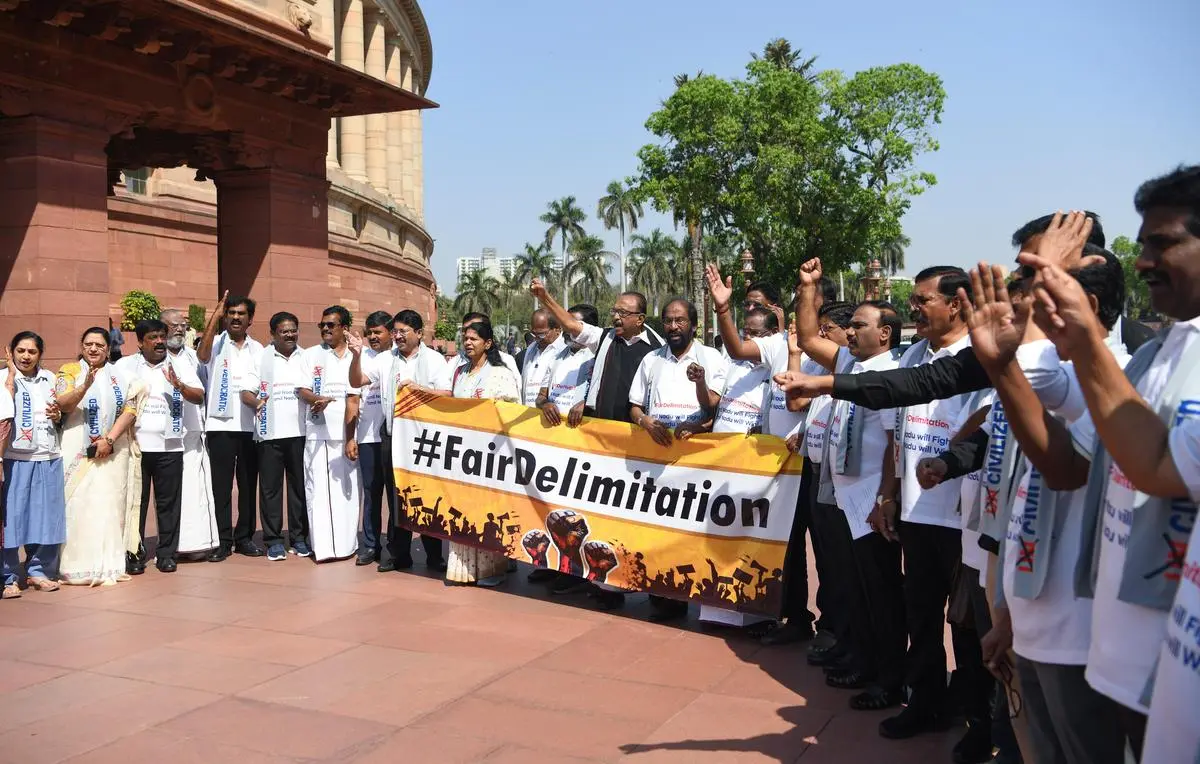
DMK MPs stage a protest against the proposed delimitation at Parliament House premises, in New Delhi, on March 20, 2025. | Photo Credit: RAHUL SINGH/ANI
Article 81 of the Indian Constitution specifies that the ratio between the number of seats and the population of various States should, as far as practicable, be the same across the country. Due to this constitutional provision, the States in southern India were predictably apprehensive about losing legislative representation. This could be prevented only by political consensus. The government’s proposals which have been shared with some parties, is likely to find widespread acceptance, with some amendments.
The government is yet to share its opinion on providing constitutional guarantee about the proportion of seats between States remaining unchanged for the next 30 years as rightly demanded by Tamil Nadu Chief Minister M.K. Stalin. It will be a “please-all” formula in the event of the BJP accepting this demand, despite it likely to benefit the BJP more than other parties.
By retaining the existing proportion of seats between various States, irrespective of it amplifying the existing population-to-seat imbalance between States, the BJP has prevented the southern States from feeling further alienated.
For three-and-a-half decades, beginning with the 1991 Lok Sabha election, the BJP has maintained a significant presence in Karnataka. The party is also not a completely insignificant force in the other States and has ambitions to enhance its strength in the region.
The BJP may consider accepting this all-win formula, along with the constitutional undertaking, in pursuit of its ambition to emerge as a complete national party. It is also not expected to raise hackles among States in the north, west and the east because the pro-rata seat increase ensures that every State shall have 50 per cent more seats than at present.
In the 12 years that the BJP has been in power, it has been dogged by the accusations of “democratic backsliding” and “Brahminical patriarchy”. However, this initiative will provide the party’s spin doctors an opportunity to rebrand the party’s global image and improve its standing on various indices.
The BJP is likely to project the process, once completed before the 2029 election, as the most comprehensive overhaul of India’s democratic architecture, while also claiming credit as the party that spearheaded it. This will have a spiralling effect on several other facets of the Indian Republic which cannot be fathomed at this stage.
Prior to 2014, the BJP’s agenda was visualised as restricted to three contentious issues: the construction of the Ram temple, the abrogation of Article 370, and the passage of the Uniform Civil Code (UCC).
While the first two objectives have been fulfilled in totality, the third goal has witnessed considerable progress, with the UCC being legislated from the BJP-ruled States: Gujarat is the second State after Uttarakhand to have enacted the law on March 25.
From 2019 onwards, the BJP under Modi has evolved into a party that constantly generates fresh objectives once the older ones are fulfilled. It would be politically naïve to imagine the latest initiative of the government as being the last before 2029. After being in the pipeline for decades, the push for “One Nation, One Election” is already gaining momentum.
It is not beyond the realm of possibility that the present Lok Sabha will enact the legislative changes needed to give effect to the recommendations of the High-Level Committee on Simultaneous Elections.
If the BJP successfully gets these laws passed by Parliament, the character of the Indian Republic will have been truly “Modi-fied”. Consequently, by the time the next Lok Sabha elections are held, Modi shall have truly “changed” the face of India.
Nilanjan Mukhopadhyay is an author and journalist based in Delhi-NCR. His latest book is The Demolition, The Verdict and The Temple: The Definitive Book on the Ram Mandir Project. He is also the author of Narendra Modi: The Man, The Times.
Also Read | Women voters of India: A force to be reckoned with
Also Read | Delimitation debate: Why southern States fear losing political voice after 2026