


The celebration of Ambedkar Jayanti involves a lot of enthusiasm and fervour across India as well as in the diaspora, especially amongst Dalit-Bahujan groups. The celebration marks the birth anniversary of the anti-caste icon Babasaheb Ambedkar, remembered for his lifelong commitment to the depressed classes.
The celebration is also a part of political optics in which Ambedkar’s iconography becomes representative of the ideas that political parties want to pick and choose from. Notwithstanding the divergent political readings and misreadings of Ambedkar, his icon has attained a stature in contemporary public life that makes his legacy inescapable. This political desirability for proximity with Ambedkar is the reason why he has become iconised. Ambedkar is reinscribed not merely in the act of memorialisation, but in the everyday democratic-symbolic ways in which his philosophy is constantly reworked and reframed.
India has constantly strived towards socio-political mobilty, particularly through social movements and public policies, claiming its authenticity through the Constitution. For the oppressed caste groups, the claim for social justice needed an organic intellectual who could resonate with their everyday experiences and also motivate them. For these voices, the philosophy of Ambedkar generates ideas of social justice that pitches for a structure of solidarity.
The celebration of Ambedkar Jayanti is significant of Ambedkar’s iconography, but his visual presence is not limited to this. Unlike this sanitised iconography that comes to life only on specific occasions, Ambedkar’s imagery is part of everyday resistance and celebration as well. It is significant to note in this context that Ambedkar’s image with the Constitution is part of the protest narrative. During the CAA-NRC protest, Ambedkar’s image was creatively curated to become part of public memory. Similarly, whether it is a protest by women athletes against molestation, a protest in support of the UGC anti-discrimination bill or against the Transgender Bill, 2026, Ambedkar’s imagery is ubiquitous.
The use of Ambedkar’s iconography at these protest sites symbolises how the idea of social justice is contagious and travels beyond enclosed identities. While Ambedkar’s credentials as an anti-caste hero are impeccable, his philosophy resonates within the wider spectrum of democratic-social justice values, something that makes his iconography interchangeable with constitutional ethics itself.
The symbol of Ambedkar pushes for the everyday solidarity of marginalised identities. His image connects marginalised voices. If the notion of “we”ness is fundamental to the idea of nation-building, it is the metaphor of Ambedkar that weaves it all together. It is a significant part of the vocabulary that fights to keep democratic values alive.
Ambedkar believed that a country’s democratic values are upheld only when people question and contest it, and not accept the political process as a given. Reflecting on the nature of the Indian democracy he said, “… it is quite possible in a country like India… that there is a danger of democracy giving place to dictatorship”. He believed that the grammar of anarchy should be replaced by a constitutional grammar.
In the acknowledgement of Ambedkar’s iconography lies the acceptance of his philosophy of equality and social justice. Ambedkar’s icon today has traversed far from a narrow/selective reading of Ambedkar or reducing him only to a Dalit leader, acknowledging the wide terrain in which his claims for constitutional ethics and vision are actually embedded. While it is true that iconography often creates a larger-than-life image and, unfortunately, the tendency to hero-worship the man rather than his philosophy, in such reiteration also lies the claim of history and the role of subaltern identities that have been historically sidelined.
The iconography of Ambedkar also opens up the possibility of understanding the trajectories of Indian history and polity. From the popular images of Ambedkar handing over the Constitution to Rajendra Prasad to contemporary art practices that have sprung up around him, the imagery is a trajectory of history in itself. It is a reminder that the Constitution remains the soul of nation and generates a public consciousness towards what morality of democracy means.
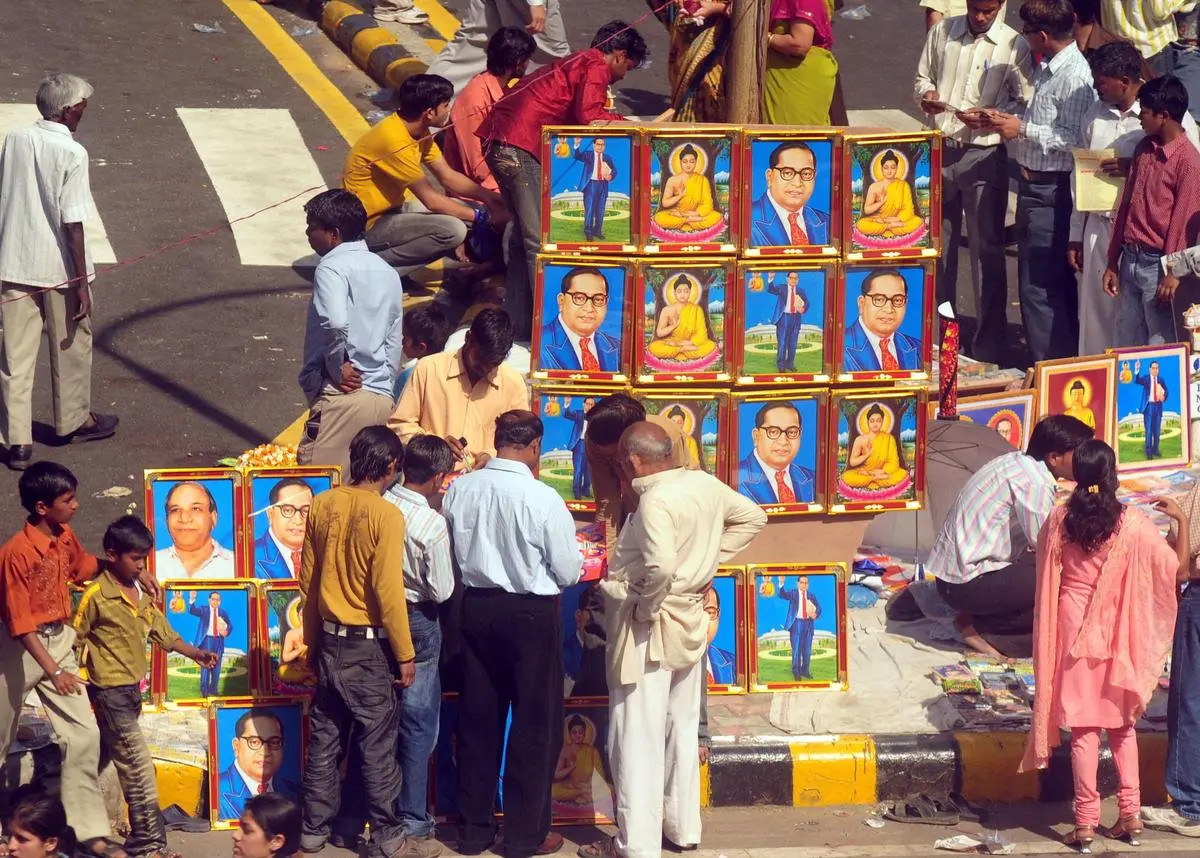
Pictures of B.R. Ambedkar and Buddha displayed for sale on Parliament Street in New Delhi. A file photograph. | Photo Credit: S. Subramanium
The presence of Ambedkar iconography at protest sites is a reminder of his own struggles and claims for dignity. Thinking of anti-caste history was never an easy journey, especially at the time when Ambedkar was writing. Ambedkar’s life was filled with difficulties and constraints. In his autobiographical work, Waiting for a Visa, he explains the hardships he had to undergo as an “untouchable”, despite his intellectual acumen and several degrees. The journey from that indignity to becoming memorialised as an icon of social justice itself speaks of his significance in the conceptualisation of Indian democracy.
Ambedkar in digital worldview
With the emergence of new media, digital topography, and AI, Ambedkar’s iconography has shifted from the street to the online world. Digital gift cards, WhatsApp messages, reels, YouTube shorts, and other forms of digital circulation now use his image. This presence has a significant contribution to make in the spread of anti-caste awareness, given its widespread reach.
When anti-caste political movements have taken a back seat, the digital space has offered a fresh space to promote Ambedkar’s ideas and anti-caste awareness. These are the new counter-publics in which Ambedkar is imagined, and the digital space is the new canvas for cultural reimagination.
The presence of the Dalit-Bahujan in the digital space is not limited to pain, agony, or violence, but expands to pride and joy in being an Ambedkarite. This everyday assertion often comes through showcasing Ambedkar icons in everyday lives and belongings. Ambedkar songs are also a part of this digital world, and together they all make for the constant reiteration of the Ambedkarite legacy.
The digital space is also a contested space, especially in terms of negative comments, casteist slurs, trolls, and so on. This is the other side, where questioning caste hegemony remains unacceptable to Savarna thinking. The language of violence, indignity, and threats reflects the non-acceptance of Ambedkar’s modern values of constitutionalism. From the physical destruction of Ambedkar’s statues and images in public spaces to the digital resistance and hatred, the critical question remains: is India’s journey to being truly modern complete? Why then does Ambedkar’s presence discomfort some digital audiences? The answer is that Ambedkar’s continued resonance unsettles the fundamentals of the caste structure. The act of digitally reclaiming his legacy through visual and sonic practices brings back to life his promises of a modern, democratic India that cannot rejects caste.
Bhim Jayanti as a counter-public
Bhim Jayanti marks the deification and eulogisation of Ambedkar and is an intense celebration across India, which subverts caste and claims equality. It is especially significant for Dalit-Bahujan women, who were doubly marginalised due to their caste identity. They come together, in blue and white clothes, sing, celebrate, and form a joyful communion. Their presence also speaks of the Ambedkar’s contribution towards gender equality, particularly his position against Brahmanical patriarchy as well on women’s property rights and other reforms brought by the Hindu Code Bill. The shift of Bhim Jayanti from a spectacle to a counter-public is marked by its democratic potential to generate space for critical thought and its ability to rise against injustice.
The ubiquity of Ambedkar’s image today reflects a growing popularity and a quotidian public presence. In the political sphere, his image can immediately connect to the subaltern masses while in the civil sphere, he is upheld as the symbol of constitutionalism. The shift from anti-caste icon to nation-building figure is remarkable.
This new “publicness” of Ambedkar reflects a gradual growth of the democratic paradigm that India is striving for. In his speech on the last day of the Constituent Assembly meetings, Ambedkar said, “…however good a Constitution may be, if those who are implementing it are not good, it will prove to be bad. However bad a Constitution may be, if those implementing it are good, it will prove to be good” (Babasaheb Ambedkar Writings and Speeches, Vol 11).
The celebration of Ambedkar, whether at a protest site or a cultural event, should strive towards recollecting what his iconisation truly stands for. If it is reduced to empty deification, it will be counter to what Ambedkar and his philosophy stood for, and will end up being vacuous words only. His memorialising must stand for something much more substantial and deep-seated.
K. Kalyani is Assistant Professor at Azim Premji University, Bangalore. Views are personal.
Also Read | Caste over Constitution
Also Read | Schools as sites of dissent