


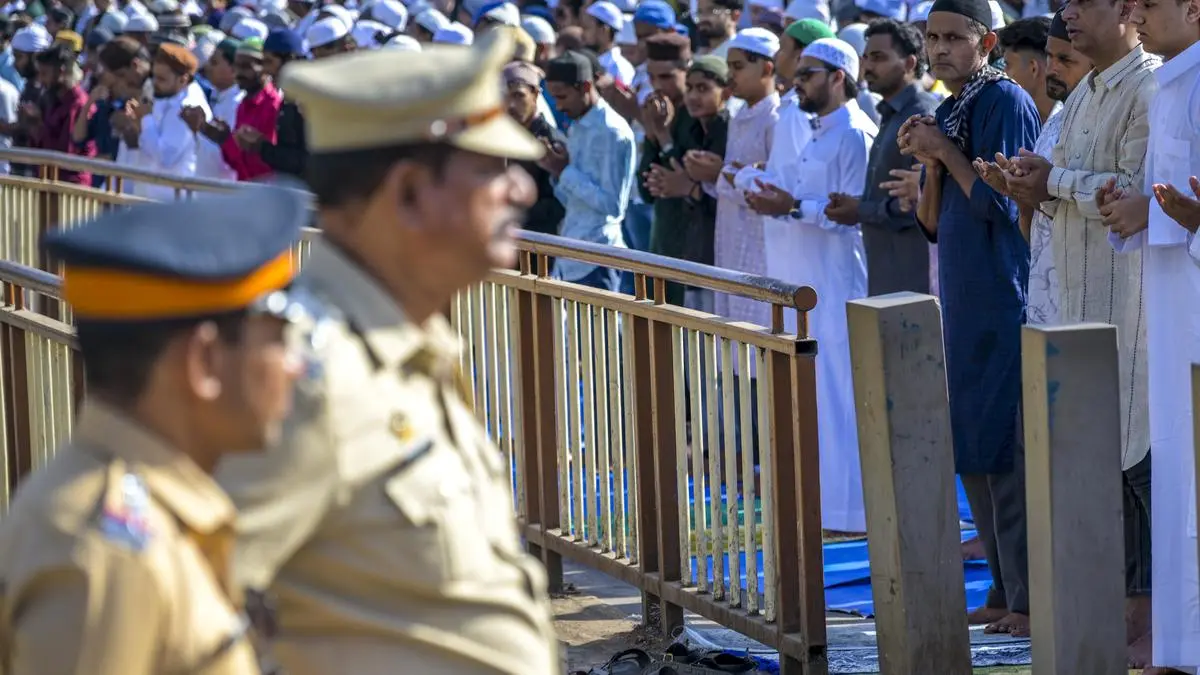
No rule was changed, yet the Devendra Fadnavis government succeeded in making Bakr Eid a tension-filled day for Mumbai’s Muslims. The Maharashtra Chief Minister managed this without uttering a word, unlike his Uttar Pradesh counterpart, who makes sure before every Eid to remind Muslims and his own legion of fans that he’s waiting to crack the whip in case Muslims deviate from the strict norms set by him for their festivals.
In Mumbai, municipal rules allow the ritual of goat sacrifice on Bakr Eid within residential society premises, subject to certain conditions. The Bombay High Court, in its 2019 order, restrained the Brihanmumbai Municipal Corporation (BMC) from granting permission for animal slaughter inside individual residential flats. However, it did not impose a complete ban within residential community premises. Yet, at least three large housing societies had their permissions, issued by the municipal corporation, withdrawn on the eve of Bakr Eid, leaving Muslims scrambling to find ways to perform a religious ritual they felt was essential to their belief.
Three societies in a megapolis like Mumbai would have been a drop in the ocean had the developments and their ugly denouement not played out in front of the media. Every local and many national TV channels focussed on the story, repeatedly playing visuals of Muslims forced to take their goats out of the building societies. The result: the hounding of a community on its second most important religious festival became a public spectacle. Social media was awash with revulsion and outrage against Muslims, based as always on half-truths and hyperbole.
What made this last-minute drama seem scripted was the involvement in all three incidents of politically connected outsiders: the local BJP corporator; the Bajrang Dal or Vishwa Hindu Parishad (VHP); and State BJP vice president Kirit Somaiya. A former BJP MP who was denied a ticket in 2019, Somaiya sprang into action after the defeat of his party in Maharashtra in the 2024 Lok Sabha election, blaming it on Muslims voting en masse for the INDIA bloc, and calling it “vote jihad’’. The same phrase became Devendra Fadnavis’ refrain a few months later in the run-up to the State Assembly election.
After the BJP swept these polls, Somaiya made it his mission to go after Muslims, raising the bogey of Bangladeshis and Rohingyas wherever Muslims constituted the majority. Thanks to him, thousands of Muslims in Malegaon have had their birth certificates cancelled without having been proven to be illegal immigrants; and Mumbai’s mosques have had their loudspeakers removed.
None of this would have been possible without support from the very top. Today, Somaiya is a de facto power centre, moving around with a police escort, with the media hanging on to his abusive rants and often even egging him on.
Somaiya’s campaign
For Bakr Eid, Somaiya started his campaign 10 days before the festival, urging the BJP Mayor of Mumbai to ban goat sacrifice within residential premises. Given the High Court judgment, such a ban would have been immediately challenged. The ban, therefore, did not happen, but Somaiya achieved his aim.
Hindus either unhappy with the goat sacrifice being performed within their society premises, or those simply wanting to harass Muslims, knew whom to call. Given Somaiya’s clout, the BMC and the cops fell in line.
Interestingly, while in two of the three societies, the sacrifice had been performed inside the premises for the past 20 years, despite Hindu residents constituting a majority there, in one society, the first to face the brunt of the VHP’s intervention, goats were never sacrificed inside the premises but only kept there until Eid, then taken away for sacrifice at a designated spot. This important difference was deliberately ignored by the VHP and Somaiya, of course, but also by the police and the BMC and, most significantly, the media.
The manner in which their religious festival was marred, despite having followed all the rules, has left Mumbai’s Muslims resentful and alienated. In this atmosphere, a minority among them who actually disapprove of conducting the sacrifice within residential premises, especially if Hindus live alongside, feel hesitant to express their views.
However, while sacrifice within a housing society isn’t exactly a desirable practice, what’s the alternative? The 109 places—licensed butcher shops and small open grounds—designated by the BMC this year for the sacrifice would hardly have been enough to accommodate over one lakh goats that were purchased for the occasion. Municipal corporations in Maharashtra have the power to build temporary slaughterhouses for Bakr Eid; in some Muslim-majority towns, they have done so. But with the BJP in control of Mumbai’s municipal corporation (and of a majority of Maharashtra’s local bodies), it’s hardly likely that it will take measures to facilitate a Muslim ritual, even if it benefits the Hindu farmers who rear goats.
The happenings around Bakr Eid are a vivid illustration of what our society has become after 12 years of BJP rule. Minorities may follow all the rules, but that is no guarantee against the parallel power system that is now in place, operated by vigilantes and unelected leaders, with considerable support from the media. Will the courts provide a solution?
Jyoti Punwani is a Mumbai-based freelance journalist.
Also Read | Himanta Sarma’s hate speech is more divisive than the UGC regulation. Will the Supreme Court stop him?
Also Read | Mohammad Deepak and the idea of India