
惯性聚合 高效追踪和阅读你感兴趣的博客、新闻、科技资讯
阅读原文 在惯性聚合中打开

推荐订阅源

Cloudbric
Cloudbric
有赞技术团队
有赞技术团队
CTFtime.org: upcoming CTF events
T
Threat Research - Cisco Blogs
L
LangChain Blog
Simon Willison's Weblog
Project Zero
Project Zero
Latest news
Latest news
S
Schneier on Security
Cisco Talos Blog
Cisco Talos Blog
MyScale Blog
MyScale Blog
C
Check Point Blog
IT之家
IT之家
P
Palo Alto Networks Blog
Threat Intelligence Blog | Flashpoint
C
CERT Recently Published Vulnerability Notes
Scott Helme
Scott Helme
The Hacker News
The Hacker News
C
CXSECURITY Database RSS Feed - CXSecurity.com
G
Google Developers Blog
T
Tor Project blog
T
Threatpost
D
DataBreaches.Net
博客园 - 【当耐特】
酷 壳 – CoolShell
酷 壳 – CoolShell
T
Troy Hunt's Blog
奇客Solidot–传递最新科技情报
奇客Solidot–传递最新科技情报
Vercel News
Vercel News
云风的 BLOG
云风的 BLOG
NISL@THU
NISL@THU
P
Privacy & Cybersecurity Law Blog
cs.AI updates on arXiv.org
C
Cisco Blogs
博客园_首页
S
Securelist
T
The Exploit Database - CXSecurity.com
Last Week in AI
Last Week in AI
量子位
U
Unit 42
Know Your Adversary
Know Your Adversary
Hugging Face - Blog
Hugging Face - Blog
S
Security Affairs
Google Online Security Blog
Hacker News: Ask HN
Hacker News: Ask HN
Webroot Blog
Webroot Blog
S
SegmentFault 最新的问题
Engineering at Meta
Engineering at Meta
N
News and Events Feed by Topic
P
Proofpoint News Feed
阮一峰的网络日志
阮一峰的网络日志

Latest Politics News | Frontline | Frontline

West Bengal election: How ethnic identities are reshaping the TMC-BJP contest BJP turns Women’s Reservation Defeat into a New Campaign Plank in Uttar Pradesh Dantewada Cricket Event and India’s “Post-Maoist” Claim Maharashtra’s Sugar Mills Face a Deepening Economic Crisis Election Commission Bias in West Bengal Polls 2026? Tamil Nadu election 2026: Cash-For-Votes and Missing Voters One Year After Pahalgam: Violence, State Response, and Kashmir Narrative West Bengal Election 2026: Kudmi, Adivasi, Matua Identity Politics Explained When majoritarian march meets its first hard stop Will Didi prevail over Delhi? What Nithin Raj’s death says about caste in Kerala’s private colleges West Bengal election 2026: Identity politics, vote banks, and the BJP vs Trinamool battle Exclusive interview | Tamil Nadu Chief Minister M.K. Stalin talks about Assembly election 2026, fiscal authoritarianism, and the fight for federalism Women’s Reservation Bill 2026: Modi’s Delimitation Trap Exposed What was wrong with BJP's so-called Women Reservation Bill J&K liquor controversy explained: Tourism, revenue, and politics | The Kashmir Notebook Ep 13 Delhi Pink Saheli Card 2026: Domicile Rule Hurts Women Manipur’s Rumour Economy: How Disinformation Fuels Mob Violence Punishing the South: Modi’s Delimitation Plan and the Politics of Control The Vijay Factor AIADMK Delta Strategy: Can Leema Rose Win? Maharashtra Shows Why Women’s Reservation May Aid Elites CBI Reply in Kejriwal Case Exposes Judicial Conflict Norms Tamil Nadu Election 2026: Social Media Narratives, War Rooms, and Players Modi’s Roadshow and BJP’s High-Stakes Push in South Tamil Nadu SIR West Bengal Voter Exclusion Case 2026 TN Assembly Polls 2026: Senthil Balaji and SP Velumani Clash for Western Belt Supremacy Women’s Reservation Act Amendments Raise Delimitation Fears Partha Chatterjee’s For a Just Republic and the Limits of the People-Nation Hungary Election 2026: Orbán Defeated, Magyar Wins Big Free Speech Crackdown in India: Is Dissent Under Threat? Ambedkar Jayanti and the New Publicness of Protest Politics Implementing Women’s Reservation: Why a Hybrid 651-Seat Lok Sabha Model Outperforms Mass Expansion Ambedkar and Free Speech: Who Controls Dissent in 2026? Reforming Tamil Nadu's Local Governance: Why MLAs Aren't Fixers in 2026 West Bengal voter list controversy explained | Why names are being deleted Will Vijay’s TVK disrupt DMK and AIADMK? | Tamil Nadu election 2026 Constitutional Morality vs Social Morality in India 2026 Amit Shah’s Anti-Conversion Promise Opens a New Faultline in Punjab Politics Why Indian Shias Protest for Iran: History of Solidarity (2026) West Bengal Voter List Row 2026: “Votercide” Debate From Grief to Politics: Porkodi Armstrong and the Battle for Dalit Power in North Chennai West Bengal election 2026: Will Babri Masjid split the Muslim vote? West Bengal Communal Politics and the 2026 Election Battle Raghav Chadha-AAP Rift Explained: Rise to Fallout (2026) Why India Is Not Energy-Secure Amid Global Oil Shocks India IT Rules 2026: Threat to Free Speech? Iran War Ceasefire Signals a Shift Toward Multipolar Deterrence 2026 Assembly Polls: Congress vs BJP Power Test Kerala Assembly Election 2026: LDF Anti-Incumbency vs UDF Momentum Gujarat Local Polls: AAP Rise Deepens Congress Crisis SIR controversy deepens fear of Muslim disenfranchisement in Bengal Kerala Election 2026: LDF, UDF, and the BJP “B Team” Charge Who will win Kerala Assembly Election 2026? LDF or UDF? Assam Polls: Cash Transfers Mask Stagnant Incomes and Job Distress Jaishankar and India's Diplomacy Crisis After Nitish Kumar, Bihar BJP faces its biggest test: caste coalition without a ‘Mr Clean’ Actor Vijay and Politics: An Emerging Landscape N Rangasamy’s 2026 Puducherry Poll Strategy and Power Play Kashmir Encounter Killing Sparks AFSPA Debate 2026 GST Federalism Crisis 2026: How States Lost Fiscal Power US-Iran War 2026: Petrodollar Stakes Behind Hormuz Clash White Savior Complex in Arab Regimes Drives Ukraine Deals Not Self Reliance UPA Corruption Narrative vs Court Verdicts 2026 Mathur Sathya Case Exposes Patriarchy in Progressive Politics India Needs a New Economic Model Beyond Neoliberalism Why J&K MLAs Are Fighting the Lieutenant Governor Over Security Puducherry election 2026: Can Congress return to power? | V. Narayanasamy explains Pawar Family Rivalries Stall NCP Factions Merger in Maharashtra How Foreign Thinkers Shaped Hindutva’s Rise Naxalism’s Shift: Armed Struggle to Ideological Influence G. Haragopal on Tribal Resistance, Maoist Surrenders, and Politics DMK manifesto 2026: Key promises, alliances, & welfare politics Rajya Sabha Polls Expose India’s Open Secret: Cross-Voting and Poaching State Assembly Elections 2026: How Voter Dynamics Are Shaping India DMK Seat-Sharing Deal Reveals a Tougher M.K. Stalin What Iran Means to Kashmir | War, Identity, and 5000 Years of History Thirumavalavan Signals Shift in Tamil Nadu Politics Golgappa diplomacy and the fragile reset in India-Bangladesh ties Tamil Nadu election 2026: DMK vs AIADMK, alliances, and Vijay’s entry Is Indian Cinema Losing its Moral Voice? How the BJP’s strategic pivot on delimitation and women’s quota will reshape the 2029 electoral landscape Why INDIA Bloc Collapsed in Puducherry | DMK, Congress & VCK Rift Explained West Bengal 2026 Assembly Elections: Candidate Controversies Stir Party Rebellions Tamil Nadu Elections: CPI(M) on DMK Alliance & BJP Fight Ashok Kharat Scandal Exposes Maharashtra’s Godman–Power Nexus India Migration Crisis: Gulf Conflict Exposes Gaps 2011 Election Petition Against Stalin Returns Ahead of Tamil Nadu Election Delhi Budget 2026: Growth Claims and Welfare Gaps Tamil Nadu NDA Deal Reveals AIADMK’s Upper Hand Inside AIADMK Strategy: EPS Leadership, BJP Alliance, and TVK Challenge Vijay Politics: Can TVK Break Tamil Nadu's DMK AIADMK Duopoly? How Eid went under siege in Uttam Nagar Assam Elections 2026: BJP Faces Tribal Backlash Over Evictions in Karbi Anglong First Impeachment Notice Against India’s CEC Shakes Politics 2026 Hindu Rashtra Debate: 2026 State Elections Test Secular India Tamil Nadu Election 2026: How Gender and Gen Z Voters are Reshaping the Dravidian Power Struggle Maharashtra’s Anti-Conversion Bill and the Politics of 'Love Jihad' Post-Colonial Nationalism and the Western Far Right: Why the Comparison Fails Gujarat's proposed marriage registration amendment 2026 polices choice
Tamil Nadu Assembly Election 2026: Why the Unattached Urban Voter Holds the Key in a Waveless Contest
2026-04-22 · via Latest Politics News | Frontline | Frontline

As the election campaign in Tamil Nadu wound down on April 21 ahead of the Assembly election on April 23, one question has occupied political parties and strategists: what goes on in the mind of the voter who is not committed to any organised political party? Which way will he or she sway?

This question is important because all parties have a fixed cadre voter base, and it is the votes of the unattached voter that they desperately seek, especially in a waveless election like this one. Across the State, political observers and journalists have not identified any wave favouring any single party. While the presence of actor Vijay and his political party, the Tamilaga Vettri Kazhagam (TVK), has created huge euphoria among some sections of the youth, it falls well short of a wave in an election.

The ruling Dravida Munnetra Kazhagam (DMK) vote base is between 25 and 30 per cent while the All India Anna Dravida Munnetra Kazhagam (AIADMK) cadre vote base, which shrank a little in 2021, is between 20 per cent and 22 per cent depending on the constituency. The national parties, the BJP and the Congress, have a fraction of this number. So do the smaller political parties, including the Left parties. “This is the minimum guarantee for both Dravidian parties. They can be sure of getting these minimum numbers,” said ”Aspire” Swaminathan, a political strategist and former AIADMK IT wing secretary.

According to Swaminathan and other experts, the voter has already decided how he or she will vote, even if the decision is to go for NOTA (None of the Above). “I would not say that the percentage of the undecided voter is big in Tamil Nadu. It can be 1 to 1.5 per cent,” he told Frontline. There is also a rural and urban divide in the unattached voter.

A quick look at past elections as well as conversations with strategists and leaders of political parties indicate that this vote, in the normal course, is captive to two factors—caste and the “insider” tag for candidates. Thus, either caste affiliations will impact this individual voter or they will decide based on whether the candidate is considered an “insider” or “outsider”. But since many rural affiliations or networks have a basis in caste, it essentially means that the ball comes back to the “caste” court.

“Rural voters are well aware of what affiliations matter,” said a senior Viduthalai Chiruthaigal Katchi (VCK) functionary from Perambalur, speaking about how the rural voter responds when he or she is undecided. “In all the elections that I have been part of, in the end, caste is the factor. If the candidate is from the same caste, then the next factor is whether the candidate is a local person or an outsider,” said the functionary, who stays in the background and has managed elections for the VCK over the past three decades.

The unattached voter can also be swayed by other factors. “Some voters are interested but unaffiliated and there are others who are without any interests or stakes,” said Raveendran Duraisamy, a political analyst. “Interested voters are from the major castes and [religious] minorities. They vote strategically, even though their choice can differ from one election to another,” he said. For instance, in 2024, the Social Democratic Party of India (SDPI) was in alliance with the AIADMK, but after the AIADMK allied with the BJP for the 2026 election, the SDPI, with its major base among Muslims (who make up approximately 5.86 per cent of the State’s population), has moved away and will vote for the DMK-led Secular Progressive Alliance (SPA).

Unattached voters belong to smaller caste groups, who do not have the numbers to become a lobby. They are often largely urban. They can be linguistic minorities or micro caste groups. In a close election, their votes become very important. This unattached urban voter is the person that all political parties are eyeing. That is why the DMK released an additional manifesto in Chennai, the Naam Tamilar Katchi (NTK) published an unprecedented advertisement in The Hindu on April 21, and Andhra Pradesh Chief Minister N. Chandrababu Naidu campaigned in support of the AIADMK-BJP’s National Democratic Alliance (NDA) in Chennai on April 21. Each of these moves needs an explanation.

The DMK realised that despite its overwhelming presence in Chennai, it needs to get last-minute traction. So it took the “development” approach to woo the undecided voter. While this is something the party has pushed from Day 1, the absence of any other emotive factor made it use the same push for undecided urban voters too—that its government is committed to development and its leader’s image is much better than that of other party leaders.

For the NTK, it is a question of survival as it struggles to maintain its flock and its numbers. The party has been the beneficiary of first-time voters across many elections. This time that voter has another choice—actor Vijay’s TVK. This is where the NTK’s change in strategy comes into play. It has fielded as many as six Brahmin candidates in a bid to attract this community. The TVK, too, has fielded Brahmins. The two parties are banking on the fact that the two main political alliances have no Brahmin candidates in the field. NTK’s advertisement in The Hindu is part of this strategy, to get the urban Brahmin vote.
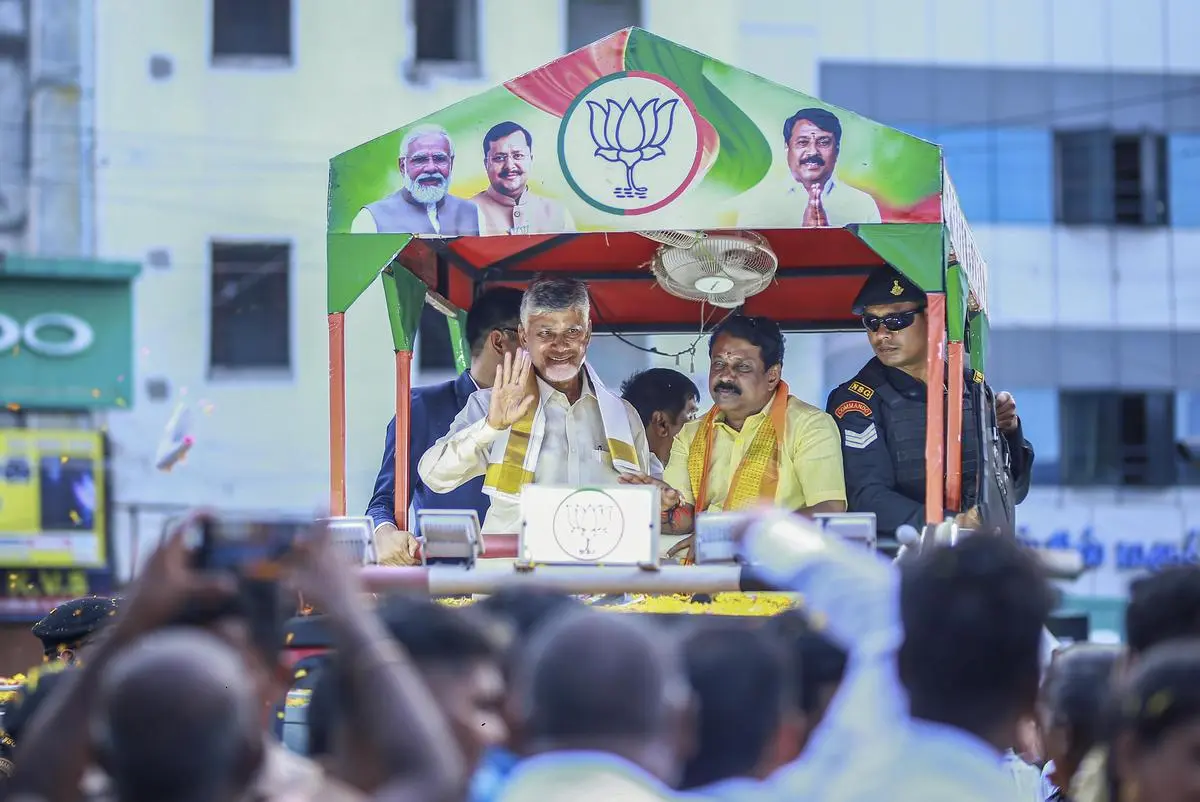
Andhra Pradesh Chief Minister N. Chandrababu Naidu campaigns in support of BJP candidate from Sattur constituency Nainar Nagendran ahead of the Tamil Nadu Assembly election, in Virudhunagar, on April 21, 2026.

Andhra Pradesh Chief Minister N. Chandrababu Naidu campaigns in support of BJP candidate from Sattur constituency Nainar Nagendran ahead of the Tamil Nadu Assembly election, in Virudhunagar, on April 21, 2026. | Photo Credit: PTI

Naidu’s presence in Chennai is to appeal to the sizeable Telugu-speaking population in Chennai. While this looks like a strategy that the DMK-led SPA has failed to adopt, a DMK leader counters: “A lot of DMK leaders are native Telugu speakers. The question of the party neglecting Telugu speakers does not arise.” Besides, he added, “Language is not a voting group; even within this group, it is caste that matters.”

For over a decade now, it is the same unattached urban voter who has been bombarded by the BJP’s slogan for “a Tamil Nadu without kazhagams”. The BJP is responsible for increasing the voter base of people who do not want to vote for either Dravidian party. The saffron party under Narendra Modi began talking about the corruption of both these parties. This is what prompted the AIADMK supremo Jayalalithaa to ask the crowd in 2014: “Andha Gujarat Modi-ya indha Lady-ya?” [That Gujarat Modi or this Lady?]. The voters of Tamil Nadu chose the “lady”, but the BJP continued with the script of the “corrupt” Dravidian parties.

In 2024, the BJP’s script of a Tamil Nadu without either Kazhagam was sharpened because there were three fronts fighting the election—one led by the DMK, another by the AIADMK, and a third by the BJP. In 2026, the BJP could not use this script because it is in a formal alliance with one of the Kazhagams, the AIADMK. However, thanks to the tech-savvy NTK and TVK cadres, the old BJP social media campaigns attacking both Dravidian parties have made a comeback, embarrassing the NDA partners. Tamil Nadu has a large urban base (over 50 per cent of its population lives in urban areas), and the message is spreading widely.

Analysts define the last category of unattached voter as the person who does not want their vote to be wasted. This voter always votes for the party or combine they think is set to win. After all, picking a winner is a great feeling.

Also Read | This election is a battle between ‘Tamil Nadu Team’ and ‘Delhi Team’: M.K. Stalin

Also Read | Vijay factor might hit AIADMK more than DMK