


The 2023 delimitation exercise in Assam redrew constituency boundaries to reflect population shifts—changes widely seen as benefiting the ruling BJP. The impact is expected to be significant when results of the 2026 Assembly election, held on April 9, are declared on May 4. Muslim-dominated seats reduced from around 29–30 to 22–23, while Muslim-influenced seats dropped from 41 to 26.
The restructuring comes at a time when Muslim voting patterns in Assam were already in flux. Once a reliable support base for the Congress, Muslim voters now make more deliberate choices, driven by local factors and the altered political landscape following the BJP’s rise. But for many, the central concern remains community protection—quam bachao (save the community).
Analysts expect the results to show tight contests in several Muslim-majority constituencies, particularly between the Congress and the Assam Gana Parishad (AGP), a BJP ally. “Hindu-Muslim polarisation was clearly visible this time,” said Dr Biswajit Choudhury of Handique Girls’ College, Guwahati, adding that the BJP’s strategy of communal polarisation appeared to work across urban and rural areas.
Critics point out that the State government reinforced electoral polarisation. The Chief Minister’s rhetoric frequently targeted Muslims as “immigrants”, a framing seen as central to the BJP’s political strategy. At the same time, the Congress appeared to struggle to counter the BJP’s communal pitch, while parties such as the AIUDF and AGP were accused of fragmenting Muslim votes.
The communalisation of rhetoric extended to everyday life. In July 2023, the Chief Minister claimed that “Miya” vendors—a pejorative term for Bengali-speaking Muslims—charged more than Assamese vendors in Guwahati’s markets, and called for an economic boycott.
On the ground, too, Muslims noticed the change. Fakrul Islam, who has owned a ration shop in Silchar for over 25 years, recalled a shift after 2021. “My business was doing well,” he said. “But after Himanta Biswa Sarma became Chief Minister, some customers from other communities stopped coming, people who were regulars.”
A pattern from previous elections
Assam’s Muslim community—about 34.22 per cent of the population and concentrated in districts such as Dhubri, Barpeta, Morigaon, Nagaon, and the Barak Valley—has never been a uniform electoral bloc. Yet, over the last three Assembly and one Lok Sabha election, a pattern has emerged. In 2016, with the Congress contesting alone and refusing an alliance with the AIUDF, Muslim votes split between the Congress, the Badruddin Ajmal-led All India United Democratic Front (AIUDF), and Independents. The result: the BJP won 60 seats, its first victory in the State, aided by Hindu consolidation while the Muslim vote fragmented. By 2021, the equation shifted. The Congress-AIUDF alliance—the Mahajot—attempted to consolidate the minority vote. Surveys suggest that around 81 per cent of Muslims backed the Grand Alliance. Yet the BJP retained power with 75 seats, as Hindu consolidation was equally—if not more—decisive. The NDA’s weak presence in Muslim-dominated seats was offset by its strong performance in Assamese-majority Upper Assam and among Scheduled Caste and Scheduled Tribe constituencies.
The 2024 Lok Sabha election, however, produced a result that challenged received wisdom about Assam’s minority politics. In Dhubri—a constituency with a substantial Muslim majority and Badruddin Ajmal’s stronghold since 2009—the Congress candidate Rakibul Hussain secured 14,71,885 votes, defeating Ajmal by 10,12,476 votes, the second-largest margin in Lok Sabha history. The AIUDF drew barely 18.7 per cent of the vote. Turnout was 92.08 per cent, the highest in India. This was not merely a candidate’s defeat; it was a decisive verdict by Muslim voters against identity-based politics and in favour of the Congress as the more viable opposition.
The 2025 panchayat elections offered different signals. The BJP recorded surprising victories even in Muslim-dominated areas, an outcome Sarma cited while setting his party a target of 95 Assembly seats. At the same time, the Congress failed to win a single Zilla Parishad seat even in Gaurav Gogoi’s Jorhat Lok Sabha constituency, signalling that its revival was uneven and that it was organisationally fragile.
Also Read | Assam citizenship crisis: 19 lakh people continue to face uncertainty over cut-off dates
The panchayat results created a paradox: Muslim voters appeared to consolidate behind the Congress at the Assembly level, but the party struggled locally, where the BJP’s welfare machinery operates most effectively.
The contradiction explains the BJP’s strategic gamble. Polarisation served not merely as ideology but as poll arithmetic. When Hindu voters consolidate around a shared threat perception, the BJP does not need Muslim votes, nor does it need to address governance deficits. It only needs to ensure that Muslim identity remains the dominant frame through which voters—Hindu and Muslim alike—interpret the election. Sarma built the 2026 campaign on this logic.
On the seeming contrast between refusing to deport Muslims while constantly pressuring them to leave, Sarma said, “I won’t be able to deport them in my lifetime. That’s why I keep pressuring them; so that they leave by themselves.” But strategists point out that without Muslims, Sarma would not have had a campaign.
A party confident of its governance record would not need to manufacture fear. But the scale and intensity of the anti-Muslim rhetoric ahead of this election also suggested a party anxious about anti-incumbency and choosing identity conflict as deflection.
The BJP’s approach to Assam’s Muslim population operates on two tracks that appear contradictory but are, in practice, mutually reinforcing. The first is exclusion: defining a section of Muslims—the Bengali-speaking “Miya” community—as culturally alien, legally suspect, and politically threatening. Speaking in the Assembly in 2024, Sarma said, “I will take sides—what can you do? I won’t let Miya Muslims take over Assam.”
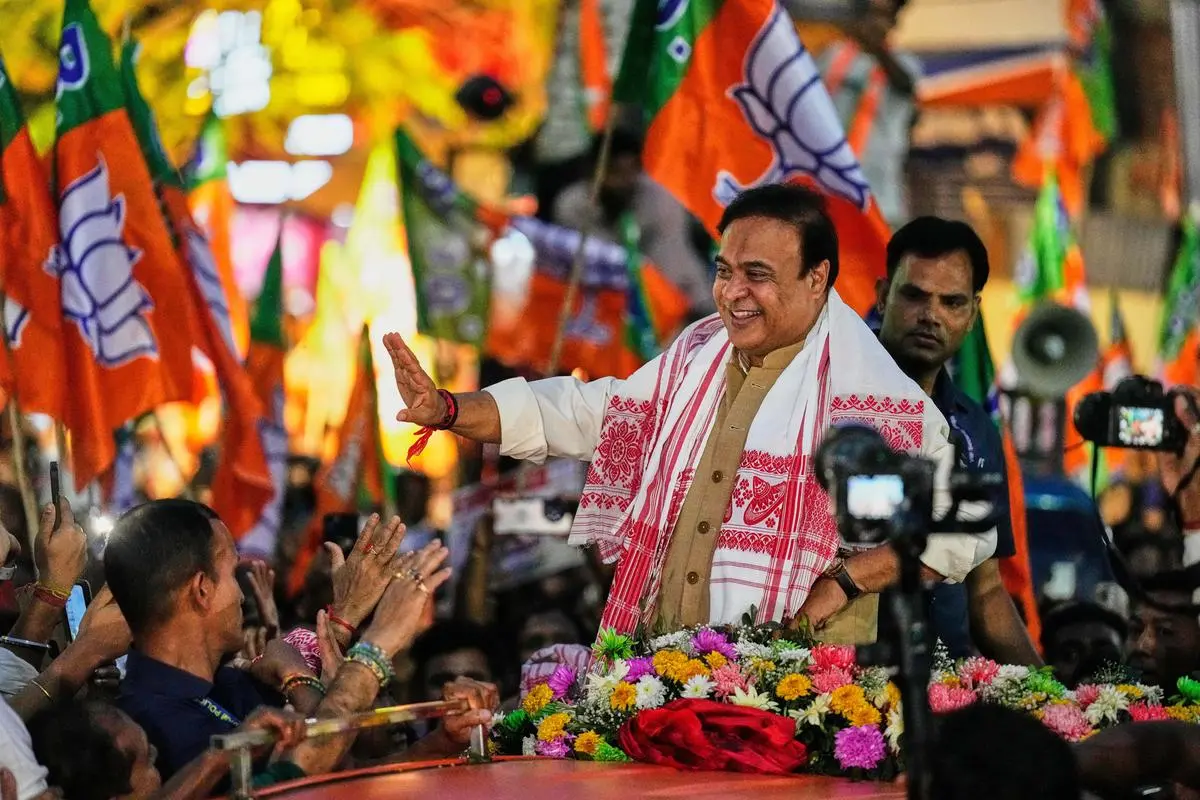
Assam Chief Minister Himanta Biswa Sarma attends an election campaign rally ahead of State Assembly election in Guwahati, March 23, 2026. | Photo Credit: AP
The second track is selective welfarism directed at “indigenous” Assamese Muslims, distinguished from the Miya on ethnic grounds and courted as potential BJP supporters. This twin-track strategy is not unique to Assam; it echoes the BJP’s national template of pitting Muslim sub-communities against each other while constructing a unified Hindu identity across caste and regional divisions.
The Congress strategy is the inverse. After ending its alliance with the AIUDF in August 2021, the party under Gaurav Gogoi has attempted to position itself as a broad secular alternative—absorbing Muslim votes without foregrounding Muslim identity. Samad Hussain, a Congress office-bearer in Sonai constituency, said, “The Congress’s main strategy is to safeguard the community from Himanta’s aggressive anti-Muslim stance.” The logic is that a formal Congress-AIUDF alliance would allow the BJP to brand the opposition as a “Muslim party,” potentially alienating undecided Hindu voters.
There is, however, a risk: without alliance coordination, the Congress and the AIUDF could split the minority vote in precisely those marginal constituencies where unity would determine the outcome. The AIUDF, contesting with support from AIMIM chief Asaduddin Owaisi, retains residual cadre strength in parts of Lower Assam and the Barak Valley. Even a 15–20 per cent AIUDF vote share in competitive constituencies could be enough to hand victory to the BJP when results are announced.
The BJP’s communal approach had a structural dimension this time: the 2023 delimitation exercise. By reducing Muslim-influenced constituencies from around 41 to 26, delimitation concentrated minority votes in fewer seats. Fewer competitive constituencies mean fewer opportunities for minority electoral leverage, even when the community votes cohesively. The BJP, meanwhile, benefits from a more favourable seat distribution in Hindu-majority constituencies.
This structural reengineering—done through nominally neutral electoral mechanisms—is perhaps the most durable element the BJP introduced in this election, outlasting any single election cycle.
The rhetoric of communal mobilisation
No analysis of the recent Assam election can avoid engaging with Sarma’s rhetoric. His political communication was marked not just by its content but by its media strategy: the systematic use of social media, press conferences, and public addresses to construct the “Miya Muslim” as a multi-dimensional threat—demographic, cultural, economic, and civilisational. Zohirul Islam, an independent candidate from Borkhola, said, “The CM of Assam was afraid of losing. In my constituency, I have all kinds of voters—Muslims, Hindus, Christians, farmers—but none of them say that their biggest problem is their neighbour’s religion. They say their children are unemployed, their paddy fields are flooded, their ration cards are pending.”
The lexicon Sarma has built is elaborate and he deployed it extensively in this election. “Love jihad” frames Muslim men’s relationships with Hindu women as conspiracy; “vote jihad” casts Muslim electoral participation as a threat to Hindu political power; “land jihad” portrays Muslims buying land as encroachment. At a BJP State executive meeting in Guwahati in August 2024, Sarma said: “People from a particular community have taken land from indigenous people, making us a minority in our own land… we have freed land equivalent to Chandigarh, yet the community still occupies land equal to 20 Chandigarhs.” As an example of “food jihad”, Sarma alleged that Muslims were using beef waste to drive Hindus out of shared neighbourhoods.
In September 2025, the BJP’s Assam unit posted an AI-generated video titled “Assam Without BJP”, depicting the State falling to Muslim “illegal immigrants.” On February 7, 2026, weeks before voting, the BJP’s Assam unit posted a 17-second AI clip on X showing Sarma firing at two skull-capped Muslim men, captioned “Point Blank Shot” and “No Mercy.” The video was deleted after widespread condemnation.
The pattern was consistent: provocation, a brief retreat under legal pressure, then resumption on a different register.
By repeatedly placing the “Muslim threat” at the centre of public discourse, Sarma ensured that economic and governance issues—flood management, unemployment, corruption—remained peripheral.
The other side of his strategy was to delegitimise Muslim politicians. Badruddin Ajmal, whose AIUDF represents sections of Bengali Muslims, was cast as a symbol of “Bangladeshi encroachment,” with his religious identity and attire repeatedly foregrounded in BJP campaign material. Rakibul Hussain, deputy leader of the Congress Legislature Party and MP from Dhubri, faced similar treatment, his presence framed as evidence of “minority appeasement”. The aim was to make any Muslim political figure a liability for secular parties.
Sarma’s political communication is crafted for a dual audience. His “Miya Muslim” rhetoric targets Assam’s indigenous Hindu communities and “Khilonjia” Muslims, who share anxieties about Bengali demographic change. But it simultaneously speaks to a national audience, reinforcing Sarma’s image as a defender of Hindutva, which analysts interpret as his positioning for a larger national role in 2029.
The rhetoric also works because the BJP does not need Muslim votes to win in Assam. What it needs is for Muslim votes to be divided. This has been the underlying logic of its approach to the Congress-AIUDF relationship. If Muslim votes in Muslim-influenced seats split between the Congress and the AIUDF, the BJP or its allies can win.
In 2016, this dynamic delivered the BJP its first Assam majority. The Congress’s refusal to ally with the AIUDF—driven by fears of being labelled a “Muslim party”—fragmented the minority vote and enabled BJP wins wherever an anti-BJP majority existed but was rendered electorally ineffective. In 2026, the BJP placed its hopes on similar fragmentation, although minority voters appear to have learned from 2016.
Also Read | In Assam, ‘indigenous’ means many things—until it means Muslim
It is not clear how the Congress decision to contest without the AIUDF will fare. The AIUDF contested several seats, many overlapping with the Congress, and the two parties could have split votes in several Muslim-influenced constituencies.
It may have been a mistake for the Congress to fall for Sarma’s rhetoric that labels all secular parties as “Muslim refugees” and makes any association with Muslim interests politically costly. By pushing secular parties to distance themselves from Muslim voters, Sarma has tried to weaken the possibility of a unified anti-BJP front.
Equally, as Mozbul Hoque, a reporter with Jugasankha, said, “This time many Muslims supported the BJP; for them, the focus is development, jobs, and infrastructure.”
The results will show whether the lessons of 2024 made the contest more complex this time or whether the binaries were maintained. The outcome will hinge on how the internal churn within the Muslim electorate played out.
Suwa Lal Jangu is assistant professor, political science, Mizoram University, Aizawl.
Mosrur Ahmed Talukder is a research scholar at Mizoram University from Assam.