








On April 24, the Aam Aadmi Party’s national convenor, Arvind Kejriwal, along with his family, moved out of 5 Ferozeshah Road. The address in the heart of the national capital had been their home since his resignation as Delhi’s Chief Minister in September 2024. He has now shifted to another Lutyens’ bungalow, which was allotted to him as the head of a national party.
The timing of the move and the circumstances surrounding it lent what would otherwise have been a routine change of address tremendous meaning and import. The house on Ferozeshah Road is the official residence of Ashok Mittal, a Rajya Sabha member who has several business interests and is the founder of Lovely Professional University. Mittal, who entered the Upper House in 2022 as an AAP nominee from Punjab, had graciously offered the house to Kejriwal after he quit as Chief Minister. Just hours after Kejriwal moved out, Mittal accompanied fellow Rajya Sabha MPs Raghav Chadha and Sandeep Pathak to a press conference where they announced they were leaving the AAP and joining the BJP along with four other party MPs.
What made the situation even more curious was that it was only on April 2 that Mittal was named by the AAP as Chadha’s replacement for the post of the party’s Deputy Leader in the Rajya Sabha. AAP leaders have pointed to Directorate of Enforcement raids on multiple addresses associated with Lovely Professional University on April 15 to claim that Mittal was under pressure to join the BJP.
The exodus of the Rajya Sabha MPs comes as a major setback for the AAP at a time when it has not yet fully recovered from its loss in Delhi in the February 2025 Assembly election and faces a do-or-die battle in the election in Punjab, the only State it now rules, in early 2027.
The development has also brought to the fore the AAP’s organisational and leadership issues and the mounting challenges the 14-year-old party faces in its bid to stay relevant in the national political mindscape.
Besides Chadha, Pathak, and Mittal, the MPs who have crossed over are Swati Maliwal, Rajinder Gupta, Vikramjit Singh Sahney, and Harbhajan Singh. All of them are from Punjab except Maliwal, who was nominated from Delhi.
The AAP is now left with three MPs in the Rajya Sabha—Sanjay Singh (who leads the party in the Upper House), N.D. Gupta, and Balbir Singh Seechewal—and three in the Lok Sabha: Gurmeet Singh Meet Hayer, Malvinder Singh Kang, and Dr Raj Kumar Chabbewal.
Taking strong exception to the development, the AAP has accused the BJP of activating “Operation Lotus” once again and using all means, including the threat of enforcement agencies, to force its leaders to switch loyalties. AAP leaders have accused the rebel MPs of betraying the party, claiming that they have left in search of greener pastures and are guided by opportunism. They have also emphasised that the MPs have gone to a party that the AAP holds responsible for the “fake corruption cases” against its leaders because of which many of them, including Kejriwal, spent time in jail.
“We knew Chadha’s departure was only a matter of time, and we were prepared for it. We also knew a couple more MPs could leave along with him,” said a senior AAP leader. “It is definitely a setback that seven of our MPs crossed over to the BJP. But we will rise up to this challenge too.”
Centralised decision-making
The exit of Chadha and Pathak—both of whom were deeply involved in the AAP’s organisational matters and electoral strategy and were considered close to Kejriwal—is also being linked to the growing perception that the party is run in a highly centralised manner, with decision-making resting solely with Kejriwal. The exit of his other one-time close confidants, too, has raised questions about why so many of his party colleagues have either parted ways or were made to leave.
Sayantan Ghosh, former associate fellow at the Delhi Assembly Research Centre and author of The Aam Aadmi Party: The Untold Story of a Political Uprising and Its Undoing, said: “The exit of the Rajya Sabha MPs shows that the control that Kejriwal has sought to exert is not so effective now. This also has to do with the electoral reverses and the damage to his own image because of the alleged corruption scams.”
He added: “A question that arises is whether Kejriwal is losing his grip on the party. Knowing that party members might leave and join the BJP, and especially since it is the BJP, makes it supremely important for a party chief to have some kind of backchannel mechanism to sort out issues and try and hold on to people.”
Chadha, a chartered accountant, first met Kejriwal during the India Against Corruption movement in 2011 and was among the original AAP leaders when the party was formed in 2012. The young leader became the face of the party on national television debates and rapidly rose within its ranks. He was entrusted with preparing the AAP for the 2022 Punjab Assembly election and was in charge of the party’s affairs in the State. His nomination to the Rajya Sabha that year was seen as a big promotion, which many within the party, especially his detractors, attributed to his proximity to Kejriwal.
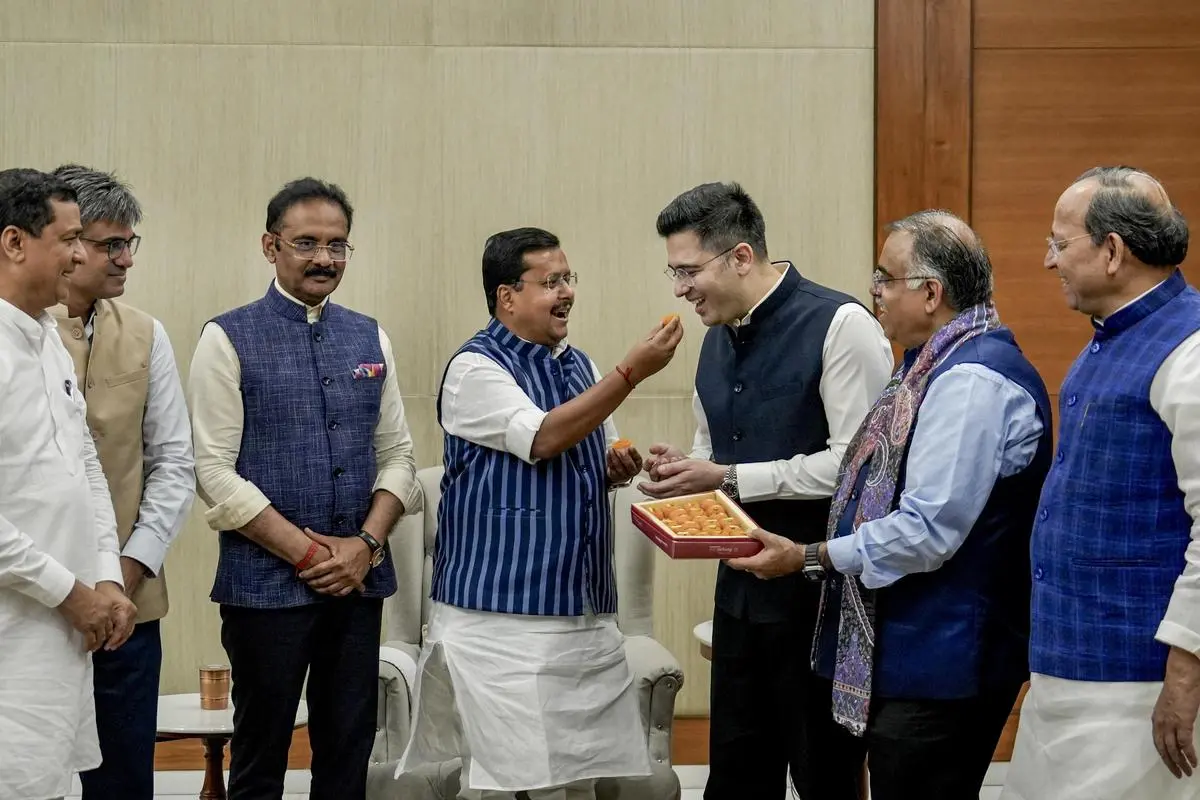
BJP National President Nitin Nabin with the former AAP leaders Raghav Chadha, Sandeep Pathak, and Ashok Mittal at the BJP’s headquarters in New Delhi on April 24, 2026. | Photo Credit: Salman Ali/PTI
Pathak, a far less recognisable face than Chadha, nevertheless had an equally important role. A former assistant professor at IIT Delhi, Pathak worked behind the scenes in Punjab, designing the party’s strategy and building its organisation in the run-up to the 2022 Assembly election. His Rajya Sabha nomination that year was attributed to his contribution to the party’s victory in the State. He was designated the AAP’s national general secretary (organisation), which placed him in the top brass of the party.
Of late, Pathak is learnt to have felt sidelined after being divested of his responsibilities in Punjab and Gujarat. In a March 2025 reshuffle, he was replaced as the Punjab in-charge by Manish Sisodia, Kejriwal’s long-time associate and his former Deputy Chief Minister in the Delhi government. In Gujarat, he was replaced as the State in-charge by Gopal Rai. Two FIRs have purportedly been lodged against Pathak under non-bailable sections in Punjab. The BJP has described this as vendetta politics and a way to divert attention from allegations that Punjab Chief Minister Bhagwant Mann came in an inebriated condition to the Vidhan Sabha on May 1 when a Special Session was held.
Maliwal too was once close to Kejriwal. She was appointed Chairperson of the Delhi Commission for Women and later nominated to the Rajya Sabha. She was conspicuous by her absence when Kejriwal was arrested on March 21, 2024. She later alleged that Bibhav Kumar, Kejriwal’s personal assistant, assaulted her on May 13, 2024, at his official residence at the time.
The political commentator Harjeshwar Pal Singh said: “The authoritarianism and insecurity of Kejriwal are once again on display. He has made a habit of ignoring, humiliating, or discarding his one-time closest allies.”
The exit of Sahney, chairman of the Sun Group, and Gupta, the founder and chairman emeritus of the Trident Group, also showed the party in a poor light as it had nominated the businessmen to the Rajya Sabha despite opposition from within the party.
There had also been discontent within the party over its nomination of the former cricketer Harbhajan Singh to the Upper House, especially since he was not vocal on issues of importance to the AAP and did not regularly attend Parliament.
Ideological ambiguity
Harjeshwar Pal Singh said: “This episode has justified the hue and cry of many of us when the AAP sent moneybags and outsiders to the Rajya Sabha.” He added that the party’s “ideological ambiguity” was now laid bare.
Ghosh, too, emphasised this issue: “In terms of ideology, there is nothing that can bind them together because they do not have an ideology. To what do the AAP leaders owe their allegiance? There is no clear answer to that question.” This analysis also draws from the widely held perception that the idealism that the party once exuded—given that it was born out of the India Against Corruption movement—has worn off and been replaced with short-sighted ideological fixes. The party’s “kaam ki rajneeti [performance-based politics]” slogan and the “Delhi model of governance” seem to have drowned under its ever-increasing problems.
The clean chit a trial court gave Kejriwal, Sisodia, and all the others accused in the Delhi excise policy case in February 2026 came as a reprieve to the party, especially because the allegations are perceived to have dented its “kattar imandaar [staunchly honest]” credentials.
When the CBI challenged the discharge in the Delhi High Court, Kejriwal sent a strong political message by first seeking the recusal of Justice Swarana Kanta Sharma from the case for lack of confidence in her impartiality (Kejriwal argued the plea for the judge’s recusal himself) and then by withdrawing from the case when Sharma refused to recuse herself.
However, political observers feel it will be an uphill task for Kejriwal and his party to redeem themselves, especially when an aggressive BJP is likely to double down on its efforts to corner the party. Harjeshwar Pal Singh said: “The brazenness of the BJP is [there] for all to see. The party has used every tactic, including [manipulating] central agencies, to effect wholesale defection of the AAP MPs. It will continue to go after the AAP and its leaders.”
Of primary concern to the AAP now is the likely impact of the defection of leaders like Chadha and Pathak on the party in Punjab. According to party insiders, the leadership is extra-vigilant about the damage the two leaders can potentially inflict to their former party. While the BJP may not be able to extract much electoral benefit in Punjab by getting these MPs on its side, it could utilise the connections that Chadha and Pathak have within the AAP’s organisation in the State to engineer further splits and get MLAs to leave the party. The Bhagwant Mann government proved its majority on the floor of the Assembly during the Special Session on May 1, a move meant to convey that the party’s MLAs were not straying.
The senior AAP leader quoted earlier said that besides Chadha, none of the other MPs have a recall value that the BJP can use in its public outreach in Punjab. However, Chadha himself may prove to be of very limited value in this regard since he was seen as Kejriwal’s man in Punjab (he was even described by the party’s critics as “super CM”) when he was in charge of the State. Chadha had also struggled to establish his Punjabi credentials and was always seen as a Dilliwallah exerting influence in Punjab.
The leader said the optics of a wholesale defection of AAP MPs to the BJP could ultimately end up hurting the saffron party because the people of Punjab may not appreciate the move. The hope that the development would not sit well with Punjab’s electorate was evident in Kejriwal’s reaction on X: “BJP has betrayed Punjabis once again.”
Meanwhile, the large-scale defection in the Rajya Sabha raises concerns for the AAP about a possible ripple effect in the Lok Sabha—all three of its MPs are from Punjab—and in Delhi, where it has 22 MLAs in the Vidhan Sabha.
Ghosh said: “Operation Lotus was bound to happen after the AAP lost Delhi. I feel the Rajya Sabha defections is a mild form of Operation Lotus. It is not as much a political loss as a loss of face, a loss of numbers, and also a financial loss. The BJP would definitely try to inflict a bigger blow to the party in Delhi and more importantly in poll-bound Punjab.”
It may be premature to write off Kejriwal and the AAP. But the activist turned politician and his party are clearly in deep trouble.
Also Read | What went wrong with AAP—and what, if anything, remains
Also Read | Sandeep Pathak: The backroom man who walked out