







A significant statistical trend that came into focus following the recent Assembly elections is the decline in the number of Muslim MLAs. Out of 823 MLAs elected to the Legislative Assemblies of West Bengal, Tamil Nadu, Assam, Kerala, and Puducherry, only 107 are Muslims, down from 112 elected in the 2021 Assembly elections.
On the whole, Muslim MLAs account for 13 per cent of elected State legislators; the percentage is 1 per cent lower than the proportion of the community in the country’s population. A closer look at the State-wise figures, especially in West Bengal and Assam, shows a decline in the number of Muslim legislators. In West Bengal, where the Assembly has 294 seats (re-election in 1 seat was held on May 21), the number has come down from 42 in the previous Assembly to 40. The fall is more pronounced in Assam, which has 126 seats: from 31 in the previous Assembly to 22 in the new one.
In Kerala, which has 140 Assembly seats, the number has risen: from 32 in the previous Assembly to 35 in the new one. In Tamil Nadu’s 234-member House, the number has gone up from 6 to 9. Puducherry has only 1 Muslim MLA in a House of 30 elected legislators, like last time.
Experts emphasise that under-representation of Muslims in legislative bodies in relation to their population has been a consistent trend since the first general election of independent India, held in 1952. It has been observed that on account of the manner in which the sociopolitical scenario has evolved since Independence, there has been a constant decline in the number of lawmakers belonging to the minority community. The dip has become more noticeable in recent years, especially since the BJP came to power at the Centre in 2014..
The 1941 Census put India’s population at 31.86 crore, with around 66 per cent Hindus and close to 24 per cent Muslims. The Muslim population declined after Partition. The 1951 Census put the population at 36.10 crore, with Hindus accounting for 84 per cent and Muslims, 10 per cent. According to the 2011 Census, out of a total population of 121.09 crore, Hindus accounted for 79.8 per cent, while Muslims accounted for 14.2 per cent. However, the legislative representation of Muslims in the Lok Sabha has largely remained much below the proportion of the community in the national population.
In the 1952 parliamentary election, 25 Muslims were elected to the Lok Sabha. This number was 5.11 per cent of the total strength of the House, which was 489. In the 1957 election, the number dipped to 23, which was 4.66 per cent of the total number of Lok Sabha MPs. The percentage of Muslim MPs in the Lok Sabha has generally hovered between 4 and 6 per cent, except in 1980 and 1984 when their number crossed 40.
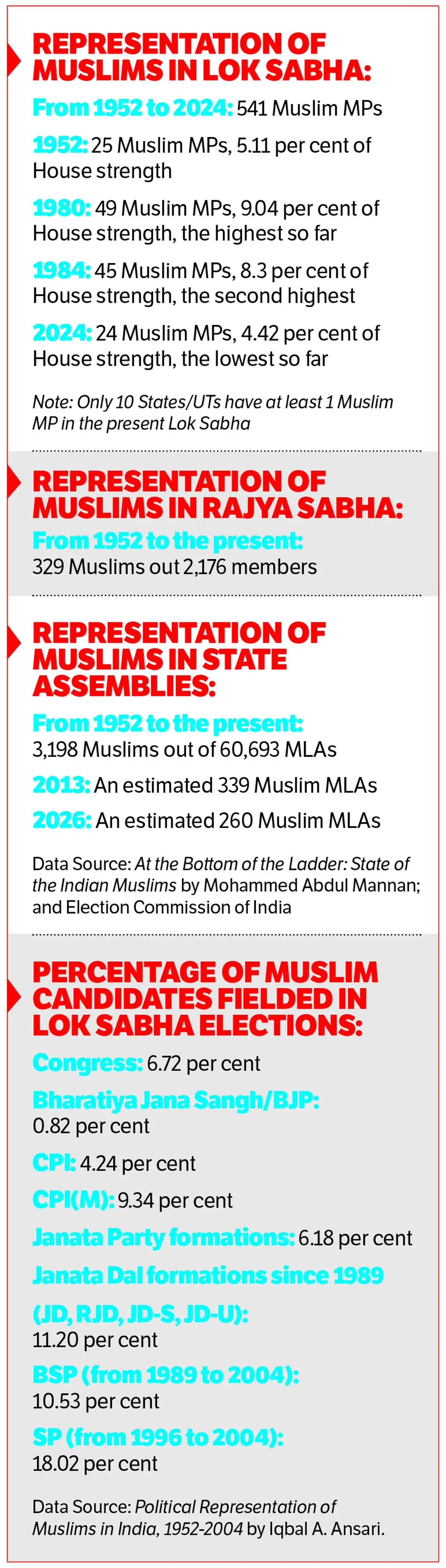
In the 1980 election, a record 49 Muslim MPs were elected, which was 9.04 per cent of the total strength of the Lok Sabha. In 1984, 45 Muslim members were elected, which was 8.3 per cent of the total strength of the House. The present Lok Sabha has 24 Muslim members, which is 4.42 per cent of its total strength.
Iqbal A. Ansari, in his book Political Representation of Muslims in India, 1952-2004, attributes the under-representation of Muslims in the first elected Lok Sabha mainly to the low number of such candidates fielded by political parties, especially the Congress. There were 21 Muslims among the 479 candidates it fielded.
Ansari writes: “It is reported that Nehru did show some concern and wrote to the party managers reminding them of the promise to minorities regarding their fair share; but neither the persistent pattern of under-nomination by major political parties nor a corresponding under-representation in the Lok Sabha was ever analysed or discussed in any party forums.”
He notes that the pattern that emerged in the very first general election continued to mark later elections. For instance, only constituencies with sizeable Muslim populations (between 25 per cent and 50 per cent or more) were selected for fielding Muslim candidates. Even then, some regions and States that had a sizeable percentage of Muslim voters remained totally unrepresented or grossly under-represented in terms of Muslim legislators.

A Muslim voter after casting his ballot in Guwahati on April 9. Assam, which historically had a substantial representation of Muslims in the Assembly, shows the impact of changing political dynamics following the BJP’s ascendance as the ruling party. The new Assembly (126 seats) has only 22 Muslim MLAs. | Photo Credit: ANI
In State legislatures, the number of Muslim members is underwhelming even in States where they form a sizeable population. Mohammed Abdul Mannan’s analysis of electoral statistics in his book At the Bottom of the Ladder: State of Indian Muslims shows that in the most populous State, Uttar Pradesh, there were only 628 Muslim MLAs out of a total of 7,389 until 2022. This works out to 8.49 per cent, while Muslims form over 15.5 per cent of the State’s population.
Mannan’s study found that Bihar has had 326 Muslim MLAs out of 5,146—that is, 6.3 per cent, while 13.4 per cent of the State’s population is Muslim. Gujarat, experts say, is the worst when it comes to Muslim representation. Mannan’s book says the State has had only 39 Muslim MLAs out of 2,296 until 2017—just 1.69 per cent, whereas Muslims constitute 8.6 per cent of the State’s population.
According to experts, a marked decline in the number of Muslim legislators in recent decades coincides with the rise of the BJP and majoritarian politics.
“In the recent past, with the BJP occupying pole position in Indian politics, the situation has changed drastically. The BJP will not field any Muslim candidates, and the other parties are apprehensive about doing so because they would then be accused of minority appeasement. And obviously, in view of the polarisation of the polity, Muslim candidates have lower chances of winning,” said Mirza Asmer Beg, professor of political science at Aligarh Muslim University.
The growth of majoritarian politics, it is believed, has resulted in non-BJP parties looking at Muslim candidates as a liability even while they appeal to the community for its votes. The Muslim vote bank is valued, but parties are wary of fielding Muslim candidates.
According to the Samajwadi Party’s Rajya Sabha MP Javed Ali Khan, the rise of Hindutva politics has a direct correlation with the decline in the number of Muslim MLAs. “The impact of the communally surcharged atmosphere after the demolition of the Babri Masjid in 1992 could be directly felt in the Assembly elections that took place in Madhya Pradesh in 1993. Not a single Muslim MLA was elected, whereas earlier the House would have a few members from the Muslim community,” Khan said.
Afroz Alam, professor of political science at Maulana Azad National Urdu University, said: “Most parties speak the language of secularism, inclusion, and social justice, but when tickets are distributed, the logic often changes to winnability. Unfortunately, winnability is sometimes a polite word for systemic exclusion. Parties often want Muslim votes without producing Muslim leadership. This reduces Muslims to voters, not partners in power.”
Assam, which historically had a substantial representation of Muslims in the Assembly, shows the impact of the changing political dynamics following the BJP’s ascendance as the ruling party. Not only are there significantly fewer Muslim MLAs, all Muslim MLAs in the new Assembly belong to the opposition.
The BJP, which has won as many as 92 seats in the 126-member Assembly, did not field a single Muslim candidate. The Congress won 19 seats, and 18 of them are Muslims, drawing “Muslim League” jibes from the BJP.
Accelerated decline
An accelerated decline in the number of Muslim MLAs can be traced through the 12 years of BJP rule at the Centre. There were around 339 Muslim legislators in the State Assemblies in 2013. After the recent round of Assembly elections, the number of Muslim MLAs stands at around 260. In Uttar Pradesh, the number has fallen from 63 to 31, in West Bengal, from 59 to 40, and in Bihar from 19 to 11. In Rajasthan, the number has gone down from 11 to 6.
P.K. Kunhalikutty of the Indian Union Muslim League taking oath as Cabinet Minister in Thiruvananthapuram on May 18. While the decline in the number of Muslim legislators is a countrywide pattern, Kerala has bucked the trend. There are 35 Muslim MLAs in the new Assembly against 32 in the previous one. | Photo Credit: PTI
Madhya Pradesh, whose Vidhan Sabha has a total strength of 230, has only 2 Muslim legislators at present. Neighbouring Chhattisgarh, which has a 90-member Assembly, has no Muslim MLA. In Maharashtra, there are only 10 Muslim MLAs, and in Karnataka there are 9. In Telangana, there are 7 Muslim MLAs in the 119-member House, and all of them belong to the All India Majlis-e-Ittehadul Muslimeen (AIMIM). In all, Muslim MLAs comprise around 6 per cent of the total number of State legislators..
According to Beg, various other factors have accentuated the decline in the number of Muslim legislators: delimitation resulting in the diminishing of the significance of the Muslim electorate; reservation of seats with a sizeable Muslim community for Scheduled Castes and Scheduled Tribes; and counter-polarisation of majority votes that works against Muslim candidates. “All these factors combined to work to the disadvantage of Muslims when it comes to their representation in the Lok Sabha and in the Assemblies. It amounts to invisibilisation of the community in the crucial lawmaking bodies,” he said.
Under-representation of Muslims in the legislative bodies, according to Khan, is part of a much larger pattern of discrimination. “Of course, it is important that the community is adequately represented in the Lok Sabha and in the Assemblies. However, the issue is far bigger than just a headcount of Muslim MLAs and MPs. We need to look at how the institutions and the schemes that are supposed to work for the welfare of the community are working, and then the vastness of the scale of discrimination against the community becomes clear,” he said.
The repercussions of this exclusion, according to experts, are serious and can result in the community feeling marginalised and alienated. “When a community is under-represented, its concerns are heard less directly in lawmaking, particularly with regard to their education, security, discrimination, employment, housing, and welfare. It also creates a psychological distance from the state,” said Alam.
“Democracy does not collapse only when people lose their vote. It also weakens when people begin to feel that their voice has no face in power,” he said.
Also Read | Assam’s polarised mandate
Also Read | Muslims might lean strongly towards the Congress: Abu Nasar Saied Ahmed