
惯性聚合 高效追踪和阅读你感兴趣的博客、新闻、科技资讯
阅读原文 在惯性聚合中打开

推荐订阅源

cs.AI updates on arXiv.org
L
LINUX DO - 最新话题
OSCHINA 社区最新新闻
OSCHINA 社区最新新闻
Forbes - Security
Forbes - Security
博客园 - 司徒正美
Hugging Face - Blog
Hugging Face - Blog
W
WeLiveSecurity
Jina AI
Jina AI
钛媒体:引领未来商业与生活新知
钛媒体:引领未来商业与生活新知
N
News and Events Feed by Topic
V
V2EX
Stack Overflow Blog
Stack Overflow Blog
Engineering at Meta
Engineering at Meta
PCI Perspectives
PCI Perspectives
Martin Fowler
Martin Fowler
T
The Exploit Database - CXSecurity.com
F
Full Disclosure
WordPress大学
WordPress大学
S
Security Affairs
K
KPMG report finds enterprise disconnect between AI and its ROI | CIO
S
SegmentFault 最新的问题
P
Privacy International News Feed
IT之家
IT之家
M
MIT News - Artificial intelligence
G
GRAHAM CLULEY
Hacker News: Ask HN
Hacker News: Ask HN
D
DataBreaches.Net
奇客Solidot–传递最新科技情报
奇客Solidot–传递最新科技情报
Google Online Security Blog
cs.CV updates on arXiv.org
C
Check Point Blog
美团技术团队
Security Latest
Security Latest
Cyberwarzone
Cyberwarzone
N
News and Events Feed by Topic
MyScale Blog
MyScale Blog
H
Help Net Security
宝玉的分享
宝玉的分享
The Hacker News
The Hacker News
The Last Watchdog
The Last Watchdog
The Cloudflare Blog
Cyber Security Advisories - MS-ISAC
爱范儿
爱范儿
cs.CL updates on arXiv.org
I
Intezer
Threat Intelligence Blog | Flashpoint
AI
AI
I
InfoQ
N
News | PayPal Newsroom
TaoSecurity Blog
TaoSecurity Blog

Latest Politics News | Frontline | Frontline

West Bengal election: How ethnic identities are reshaping the TMC-BJP contest BJP turns Women’s Reservation Defeat into a New Campaign Plank in Uttar Pradesh Dantewada Cricket Event and India’s “Post-Maoist” Claim Maharashtra’s Sugar Mills Face a Deepening Economic Crisis Election Commission Bias in West Bengal Polls 2026? Tamil Nadu election 2026: Cash-For-Votes and Missing Voters One Year After Pahalgam: Violence, State Response, and Kashmir Narrative Tamil Nadu Assembly Election 2026: Why the Unattached Urban Voter Holds the Key in a Waveless Contest West Bengal Election 2026: Kudmi, Adivasi, Matua Identity Politics Explained When majoritarian march meets its first hard stop Will Didi prevail over Delhi? What Nithin Raj’s death says about caste in Kerala’s private colleges West Bengal election 2026: Identity politics, vote banks, and the BJP vs Trinamool battle Exclusive interview | Tamil Nadu Chief Minister M.K. Stalin talks about Assembly election 2026, fiscal authoritarianism, and the fight for federalism Women’s Reservation Bill 2026: Modi’s Delimitation Trap Exposed J&K liquor controversy explained: Tourism, revenue, and politics | The Kashmir Notebook Ep 13 Delhi Pink Saheli Card 2026: Domicile Rule Hurts Women Manipur’s Rumour Economy: How Disinformation Fuels Mob Violence Punishing the South: Modi’s Delimitation Plan and the Politics of Control The Vijay Factor AIADMK Delta Strategy: Can Leema Rose Win? Maharashtra Shows Why Women’s Reservation May Aid Elites CBI Reply in Kejriwal Case Exposes Judicial Conflict Norms Tamil Nadu Election 2026: Social Media Narratives, War Rooms, and Players Modi’s Roadshow and BJP’s High-Stakes Push in South Tamil Nadu SIR West Bengal Voter Exclusion Case 2026 TN Assembly Polls 2026: Senthil Balaji and SP Velumani Clash for Western Belt Supremacy Women’s Reservation Act Amendments Raise Delimitation Fears Partha Chatterjee’s For a Just Republic and the Limits of the People-Nation Hungary Election 2026: Orbán Defeated, Magyar Wins Big Free Speech Crackdown in India: Is Dissent Under Threat? Ambedkar Jayanti and the New Publicness of Protest Politics Implementing Women’s Reservation: Why a Hybrid 651-Seat Lok Sabha Model Outperforms Mass Expansion Ambedkar and Free Speech: Who Controls Dissent in 2026? Reforming Tamil Nadu's Local Governance: Why MLAs Aren't Fixers in 2026 West Bengal voter list controversy explained | Why names are being deleted Will Vijay’s TVK disrupt DMK and AIADMK? | Tamil Nadu election 2026 Constitutional Morality vs Social Morality in India 2026 Amit Shah’s Anti-Conversion Promise Opens a New Faultline in Punjab Politics Why Indian Shias Protest for Iran: History of Solidarity (2026) West Bengal Voter List Row 2026: “Votercide” Debate From Grief to Politics: Porkodi Armstrong and the Battle for Dalit Power in North Chennai West Bengal election 2026: Will Babri Masjid split the Muslim vote? West Bengal Communal Politics and the 2026 Election Battle Raghav Chadha-AAP Rift Explained: Rise to Fallout (2026) Why India Is Not Energy-Secure Amid Global Oil Shocks India IT Rules 2026: Threat to Free Speech? Iran War Ceasefire Signals a Shift Toward Multipolar Deterrence 2026 Assembly Polls: Congress vs BJP Power Test Kerala Assembly Election 2026: LDF Anti-Incumbency vs UDF Momentum Gujarat Local Polls: AAP Rise Deepens Congress Crisis SIR controversy deepens fear of Muslim disenfranchisement in Bengal Kerala Election 2026: LDF, UDF, and the BJP “B Team” Charge Who will win Kerala Assembly Election 2026? LDF or UDF? Assam Polls: Cash Transfers Mask Stagnant Incomes and Job Distress Jaishankar and India's Diplomacy Crisis After Nitish Kumar, Bihar BJP faces its biggest test: caste coalition without a ‘Mr Clean’ Actor Vijay and Politics: An Emerging Landscape N Rangasamy’s 2026 Puducherry Poll Strategy and Power Play Kashmir Encounter Killing Sparks AFSPA Debate 2026 GST Federalism Crisis 2026: How States Lost Fiscal Power US-Iran War 2026: Petrodollar Stakes Behind Hormuz Clash White Savior Complex in Arab Regimes Drives Ukraine Deals Not Self Reliance UPA Corruption Narrative vs Court Verdicts 2026 Mathur Sathya Case Exposes Patriarchy in Progressive Politics India Needs a New Economic Model Beyond Neoliberalism Why J&K MLAs Are Fighting the Lieutenant Governor Over Security Puducherry election 2026: Can Congress return to power? | V. Narayanasamy explains Pawar Family Rivalries Stall NCP Factions Merger in Maharashtra How Foreign Thinkers Shaped Hindutva’s Rise Naxalism’s Shift: Armed Struggle to Ideological Influence G. Haragopal on Tribal Resistance, Maoist Surrenders, and Politics DMK manifesto 2026: Key promises, alliances, & welfare politics Rajya Sabha Polls Expose India’s Open Secret: Cross-Voting and Poaching State Assembly Elections 2026: How Voter Dynamics Are Shaping India DMK Seat-Sharing Deal Reveals a Tougher M.K. Stalin What Iran Means to Kashmir | War, Identity, and 5000 Years of History Thirumavalavan Signals Shift in Tamil Nadu Politics Golgappa diplomacy and the fragile reset in India-Bangladesh ties Tamil Nadu election 2026: DMK vs AIADMK, alliances, and Vijay’s entry Is Indian Cinema Losing its Moral Voice? How the BJP’s strategic pivot on delimitation and women’s quota will reshape the 2029 electoral landscape Why INDIA Bloc Collapsed in Puducherry | DMK, Congress & VCK Rift Explained West Bengal 2026 Assembly Elections: Candidate Controversies Stir Party Rebellions Tamil Nadu Elections: CPI(M) on DMK Alliance & BJP Fight Ashok Kharat Scandal Exposes Maharashtra’s Godman–Power Nexus India Migration Crisis: Gulf Conflict Exposes Gaps 2011 Election Petition Against Stalin Returns Ahead of Tamil Nadu Election Delhi Budget 2026: Growth Claims and Welfare Gaps Tamil Nadu NDA Deal Reveals AIADMK’s Upper Hand Inside AIADMK Strategy: EPS Leadership, BJP Alliance, and TVK Challenge Vijay Politics: Can TVK Break Tamil Nadu's DMK AIADMK Duopoly? How Eid went under siege in Uttam Nagar Assam Elections 2026: BJP Faces Tribal Backlash Over Evictions in Karbi Anglong First Impeachment Notice Against India’s CEC Shakes Politics 2026 Hindu Rashtra Debate: 2026 State Elections Test Secular India Tamil Nadu Election 2026: How Gender and Gen Z Voters are Reshaping the Dravidian Power Struggle Maharashtra’s Anti-Conversion Bill and the Politics of 'Love Jihad' Post-Colonial Nationalism and the Western Far Right: Why the Comparison Fails Gujarat's proposed marriage registration amendment 2026 polices choice
What was wrong with BJP's so-called Women Reservation Bill
2026-04-20 · via Latest Politics News | Frontline | Frontline

The bane of the Modi government’s foreign policy has now come to haunt its domestic policy. For over a year, India’s diplomacy has been in a tangle because of the Modi government’s poor assessment of US President Donald Trump’s temperament and love for India. That tangle has become knottier with New Delhi’s underestimation of Iran’s capacity to endure the unjust war against it.

Likewise, a faulty assessment of women’s quest for representation was the reason the 131st Constitutional (Amendment) Bill, 2026, failed to pass in the Lok Sabha. The Bill sought to advance reservation for women in an expanded House, where its seats were to be redistributed among States and Union Territories through delimitation based on the 2011 Census.

In contrast to Prime Minister Narendra Modi silently reconciling with the setbacks to his foreign policy, he has tried, through his address to the nation on April 18, to weaponise one of his most significant reversals in the domestic realm. His fierce attack on the opposition was not only a flagrant violation of the model code of conduct, but also an attempt to deploy women as an instrument for conquering West Bengal and Tamil Nadu.

But first, the Modi government’s stratagem to introduce the 131st Constitutional (Amendment) Bill last week. At the nub of it was the government’s assessment that the political parties of the States slated to see their share in the Lok Sabha dip would vote for the Bill out of their fear of incurring the wrath of women, in case reservation wasn’t given to them by 2029. They would, in other words, care less about their States’ clout diminishing in the Lok Sabha than losing the support of women.

This assessment presumes the existence of an extremely large, cohesive constituency of women that is so politically conscious as to prioritise political representation over their own and their family’s material needs. Had this presumption been correct, the P.V. Narasimha Rao government, which introduced 33 percent reservation for women in local bodies in 1992-93, wouldn’t have been voted out of power in 1996.

Women, to invoke Marxist terms, are neither a “class-in-itself” nor a “class-for-itself”. All women don’t share the same economic position, because of which they are unlikely to unite on most policies as these impact differently the various segments of them.

For sure, there exists a growing, relatively cohesive constituency of women in comparison to, say, the 1990s, which is increasingly autonomous of the control of men, including in exercising their franchise. Yet it is also true that this constituency has emerged because of the transactional relations between the state and women. In Bihar, Haryana, Jharkhand, and Maharashtra—the States that have had Assembly elections since May 2024—women in substantial numbers voted for the ruling parties that transferred money to their bank accounts.

Modi and the BJP failed to grasp the fact that cash transfers have a more compelling reality for women than reservation, not least because they lack the wherewithal to fight elections. This misconception had them time the special session of Parliament for passing the 131st Constitutional (Amendment) Bill days before West Bengal and Tamil Nadu were to have their Assembly elections, believing the ruling parties there would support reservation for women rather than risking losing women’s support.

Welfare and representation

Neither the Trinamool Congress nor the Dravida Munnetra Kazhagam chose to bite the bullet, preferring to prioritise India’s federal structure over quota for women. Quite understandable, indeed. Take West Bengal Chief Minister Mamata Banerjee, whose formidable support among women has been built on the economic relief she has provided them. For instance, through the Lakshmir Bhandar scheme, Banerjee has been transferring, since 2021, Rs.1,000 a month to women aged 25-60, upped to Rs.1,500 in the 2026 Budget. There are payouts to girls who continue their education and don’t get married at 18; and also grants to poor families for marrying their daughters.

These schemes will likely have a greater electoral pull than reservation for women, more so as the Trinamool’s record on gender representation is far more impressive than the BJP’s. The former has fielded 55 women candidates in the current Assembly election, 22 more than the BJP. Again, 38 per cent of Trinamool MPs are women, the highest among all parties; 13.7 per cent of MLAs in Bengal are women, the second highest among all State Assemblies.

The DMK’s record on gender representation is lacklustre—only three of its 22 MPs and six of its 133 MLAs are women. Yet the DMK would have cemented its bonds with women through a monthly transfer of Rs.1,000 to them. Women would, in case the party returns to power, receive coupons worth Rs.8,000 to buy home appliances of their choice. In contrast to crores of women benefiting from many such schemes, 33 percent reservation would bring only 77 women MLAs to the Tamil Nadu Assembly.

At least in West Bengal, it’s the BJP that should worry about the wrath of women, for they comprise 61.8 per cent of voters deleted from the State’s electoral rolls, because of the Special Intensive Revision (SIR), according to the Kolkata-based Sabar Institute, which engages in public-interest data analysis. These deletions are popularly perceived to have been deliberate, aimed at shrinking the Trinamool’s social base. The female relatives of these women would be seething against the BJP.

If DMK and Trinamool stumble

Yet, should the Trinamool and the DMK stumble at the hustings, the BJP would cite their vote against the 131st Constitutional (Amendment) Bill as the reason for their defeat. The media, as is its wont, would amplify the BJP’s analysis, effectively shifting the focus away from the massive SIR-induced disenfranchisement as being a significant factor behind their defeats. This is one use the collapse of the 131st Constitutional (Amendment) Bill in the Lok Sabha could have for the BJP.
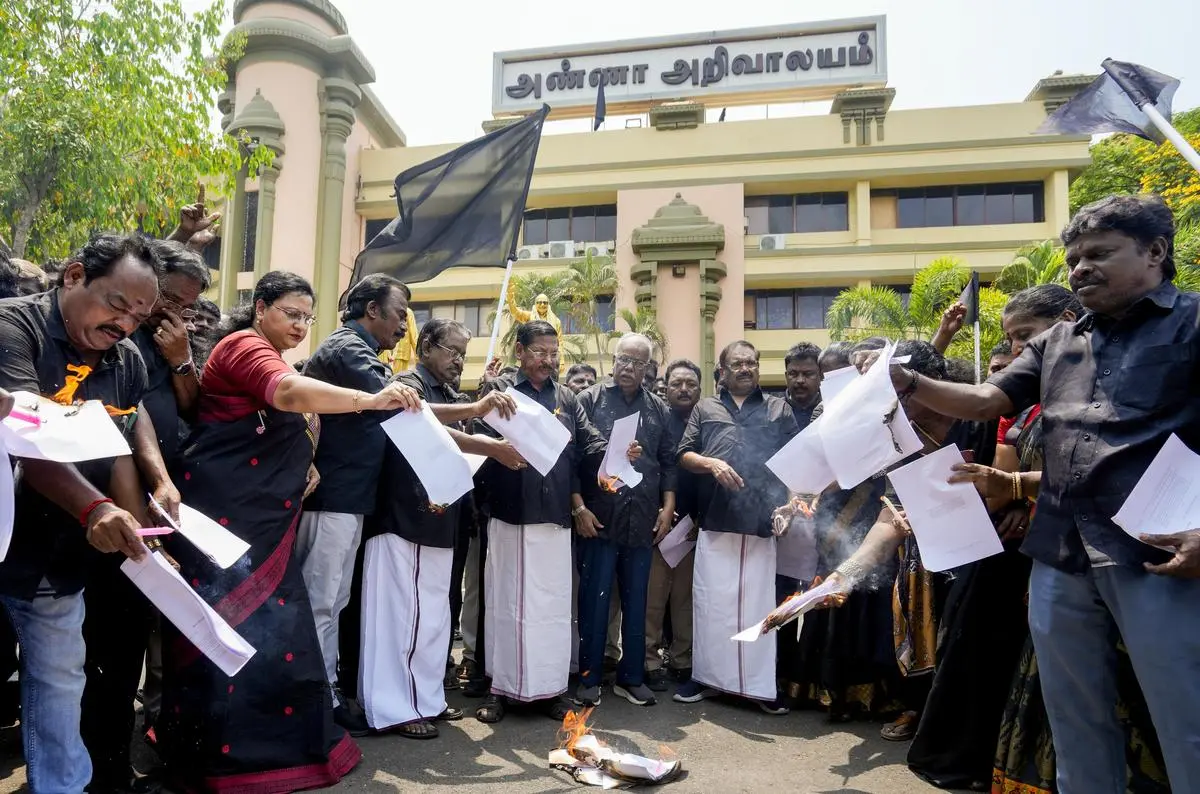
Supporters of the DMK burn copies of the proposed delimitation Bill during a protest at the party office, in Chennai, on April 16, 2026.

Supporters of the DMK burn copies of the proposed delimitation Bill during a protest at the party office, in Chennai, on April 16, 2026. | Photo Credit: R. SENTHILKUMAR/PTI

Its another use for the BJP would be to build a campaign, as was palpable from Modi’s April 18 speech, to project the opposition parties as villains who banded together to deny women their rights; that he alone among all leaders strives to further the interests of women. This campaign, based on a false narrative, is typically from Modi’s playbook, of depicting himself as a messiah of the weak taking risks to empower them.

For instance, after his policy of demonetisation went horribly wrong, Modi said in Goa on November 13, 2016, “I will not stop doing these things, even if you burn me alive… They may ruin me because their loot of 70 years is in trouble…” In May 2017, about the government’s decision to introduce neem-coated urea, Modi said, “Don’t you think by taking this step… I have ended the business of black marketeers? Don’t you think they will avenge it? I carry my maut [death] in mutthi [fist].”

Just as he engaged in ersatz class war in the past, he will now do so in ersatz gender politics. He may not succeed because the disempowerment of women is due to the overlapping factors of class, caste, and gender, not on account of their poor representation in the legislatures. Women don’t resent or nurse grievances against men to the same degree as the lower classes do against the elite.

In foreign policy, Modi’s and the BJP’s assessment went awry because of their exaggerated belief in India’s importance in the global order and the efficacy of personalised diplomacy. Their estimate of the opposition parties has gone wrong because their hubris, arising from their 12 years of winning spree, has blinded them from seeing that women prefer the parties that ease their burden of living than those who grant reservation. The opposition’s bestowing of ample benefits on women insulated it from the fear the BJP sought to evoke in them.

Ajaz Ashraf is a senior journalist from Delhi and the author of Bhima Koregaon: Challenging Caste.

Also Read | Why Modi’s delimitation exercise makes Stalin see red

Also Read | Census 2027 must capture the lived realities of vulnerable groups, minorities: Poonam Muttreja