





“I have been standing here for an hour and the line has crawled three places ahead,” said Fathima, waiting under a shed at the Kashmere Gate Bus Depot in peak Delhi summer for her turn to collect the Saheli Smart Card. The queue grew longer; one of the two counters was dysfunctional—the printer had stopped working.
On March 2, 2026, the Delhi government launched the Pink National Common Mobility Card (NCMC), or the “Pink Saheli Smart Card”, offering free and unlimited bus travel for female and transgender residents of Delhi. The card replaces the earlier pink ticket system, which gave every female passenger a free ride regardless of domicile. The new scheme requires Aadhaar-based proof of Delhi residency.
“Services of Delhi should be available to the voters of Delhi,” said an employee from the Public Relations Office of the Delhi Transport Corporation (DTC). Indu Prakash Singh, social activist and author, countered: “No one questions the affluent living in Delhi, but the poor are questioned. As per the Constitution of India, anyone has the right to come, live, and work in Delhi.”
As per the Economic Survey of Delhi (2024–25), migration added 2,83,000 people to the city’s population in 2021—more than double the 1,01,000 additions through natural births. Delhi attracts nearly one lakh migrants annually. If the Saheli Smart Card becomes mandatory for free bus travel, a large number of current beneficiaries who depend on the bus network for daily commutes will lose access.
“My husband does not work. I am the sole earner in my household of four kids,” said Leela. “Travelling from Mahipalpur to Dwarka daily free of cost saves nearly Rs.600 per month for me.” That money goes towards her children’s tuitions or medical visits. But Leela’s Aadhaar card lists her home State, Bihar. When the scheme is fully enforced, she will not qualify.
Domicile as gatekeeper
The application requires Aadhaar-based e-KYC verification; if the card is not linked to a Delhi PIN code, the applicant is ineligible. The DTC employee said the scheme would eventually replace the pink ticket system entirely, functioning as an NCMC that can also be used for metro travel and payments.
The DTC employee told Frontline that conductors had previously printed excess pink tickets and discarded them to inflate reimbursement claims. “Many migrants issue duplicate documents with a residential address of Delhi to secure benefits in both their home State and Delhi. This is why only Aadhaar will be accepted,” he said.
A representative from the Trade Union Coordination Centre (TUCC), speaking on the condition of anonymity, called the previous system more equitable: “Be it the Chief Secretary or a manual worker, both could travel for free.” He added that informal workers contribute to the State’s tax pool through daily purchases. “The reimbursement to the DTC comes from the treasury. These workers also contribute to the State’s pool.” Singh called it a misconception that Delhi’s taxpayers are only the middle class: “Citymakers—the homeless workers—purchase commodities in smaller amounts and pay taxes. Everything is taxable.”
Applicants must visit one of 50 designated offices with their original Aadhaar card in hard copy. An online portal exists but users reported it crashing repeatedly. Frontline contacted the offices of the Chief Minister and the Transport Minister; both declined to comment.
“The crowds were overwhelming and the management was completely chaotic,” said Nutan, who commutes daily between Kashmere Gate and Dwarka. Riya, a student of Dr B.R. Ambedkar University, Delhi, took a half-day off from college to collect her card but found she first had to update the phone number linked to her Aadhaar. She returned without the card.
Shyam Lal, who came to the depot for his wife, raised a concern: those with Delhi addresses on their Aadhaar tend to be from higher economic strata. “Those who actually require it, like maids or factory workers, will not get the benefit as they will not be able to take the day off,” he said.
Ritambara, a transwoman, said she fears the stares at a bus depot. “Having to prove my identity as a transwoman by having it mentioned on my Aadhaar card is a privilege not many have,” she said. Many transgender people do not have their gender listed as “Transgender” on the card, as this requires a medical certificate or a transgender ID.
Chanda, a transwoman at the Kashmere Gate depot, told Frontline that many of her transgender friends had left home for Delhi seeking work. “They barely make enough to afford three meals a day and every penny saved is important.” She appreciated the inclusion of transgender people in the scheme but feared the residency requirement would exclude many.
The TUCC representative said migrant workers are contracted for short periods and live in slums and unauthorised colonies. “Multiple families occupy single rooms and earn Rs.500–Rs.700 a month. Free services are a major support for them.” He added that women earn half the wages of men and that contractors do not comply with laws protecting interstate migrant workers. “Only the permanent staff get regular income; everyone else hardly receives the daily wage rate.”
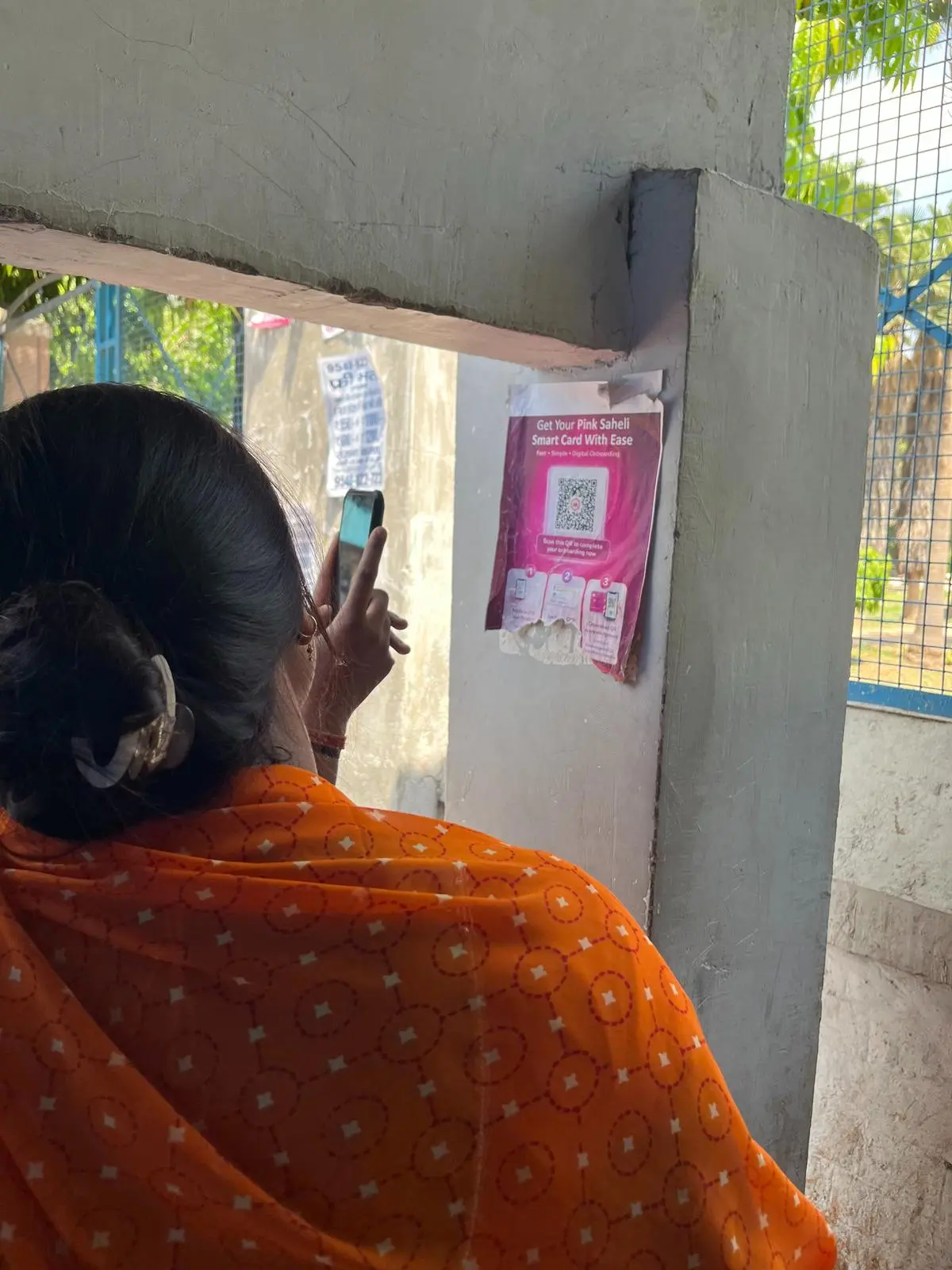
Users said the online portal crashed repeatedly. | Photo Credit: Aparna Vats
Singh called the domicile requirement foolhardy. Many women, he said, could lose employment if they can no longer afford the commute.
Free bus travel across States
Delhi’s free bus services for women were introduced by the AAP government in 2019. The BJP criticised the move as fiscally burdensome. The scheme was widely used; a World Resources Institute India study found that women saved between Rs.400 and Rs.800 monthly, and a 2023 Ashoka University study found a 24 percentage point increase in average employment among women from economically weaker sections after its introduction.
Free bus travel for women now operates in several States. Tamil Nadu offers free rides on ordinary State-run buses for short distances; an outlay of Rs.3,600 crore was set aside in its last budget. Karnataka’s “Shakti” scheme covers ordinary and express services. Punjab, Jammu and Kashmir, and Andhra Pradesh have similar programmes. The Andhra Pradesh “Stree Shakti” scheme, launched in August 2025, covers women and transgender individuals on non-luxury government buses. None of these schemes impose a domicile-linked smart card requirement of the kind Delhi has introduced.
The fiscal question
A Comptroller and Auditor General of India report tabled in the Delhi Assembly in March 2025 found that the DTC’s cumulative losses rose from Rs.25,300 crore in 2015–16 to nearly Rs.60,750 crore in 2021–22, attributed in part to a fare freeze since 2009 and the introduction of free travel. The subsidy bill for free bus travel rose to Rs.670 crore, exceeding initial budget estimates for 2025–26. In Karnataka, Rs.4,500 crore was reported pending as dues to four transport corporations; the State raised fares by 15 per cent for non-Shakti users in early 2025.
The Delhi government has, for the first time, borrowed Rs.16,700 crore from the open market in its 2026–27 Budget. Yet the BJP’s own 2025 Sankalp Patra pledged to continue free electricity (up to 200 units), free water (up to 20 kilolitres), and free bus travel for women, stating that existing schemes would be made “more effective” and transparent.
Singh said women had reported that bus services became better, more accessible, and safer after the pink ticket initiative because of the increased presence of women on buses. “You are taking away the basic right to travel because they cannot foot the bill of DTC,” he said.
The transition from the universal pink ticket to a domicile-linked smart card narrows access to a service that has measurably increased women’s economic participation. Singh proposed more DTC buses, better last-mile connectivity, and extending the service to all of India’s electorate, not just Delhi’s. “There is nothing sacrosanct about Delhi and the Constitution is not only applicable to this city,” he said.
For workers like Leela, free bus travel is not a political question but a daily necessity. As Fathima waits under the scorching Delhi sun, watching a stagnant line and a broken printer, the smart card feels less like a digital upgrade and more like an added barrier.
Frontline also contacted the Transport Minister’s office, the DTC Chairperson, and the NHAI; all declined to comment. This report will be updated if they respond.
Aparna Vats is an intern with Frontline.
Also Read | Delhi’s women-only gardens: A double-edged solution to urban safety
Also Read | Trans voters in Delhi cannot be themselves at the election