







Former Chief Election Commissioner N. Gopalaswami is credited with ending booth capturing in Bihar by cracking down ruthlessly on electoral violence. Before he joined the Election Commission of India in 2004, Gopalaswami was the Union Home Secretary—a a post reserved by the ruling party only for the most trusted IAS officers. The BJP coalition was in the saddle in Delhi then, and the all-powerful L.K. Advani was the Union Home Minister.
In November 2013, when Gopalaswami was in Male as an observer for the island’s presidential polls, he explained in an informal meeting his solution in Bihar—employ forces from outside the State, clear out the local police, videograph each booth, and issue shoot-at-sight orders at the first sign of trouble.
Clearly, the current Chief Election Commissioner Gyanesh Kumar has a similar ambition. He dispatched 2,407 companies of Central Armed Police Personnel to West Bengal for the first phase of the Assembly election. That is nearly 2.5 lakh uniformed personnel—almost one for every 30 voters.
There is, however, a small problem: at no point in the past has West Bengal been considered to be as problematic or prone to booth-capturing as Bihar. Shuvankar Mukherjee, a TMC sympathiser, posted on X about the security forces: “That’s way more troops than the British sent to retake independent Midnapur of Matangini Hazra.”
Kumar seems to believe that West Bengal under Trinamool is a lawless outpost like Bihar. “In these elections of West Bengal, the ECI will leave no stone unturned to hold free, fair and transparent elections,” said a press note from his office on April 20. The election would be “fear free, violence free, inducement free, chappa (bogus vote) free, booth jamming free and source jamming free,” the note added. Kumar emphasised the “fearless” aspect again, asserting that no government employee would be allowed to influence the electoral process.
His professed zeal stands exposed when one zooms out and looks at Kumar’s conduct in other election-bound regions. First, the hurried and arguably unworkable exercise of conducting the Special Intensive Revision of the electoral roll had already stressed out election officials in Bengal, Tamil Nadu, Kerala, and Puducherry. A few even died by suicide. “The SIR process should be done every year,” said a former IAS officer, who headed the Census. “It is impossible to conduct it just ahead of the elections.”
That is not the end of the SIR story. Petitions filed by multiple States are pending before the Supreme Court. In the case of Bengal, the Supreme Court ordered that everyone who had been verified until April 21 be included in the roll. But it was too little, too late. When the first supplementary list after the tribunal review was released on April 21 night, out of 27 lakh names deleted, only 136 were added back. The tribunals had taken up 138 cases, said a source, and added that of this, 136 voters were allowed to vote. Multiple Trinamool Congress leaders, including Mahua Moitra, flagged the issue of the tribunals not functioning on the days leading up to April 21.
The second problem relates to the mass transfer of government officials ahead of the polls, which has no precedent in independent India. Two opposition-ruled States, West Bengal and Tamil Nadu, were singled out for these inexplicable transfers. In West Bengal, the orders were pronounced soon after the announcement of elections, while in Tamil Nadu, it was titrated. Within 24 hours of announcing the election schedule for four States and the Union Territory of Puducherry on March 15, the ECI transferred West Bengal’s Chief Secretary, Home Secretary, the DGP, and the Commissioner of Police of Kolkata.
In Tamil Nadu, a few District Collectors were first moved out. Later, State Chief Secretary N. Muruganandam and DGP (Armed Police, Vigilance and Anti-Corruption) S. Davidson Devasirvatham were transferred. Just a few days before the election, the Inspector General (Intelligence) was changed. The Commission directed that Muruganandam and Devasirvatham should not be posted in any election-related positions until the completion of the Assembly election. The order surprised many because neither the Chief Secretary nor the DVAC head has any role to play in the conduct of the election.
“The moment an election is announced, the machinery shifts from the State to the Chief Electoral Officer [the IAS officer in charge of conducting elections in a State who reports to the Election Commission while still in the State cadre]. It is ridiculous to pretend that the CS or the DVAC boss has anything to do with elections,” a former Chief Secretary told Frontline.
This is not all. The CEC had, in fact, held an unprecedented meeting of the Chief Secretaries of all poll-bound States soon after the announcement of the elections. “This is laughable. I can only imagine that the CEC has no clue how elections in India are run,” said a serving IAS officer.
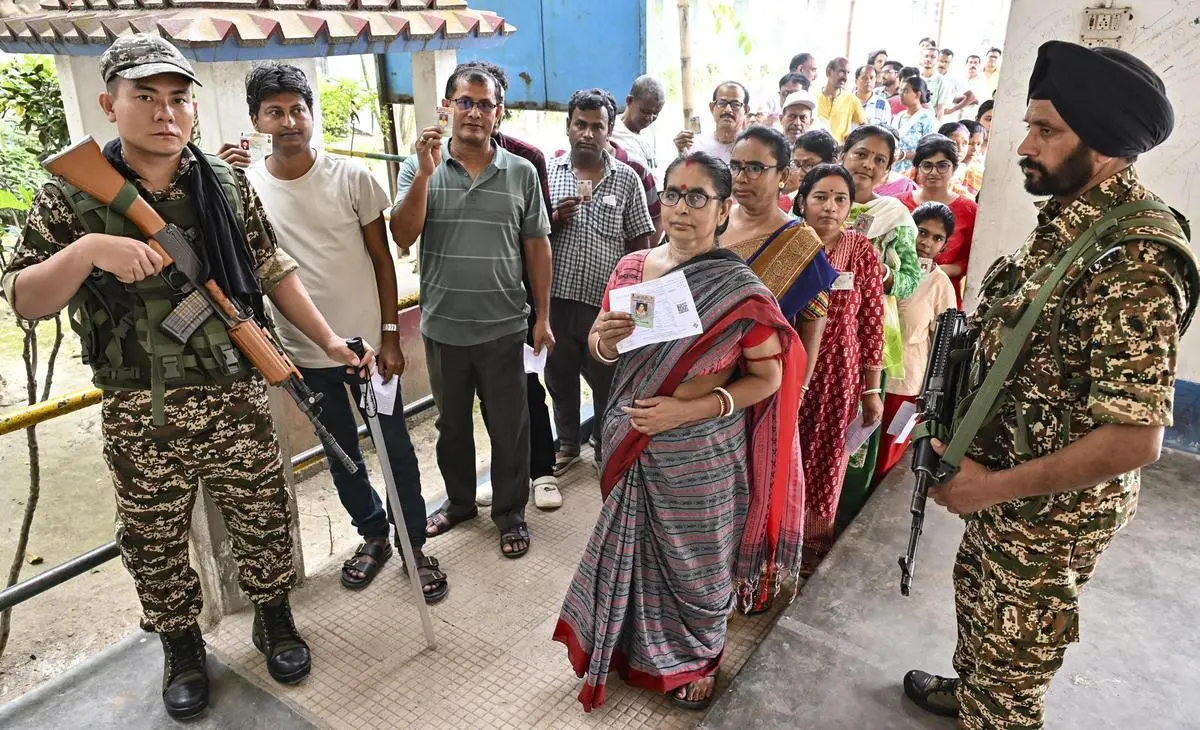
Security personnel keeping vigil during voting in the first phase of West Bengal Assembly election, in Malda, on April 23, 2026. | Photo Credit: PTI
In the view of another officer, who was involved in election work, there are two approaches to conducting an election—do everything to ensure it is free and fair; or do things in a certain way that it helps a particular political party. He said that he was not sure what the commission’s objective was this time around.
Charges of bias
The charges of bias raised against the ECI may have some merit when one examines its conduct in Assam, where the BJP is in power; in Kerala, where the BJP has a fighting chance; and in Puducherry, where the BJP is riding piggyback on the All India N.R. Congress. In Kerala, except for a minor reshuffle of some officers, there were no mass transfers.
In Assam, on March 16, the poll body issued a few instructions, mostly seen as unimportant, to the ruling BJP: in a letter to the Chief Secretary, the ECI directed that Somalin Shubhdarshini be posted as the SSP in Majuli; R. Sheetal Kumar be posted as the SSP in South Salmara; Anchal Chauhan be posted as the SSP in Sadiya; Sudhakar Singh be posted as the SSP in Chirang; and Mohan Lal Meena be posted as the SSP in Dhemaji.
The ECI’s comparable mildness in Kerala prompted the Congress leader Rahul Gandhi to allege that the CPI(M)-led Left Democratic Front had a secret understanding with the BJP. Gyanesh Kumar is an IAS officer from the Kerala cadre.
The inconsistency in the ECI’s approach does not end there. In Bengal, its regulations are draconian: no pillion riders on motorbikes; restrictions on tourists; and a bar on the entry of non-residents into apartment complexes. The biggest pain point is the ban on motorcycles. In addition to being difficult to enforce, it forces parties to hire the far more expensive three-wheelers. This gives a resource-rich party like the BJP a distinct advantage.
The ECI also drew up a list of 800 Trinamool leaders and workers and called for their detention, claiming they were trouble-makers. The Calcutta High Court on April 22 heard a plea challenging this, and it stayed the list until June, only specifying that if a specific case of violence came up against any of those names, immediate action would be taken.
Another instance that arguably reinforces the perceptions of bias is the ECI’s selective response to complaints against political leaders.
Modi’s address to the nation
On April 18, at 8.30 pm, the Prime Minister addressed the nation, using Doordarshan and All India Radio to deliver what was, in substance, an election speech—in which he mentioned the Congress 59 times and singled out parties such as the Trinamool, the DMK, and the Samajwadi Party, just ahead of the Tamil Nadu and West Bengal elections. Complaints were lodged against Prime Minister Narendra Modi for this breach, which the ECI ignored. However, in a separate complaint lodged against the Congress president Mallikarjun Kharge for the use of the word “terrorist” while speaking of Modi, the commission served notice immediately.
Pranay Mahesaawi, an advocate, said that he had filed a formal complaint with the ECI regarding Modi’s misuse of Doordarshan (a public broadcaster) for airing the national address while the Model Code of Conduct was in force. “The address on 18.04.2026 delivered in haste & the political fallout, following the defeat of the Constitution (131st Amendment) Bill, 2026, prima facie constitutes a serious violation of the MCC and provisions saunder the Representation of the People Act, 1951,” he said. The former Congress MP, T.N. Prathapan, too, has approached the court.
Manoj Kumar Jha, RJD spokesperson, posted on X: “Whatever the results on 4th May, this Chief Election Commissioner and his team will not be remembered as custodians of democracy, but as willing participants in the systematic ‘dismantling’ of its very foundations.”
The Congress leader Jairam Ramesh posted on X: “That the Election Commission dances to the tune of the PM and HM has been obvious for some time. After masterminding vote chori in very many lakhs - especially in West Bengal - today it has given fresh evidence of its functioning as an attached office of the Home Ministry. The EC is a Constitutional body. But its behaviour is an assault on the Constitution and a disgrace for which this CEC bears the heaviest responsibility.”
The Trinamool released a video on April 22 seeking to prove its point that the ECI-appointed observers are working for the BJP. “Police Observer for Diamond Harbour, Parmar Smit Parshottamdas, has been caught red-handed,” the party said.
“Despite being provided official accommodation at the IPS Mess in Alipore, Parshottamdas disregarded protocol entirely and chose instead to stay at Room 208 of Sagarika Hotel in Diamond Harbour, where he conducted a private, unscheduled, unrecorded, and entirely unofficial meeting with Gour Sundar Ghosh, BJP’s candidate from Magrahat Paschim.
The BJP-ECI nexus is not a theory. It has now been documented, dated, and located. Room 208, Sagarika Hotel, Diamond Harbour, 20th April 2026,” it said.
The standards that the Election Commission is expected to uphold were set by formidable figures such as T.N. Seshan, T. S. Krishnamurthy, and J.M. Lyngdoh—benchmarks of integrity. Since 2014, however, successive Chief Election Commissioners appear to be charting a different course. Gyanesh Kumar appears to have set a new low.
Also Read | Will Didi prevail over Delhi?
Also Read | What the first impeachment notice against a CEC means