
惯性聚合 高效追踪和阅读你感兴趣的博客、新闻、科技资讯
阅读原文 在惯性聚合中打开

推荐订阅源

cs.AI updates on arXiv.org
L
LINUX DO - 最新话题
OSCHINA 社区最新新闻
OSCHINA 社区最新新闻
Forbes - Security
Forbes - Security
博客园 - 司徒正美
Hugging Face - Blog
Hugging Face - Blog
W
WeLiveSecurity
Jina AI
Jina AI
钛媒体:引领未来商业与生活新知
钛媒体:引领未来商业与生活新知
N
News and Events Feed by Topic
V
V2EX
Stack Overflow Blog
Stack Overflow Blog
Engineering at Meta
Engineering at Meta
PCI Perspectives
PCI Perspectives
Martin Fowler
Martin Fowler
T
The Exploit Database - CXSecurity.com
F
Full Disclosure
WordPress大学
WordPress大学
S
Security Affairs
K
KPMG report finds enterprise disconnect between AI and its ROI | CIO
S
SegmentFault 最新的问题
P
Privacy International News Feed
IT之家
IT之家
M
MIT News - Artificial intelligence
G
GRAHAM CLULEY
Hacker News: Ask HN
Hacker News: Ask HN
D
DataBreaches.Net
奇客Solidot–传递最新科技情报
奇客Solidot–传递最新科技情报
Google Online Security Blog
cs.CV updates on arXiv.org
C
Check Point Blog
美团技术团队
Security Latest
Security Latest
Cyberwarzone
Cyberwarzone
N
News and Events Feed by Topic
MyScale Blog
MyScale Blog
H
Help Net Security
宝玉的分享
宝玉的分享
The Hacker News
The Hacker News
The Last Watchdog
The Last Watchdog
The Cloudflare Blog
Cyber Security Advisories - MS-ISAC
爱范儿
爱范儿
cs.CL updates on arXiv.org
I
Intezer
Threat Intelligence Blog | Flashpoint
AI
AI
I
InfoQ
N
News | PayPal Newsroom
TaoSecurity Blog
TaoSecurity Blog

Latest Politics News | Frontline | Frontline

BJP turns Women’s Reservation Defeat into a New Campaign Plank in Uttar Pradesh Dantewada Cricket Event and India’s “Post-Maoist” Claim Maharashtra’s Sugar Mills Face a Deepening Economic Crisis Election Commission Bias in West Bengal Polls 2026? Tamil Nadu election 2026: Cash-For-Votes and Missing Voters One Year After Pahalgam: Violence, State Response, and Kashmir Narrative Tamil Nadu Assembly Election 2026: Why the Unattached Urban Voter Holds the Key in a Waveless Contest West Bengal Election 2026: Kudmi, Adivasi, Matua Identity Politics Explained When majoritarian march meets its first hard stop Will Didi prevail over Delhi? What Nithin Raj’s death says about caste in Kerala’s private colleges West Bengal election 2026: Identity politics, vote banks, and the BJP vs Trinamool battle Exclusive interview | Tamil Nadu Chief Minister M.K. Stalin talks about Assembly election 2026, fiscal authoritarianism, and the fight for federalism Women’s Reservation Bill 2026: Modi’s Delimitation Trap Exposed What was wrong with BJP's so-called Women Reservation Bill J&K liquor controversy explained: Tourism, revenue, and politics | The Kashmir Notebook Ep 13 Delhi Pink Saheli Card 2026: Domicile Rule Hurts Women Manipur’s Rumour Economy: How Disinformation Fuels Mob Violence Punishing the South: Modi’s Delimitation Plan and the Politics of Control The Vijay Factor AIADMK Delta Strategy: Can Leema Rose Win? Maharashtra Shows Why Women’s Reservation May Aid Elites CBI Reply in Kejriwal Case Exposes Judicial Conflict Norms Tamil Nadu Election 2026: Social Media Narratives, War Rooms, and Players Modi’s Roadshow and BJP’s High-Stakes Push in South Tamil Nadu SIR West Bengal Voter Exclusion Case 2026 TN Assembly Polls 2026: Senthil Balaji and SP Velumani Clash for Western Belt Supremacy Women’s Reservation Act Amendments Raise Delimitation Fears Partha Chatterjee’s For a Just Republic and the Limits of the People-Nation Hungary Election 2026: Orbán Defeated, Magyar Wins Big Free Speech Crackdown in India: Is Dissent Under Threat? Ambedkar Jayanti and the New Publicness of Protest Politics Implementing Women’s Reservation: Why a Hybrid 651-Seat Lok Sabha Model Outperforms Mass Expansion Ambedkar and Free Speech: Who Controls Dissent in 2026? Reforming Tamil Nadu's Local Governance: Why MLAs Aren't Fixers in 2026 West Bengal voter list controversy explained | Why names are being deleted Will Vijay’s TVK disrupt DMK and AIADMK? | Tamil Nadu election 2026 Constitutional Morality vs Social Morality in India 2026 Amit Shah’s Anti-Conversion Promise Opens a New Faultline in Punjab Politics Why Indian Shias Protest for Iran: History of Solidarity (2026) West Bengal Voter List Row 2026: “Votercide” Debate From Grief to Politics: Porkodi Armstrong and the Battle for Dalit Power in North Chennai West Bengal election 2026: Will Babri Masjid split the Muslim vote? West Bengal Communal Politics and the 2026 Election Battle Raghav Chadha-AAP Rift Explained: Rise to Fallout (2026) Why India Is Not Energy-Secure Amid Global Oil Shocks India IT Rules 2026: Threat to Free Speech? Iran War Ceasefire Signals a Shift Toward Multipolar Deterrence 2026 Assembly Polls: Congress vs BJP Power Test Kerala Assembly Election 2026: LDF Anti-Incumbency vs UDF Momentum Gujarat Local Polls: AAP Rise Deepens Congress Crisis SIR controversy deepens fear of Muslim disenfranchisement in Bengal Kerala Election 2026: LDF, UDF, and the BJP “B Team” Charge Who will win Kerala Assembly Election 2026? LDF or UDF? Assam Polls: Cash Transfers Mask Stagnant Incomes and Job Distress Jaishankar and India's Diplomacy Crisis After Nitish Kumar, Bihar BJP faces its biggest test: caste coalition without a ‘Mr Clean’ Actor Vijay and Politics: An Emerging Landscape N Rangasamy’s 2026 Puducherry Poll Strategy and Power Play Kashmir Encounter Killing Sparks AFSPA Debate 2026 GST Federalism Crisis 2026: How States Lost Fiscal Power US-Iran War 2026: Petrodollar Stakes Behind Hormuz Clash White Savior Complex in Arab Regimes Drives Ukraine Deals Not Self Reliance UPA Corruption Narrative vs Court Verdicts 2026 Mathur Sathya Case Exposes Patriarchy in Progressive Politics India Needs a New Economic Model Beyond Neoliberalism Why J&K MLAs Are Fighting the Lieutenant Governor Over Security Puducherry election 2026: Can Congress return to power? | V. Narayanasamy explains Pawar Family Rivalries Stall NCP Factions Merger in Maharashtra How Foreign Thinkers Shaped Hindutva’s Rise Naxalism’s Shift: Armed Struggle to Ideological Influence G. Haragopal on Tribal Resistance, Maoist Surrenders, and Politics DMK manifesto 2026: Key promises, alliances, & welfare politics Rajya Sabha Polls Expose India’s Open Secret: Cross-Voting and Poaching State Assembly Elections 2026: How Voter Dynamics Are Shaping India DMK Seat-Sharing Deal Reveals a Tougher M.K. Stalin What Iran Means to Kashmir | War, Identity, and 5000 Years of History Thirumavalavan Signals Shift in Tamil Nadu Politics Golgappa diplomacy and the fragile reset in India-Bangladesh ties Tamil Nadu election 2026: DMK vs AIADMK, alliances, and Vijay’s entry Is Indian Cinema Losing its Moral Voice? How the BJP’s strategic pivot on delimitation and women’s quota will reshape the 2029 electoral landscape Why INDIA Bloc Collapsed in Puducherry | DMK, Congress & VCK Rift Explained West Bengal 2026 Assembly Elections: Candidate Controversies Stir Party Rebellions Tamil Nadu Elections: CPI(M) on DMK Alliance & BJP Fight Ashok Kharat Scandal Exposes Maharashtra’s Godman–Power Nexus India Migration Crisis: Gulf Conflict Exposes Gaps 2011 Election Petition Against Stalin Returns Ahead of Tamil Nadu Election Delhi Budget 2026: Growth Claims and Welfare Gaps Tamil Nadu NDA Deal Reveals AIADMK’s Upper Hand Inside AIADMK Strategy: EPS Leadership, BJP Alliance, and TVK Challenge Vijay Politics: Can TVK Break Tamil Nadu's DMK AIADMK Duopoly? How Eid went under siege in Uttam Nagar Assam Elections 2026: BJP Faces Tribal Backlash Over Evictions in Karbi Anglong First Impeachment Notice Against India’s CEC Shakes Politics 2026 Hindu Rashtra Debate: 2026 State Elections Test Secular India Tamil Nadu Election 2026: How Gender and Gen Z Voters are Reshaping the Dravidian Power Struggle Maharashtra’s Anti-Conversion Bill and the Politics of 'Love Jihad' Post-Colonial Nationalism and the Western Far Right: Why the Comparison Fails Gujarat's proposed marriage registration amendment 2026 polices choice
How Women Voters Are Reshaping Assembly Election Outcomes in Kerala, Tamil Nadu, West Bengal, and Assam
Sanjay Kumar,Vibha Attri ,Arindam Kabir · 2026-05-16 · via Latest Politics News | Frontline | Frontline

The recently concluded Assembly elections in Kerala, Tamil Nadu, Assam, and West Bengal reaffirm a well-established feature: women form a large, active, and electorally consequential segment of the electorate. In these elections, too, women’s turnout remained high, and in several cases, slightly higher than that of men, making their participation central to the outcomes.

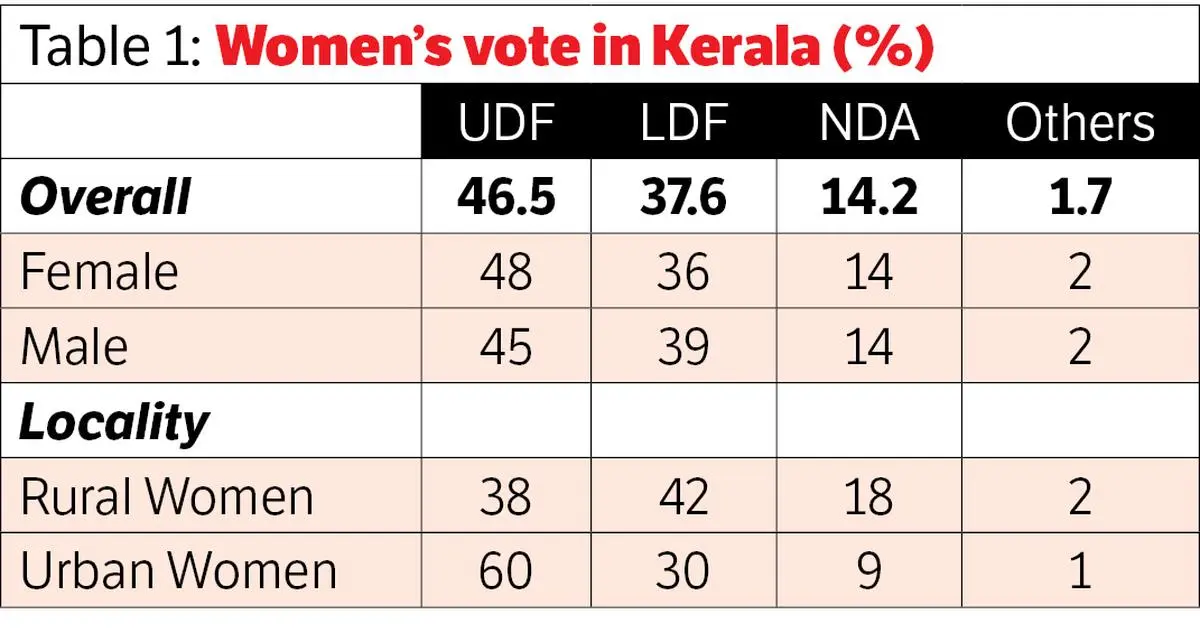
In Kerala, women leaned more decisively towards the United Democratic Front (UDF), with roughly 48 per cent backing it as compared to 36 per cent backing the Left Democractic Front (LDF) and 14 per cent the National Democratic Alliance (NDA). Men also favoured the UDF, though less decisively (about 45 per cent for the UDF and 39 per cent for the LDF). The difference, however, was one of degree rather than direction, as both men and women favoured the UDF as the leading choice (Table 1).

These aggregate patterns were further differentiated by location, age, and class among women voters in Kerala. A rural–urban divide was evident: rural women were more inclined towards the LDF (42 per cent) than the UDF (38 per cent), while urban women showed a strong and decisive preference for the UDF (60 per cent) over the LDF (about 30 per cent), indicating a sharp spatial divergence in voting behaviour (Table 1).
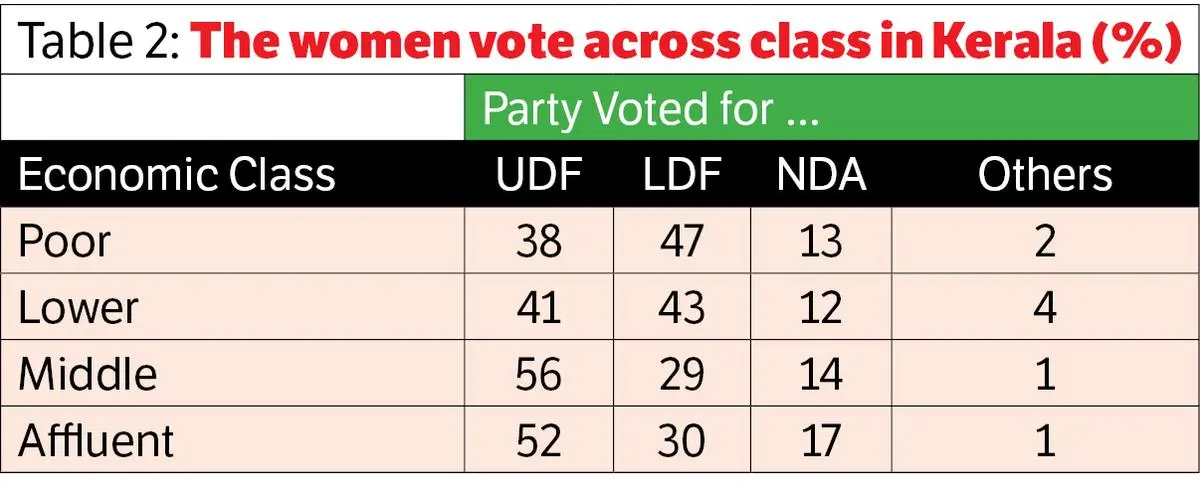
Younger women (up to 45 years) supported the UDF at levels above 50 per cent, while support for the party declined among older women, who showed a stronger inclination towards the LDF. Class divisions were equally significant. Women from poor and lower-income households were more supportive of the LDF (around 47 per cent and 43 per cent respectively), whereas those from the middle and affluent classes showed a clear preference for the UDF, with support ranging from about 52 per cent to 56 per cent (Table 2).
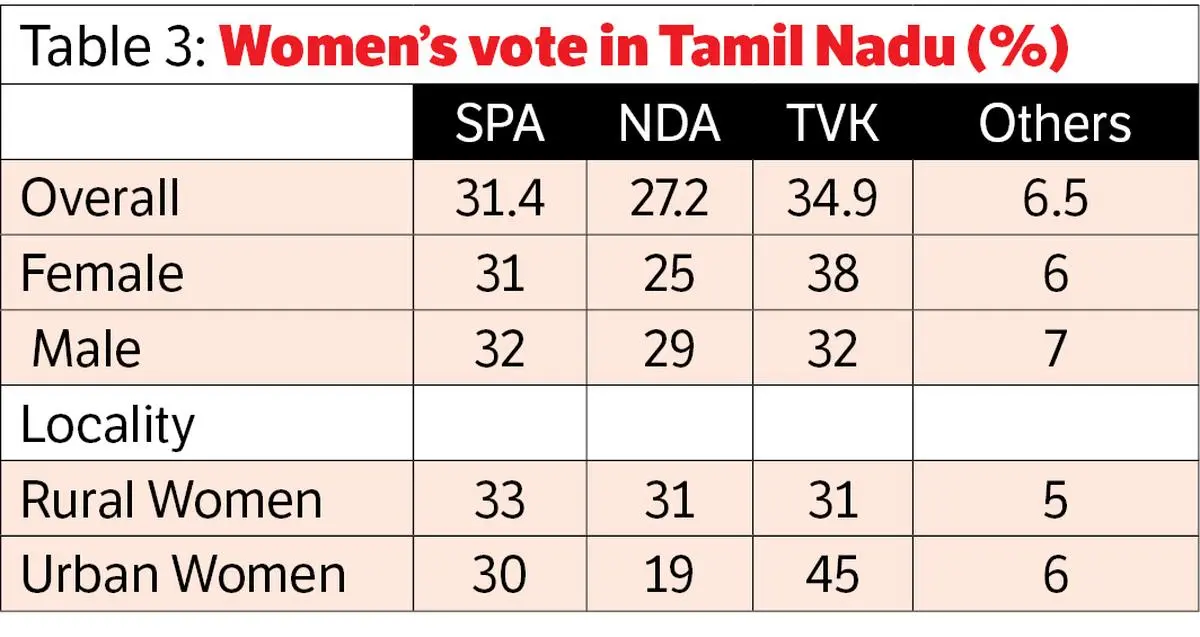
In Tamil Nadu, women voters showed a relatively fragmented but clearly structured pattern of electoral choice. Overall, women were most inclined towards the Tamilaga Vetri Kazhagam (TVK) (38 per cent), followed by the Dravida Munnetra Kazhagam (DMK)-led Secular Progressive Alliance (SPA) (31 per cent) and the AIADMK-led NDA alliance (25 per cent), indicating that the TVK emerged as the single largest preference among women. Compared to men, women showed a stronger preference for TVK and a relatively lower inclination towards the NDA alliance, while the DMK’s support remained broadly similar across genders (Table 3).

The rural-urban divide was pronounced. Rural women showed a fairly even distribution of preferences across the SPA (33 per cent), NDA (31 per cent), and TVK (31 per cent), suggesting a closely contested three-way split. Urban women, by contrast, showed a strong tilt towards the TVK, which received 45 per cent support, compared to 30 per cent for the SPA and 19 per cent for the NDA (Table 3).
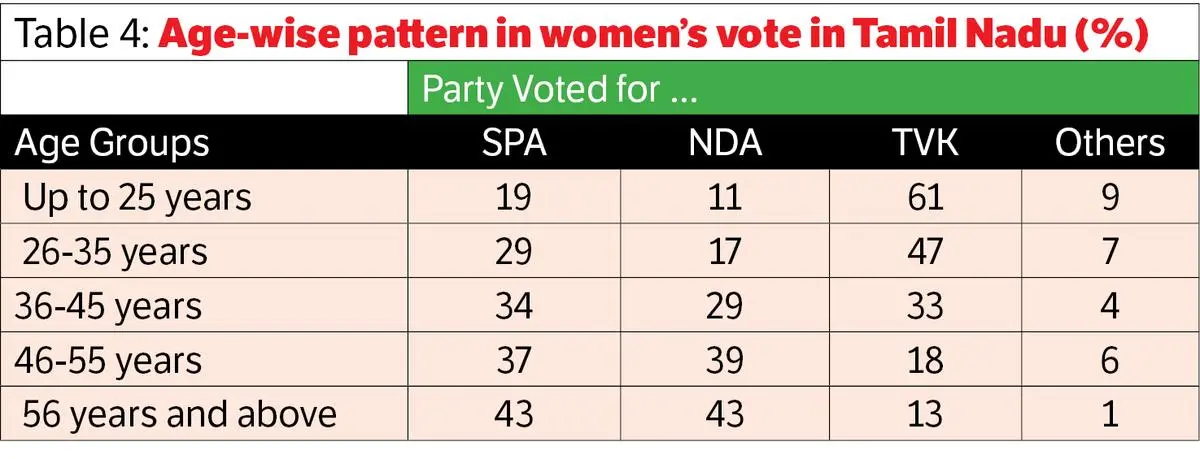
The age-wise variation was particularly sharp and indicated a clear generational shift. Younger women strongly favoured the TVK, and support declined steadily with rising age, while the other two alliances gained relatively greater support among older women (Table 4).
Class differences followed a similar pattern. Among poorer women, voting was relatively divided, with the NDA (36 per cent) and TVK (34 per cent) ahead of the Secular Progressive Alliance (27 per cent). As economic status increased, support for TVK rose, reaching 41 and 42 per cent among women from middle and affluent classes.

The data point to a significant concentration of TVK support among younger and economically well-off women, while older and poorer women remained more divided across the two Dravidian parties.

In Assam, women voters showed a clear and consolidated preference for the NDA, with 51 per cent supporting it compared with 31 per cent backing the Congress-led coalition Asom Sonmilito Morcha (ASM), 5 per cent the All India United Democratic Front (AUDF), and 14 per cent others. Compared to men, women were more strongly aligned with the NDA and less supportive of ASM, indicating a modest but clear gender tilt in favour of the NDA (Table 5).
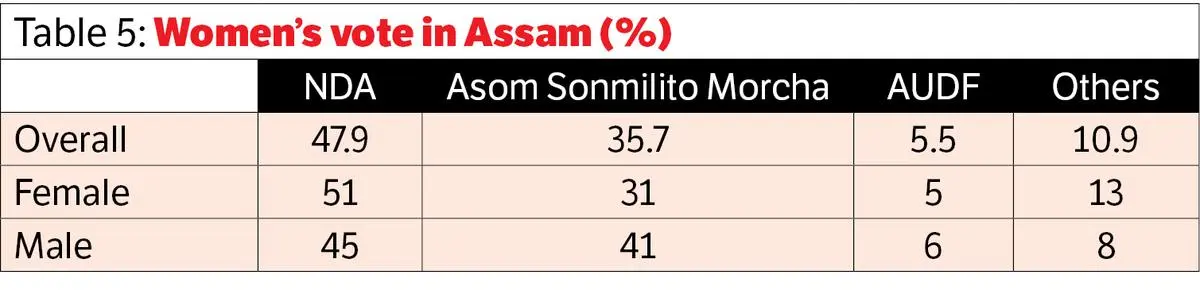
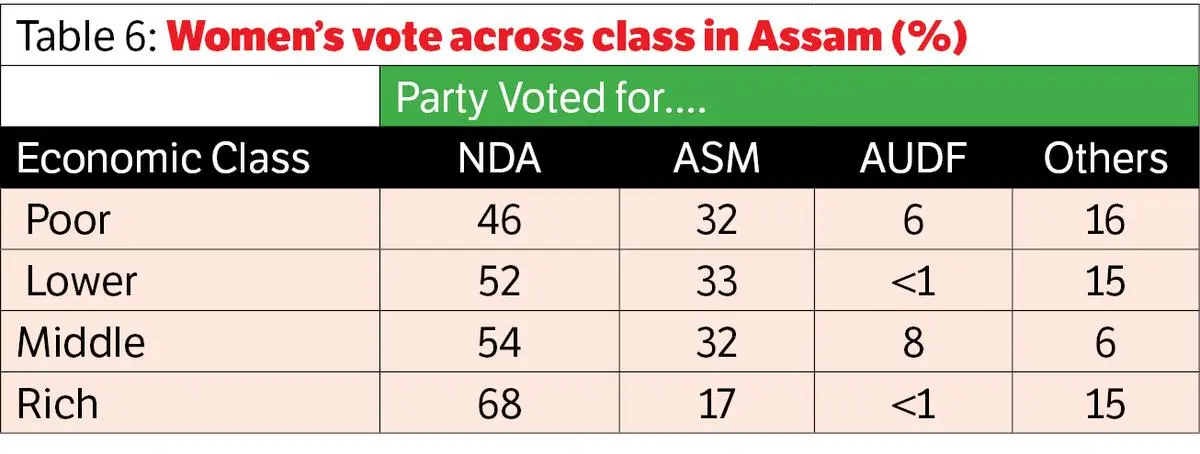
The NDA drew strong support from both younger and older women, with support dipping slightly in the 36-45 age group, though it remained around 45 per cent . Class differences reinforced the dominance of the NDA among economically better-off groups, with support rising in direct proportion to economic status (Table 6).
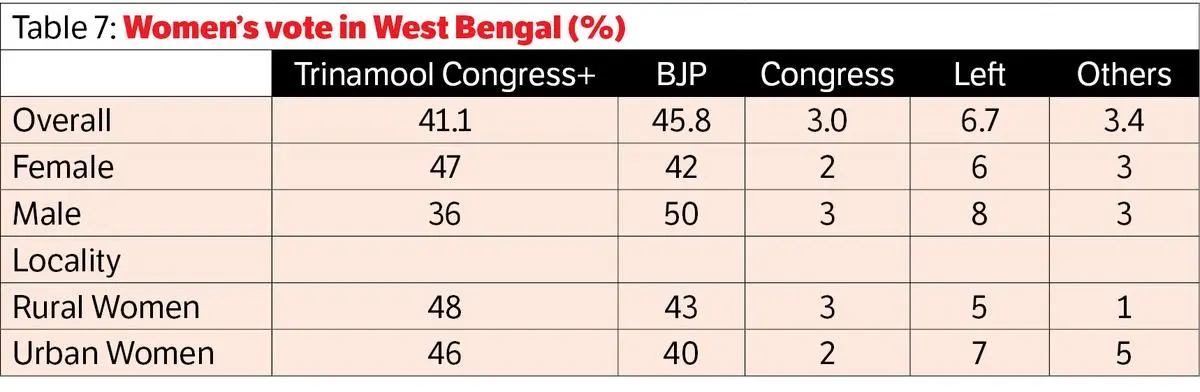
In West Bengal, women voters were closely divided between the All India Trinamool Congress (AITC)-led alliance (47 per cent) and the BJP (42 per cent), with only a small gap. Men, by contrast, showed a clearer preference for the BJP (50 per cent) over the Trinamool (36 per cent), indicating a pronounced gender difference in voting. While the Trinamool retained a narrow lead among women, the BJP took a substantial share, suggesting that the BJP had made significant inroads into this segment (Table 7). In 2021, the women vote went far more sharply for the Trinamool. Rural-urban differences were limited, with the Trinamool holding only a narrow lead, while the BJP trailed closely in both spaces, but showing growing inroads (Table 7).
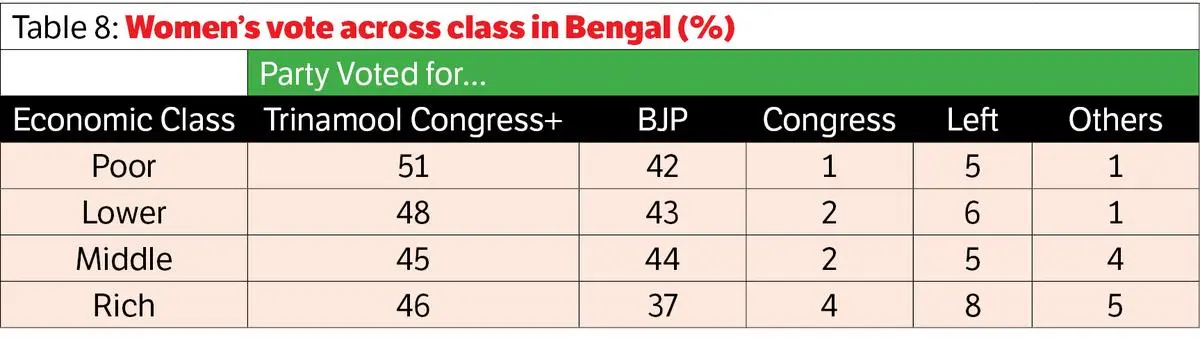
Across age groups, the women’s vote in West Bengal showed a close contest between the Trinamool and the BJP, with variation across cohorts but no single trend. Class-wise differences were visible among women, with those from poor backgrounds showing stronger support for the Trinamool (51 per cent) compared to the BJP (42 per cent). Among lower-income and middle-class women, the gap was smaller, with near parity in the middle group (45 per cent for the Trinamool and 44 per cent for the BJP). Among affluent women, the Trinamool again had a clear lead (46 per cent versus 37 per cent for the BJP) (Table 8).
While there have been variations, there is no doubt that women’s participation has been on the rise and they are a constituency that no political party can ignore.

Sanjay Kumar is an election analyst and a psephologist. Vibha Attri and Arindam Kabir are researchers with Lokniti-CSDS.

The views expressed by the authors are their individual views. They do not reflect the views of any institution.

Also Read | Did women-centric welfare schemes influence voting in Bengal, Kerala, and Tamil Nadu?

Also Read | How Vijay achieved a breakthrough in Tamil Nadu