
惯性聚合 高效追踪和阅读你感兴趣的博客、新闻、科技资讯
阅读原文 在惯性聚合中打开

推荐订阅源

Threat Intelligence Blog | Flashpoint
Microsoft Azure Blog
Cloudbric
Cloudbric
I
InfoQ
V
V2EX
博客园_首页
The Register - Security
cs.CV updates on arXiv.org
S
Secure Thoughts
Vercel News
Vercel News
Forbes - Security
Forbes - Security
云风的 BLOG
云风的 BLOG
PCI Perspectives
PCI Perspectives
L
LINUX DO - 最新话题
D
DataBreaches.Net
H
Hacker News: Front Page
Application and Cybersecurity Blog
B
Blog RSS Feed
A
About on SuperTechFans
N
News and Events Feed by Topic
Apple Machine Learning Research
Help Net Security
Help Net Security
Attack and Defense Labs
N
Netflix TechBlog - Medium
Spread Privacy
Spread Privacy
F
Full Disclosure
Recorded Future
Recorded Future
AWS News Blog
AWS News Blog
博客园 - 【当耐特】
The Cloudflare Blog
T
Threatpost
T
Tor Project blog
Google DeepMind News
C
CXSECURITY Database RSS Feed - CXSecurity.com
CTFtime.org: upcoming CTF events
Recent Announcements
M
MIT News - Artificial intelligence
A
Arctic Wolf
C
Check Point Blog
Stack Overflow Blog
Stack Overflow Blog
T
Threat Research - Cisco Blogs
Security Archives - TechRepublic
Hacker News - Newest:
Hacker News - Newest: "LLM"
WordPress大学
WordPress大学
Cyberwarzone
Cyberwarzone
小众软件
小众软件
C
Cyber Attacks, Cyber Crime and Cyber Security
P
Proofpoint News Feed
Security Latest
Security Latest
The Last Watchdog
The Last Watchdog

Explore Curated News Packages on Top Stories | Frontline

Operation Sindoor at One: Conflict, Politics, Fallout One Year After Pahalgam: Violence, State Response, and Kashmir Narrative The US–Iran Conflict: What to Know Now Remembering the Masters Who Rewrote Indian Cinema Colonial Conflicts, Climate Crisis, and Caste Privilege: 10 Essential Non-Fiction Books for 2025 Society Roundup 2025: An Annual Report on Being Human Fiction Picks of 2025 That You Shouldn’t Miss Reading India 2025: Elections, Power Shifts, and Democratic Resistance Ladakh Statehood Demands: Identity, Land, and Safeguards Pather Panchali at 70: Ray’s Enduring Legacy in Indian Cinema Independence Day 2025: Rethinking Freedom 79 Years On Frontline Explains: India’s mental health crisis 10 Years of Digital India: Hype vs. Reality Planet on Fire: Inside India’s Climate Emergency and the Justice Crisis Will NEET Break More Students Than It Makes Doctors? Counting Caste: What the Cabinet’s Decision Means for India’s Political Future Ambedkar Jayanti 2025: Rethinking Justice, Democracy, and the Nation Curated Articles on Delhi Assembly Election 2025: AAP Faces Tough Battle for Third Term as BJP, Congress Court Women Voters Israel-Hamas Ceasefire: Unpacking the Historic Gaza War Deal Frontline Wrapped: Top Ten Defining Economics Narratives of 2024 Israel-Palestine Conflict: Two Years After October 7 Attack | In-Depth Analysis Tribute | Sitaram Yechury Speaks: Interviews with Frontline India, Canada, and the Khalistan conundrum
Booming GDP, Broken Dreams: Is India’s Youth Staring at a Jobless Future?
TEAM FRONTLINE · 2025-05-29 · via Explore Curated News Packages on Top Stories | Frontline
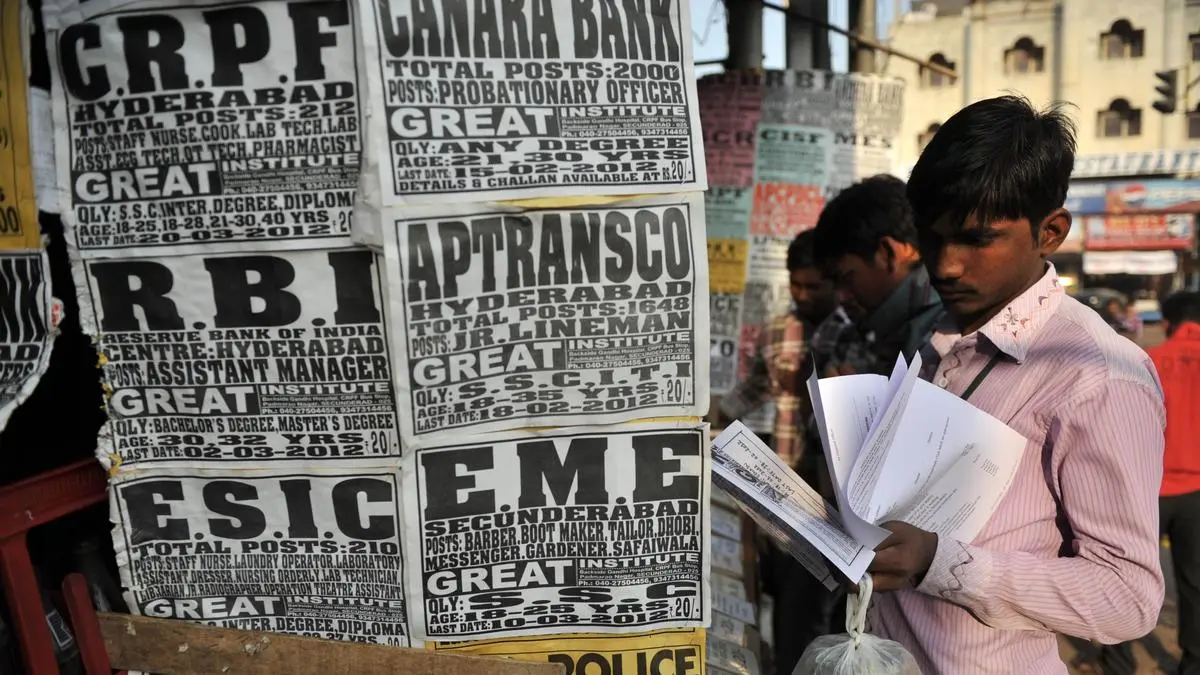
Indian youth search for jobs at a shop in Hyderabad in February 2012. India is navigating a critical juncture with deepening economic inequality, rising joblessness, and a young population grappling with a future of uncertainty.

Indian youth search for jobs at a shop in Hyderabad in February 2012. India is navigating a critical juncture with deepening economic inequality, rising joblessness, and a young population grappling with a future of uncertainty. | Photo Credit: NOAH SEELAM/AFP

Recently, NITI Aayog CEO B.V.R. Subrahmanyam announced that India has become the world’s fourth-largest economy, surpassing Japan—citing projections from the International Monetary Fund. While the milestone has been hailed in official circles as a moment of national pride, economists and policy experts have urged caution. They point out that GDP rankings offer only a partial picture, often masking major issues such as the quality of growth, income inequality, and living standards. Behind the celebratory headline lie persistent and widening socioeconomic disparities that demand urgent attention.

India is navigating a critical juncture with deepening economic inequality, rising joblessness, and a young population grappling with a future of uncertainty. Far from the shining vision of a self-reliant, digitally empowered nation, what confronts us instead is a fractured labour market, where automation, climate change, and policy apathy intersect to leave millions behind.

This Frontline package unpacks the multiple dimensions of India’s employment crisis. At its heart is the contradiction between headline growth and jobless realities.

Sujoy Chakravarty examines how automation, climate volatility, and weak policy interventions have led to a dramatic decoupling of GDP growth from job creation. He also turns the spotlight on India’s rising number of graduates, where overqualification meets chronic underemployment in a labour market unprepared for the AI revolution.

The consequences of this mismatch are most visible among India’s youth, once seen as a demographic dividend but now drifting toward a demographic liability. In “Nope, the kids aren’t alright”, an episode of The Frontline Weekly, Jinoy Jose P. captures the simmering frustration of Gen Z, further explored in Rama Bijapurkar and Mathangi Krishnamurthy’s essay on the identity struggles, digital lives, and the precarious futures of this generation.

T.K. Rajalakshmi’s reporting exposes two core structural inequities: the illusory rise in women’s employment, and the persistent underrepresentation of marginalised communities in both public and private sectors. The situation in the gig economy, once marketed as a solution to joblessness, is similarly grim, Frontline’s reporting lays bare the exploitative underbelly of platform work, where the promise of flexibility is undermined by absence of rights, benefits, or stability—especially for women.

In the background looms a larger failure of governance. Jayati Ghosh and Ashoka Mody dissect the Modi government’s continued reliance on elite-driven growth, crony capitalism, and cosmetic budgetary announcements, which have deepened deprivation rather than alleviated it. Prabhat Patnaik captures the moral urgency of this moment, arguing that India is not just facing unemployment but a broader economic and social unravelling.

As the IT sector slows, as formal jobs dry up, and as rural and urban distress collide, this package asks the most fundamental question: Is the Indian state capable—or even willing—to address the scale and nature of this crisis?

Read the package to find out.