







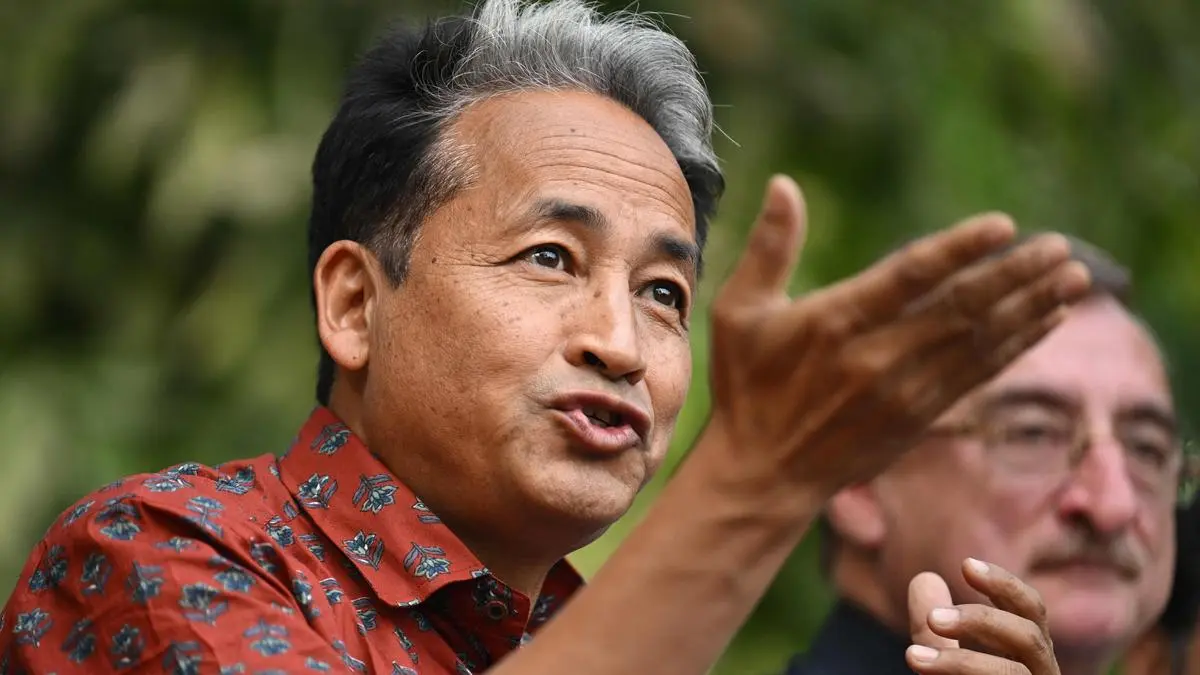
After his release from jail in March, climate activist Sonam Wangchuk spoke to Safeena Wani in Leh about his time in prison, Ladakh’s shifting politics, the role of the Apex Body, Leh (ABL) and the Kargil Democratic Alliance (KDA), the Gen Z mobilisation, and expectations from Amit Shah’s visit.
Excerpts from the conversation:
Why do you think you were jailed and the National Security Act was slapped against you?
It was a nefarious action by some people in the official hierarchy to please their masters. The aim was to silence my voice for raising the rightful demands of the people of Ladakh.
Have you crossed a line: from being an educator activist to becoming a politician?
I was never a face of ABL and did not want to get into its politics. Mine was a time-bound intervention till we achieved some safeguards for Ladakh. I am sacrificing so many things for this. I won’t be getting into the nitty-gritties of local politics. The earliest I can leave and return to doing my own things, the happiest I will be.
I came to help ABL and the KDA, and unfortunately, I got stuck for so long. And when they said I was needed here, I reluctantly said “okay”. I told them you can discuss and negotiate; and I am good at garnering support from the people of Ladakh and the rest of the country and I will do it.
What was the role of your wife when you were arrested?
She was the surprise in this story. She was the best kept secret. I didn’t know that she could fight through this in the best possible way. It was a surprise for me as well.

People protest demanding statehood and inclusion under the Sixth Schedule, in Leh, Ladakh, on March 16, 2026. | Photo Credit: PTI
Has jail changed you in any way?
Honestly, I was moved and disturbed by the horror story of Ladakh on September 24, 2025, but there was not much I could do at that stage except let the world know that this was uncalled for. After that incident, I was kept in total isolation, and I could do nothing, contribute nothing, and received no information from anywhere. I tried to turn inwards, take time to calm myself, reflect, read, write, meditate, and prepare for the next steps.
But I always thought that my absence and my being in jail would have a stirring effect on the conscience of the nation: sooner or later the nation will question the use of such force on a person who has been upright and has contributed to national security in many ways. For example, I supported the armed forces to ensure their comfort and logistics in the sub-zero temperatures through innovation like solar-heated military tents. I stood by our armed forces during the times of the Chinese aggression in Galwan and mobilised people across India to do something. I started a campaign to fight with our wallets by discarding Chinese-made goods. Unfortunately, somebody who has been in support of the nation was labelled as anti-national. So, I thought that not doing anything is also doing a lot.
After coming out of jail, I saw the memes, articles, and videos people had made in response to my detention. And I had said that my being in jail will be more trouble for you [the government] than my being outside.
Can you share some experiences from the jail?
I was not interacting with anyone except with the uniformed officials of the jail and my family whenever they would visit. In every interaction, the guards and officers would say this was unjust. Despite being in the government, they would say their heart is with me. They were disciplined and never moved an inch from the rule book in the nicest possible way. I like people following their duties with discipline. Apart from security guards, squirrels, peacocks, and most importantly, ants were my friends. These ants taught me community spirit, diligent hard work, and selflessness. Then I asked Gitanjali, my wife, to get me a book on ants, which I read and got acquainted with about their culture and genetics.
WATCH | Sonam Wangchuk speaks with Frontline
Wangchuk talks about what he sees as key unresolved issues in Ladakh, including governance demands, administrative changes, and the announcement of new districts. | Video Credit: Host: Safeena Wani
Has the politics of Ladakh changed after the protests and killings on September 24, 2025?
Initially, when Ladakh was made a Union Territory, people were grateful to the ruling party, the BJP. They reciprocated by voting it into power. But when the party revealed its other side and unexpectedly backtracked on its promises, people lost their trust and that changed the politics of Ladakh. Now it [BJP] is the least liked party; tomorrow it can change if it fulfils its promises. Even opposition parties like Congress, if they really fulfil the promises, we will help them as well, and we will offer our seats. But let us see how the talks with the current government go and what comes out of it. If nothing happens, the BJP, which suffered in the last parliamentary elections, will continue to suffer.
Also, I do see some changes in some leaders [in Ladakh] because it is not easy to deal with this party [BJP] of strong-minded people. So, some people succumb while others continue. Everybody faced threats of killing, raids, and jail terms after September 24 and there was confusion all around, even among the leadership.
All kinds of allegations were levelled [by the administration and the central government]. But they have revoked all such charges against me. If I were the “chief conspirator” and all charges were dropped against me, then the cases against all those who were put behind the bars for the same reasons do not stand as well.
What would be the win-win situation between Ladakh and the central government?
When I was in jail, I heard that the last meeting of the representatives of Ladakh and the Ministry of Home Affairs on February 24, 2026, was a total failure, with the government reportedly being adamant on a “win-lose” scenario with Ladakh losing. They were not accepting the two main demands of statehood and the Sixth Schedule. After that, in my NSA revocation order, they [the Union Government] wrote that it aimed “to bring peace and stability and build an environment of mutual trust towards a process of meaningful dialogue”.
And if they follow this order in letter and spirit, it will create a win-win situation for all the stakeholders.

Security personnel during a curfew days after protests, in Leh on September 29, 2025. | Photo Credit: S. Irfan/PTI
What is your message to the BJP and the Union government?
They have to reflect a lot on their ways. A country cannot progress in an environment of fear. You should win the hearts of people and not just ensure their submission by fear. I do admire the BJP’s policies like Swachh Bharat, Smart Cities, and International Solar Alliance. I want to say that they don’t have to use repressive tactics. The BJP was doing a good job, and it should continue that rather than using means to silence people and dissent. As a person born in Ladakh and in this great nation with a great Constitution, I will be failing as a responsible citizen if I am not able to exercise my right to express myself in peaceful ways. Then I might as well have been born in China, where they don’t care about your rights but at least the trains run on time.
What is your message to the Gen Z in Ladakh?
Revolution is good, but not in violent ways and forms. Gen Z should be aware of the rights and wrongs that are happening. They should express their opinion and bring change in peaceful ways. Be courageous but in a constitutional and ethical way. Don’t think going to jail is a bad thing. Every young person should go to jail once in a lifetime. Go to jail not for crime but for a cause. If people do not rise up, the government will continue with its wrongful actions.
What will be your future course of action? You were saying you were waiting for meaningful dialogue?
I will go and continue my education and environmental work. But if “meaningful dialogue” doesn’t happen, we will again fight for the rights of Ladakh under a constitutional framework.
What are your expectations from the subcommittee meeting on May 22. What is your view on this?
We are disappointed. When everything has been discussed, and you await a conclusive outcome, you don’t need a sub-committee meeting. Even if you need it for working out the details, a broader high-powered committee chaired by the Home Minister is the most logical thing to happen, that too when he happens to be in Ladakh. So, not holding a dialogue when the Home Minister visits Ladakh after so much that has happened will neither prove meaningful nor constructive.
What is the impact of announcing five new districts?
It is like you have a headache and you are being prescribed a medicine for a stomachache. So this was not sought by anyone other than a few people from Zanskar and perhaps Drass. At most, we needed two districts. But announcing three more districts doesn’t mean anything, and many of them will find it most inconvenient. These will not be full-fledged districts with all departments in one place. In any case, this was not a public demand. But it may lead to something they have in mind which we don’t understand.
For statehood or a UT with a legislature, this is actually a retrograde step, because it will increase the expenses. Already, the argument they have put forth concerning the demand for statehood is that Ladakh doesn’t have sources for revenue generation. So, these five districts, I am being told, will add Rs.850 crore or so to expenses, making it harder for the State to survive or be self-reliant. This is why there is no celebration at these places.
What will be the strategy of ABL and KDA if Amit Shah does not meet its representatives?
This will be a signal that the trust-building exercise was not sincere. It was perhaps to escape the Supreme Court’s order. I always say that we want to believe it is a sincere effort. But if they don’t do this, it will almost prove that we were wrong to assume so.
What is the mood in Ladakh right now?
I am more concerned about—and afraid of—the message the people of Ladakh might send. It is not good if they give a cold welcome. It is best that he receives a warm welcome, and to do so, he has to fulfil the expectations of a meeting with KDA and ABL. I am also concerned about the wrongs that happened in September last year. I am hoping that they will take the right steps. It has to be a mutually accepted resolution.
Safeena Wani is an award-winning journalist with eight years’ experience in multimedia reporting from Ladakh and Kashmir.
Also Read | Ladakh after protests
Also Read | Ladakh’s battle for identity and autonomy