








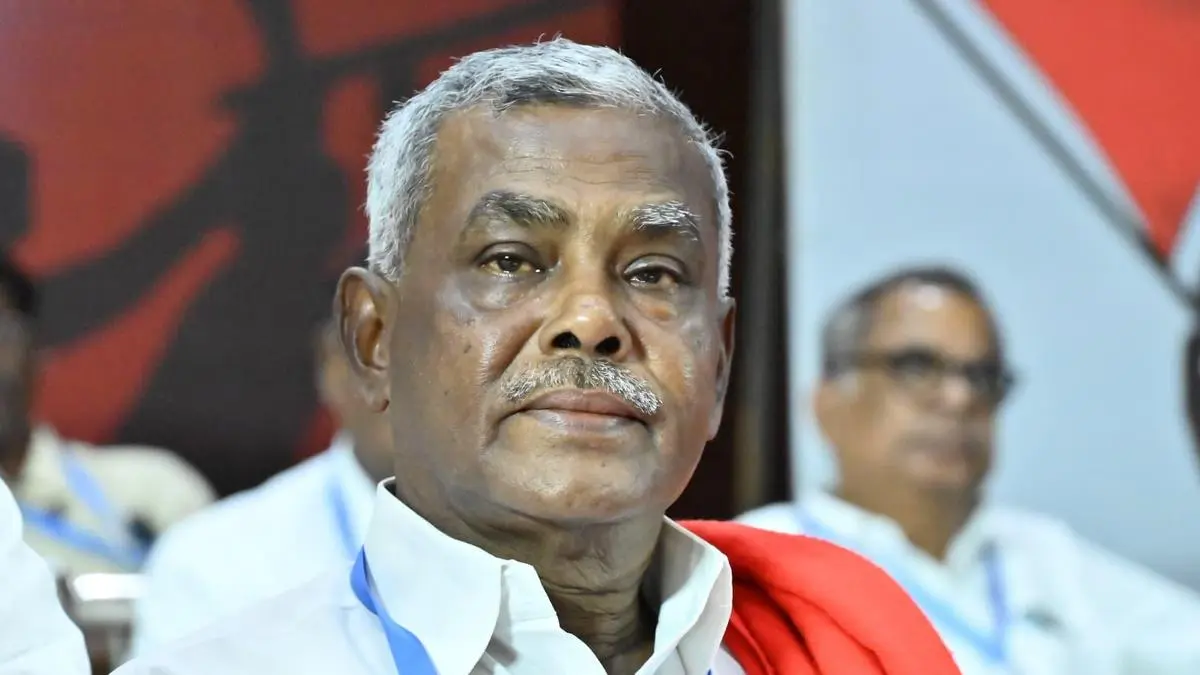
Ahead of the Assembly election in Tamil Nadu, CPI(M), which is part of the Secular Progressive Alliance led by the Dravida Munnetra Kazhagam (DMK) was allotted five seats on March 23. In the previous 2021 election, the party contested in six seats and won two seats–Keezhvelur and Gandarvakottai. After signing the seat-sharing agreement, CPI(M) State secretary P. Shanmugam told the media that though the party is not satisfied with the number of seats allotted, it will continue to be part of the alliance with the common objective of defeating the BJP–AIADMK combine.
In this interview with Frontline, Shanmugam talks about the DMK government’s approach to workers’ issues, the new political entrant Tamilaga Vettri Kazhagam, anti-caste politics in the State, and the party’s plan for the future. Edited excerpts:
You are not happy with the seats allotted by the DMK...
In the 16th Assembly election, we contested six seats. Reaching an agreement with one seat less than that is not satisfactory to us, and we have stated this openly. We have to view this in the backdrop of the DMK bringing in several new parties with the sole aim of securing victory in this election. They themselves have revealed that negotiations continued on both sides until the very day the alliance was finalised. In such a situation, the inclusion of these parties cannot be viewed as a decision based on ideology. It can only be understood as a move driven by electoral considerations.
Won’t such concessions compromise CPI(M)’s individual growth?
Opposition to the BJP and the RSS is a position that the CPI(M) has taken both ideologically and politically. Elections will come and go, but we approach them from our fundamental political principles. Our position is rooted in ideology. However, it appears that capitalist parties may be viewing this principled stand as a weakness when it comes to seat-sharing talks. We approach everything, including elections, from our ideological standpoint. At the same time, we cannot change our position based on the approach taken by the parties with whom we enter into an alliance. This is our strength, but others see this as our weakness.
Why has the CPI(M) not expressed any interest in power-sharing or government positions, unlike allies such as the Congress and the VCK?
The calls for share in governance and power are something we are hearing from various quarters only in this election. In the previous elections such demands were not raised—this is the first time, and that too quite strongly. At the Vikravandi rally, when Vijay spoke, he openly extended an invitation, saying that those who join his alliance would be given a share in governance and power. However, no party has accepted that invitation so far.
If an alliance is formed on the basis of a common minimum programme, then there is some justification in everyone seeking a share in governance. In Tamil Nadu, alliances are not formed on the basis of such a programme; they are essentially seat adjustments and electoral arrangements. Therefore, whichever party secures a majority forms the government.
As far as the CPI(M) is concerned, when we consider participating in governance or sharing power, we assess whether we can exert influence on issues related to the working-class and people’s demands. If we join merely for a ministerial position, we would then be bound by the decisions of the Cabinet, whether they are good or bad.
We have all come together as an alliance with the common objective of defeating the BJP–AIADMK combine.
![Trade union activists protest against the labour codes during a rail blockade in Trichy, Tamil Nadu, on February 2, 2026. “The attempt by the State government to increase working hours must be seen as part of the broader trend [of the Centre in diluting minimum legal protection to workers],” said P. Shanmugam.](https://fl-i.thgim.com/public/incoming/s6z5x8/article70791710.ece/alternates/FREE_1200/labour%20code%20protest.jpeg "Trade union activists protest against the labour codes during a rail blockade in Trichy, Tamil Nadu, on February 2, 2026. “The attempt by the State government to increase working hours must be seen as part of the broader trend [of the Centre in diluting minimum legal protection to workers],” said P. Shanmugam.")
Trade union activists protest against the labour codes during a rail blockade in Trichy, Tamil Nadu, on February 2, 2026. “The attempt by the State government to increase working hours must be seen as part of the broader trend [of the Centre in diluting minimum legal protection to workers],” said P. Shanmugam. | Photo Credit: R. Vengadesh
The DMK’s response to strikes and protests has drawn criticism. How do you evaluate its handling of labour issues in the State?
The CPI(M) rejects the DMK government’s approach and has openly voiced its opposition. The Constitution guarantees the right of all citizens to protest, and while governments can regulate this right, they cannot deny it. No party or administration has the authority to strip people of a constitutionally granted fundamental right. I maintained this stance even during the Samsung workers’ protest.
While the DMK government attempted to increase the working hours to 12 hours a day through amendments to the Factories Act in 2023, this year we saw the party honouring Karl Marx with a statue. What does this contradiction say about the government’s stance on labour and workers’ rights?
In today’s globalised context, factors such as the pressure from capitalists and the State government’s interest in attracting foreign investment are closely linked to these issues. This cannot be seen merely as a policy issue specific to the DMK as a party. The four Labour Codes introduced by the Union government themselves contain several provisions that go against trade unions and dilute the minimum legal protections available to workers. The attempt by the State government to increase working hours must be seen as part of this broader trend. However, due to strong opposition from the Left, the State government eventually withdrew that move.
Even in the case of the Samsung workers’ union, the Labour Department failed in its responsibility to register the union. It was only after going to court and after 37 days of protest that the union was finally registered. This reflects a tendency to deny and delay the recognition of workers’ rights.
Then the question arises: why continue with this alliance? It is because the BJP, which is in power at the Centre, is undermining social unity, pursuing an entirely pro-corporate approach, and discriminating against States where it is not in power. We are seeing bias in fund allocation and in granting approvals for projects, as well as actions that undermine the rights guaranteed to States under the Constitution. These are serious challenges that both the country and our State are facing today.
While there may be shortcomings in the functioning of the State government, the DMK has taken a firm stand against this dominant Union government. They have stood with us, and we have stood with them in opposing it.
![Samsung workers demand better working conditions at the Samsung facility in Sriperumbudur, near Chennai, on March 7, 2025. “It was only after [the Samsung workers went] to court and after 37 days of protest that the union was finally registered. This reflects a tendency to deny and delay the recognition of workers’ rights,” said P. Shanmugam.](https://fl-i.thgim.com/public/incoming/1mhbrg/article70791553.ece/alternates/FREE_1200/Samsung%20workers%20protest.jpg "Samsung workers demand better working conditions at the Samsung facility in Sriperumbudur, near Chennai, on March 7, 2025. “It was only after [the Samsung workers went] to court and after 37 days of protest that the union was finally registered. This reflects a tendency to deny and delay the recognition of workers’ rights,” said P. Shanmugam.")
Samsung workers demand better working conditions at the Samsung facility in Sriperumbudur, near Chennai, on March 7, 2025. “It was only after [the Samsung workers went] to court and after 37 days of protest that the union was finally registered. This reflects a tendency to deny and delay the recognition of workers’ rights,” said P. Shanmugam. | Photo Credit: Bijoy Ghosh
There is a view that the DMK has distanced itself from anti-caste politics, leaving much of that work to parties like the CPI(M), the VCK, and the CPI. What is your response?
For them, electoral politics is important. Votes are important. We are not concerned about votes. That is why we are able to do this, while they are not. At the same time, I do not believe that they ideologically accept caste. Rather, in electoral politics, they seem to avoid intervening in such issues out of fear that they might lose the support of certain communities.
Periyar played a tremendous role in transforming Tamil society through his reforms. That contribution deserves to be acknowledged and appreciated. The shortcomings lie in how that legacy is being carried forward.
Is the Dravidian model the standard India should emulate, or does the Left offer a separate developmental vision for Tamil Nadu?
There are fundamental differences between the Left model and the Dravidian model. Take land rights, for example. In the name of development, land is taken from ordinary farmers and handed over to corporates and private enterprises. Such an approach would certainly not exist in the Left model. Beyond land, there are differences on issues like job security, contract labour, outsourcing, hire-and-fire practices and so on. These are being pursued under the LPG (liberalisation, privatisation, globalisation) policies. They may claim that the Dravidian model is superior to the Left model, but we cannot accept that. It won’t be an accurate assessment.
What is your view on Vijay’s political entry?
As for Vijay, I do not think the youth support behind him is based on political considerations. He is a successful actor with an established fan base. That may give him a certain vote share, but it is unlikely to result in electoral victories. In my assessment, he himself is unlikely to win.
Also Read | July 9 strike unites 25 crore workers against labour codes and low wages
Also Read | We didn’t consolidate the gains: M.A. Baby