


Fifteen years after the searing socio-political satire of Peepli Live, filmmaker Anusha Rizvi returns with a more intimate exploration of anxiety in The Great Shamsuddin Family. In conversation with Amit Baruah, Rizvi talks about a change that many artists feel but seldom state so plainly: a new and palpable pressure. Comparing her creative freedom then to the cautiousness she feels, the filmmaker examines how this pervasive fear—of being misconstrued, of explosive reactions to small things—seeps into both life and art. Beyond this personal and political understanding, Rizvi also confronts the cinematic clichés that plague portrayals of Muslim life, from the trope of “green walls” in homes to the narrow archetypes of women, insisting instead on telling stories of specific and empowered characters. Edited excerpts:
What provoked you to make The Great Shamsuddin Family? Is it personal?
Of course. At one level it’s very personal. Peepli Live was such an external gaze, because it was coming from me into a world I was not part of. This is much more internal. I won’t say it’s autobiographical in any way, or that I’m creating characters from real-life situations, but I’m trying to explore a few things.
One of the things I wanted to explore was how women professionals who are working out of home—what kind of work process do they get? What happens with the distractions, people calling, the doorbell constantly ringing. The doorbell is very much a thing for a lot of women professionals. I also wanted to explore a Delhi we normally don’t end up seeing. We see a lot of Delhi in cinema, especially Bollywood, but it’s a particular kind of Delhi. I wanted to explore it from the perspective of a person who was born here. My life is here. And how my family sees that Delhi—a bit of that.
Also, of course, the kind of representation we have of communities in cinema, to see how much of that can be broken. This exploration can’t happen individually at the level of the filmmaker; it has to happen once the film is made. Then the exploration involves the audience—how they’re reading it, how they’re able to understand it, how they’re able to sympathise with the characters.
The fear that Bani feels when she sees on her phone that a writer has been arrested—that is when I first realised this is something more serious than the light, lovely note the film starts on. What is the exploration here? Had this been a Hindu family, how would you have treated it?
I would have treated it pretty much the same. The characters are the ones whose lives we’re discussing, and it’s their situations. It doesn’t matter whether Bani is Muslim or not. In this particular situation, she’s also a writer, and there’s a certain restraint she feels in expressing herself freely. What if I write something which is not palatable to someone?

Anusha Rizvi, writer and director of The Great Shamsuddin Family, says that there are many more stories to be told. | Photo Credit: R.V. Moorthy
You felt that restraint as a writer?
All of us do, don’t we? We have seen in the past that very small things can be made into things which can become very explosive. Things can be debated, things can be discussed, but when it immediately reaches an explosive level, you tend to become wary. That’s probably true for all artists right now, irrespective of their religion or background.
But you happen to be Muslim. What has your experience been?
Personally, I can’t judge whether my sense of the situation is comparable to that of my counterparts in other communities. I can only say that I do feel a restraint about what you can say, what you should not say. When I was making Peepli Live, this sense that I should not say this was not there.
That was fifteen years ago. India has changed in fifteen years.
Of course it has. We’ve become very explosive about small things, small matters that can just be discussed and figured out and sorted. We can hold differing opinions; we can also remain with different opinions without resolution.
Your film is multilayered. It talks about Bani’s fear, but also so many vulnerabilities. Nothing catastrophic happens—everything is quite well managed—but the underlying theme of fear is present. How you delved into the characters and showed the family support as crucial in times of great change. You also showed Muslims in ways that break stereotypes—someone looking for a drink, poking fun at Pakistan, referring to people not being as namazi as they project themselves.
Absolutely true. For one, there’s no such thing as one Muslimness in this country. We’re such a vast country. Muslims in Tamil Nadu have absolutely nothing to do with Muslims in Kashmir or UP or Rajasthan. Each section brings their own culture, their own identity of being Muslim. There’s no one definition that can be extended pan-India.
Something really interesting—when I was looking for a production designer for this film, I interviewed many people. Invariably, they came back and said, “Oh yeah, Muslim house—I’ve done it before. I do the walls green, and I do this and that, and there’ll be tiles here.” After the fourth person who said “green walls,” I asked: Have you ever seen a green house? I personally have not. There may be green houses, no objection, green can be very pleasing. But why is it that the moment I say it’s a Muslim household, the immediate reaction is “green from inside”?
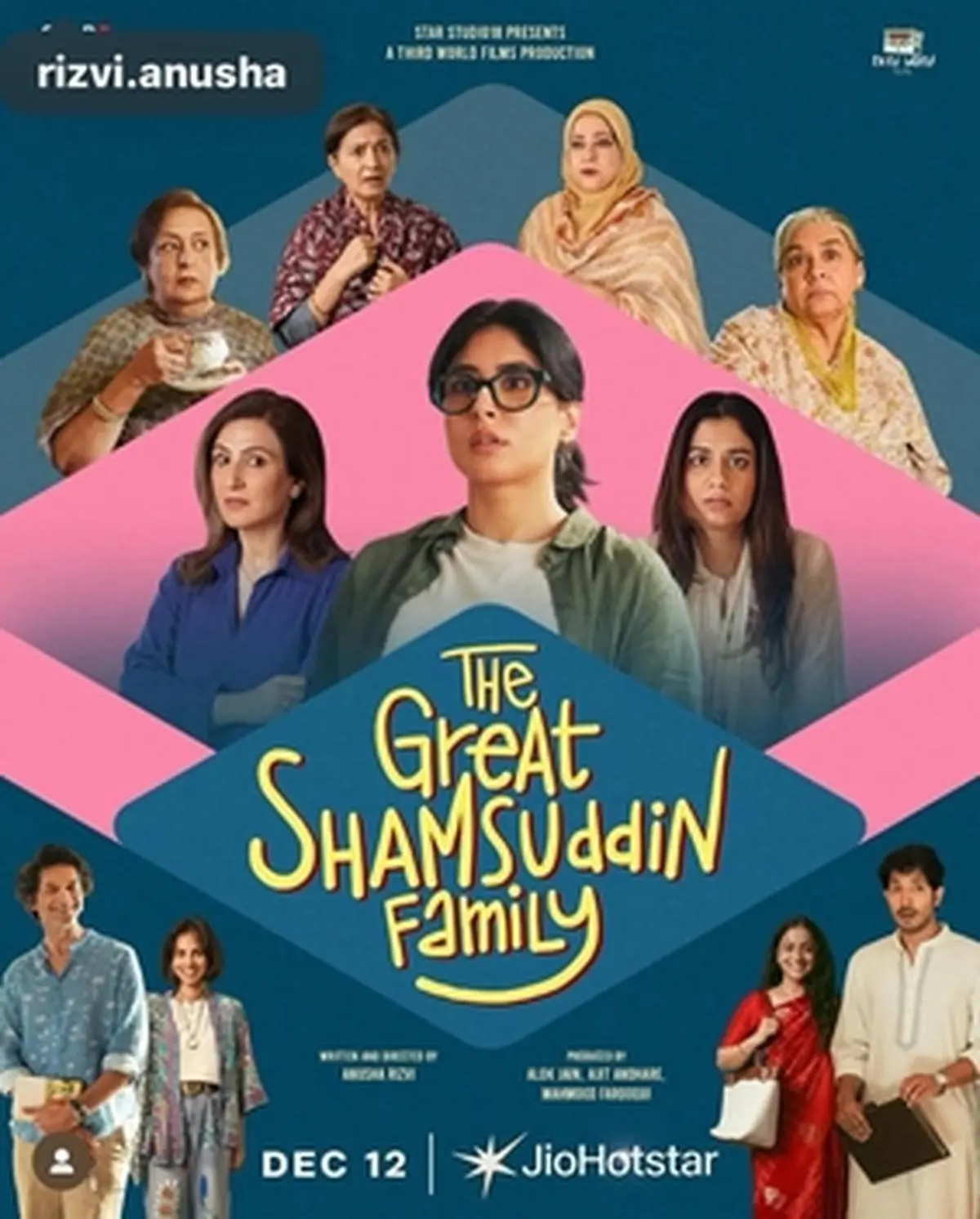
A poster of The Great Shamsuddin Family (2025). | Photo Credit: By Special Arrangement
Have those people not gone inside Muslim houses?
They’re professionals who’ve been creating houses for films.
Bani’s house could be any reasonably well-to-do person’s house in south Delhi, cross-community.
But it is also specifically Bani’s house—there are so many books, she’s a writer. The house is not simple. One of the readings of the film is in the house itself—there are certain kinds of paintings, certain books, certain cultural elements. I leave that for audiences to read. If I’d gone with the production designer who was certain of creating a green house for a Muslim family, I’d be forcing my audience to read the house in a particular way. People don’t really think about it—a Muslim household has to be green. In the industry, if people are creating Muslim houses, they do so with this firm belief that all the houses will be green.
The film was shot in Nizamuddin. How did you get that view?
We just sat on the skyline. In fact, we shot only one scene outdoors. The idea was not to show that the person is living in Nizamuddin. The class I was trying to reflect was different. I wanted to reflect a certain act of witnessing from that monument—not its history, but its present. In Delhi as a city, what does it mean to witness that?
One thing that struck me: men play a very small role. There’s a reference to fathers and sons, but the crisis is managed by the women. Were you trying to show that Indian Muslim women are empowered?
I would say for one, I cannot in any way claim to represent the wider community or anyone—even just women. I’m only trying to tell a story about this particular family and these characters. These women exist, yes, very much they do. The only gaze I’m turning around is this: every time we think of Muslim women, we either think of them as oppressed, victimised. Muslim women don’t have even the little bit of agency that Muslim men have, who are also painted as villains, and that villainy falls upon this victimised, oppressed woman who has to be rescued. That’s perhaps the case for some, but it’s not the generalised case. I can’t represent anyone; I’m only representing my story and my characters.
In twenty-four hours, lots happens in any individual’s life. You’re showing that ordinary life continues—someone’s picking up a passport, someone’s doing this or that. Multiple facets of singular people.
What happens in a regular Indian family where a whole lot of your family is living close by? In a small town where people live near each other and visit often—this is also true for many families in Delhi. This is how every day plays out.
The running theme of Bani not completing her application, the doorbell ringing, the mobile ringing with “Papa calling,” “Mommy calling”—all those alarm bells. As she goes through this whole process, you feel something might happen. It doesn’t, but there’s a fear of something happening. Is that fear now ingrained in us, especially through social media?
It’s very interesting. As a storyteller, I have told you a story. How has the audience read it? Do they see fear in this? I’m not underlining it. How much of it is the audience reading? If the audience is reading fear, then it means that fear exists.
I read it with fear. Today, what you write, what you say—it can be misconstrued, taken out of context. Someone may use your image to say something you never said. Anything can happen. That fear is very much there.
It’s not about the event itself. When an incident or something horrific happens, it has happened. But for the rest, it’s the fear of that incident happening to them, which they live with over a prolonged period. That fear cuts into and erodes several other things.
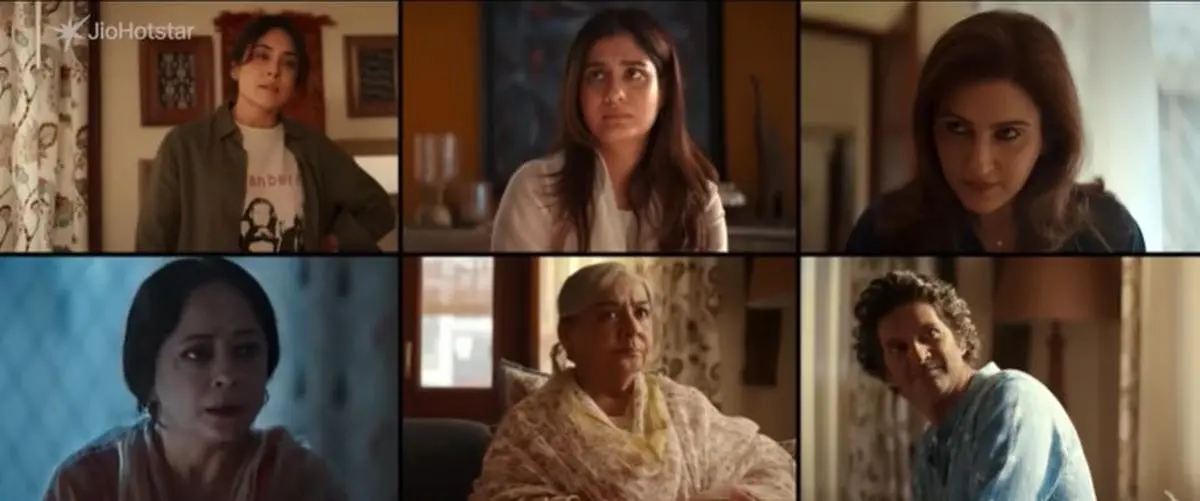
Characters from The Great Shamsuddin Family (2025). | Photo Credit: YouTube Screengrab
One film that made a huge impression on me as a child was Garm Hava—that final scene of Balraj Sahni getting off from the tonga and joining the procession with his son Farooq Shaikh, and the lines, “Mil jaaoge dhara mein to ban jaaoge dhara / Ye waqt ka ailaan, wahan bhi hai, yahan bhi hai” [If you mix with the earth, you will become the earth / This is the proclamation of time, both here, and elsewhere]. I also saw Mulk recently. This notion of moving away to be less fearful is in your film too—Bani’s talking about going, Humaira is upset that Bani hasn’t told her. There’s that reference: “Inko kahan leke jaaogi? Ye saari tumhari maasiyan aur khala hain” [Will you be able to take your aunts and go?] At one point, Humaira tells her, “Please complete the application.” So, there are contradictions. Rishi Kapoor in Mulk tells his son, “Humara mulk hai [this is our place], we’re not going anywhere.” What are you trying to say?
I may be wrong, but Garm Hava‘s ending was changed by the censor. I have seen Mulk, it’s a very good film.
The lines at the end of my film—“Koi deewar toh hogi” [Some wall will be there]—come briefly at the beginning but appear fully at the end. It’s very telling of what the film is trying to say. You’re not thinking of these options because it will provide you with emigration or a better life. It’s “koi sajar hoga” [a tree to stand under] that sense. If Bani is approaching this situation with that feeling, Humaira is also reminding her: for how many is that even possible? Your privilege allows you to sit here and say “I can do this.” How many others can do it? And is that a solution for anything at all? What you are running away from is not going to end by your running away, and you won’t escape the echoes of that by running away, because so many others cannot.
Amitav also tells Bani that the rest of the world is not easy either. Moving abroad today—just look at the number of people waiting months for interviews. It is not easy even for the privileged.
No, it’s not. But this is a different conversation. Bani and Amitav are people who, at their age, have never attempted to move out. They’ve made a life here. When Bani’s making that decision, it comes as a surprise to Humaira—it’s not something she’s expecting. Even this thought that comes briefly to her is very different from a graduate student deciding to go to university abroad, do their PhD, stay back. It’s a very conscious decision for many not to go that route, and yet today she stands here contemplating what to do next. Even if she goes somewhere, she may be wherever in the world, but the echoes of what’s happening here—she’s never going to escape that. She’s not going to be in touch with anyone? No news is going to reach her? How is she going to isolate herself completely from everything?
The romance between Zoheb and Pallavi, and the line “aap kha leejiye” [go ahead, drink poison]—you’ve really nailed that. This is typical Indian middle class. My parents had a cross-religion marriage in 1958 and didn’t have it easy, but they settled down. When I think back, I sometimes feel it was easier for them because we’d just been through Partition and there was a sense that secular values should underline the new republic. Once, someone from Filmfare magazine wanted to do a photo feature on cross-religion couples. My father refused. He said, “I want to be the norm, not the exception.” Today, from anecdotal evidence, it seems far more difficult. What’s your sense?
A lot of people have made choices to marry outside their community. I don’t know whether it’s become more difficult, but clearly there’s a problem, especially if you’re not living in a metro city—not in Bombay, Kolkata, Delhi, Bangalore. If you’re in a smaller town, I don’t know how difficult it is to approach a court or put in your application. Also, information travels quickly. I’d like to know how these couples fare when they approach the judicial system—how are they being received?
Another thing that struck me: the mob not being far away. This is a new sensibility for many people. Earlier it was the mobile, the fatwa. Now it’s top-of-mind consciousness—what you read, what you say, you’re really watching these days. You may become a victim or villain because of perceived identities. What made you make this film?
I don’t know. Stories come to you as a filmmaker, and you hope you’ll find the money to make them. Stories that stick with you are stories that speak to you; they’re important to you, they have some space in your heart, they’re not leaving. You keep hoping “kabhi na kabhi paise mil jayenge” [sometime or the other, we will get the money] and you’ll be able to make it. When I got the chance, I took it immediately. It was written a while ago. I wanted to talk about these characters because I find these women fascinating. They’re amazing, they’re lovable, they’re so open, so full of themselves, their language. And they’re so sure of themselves. I really wanted to show these women to audiences. This idea about Muslim women being a certain kind—that’s not exactly right.
You’ve been working on a documentary on Sidhu Moose Wala. What’s the fate of that?
I really hope it comes out soon.
It started as a feature film and then moved to a documentary?
It was always very clear that the kind of material we have—no fiction can do justice to it. It has to be real footage; we need to see it to believe this is actually reality. I’m never going to attempt fiction on this. I’m going to only attempt a documentary because reality is—you can’t match it. The reality of Sidhu’s rise and what happened to him—it opens out the whole of Punjab, what’s been going on there for a while. I wanted to see it through Sidhu. We’ve reached a certain point, but there are so many contrasts in the story, and many things are complicated. Maybe it needs a little more time to settle down.
Do you have the resources?
No. I wish somebody would come forward and fund it. Seventy per cent is done; about 30 to 40 per cent we still need to put together. If somebody’s interested, please come forward. I think Sidhu’s story is fascinating as a story of an artist, an amazing artist. But it’s also a story of the country, a story of Punjab, which is very important.
You’ve been an independent filmmaker for close to two decades. What are your challenges?
I was trying to remember—I think it was Fellini, but I may be mistaken—whose daughter was talking about dinner scenes in her father’s house where all these big filmmakers used to come together. The only conversation they had the entire dinner was where they were going to get funding for their next film. That’s true for all of us. It’s the only conversation: when are you going to get money from where? If somebody asked me today what I do, I’d say I raise money for my projects. If I get money, then I become a filmmaker for a brief period—and then back to raising money.
With all these OTT platforms, one would think it would be easier?
OTT platforms are definitely a great new addition, but there are also that many more stories to be told. You’re always struggling to get it past the people who are deciding what is what. It’s a hustle and you have to do it all the time.
The role of the doctor in an Indian middle-class or upper-middle-class family—things become easy for Pallavi when the Akko realises she’s a doctor. Processes suddenly run smoothly.
I’m part of a family which has many doctors. I know the importance of doctors in any family. But it also brings its own issues. What’s very important: if you notice, at one point Humaira is objecting to the fact that a doctor is getting married to a person who’s not equivalent to her class.
Amit Baruah was The Hindu’s Diplomatic Correspondent and Foreign Editor of Hindustan Times. He is now an independent journalist .
This transcript has been edited for length and clarity.