






In the latest episode of Frontline Conversations, political scientist Yogendra Yadav speaks about the growing controversy surrounding delimitation, the North-South political divide, federalism, representation, and the future of Indian democracy.
He explains why the debate over Lok Sabha seat reallocation has triggered deep anxieties in southern states, and why he believes the principle of federal balance must sometimes take precedence over the democratic principle of “one person, one vote, one value”. The discussion explores the historical freeze on delimitation, fears of political domination by the Hindi heartland, and the emerging tensions around language, culture, and representation.

Social Activist Yogendra Yadav speaks during the birth anniversary of leader of the Indian independence movement Madhu Limaye at Rajendra Bhavan, in New Delhi in May 2026. | Photo Credit: ANI
Yogendra Yadav also raises concerns about gerrymandering, citing recent delimitation exercises in Assam and Jammu & Kashmir, and warns about the dangers of manipulating constituency boundaries to favour ruling parties. He discusses the opposition’s fears around future delimitation exercises, the role of the Election Commission, and why bipartisan safeguards are necessary to protect electoral democracy.
Edited excerpts:
Before we go on to discussing the implications of delimitation and the complications involved, how do you look at the freeze on delimitation that has been in place since 1976? And what are the implications of the exercise not having taken place for such a long period of time?
First of all, let me clarify that what we call delimitation in India—what is called redistricting in some other countries—involves three different things. Some people have a problem with one component, while others are talking about another. So let’s be clear about that right at the outset.
Number one: it involves reallocation of the number of seats to different States in the Lok Sabha, and different regions or districts within an Assembly. Number two: it involves the fresh drawing of boundaries—whatever the number, the boundaries are drawn afresh. Number three: it involves deciding which constituencies are to be reserved in the case of SC or ST, and possibly in future in the case of women. These three decisions together are called delimitation.
Much of the recent discussion has focused only on the first part, and within that, only on one half of it—the reallocation of seats to different States within the Lok Sabha. But please remember, delimitation involves many things, and the problems are of many kinds.
Now, the freeze you speak of was put in place in 1976. The Constitution had said that after every 10 years, delimitation should take place—all three exercises should happen afresh. It happened twice. After the 1971 census, the Lok Sabha passed a constitutional amendment saying that for 25 years, all three things would be frozen. Why? Because at that time, family planning was a major policy priority.
Many States said, “You are asking us to pursue family planning and then punishing us for it through the delimitation exercise.” So it was agreed to freeze it.
Twenty-five years later, when Vajpayee was in power, a decision had to be made. The first freeze had happened during the Emergency—a very controversial period in Indian political history. Now Vajpayee had to decide. He said, “Okay, we continue the freeze on the first part of the first exercise. But everything else will proceed.” Please remember that after 2001, there was a delimitation exercise in 2006-07 where the remaining components were undertaken. Reallocation of seats within States did happen. A fresh drawing of boundaries did happen—everyone would recall that Delhi continued to have seven seats, but the boundaries of constituencies like outer Delhi and east Delhi were redrawn.
Fresh allocation of which seats are reserved and unreserved was also done. The only thing frozen was the allocation of Lok Sabha seats among States. Under the Vajpayee government, the consensus was to continue that freeze for another 25 years.
Was it good? On the face of it, it violates the democratic principle of one person, one vote, one value—because ideally every elector in this country should have the same weight of their vote, which means the number of persons represented by every Member of Parliament should roughly be the same. That’s a democratic principle. My first reaction in 2001 was: why are you violating a democratic principle? Why not let things happen?
But looking back now, my position over the last many years has been that this freeze was actually not a bad idea—and that instead of kicking the can forward every 25 years, we should cast it in stone. It should be made a permanent freeze. My consistent position has been that the proportions matter. If you want to increase the overall size of the House while retaining the proportions, that doesn’t bother me much. But the proportions do matter.
The ratio.
Yes, the ratio of different States in Parliament. That should be retained, because beyond the democratic principle, there is the federal principle. There is an unwritten social compact—and all such contracts are always unwritten. There is an unwritten federal compact in India. That compact is about non-domination: no one region of the country should be allowed to dominate. In this particular instance, to my mind, let’s be honest—a democratic principle does get violated, but the federal principle must, in this instance, be allowed to trump it. That is my position.
Also Read | Is India’s democracy already in the past tense?
So, do you feel we need to rethink or take a fresh look at how the constitutional principle of one person, one vote, one value plays out concerning delimitation.
No, within each State, the same principle must apply. But please remember—the Constitution and existing law have always permitted deviations from this principle. Arunachal Pradesh, put together, would perhaps be the size of two Assembly constituencies of Uttar Pradesh in terms of population. Why does it have two parliamentary seats? The entire population of Ladakh would be smaller than that of a small town in Haryana. Why does it have a parliamentary constituency of its own? Because the Constitution recognised that this broad principle must accommodate what is technically called asymmetrical federalism—the same rule is not applied uniformly across all States.
Special situations are provided for. But these were exceptions. Actually freezing the allocation, like in the United States, where a small State and a large State each get two seats in the Senate, which is the most powerful body in that country. My sense is that we don’t need to revisit the one-person-one-vote principle in general. Within each State, yes, it should be followed. For all other purposes, it should be followed.
But for Lok Sabha seat allocation among States, let’s agree on a compact. The reasons are as follows. In any country, if you have divisions that crosscut each other, they do not pose a very serious threat. For example, if you have caste divisions and gender divisions, within every caste, there are gender differences—they do not collapse into each other. They are not overlapping and do not threaten national unity. But if two divisions closely overlap—as caste and class often do—that is a problem.
In our country, we already have three broadly overlapping divisions. One is geographical—South versus North. The second is linguistic—Hindi-speaking versus non-Hindi-speaking. They are not identical, but all the southern States fall on one side, and the northern States broadly on the other, with a few exceptions like Punjab. The third division that has emerged over the last 20 years—which is what changed my mind—is the economic divide. If you draw a line between Ahmedabad and Hyderabad, every State on one side of that line is in the “second world” in terms of development, and every State on the other side is in a much poorer condition—a “third world,” again with minor exceptions.
These three divides broadly overlap. That is not good news for any country. And if you add a fourth divide—States that would gain from delimitation versus States that would lose—you are inviting serious trouble. As someone who puts national unity paramount, I would say this consideration must be allowed to trump others, because in the last instance, it is about national unity.
Consider who the beneficiaries and losers of a Lok Sabha seat reallocation would be. The losers would include Tamil Nadu, Kerala, Andhra Pradesh, Telangana, Karnataka, Odisha, West Bengal, and Punjab. Do you see a pattern? It overlaps exactly with the three divisions I’ve already described.
This is why you don’t want it. I am not saying anyone designed this outcome through conspiracy. This is strictly according to population. But we must recognise that this division almost coincides with other existing divisions. Therefore, in the larger national interest, it is simply not sensible to enforce this reallocation in the name of a democratic principle.
You spoke about the need to maintain national unity and the various divisions in the backdrop of the delimitation debate. The foremost divide we see is that of north versus south. In the past, you’ve spoken about the need not to look at the issue purely through that north-versus-south prism. Could you elaborate on that?
It’s been presented as a north-south divide. But when I spoke of the four cleavages, they are not exactly north-south. Hindi versus non-Hindi is not the same as north-south—there is the east, and there is the west, which also includes non-Hindi-speaking areas. When I spoke of the economic divide, both Gujarat and Maharashtra fall on the “developed” side. And the eastern non-Hindi-speaking States are still very poor.
So it’s not only North versus South. But it so happens that if you look at all four cleavages—geographical, linguistic, economic, and political—all the States of South India fall on one side of the divide, and all the Hindi-speaking States of the North fall broadly on the other, again with minor exceptions like Uttarakhand and Himachal Pradesh.
This is what worries me. There is a real North-South question in India. Sometimes it is more acute, sometimes less. Just after Independence, the question acquired an intense form in Tamil Nadu. But gradually, over the years, it has subsided—and that is a great achievement of our democracy. One of the reasons it subsided is that Indian democracy accepted and recognised its diversity. A Dravidian party was allowed to govern Tamil Nadu. The Tamil Nadu demand articulated by the DMK was not crushed—they were not called anti-national or disqualified.
It was that legitimate expression of regional differences that lies at the heart of the success of the Indian nation-state.
Please remember: the diversities within India are greater than those of the former Soviet Union. The diversities within India’s Northeast alone exceed those of the entire former Yugoslavia. Where is Yugoslavia today? Where is the Soviet Union today? Why did India survive? Not because of authoritarian control from the top, and not because it insisted on uniformity. We survived because we adopted a very different, non-European approach to the problem. We said: if you are different, that is all right. We will never ask you, “Are you a Tamil or are you an Indian?” We will always say: you are Tamil and you are Indian. You are Indian because you are Tamil. We will never pit one against the other. That is at the heart of the North-South issue.
To my mind, India has now reached what I call the Dakshinayan moment—a moment for the rest of India to learn from the South. South India has witnessed some of the greatest democratic experiments: the strongest social justice movements, the best implementation of welfare schemes, and some of the most nuanced approaches to the issue of reservations. This is the moment to learn from South India. And if this moment is utilised for short-term political gains at the expense of that larger project, it will not be good news for India.
DMK president M.K. Stalin burns a copy of the Delimitation Bill while staging a protest in Namakkal, Tamil Nadu on April 16, 2026. | Photo Credit: THE HINDU
There are concerns of the southern States—particularly regarding fears of cultural dominance of the Hindi heartland, and the threat to their linguistic and cultural identities. What needs to be done to assuage these concerns? And why do you think these concerns have arisen? Is it because of the political dynamics of recent years?
Some of these concerns predate this. People from South India who came to the North have often encountered hostility and unease. Those who did not speak Hindi and came to the national capital were sometimes made to feel small because they could not speak it. Officially, Hindi is not recognised as the national language. But people have often been told—sometimes quite aggressively—“Why can’t you speak Hindi? Hindi is the national language.” These things register with people, just as people from the Northeast register racial discrimination when they come to North India. So some of these things are predated. But the overall political consensus was that we would not press this. That consensus attenuated the day-to-day tensions.
In fact, the dominance of regional parties from the 1990s and for about 20 years thereafter was a beautiful phase for Indian federalism. Every community, every State felt that it could be part of—or even lead—the government at the Centre. That is a lovely and important feeling for any community to have.
In the last 10 years, however, we have had a party that is excessively dependent on North India, the Hindi heartland—and you can add Maharashtra and Gujarat to that, as they are seen as extensions of the Hindi heartland in a way that Tamil Nadu or Bengal are not. This party is both politically dependent on these areas and ideologically aligned with a project of nation-building that demands uniformity: one nation, one language, one culture. This is a classic European formula of nationalism. And no one is more European in this sense than the RSS, whose dream has been to create an Italian or German-style nationalism.
So in terms of both its political interests and its ideology, the dominant party today believes in pushing uniformity and stands to gain by making the North Indian Hindi heartland the undisputed political centre of this country. This is what has now pushed that divide into greater prominence.
I would still not say we have reached a breaking point—we have not. I would not say the fault line has become a fracture. Fortunately, it has not. But we are at a very critical juncture where it could.
And anyone who thinks seriously about nations must think not about the next five years, but the next 50, if not 500. If you want to think on that scale, then you do not want to push this delimitation in a way that sends a message to a large number of Indians—who have already been feeling somewhat uneasy—that they are not truly equal partners. That is not a message you want to send, especially to the South.
There is also a financial aspect to this. There is dissatisfaction among the southern States that, despite contributing more in revenue, the funds devolved to them are lower because of their lower population. How do you look at that?
I happen to have a somewhat different opinion on this issue. Much of what I have said so far would probably be music to the ears of my friends in South India. What I am about to say will not be. But as I said, I look at all these things from the point of view of the long-term interests of the nation.
To my mind, what we need is a dual deal. I have spelt out one part of it. The first part is: freeze political representation as it existed in 1971. Don’t touch it. Increase the numbers if you want, but don’t touch the ratios. The second part is: share the benefits of prosperity with everyone. That is the spirit of a nation, the spirit of a family.
We have had extremely uneven development in this country. Some States have been beneficiaries of that development, which is not to say they were more hardworking or that their effort alone produced those results. If Punjab, parts of Haryana, and western Uttar Pradesh have done exceptionally well in agriculture, it has to do with State policy, with national resources being allocated to those regions. If certain parts of South India have done well, it has to do with the past, some progressive governance, and also larger national policies. Belonging to a nation requires that we share our resources.
The poorest States in this country continue to be Jharkhand, Odisha, West Bengal, and Assam—some Hindi-speaking, some not—along with Bihar and parts of eastern Uttar Pradesh. So this is not simply a Hindi versus non-Hindi question.
The existing formula for devolution of economic resources under the Finance Commission basically says: while you contribute to the national kitty, you do not get back a share proportional to your contribution or even to your population. You get according to your need, and the poorest States have the greatest need, so they receive more. Just as I advocate a freeze on delimitation, I also advocate a freeze on this formula. It must be continued. The poorer States of the east and north—Hindi-speaking and non-Hindi-speaking alike—must continue to receive a greater proportion of national resources so that they can develop.
Of course, those resources should be utilised better than they have been, and there is an argument for incentivising better performance. But the transfer itself must continue. So I am speaking of a threefold federal compact: one political, one economic, and one cultural. The cultural part means no imposition of any one religion or language on anyone. No imposition of the majority Hindu religion; no imposition of Hindi, which is not a majority language, but the largest language in the country. No imposition at all.
I say this as an advocate of the three-language formula. I have consistently maintained that pedagogically, for a country like India, a three-language formula makes good sense—Hindi, English, and one’s regional language. Now, I know this is strongly opposed, especially in Tamil Nadu, and the new Chief Minister has expressed his opposition to it. I completely understand that opposition.
They are saying: you impose a three-language formula on us, but you never apply it to yourselves. Please remember—the three-language formula required North Indian States to learn a non-Hindi language, preferably one from South India. Which North Indian State has implemented that? None.
Has Haryana started teaching Tamil or Telugu? No. Have those languages been introduced in Uttar Pradesh? No. Those States circumvented the formula by substituting Sanskrit, not out of any love for the classical language, but as a simple way of evading the policy.
So, I completely understand the opposition from southern States. I completely understand their resolve: there is no national language, and Hindi cannot be imposed on them. I am entirely with them on that. And it must be written into this federal compact—non-imposition, non-domination—as its very essence.
I want to ask you about Andhra Pradesh Chief Minister Chandrababu Naidu declaring a policy to incentivise larger families, in the backdrop of the delimitation debate and concerns about population decline. How do you look at that kind of response?
When I read that report, I almost laughed. The fact is that population rise and decline do not follow statements by Chief Ministers or Prime Ministers. When the population declined in South India, it was not because of any family planning policy. The basic logic of demography is that when a society, community, or region starts doing economically well—when parents feel they have something to defend and preserve—they have fewer children.
All over the world, economic growth and a higher standard of living are associated with lower fertility rates. Sometimes a draconian state policy, like China’s one-child policy, can alter a demographic trend because the enforcement was so extreme. But normally, to say that South India had low population growth because of effective family planning, or that North India had high growth because of poor implementation, is not accurate.
I don’t think Andhra Pradesh’s overall demographic trends are going to change simply because you announced an incentive of Rs. 30,000 or some similar amount. To my mind, these are somewhat gimmicky responses to a real issue. For some reason, Chandrababu Naidu seems unwilling to stand up and say directly: Why are you doing this reallocation? It goes against the interests of South India. Instead, the onus is placed on the people: start having more children. In any case, even if this were to have any effect from tomorrow, it would only show demographic results two decades later. There is no solution at all. It is a way of evading the real question.
Women visitors making their way to the Lok Sabha visitors’ gallery to watch the debate on the Women’s Reservation Bill during the Special Session on September 20, 2025. | Photo Credit: Manvender Vashist Lav/PTI
The government recently proposed increasing the number of seats in the Lok Sabha as part of its proposal to immediately implement women’s reservation. The proposal involved maintaining the present ratio of States in the Lok Sabha, with the number of seats going up to around 816, and the ratio of the States in the house would be maintained. Do you think this was a plausible solution to the concerns around delimitation?
First of all, let me underline what I would call the complete doublespeak of the government. The Prime Minister and the Home Minister kept saying that every state would get around one-and-a-half times more seats while maintaining the current ratio and not disturbing the balance. But the written proposal placed before Parliament said exactly the opposite. Now, the country is governed not by statements made by the Home Minister, but by the laws and constitutional amendments that are passed.
The constitutional amendment that the government placed before Parliament—which was defeated—clearly said that seat allocation would take place as per a census decided by the government. And the delimitation bill proposed alongside that amendment clearly stated that the census to be used would be the latest census available at the time of the Delimitation Commission’s appointment. In other words, reading these two texts together, it meant the exercise would be based on the 2011 census.
Or, if the Commission is appointed after 2027, then it will be based on the 2027 census, which means a reallocation of seats based on new population figures. So why was the government lying? To my mind, this is plain doublespeak. To this day, no one from the government has clarified why their written text said the exact opposite of what they were claiming publicly.
Setting that aside—is it a plausible solution?
It’s not a solution to the underlying problem, but I don’t have an objection to it in itself. If you think the number of seats should be increased, I don’t mind, as long as the ratios are maintained. If Kerala goes from 20 seats to 30, then Uttar Pradesh may go from 80 to 120—the proportions remain unchanged. Some people saw a problem there; I did not.
The one real issue is something else. If the Lok Sabha expands to around 850 seats while the Rajya Sabha remains around 250, the weight of the Rajya Sabha diminishes. On certain crucial matters, if there is a disagreement between the two houses, they come together in a joint sitting where every member has one vote—the Rajya Sabha does not get additional weight. Already, the Rajya Sabha is roughly half the size of the Lok Sabha. In this scenario, it would become only one-third, which once again violates the federal principle. That is a real concern.
Otherwise, there is no unfairness to other States in the proposal. But it does not solve the underlying problem. We need to address the real, hard question directly and arrive at a national consensus—a compact based on free and frank discussion.
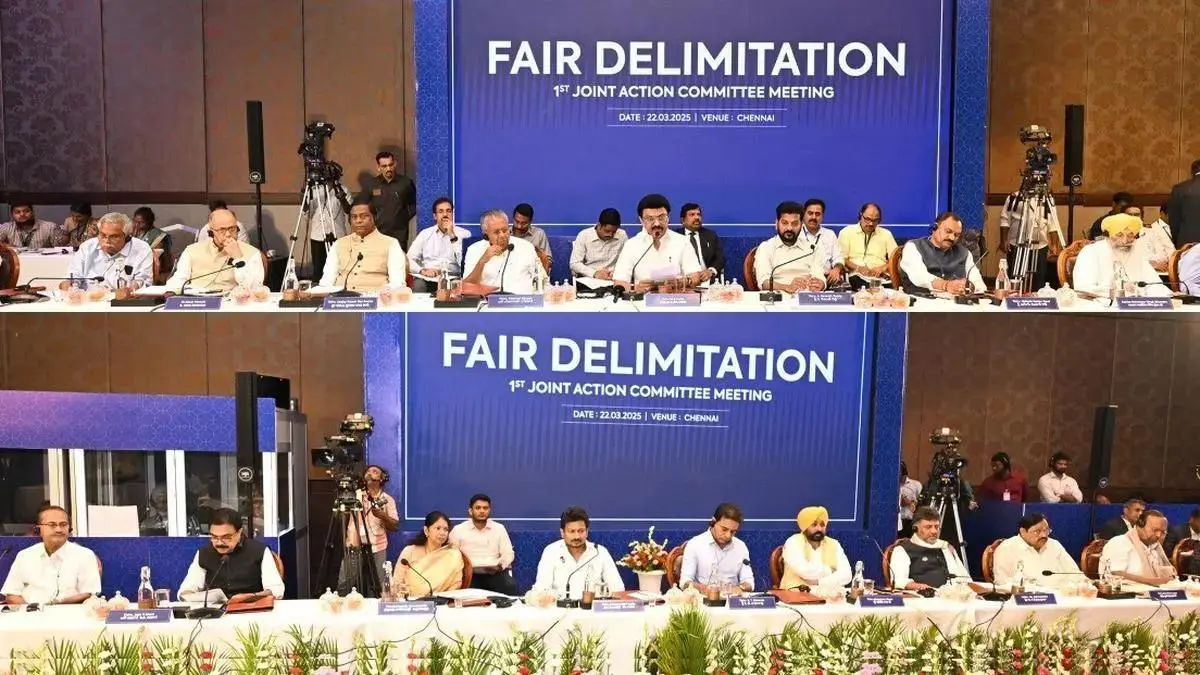
Politicians at the first meeting of the Joint Action Committee on fair delimitation, in Chennai, Tamil Nadu on March 22, 2025. The leaders demanded that States not be penalised for having achieved population stabilisation. | Photo Credit: THE HINDU
Opposition parties have also expressed a mistrust of the present dispensation carrying out the delimitation exercise, with fears that the boundaries would be drawn in a manner that favours the BJP. How do you look at those fears?
It is a very legitimate fear on the part of the opposition. In political rhetoric, people sometimes say things that don’t make sense—but in this particular instance, the opposition’s fear is absolutely justified. And it is not really about seat allocation. The real issue lies with the second and third parts of the delimitation exercise I described at the outset: the drawing of constituency boundaries.
In India, we have had a process where a judge and the Election Commission come together to form a Delimitation Commission and the boundaries are drawn. MPs and MLAs may serve as associate members, but they have absolutely no role in actually drawing the boundaries. Over the years, there have been minor issues—I have heard murmurs about a particular politician being favoured by the attachment of a specific Assembly segment to a particular parliamentary constituency. But on balance, we did not have a systematic, nationwide gerrymandering of boundaries to favour one party. The opposition fears that is exactly what will happen this time.
Americans have a name for this—it is a classic American disease from which India was largely free. It is called gerrymandering. In the American system, the political representatives themselves draw the boundaries for the next election—so they draw them to favour themselves, often producing weird constituency shapes. India was largely free of this, with minor exceptions.
Until recently. I said we had a delimitation exercise in 2006-07. For various technical reasons, Assam, Jammu and Kashmir, and Jharkhand were excluded from that exercise. Their delimitation was carried out in 2020 and 2023. So we now have a real-life example of how delimitation has been conducted under the current regime, technically by the Election Commission of India.
I have been studying maps from Assam—maps of two parliamentary constituencies and the Assembly segments within them. Look at a constituency called Laharighat. Have you ever seen a constituency of this shape? It has a very weird shape. This is gerrymandering. Americans could come and take classes from us.
What was done was that all the Muslim-majority pockets were mapped and consolidated into one constituency, taking it from 60 per cent to around 95 per cent Muslim. The other constituency accordingly went from around 40 per cent Muslim to around 20 per cent. Earlier, the BJP might have lost both. Now they will lose one—but by a larger margin. It doesn’t matter if you lose a constituency by 70,000 instead of 20,000, as long as you can win the other.
In America, this technique is called “packing”—you pack your opponents’ votes into one seat to waste them. The other technique is called “cracking”—you split a community across multiple constituencies so their votes are diluted. This has already started.
Take a look at the maps from Jammu and Kashmir as well. One constituency has two parts of the Himalayas. How can that be geographically justified? Gerrymandering has arrived in India—fully and properly. It has already been experimented with in two regions. And this was not simply about the Hindu-Muslim question. In Assam, before the delimitation exercise even began, the Chief Minister publicly announced that he wanted to ensure that the Miyas should not influence more than 20 constituencies. After the exercise ended, he expressed satisfaction and thanked the Election Commission for reducing them from 36 to 22.
What he did not announce was that even the Axomiya were cut down. What he did not announce was that in districts where his party performed better, the number of Assembly segments was increased—so you have one parliamentary constituency with 12 Assembly segments and another with only six. And in areas where a Muslim candidate simply cannot be prevented from winning, the seat can simply be designated as a Scheduled Caste reserved seat.
This is what has happened. This is what the opposition fears will happen everywhere. And frankly, even though a delimitation commission would technically still be led by a judge alongside the Election Commissioner, it would now be a judge chosen by the Prime Minister sitting alongside an Election Commissioner chosen by the government—drawing boundaries in this manner. That is why the opposition dreads delimitation. They may not always say it in these precise terms, but this is their fear.
In Assam, before the elections started, the BJP had already won 20 seats. Because the demography of those seats had been changed in such a way that the BJP was bound to be the winner. Unless this can be checked, delimitation will be a death knell for our democracy. If the Assam and Jammu and Kashmir style delimitation becomes the norm, and Bengal-style SIR becomes the norm for voter lists, you can say goodbye to electoral democracy in this country.
Also Read | Coming up, a ‘Modi-fied’ republic
So, can we have safeguards against gerrymandering and the manipulation of constituency boundaries?
Yes, we can have safeguards. Many countries have them. The safeguards can take the form of norms written into law—for example, contiguity. What justification is there for a detached pocket to belong to a constituency it is not even geographically connected to? So contiguity, equal population sizes across constituencies, rules against crossing administrative boundaries—all of these can be codified. In Assam, a single panchayat was split across three assembly constituencies, which could have been prevented by the rule.
But the best safeguard has to lie in the process itself. Because no matter what rules are written, people find ways around them. The American Supreme Court has laid down rule after rule on gerrymandering, and each time, ways are found to circumvent them. The process must be fair. That means the Delimitation Commission—and, crucially, the Election Commission of India—must be constituted in a bipartisan manner. And that is not the case today. Without that, all written safeguards amount to nothing.
Finally, how does one maintain a balance between the principle of every vote having the same value and the need to assuage the concerns of the southern States—and other States like Punjab and Himachal Pradesh—that their political relevance will not be diminished by delimitation?
As I said, we need an honest conversation. The democratic principle of one person, one vote, one value is valid, and by and large, it must prevail. However, in one exceptional situation—and this happens across the world in all kinds of federal systems—asymmetrical federalism provides for very special arrangements. In this one case, the federal principle must be allowed to trump the democratic principle.
Why? Because there is an underlying foundational value: non-domination. Non-domination must be a basic principle of our republic. Non-domination in politics, in the economy, and in culture and language.
In any given instance, one party may be a beneficiary, and another may be a loser. But you follow the principle consistently, and the earlier beneficiary may become the loser in another context—that is fine. To my mind, adopting that federal compact is the way forward.
This transcript has been edited for length and clarity.