










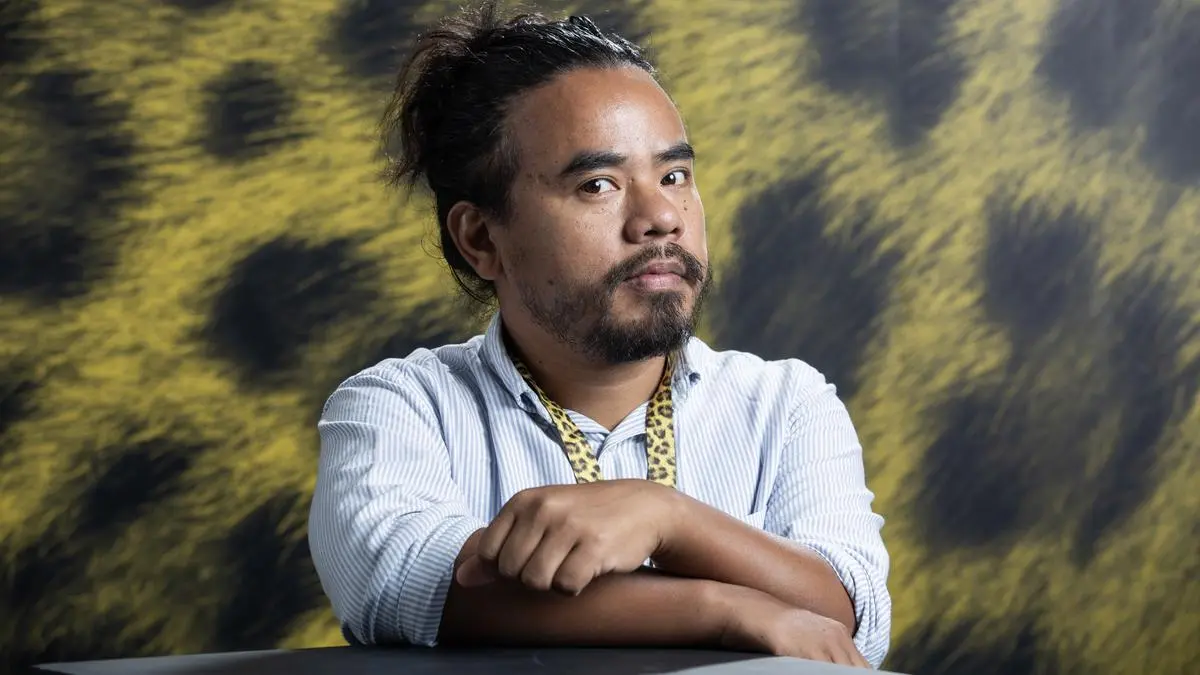
Dominic Sangma’s films travel from the Garo Hills of Meghalaya to festival circuits across continents. His second feature, Rapture (Rimdogittanga)—set in a remote Christian village haunted by rumours of child abductions and a pastor’s prophecy of 80 days of darkness—won Best Feature Film in Garo at the 71st National Film Awards in August 2025, his second National Award after Ma.Ama (2018). In May 2024, Rapture was released in over 100 theatres in France by Capricci Cinema, the first film from Meghalaya to secure a wide French theatrical release. A rare India-China co-production, it premiered at Locarno in 2023 and travelled to Busan, MAMI, and the Asia Pacific Screen Awards. Sangma now heads the screenwriting department at the Film and Television Institute of India’s Itanagar campus. In this conversation, the filmmaker discusses how fear is manufactured for political ends, and the case for what he calls a sovereign narrative—storytelling rooted in the soil of its origin.
Rapture turns on the thin line between morality and fear. What childhood memories from the Garo Hills sparked this story?
Rapture is the second part of a trilogy that began with my debut, Ma.Ama. While the first film drew on personal family memories, Rapture turns to the collective memory of my village. Growing up, I lived with a deep fear of darkness. Our village suffered from night blindness, and every year rumours circulated about child-lifters waiting in the shadows. That atmosphere of constant dread led me to fear as a theme. It is one of the most effective tools in politics today, in India and elsewhere, to control the masses.
The film centres on a 10-year-old boy with night blindness during a prophesied 80 days of darkness. How did you use this physical condition as a metaphor for the village’s psychological state?
The film opens with a quote attributed to Thelonious Monk: “Either it’s night, or we don’t need light.” In total darkness, the eyes adjust and we begin to see—but there is a danger in growing too comfortable with that darkness. Kasan’s condition mirrors a deeper, psychological blindness in his community. Most of us refuse to see what is in front of us; we accept reality in whatever colour it is presented to us. His fear of the coming 80 days is the fear of losing sight altogether—physically and morally—before he has the chance to heal.
Why was it important to tell this story now?
The world is gripped by “othering”. We are conditioned to fear anyone who does not belong to our group, whether defined by religion, tribe, or nationality. This narrative is often manufactured by those in power because fear is an effective tool for division. It erodes basic trust between human beings. When neighbours stop trusting one another, the path leads to mutual destruction. Even figures we look to for guidance, like the pastor in the film, can be consumed by the cycle. I felt it was important to show how manufactured fear eventually swallows everyone it touches.
Rapture is an India-China co-production, a rare collaboration in Indian cinema. How did your partnership with producer Xu Jianshang shape the film?
Xu Jianshang first saw my diploma film at a festival in Beijing while she was a student at the Beijing Film Academy. Her interest was immediate. She took the project to international film markets, brought other producers on board, and helped secure grants from the Hubert Bals Fund, Visions Sud Est, and the Doha Film Institute. Despite the international backing, I retained full creative control. The vision had to remain rooted in its origin.
How does Rapture bridge the personal themes of Ma.Ama with the broader concerns you intend to explore in the trilogy’s final film?
All three films come from personal memories and events that have stayed with me; making them is a form of catharsis. Rapture is set in a small village, but it is a microcosm of a larger world. Audiences elsewhere have responded to the film because the anxieties it deals with are not local. They are everywhere.
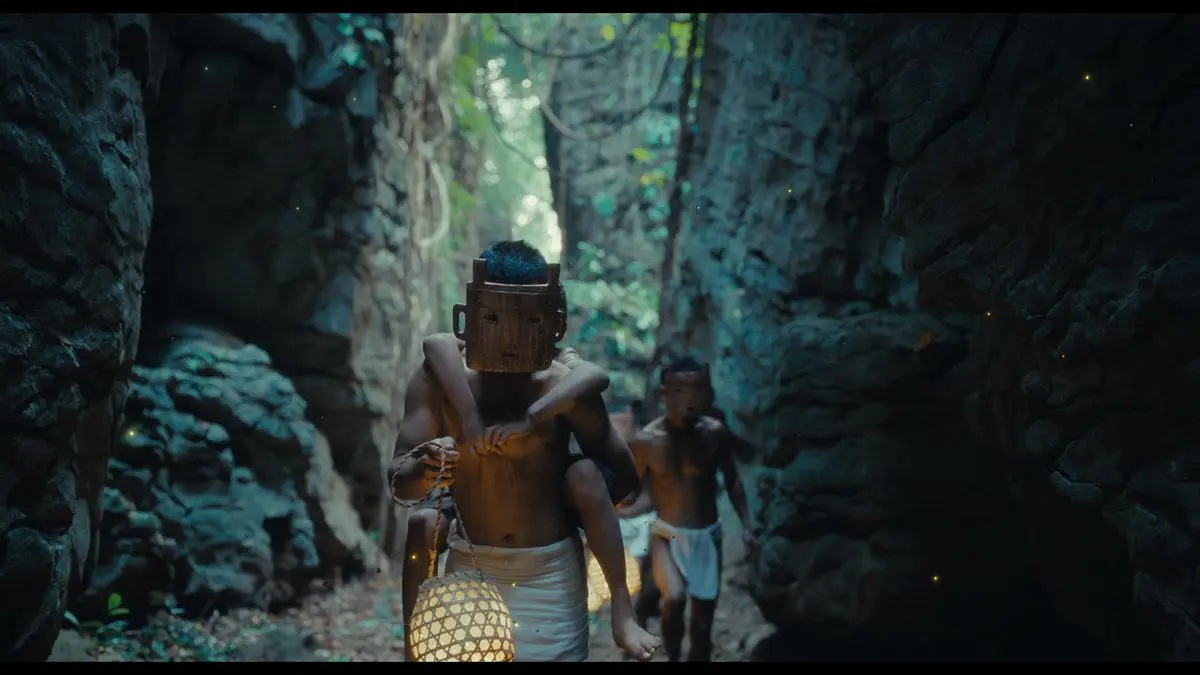
Surrealism in the Garo Hills: A scene from Rapture where the boundaries between ritual, reality, and paranoia are seamlessly interwoven. | Photo Credit: By Special Arrangement
The sound design by Vineet Vashishtha and the cinematography by Tojo Xavier give the film an eerie atmosphere. How did you collaborate with them?
Vineet, Tojo, and I were classmates at the Satyajit Ray Film and Television Institute, and most of the heads of department on the film were my peers. That shared history meant we did not have to over-explain ourselves. For the sound, we approached the village ambience from two perspectives: insider and outsider. We considered how a sound—a bird’s call, for instance—might be ordinary to a local but ominous to a stranger. Visually, we used deep focus and specific camera movements to suggest that, although events appeared isolated, everything in the community was connected. We treated darkness and light as two distinct entities. In a village, darkness is absolute; there is no city light bleeding in, and the cinematography had to honour that.
The May 2024 release in over 100 theatres in France was a milestone. Why do you think a Garo-language film travelled so well to a European audience?
The question is what makes any film connect at all. It is not about catering to a demographic but about expressing something true. Rapture deals with concerns that affect us all, whatever the geography. The setting is specific, but the experience is shared. When a director offers an authentic vision, the language of the film becomes secondary to the story.
Do you believe these awards help the case for the Garo language to be recognised in the Eighth Schedule of the Constitution?
A film of any quality, in any language, draws attention to the community and region it comes from. When a Garo-language film travels and is recognised abroad, it forces the world to acknowledge our culture. The Garo people have long sought inclusion in the Eighth Schedule, and I hope this brings us closer. Garo and Khasi were already associate official languages in Meghalaya; I am encouraged that they have been elevated alongside English.
After Locarno, Rapture travelled to Busan, MAMI, and beyond. Which audience response moved you the most?
The most moving reactions often come from my own people. In independent cinema, there is constant pressure to over-explain to outsider audiences. With Rapture, I prioritised the Garo perspective. At the Sydney Film Festival, around 20 local Garos in the audience laughed at small details in scenes the rest of the room found very serious. To watch them recognise those nuances instantly was rewarding. The best response, however, came when we finally screened the film in the Garo Hills.
As head of the screenwriting department at FTII Itanagar, how do you adapt screenwriting pedagogy to reflect the oral storytelling traditions of the Northeast?
At Itanagar, we have students from across India, though I hope to see more representation from the Northeast. My approach is not to manufacture a product or follow a fixed template—especially in an age where AI can replicate formulas. I guide students to find their own voices. The process involves introspection, helping them recognise their concerns and strengths as writers. We encourage them to remain engaged with the world without clinging to fixed ideas, so that their storytelling stays as organic as our oral traditions.
You have brought film students from across India to collaborate with aspiring local filmmakers in Meghalaya. What is the goal?
Cinema’s strength is its capacity to build empathy. The aim is to bridge visiting students and local filmmakers and produce something genuinely collaborative. An outsider often sees our region through an exotic lens, leading to representations the local people do not recognise as themselves. I argue for what I call a sovereign narrative—storytelling that belongs to the land and its people. Art should not be driven only by what sells; it should be driven by truth.

A scene from Rapture: The film’s visual language often mirrors the internal world of its protagonist, caught between religious prophecy and real-world anxiety. | Photo Credit: By Special Arrangement
What are the biggest challenges in establishing a film culture in Arunachal Pradesh and Meghalaya, compared to Kolkata or Mumbai?
My focus is on building an ecosystem in Meghalaya where filmmakers support one another rather than compete. Local creators need to understand the global market and the festival circuit, while a local audience that sustains indigenous stories has to be cultivated. Unlike the cut-throat competition of established industries, we believe every film can find its own audience and space. We want an environment where senior filmmakers mentor the next generation.
Has teaching changed your own creative process? Does it make you more or less demanding on your sets?
Teaching requires a syllabus, but my priority is helping students discover their craft. Heading a department is consuming; it takes the time and energy I would otherwise put into my own writing. I am constantly thinking about how to better guide students, and that often means setting aside my own projects. In that sense, teaching makes me more demanding of myself, as I try to balance the students’ growth with my own work.
You often cast non-professional actors from your village. How do you draw such authentic performances from people who have never been on camera?
I believe we are all actors in daily life; we carry different personas depending on whom we are with. My process is to find someone whose natural personality and body language match the character I have written. I travel across the Garo Hills looking for these faces. When I meet a stranger who fits the role, I introduce myself and invite them for an audition. I do not believe in repeating actors across films unless they are playing the same role. Their own life experience is the reference point; they embody the character rather than acting it.
You have argued for a French-style mechanism in India where commercial film earnings support independent cinema. What should the government do?
The industry needs to look beyond box-office returns and entertainment. Films like Rapture carry the collective consciousness of a people. The State must recognise the intrinsic value of such work. That was the original intent behind the National Film Development Corporation (NFDC)—to ensure that filmmakers like Mani Kaul, Adoor Gopalakrishnan, and Satyajit Ray could exist alongside the commercial industry. We need dedicated spaces and funding for films that challenge fixed ideas and bring new cinematic language to our lives. Once the government recognises the deeper necessity of such cinema, systemic change will follow.
For the next generation of filmmakers from the Northeast, what is the most important lesson from your journey?
They should stop looking for validation from Bollywood.
Herojit Nongmaithem is a film journalist and critic based in Imphal.
Also Read | Aribam Syam Sharma and a legacy that outpaces honours
Also Read | Shyam Benegal (1934-2024): A compassionate critic of the evolving history of post-Independent India