


The Bangladesh general election is set for February 12, 2026. The Bangladesh National Party (BNP) leader, Tarique Rahman, who is said to have been in exile for 17 years, is back in Dhaka. A number of alliances are being formed for the 300-member Jatiya Sangsad, Bangladesh Parliament, with 50 seats reserved for women decided by proportional representation. As many as 151 seats in the directly elected seats are needed to form a government. The Awami League is banned and cannot contest. The BNP has not allied with the Jamaat-e-Islami. The Jamaat has allied with the National Citizens Party (NCP), an offshoot from the popular protests that led to Sheikh Hasina’s ouster. Additionally, Bangladesh suspended visa and consular services for Indian nationals in a tit-for-tat move after the Board of Control for Cricket in India asked Indian Premier League player Mustafizur Rahman to return.
To discuss what the coming weeks and months could entail for the nation and its relations with India, independent journalist Amit Baruah joins former R&AW head in Bangladesh Ramanathan Kumar in the latest edition of Frontline webinar.
Edited excerpts:
Can you paint a big picture of the run-up to the elections?
Ambassador Archer Blood, who was the Consul General in Dhaka during the [Bangladesh] Liberation War and author of the famous Blood Telegram, talked of the cruel birth of Bangladesh. Anthony Mascarenhas [Pakistani journalist and writer] wrote about Bangladesh’s legacy of blood. Bangladesh has indeed had a cruel birth, a legacy of blood, and I dare say a cruel adulthood also. Even by those turbulent standards, the present is a particularly turbulent and volatile phase. I am reminded of the chaotic situation towards the end of 1975, after the assassination of Sheikh Mujibur Rahman and before [former] President Ziaur Rahman consolidated his rule. We are looking at a somewhat similar picture right now.
Elections are scheduled for February 12. The Awami League has been debarred from taking part, which raises grave doubts about the credibility of the election. If you have one of the major players not in the picture, there will be question marks about its legitimacy. The BNP, which boycotted previous elections, is now back in the fray. The Jamaat-e-Islami—their erstwhile partners when both were ranged against the Awami League—are not in agreement this time because the common foe is absent.
Clearly, the Jamaat needs allies.
The Jamaat clearly needs allies, but possibly they feel the ground is fertile for them now to do much better than in the past. There are studies and polls in the public domain suggesting they might do better than ever. They have an ally in the National Citizens Party (NCP), the new kids on the block emerging from the student movement of 2024. We don’t know how they will do—they have no track record. Half the population of Bangladesh is below the age of 25 or 30, so there’ll be many new voters with no previous track record.
There’s a big question mark about the solid 35 to 40 per cent who always voted for the Awami League—the constituency which stands for the ideals of the Liberation War, the liberal, secular sections of Bangladeshi society. If they are not going to vote at all, there may be a drop in voter turnout. But hanging above all this, there is enough information in the public domain that the forces of extremism and radicalism see an opportunity now. They have always been there in Bangladesh, but now they see an opportunity to discredit the entire system of parliamentary democracy and say this is antithetical to Islam, and Bangladesh’s destiny lies in moving towards pure Islamic rule. These voices have gained a lot of ground in recent weeks and months.
These Islamist forces have always been in Bangladesh. Jamaat-e-Islami’s role in the 1971 War of Liberation is well known. But they have never won more than 30 seats in any election since Independence. Do you believe this time could be different?
You’re absolutely right. The Jamaat operates within the parliamentary framework, though its long-term goal is to set up an Islamic state. Like the Jamaat-e-Islami in Pakistan, they have more street power than electoral power. On average, the Jamaat has not won more than 4 to 5 per cent of the popular vote. They struck an all-time high of around 12 per cent in 1991, came down to 8 per cent in 1996, then 4 to 5 per cent in 2001 and 2008.
I am reminded of what happened in Nepal in the 2008 Constituent Assembly election. The mainstream political parties had gotten thoroughly discredited—the Nepali Congress and the CPN-UML [Communist Party of Nepal (Unified Marxist–Leninist)]. The far left, the Maoists, were an unknown commodity. The people of Nepal decided that since mainstream parties had failed them completely, they would give the untested force a chance. The NCP Maoist performed spectacularly well. Something similar could happen in Bangladesh with the Jamaat. It may happen, it may not happen, but one certainly can’t rule it out.
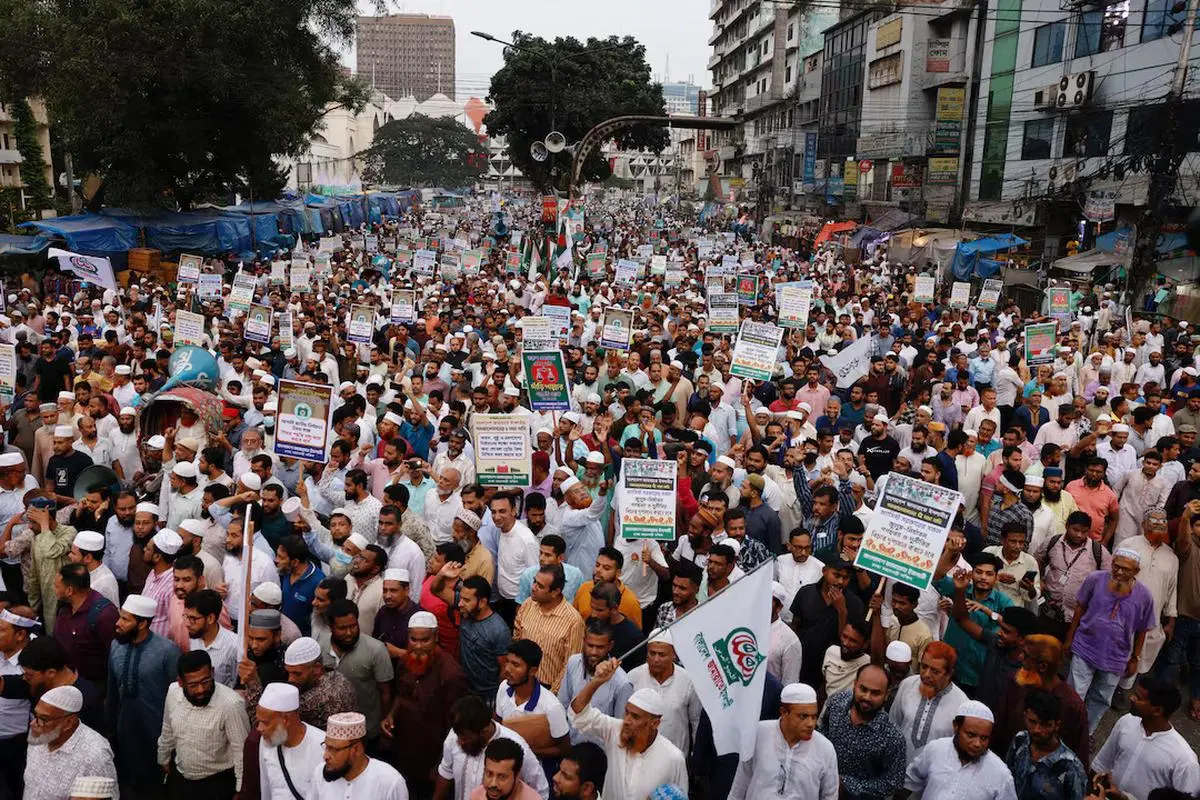
Supporters of Bangladesh Jamaat-e-Islami take part in a protest rally with five-point demand including free and fair election within February of 2026, in front of the Baitul Mukarram National Mosque in Dhaka, Bangladesh, on September 18, 2025. | Photo Credit: Mohammad Ponir Hossain/REUTERS
What about the BNP itself? The former Prime Minister has just passed away—there is a sympathy factor. What is your sense of how the BNP will perform?
Like the Awami League, which has a solid core vote bank of 35 to 40 per cent, that is roughly the vote share of the BNP also. This section believes in the BNP’s core ideology of Bangladeshi nationalism as opposed to Bengali nationalism, which underpins the Awami League’s ideology. This section is unlikely to desert the BNP. There are still question marks—even lingering ones—about whether the law and order situation will allow the election to be eventually held. There’s still a little more than a month to go.
Everything seems to suggest the elections will happen.
In that case, the straightforward reasoning would be that the BNP’s vote share being what it is, they would come to power, get a majority—whether comfortable or a landslide remains to be seen—and be able to form government in the absence of the Awami League. That will set the stage, unfortunately, for the next round of confrontation to begin.
Where will the Awami League vote go? Will it scatter or go to a mainstream force?
Something similar to what happened to the BNP vote bank in 2014 and 2018—many simply didn’t vote. You have the Jatiya Party, which has tried to occupy some space between these two parties, but the Jatiya Party itself is fractured with at least two major factions. The liberal, secular sections of the Bangladeshi electorate, which traditionally subscribe to the ideals of the liberation war and have remained steadfastly loyal to the Awami League, will largely sit out this election. I don’t see their vote going anywhere else, and it will lower voter turnout.
There was the killing of Inquilab Mancha leader Sharif Osman Hadi, a popular leader in Bangladesh, with allegations of Indian involvement. I am also interested in the attack on the offices of Prothom Alo and The Daily Star, as well as cultural organisations. What does that represent for Bangladesh, and who are the forces behind this? These were serious situations.
It is a capital mistake to theorise without facts. I don’t have the totality of facts, so I hesitate to point fingers at any particular group. But some broad points can be made. The deliberate targeting of minorities, attempts to erode law and order, attacks on mainstream media—there are forces deliberately trying to create friction between India and Bangladesh. The systematic attacks on minorities are designed to elicit a reaction on our side, which will then elicit a counter-reaction on the other side. Whoever is doing this knows exactly what will happen and is trying to precipitate this situation. As far as the attacks on Prothom Alo and The Daily Star are concerned, this is exactly what I was referring to about forces of extremism and radicalism trying to exploit conditions in Bangladesh. The message being sent is that these so-called liberal sections of the media—and there are serious studies in the public domain referring to this—are un-Islamic institutions, they are takfir or apostate, and should be got rid of. These are people who want to discredit the entire liberal democratic process—the democratic state, parliament, free media, cultural organisations—all are being delegitimised to set the stage for a far more obscurantist vision of society to be imposed.
Is it your sense that these forces of Islamist extremism have been strengthened during the interim government period, which has not been able to handle law and order properly, and the challenges might be greater in dealing with them?
Indeed, at this point in time, I would say so. That has been the great tragedy. As we are all aware, Western countries had an uneasy relationship with former Prime Minister Sheikh Hasina. They are widely believed to have backed the interim government with the help of civil society. The interim administration appears to have had the blessings of these countries. While these intentions may have been noble, we in India know this region better and the forces at play here. When inexperienced, untried, untested forces are at the helm of affairs, the situation goes out of control very quickly. That is what seems to have happened in Bangladesh in the last year and a half.
The interim administration was installed amidst great hopes of reform and change and cleaning up, but none of that seems to have happened. In many ways, the system has gone from bad to worse. Many of the backers of the interim administration who had high hopes in its ability to clean up the act are now rather disappointed and apprehensive about the future.
Also Read | Tarique Rahman is back. Now what?
We have a question from Deban Saha: How has India lost influence in less than a year? How is Chinese interest playing out? And from Amrit Rawal: Bangladesh has adopted a hostile position against India and seems to have joined hands with General Munir to give India another thousand cuts, which has been Pakistan’s policy. How can India counter this?
There is a danger in looking only at the short term or immediate past and forgetting the larger history of the relationship. India-Bangladesh relations have been characterised less by clear-cut black and white situations and more by shades of grey—at times darker, at times lighter. There have been numerous ups and downs. I refer to the situation in 1975, immediately after the assassination of Sheikh Mujibur Rahman. That was a period where India, immediately after Bangladesh’s liberation, had a lot of influence. We invested blood and treasure both in the liberation war and in reconstructing the country. But very soon the goodwill dissipated.
Even before Bangabandhu Sheikh Mujibur Rahman was assassinated, we saw Bangladesh moving closer to Islamic countries, closer to Pakistan, with Americans and the Chinese coming back and making their presence felt. India’s position of preeminence was diluted very quickly. We had long periods during President Ershad’s rule that were not comfortable for India. Many Indian insurgent groups reestablished themselves in Bangladesh. In Sheikh Hasina’s first term, the situation was not very comfortable—the government didn’t have a firm grip over administration.
Things went from bad to worse between 2001-2006. That was a very dark chapter when the BNP and Jamaat were in alliance. Bangladesh had become a veritable security nightmare for India. Pakistani terrorist groups—the Lashkar[-e-Taiba], the Jaish[-e-Mohammed]—had a free run. Indian insurgent groups—the ULFA [United Liberation Front of Asom], the NDFB [National Democratic Front of Bodoland], the UNLF [United National Liberation Front], the NLFT [National Liberation Front of Tripura], the ATTF [All Tripura Tiger Force]—were all based in Bangladesh, conducting attacks in India. The August 2008 Assam blasts took place then.
Then we had one and a half decades of uninterrupted peace when Bangladesh took decisive action against groups targeting us. But now the wheel of history seems to have turned. Pakistan, which was marginalised for a decade and a half, senses it once again has an opportunity. I am sure that in the coming months and years, they will make a concerted effort to regain their lost influence and go back to the mischief they had been indulging in from Bangladesh. This is where the great danger lies.
As for China, let us not forget that China’s strategy has all along been to reduce our strategic influence in our own neighbourhood. China is now vastly more powerful than in the past and backs Pakistan to the hilt. If you have Pakistan trying to exploit Bangladeshi territory to create difficulties for us, with China backing Pakistan, that is the broad picture.
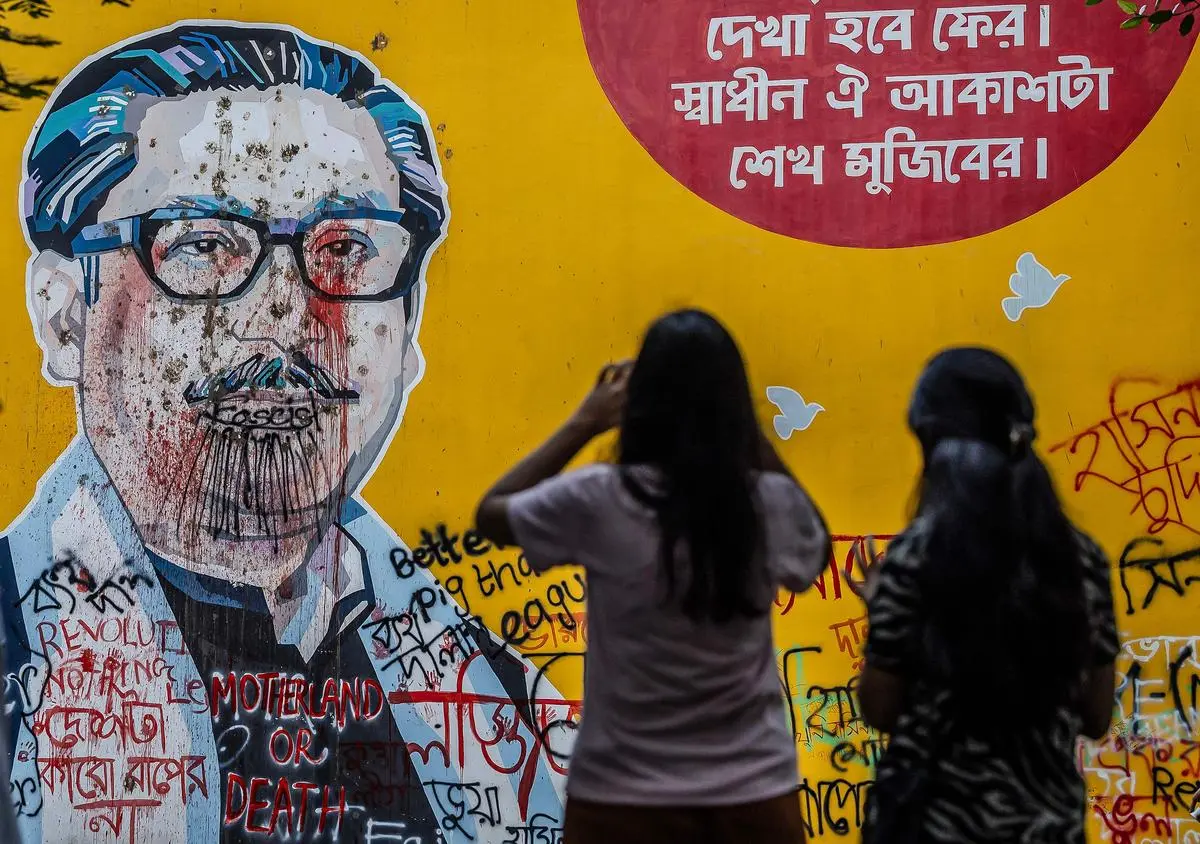
Anti-government graffitis on a vandalised mural depicting Bangladesh’s founding father Sheikh Mujibur Rahman days after a student-led uprising ended the 15-year rule of his daughter and Prime Minister Sheikh Hasina in Dhaka on August 10, 2024. | Photo Credit: LUIS TATO/AFP
Is it that India and Indian diplomacy have placed all its eggs in one basket with the Awami League and Sheikh Hasina? Is that all there is to our Bangladesh policy?
I’m glad you asked that question—it deserves a serious answer. I would start with that old saying: in international relations, there are no permanent friends or enemies, only permanent interests. India has permanent interests in Bangladesh. What is our core interest? Our national security is non-negotiable. We want to make sure that Bangladeshi territory is not exploited or misused for carrying out activities prejudicial or inimical to India’s national security. This has been our fundamental, long-term core interest.
For whatever reason, there has been one section of the Bangladeshi polity sensitive to these concerns. Sometimes even they have not been as sensitive as we would like, but at other times, they have been. On the other hand, some forces feel it is in Bangladesh’s interest to disregard these core interests and turn a blind eye to the kind of activities that Pakistan conducts from Bangladeshi territory. What do we do in these circumstances? To expect us to forget these things—no government in New Delhi can do that.
I’m reminded of another old saying: It doesn’t matter whether the cat is black or white as long as it catches the mice. We don’t distinguish between a black cat and a white cat. We want to make sure our core security interests are taken care of. If those are disregarded or if there are forces or sections of the Bangladeshi polity which say they will disregard these interests, then that has certain consequences. That is our core interest—it’s not favouring one party over another.
We now have an ousted Prime Minister living in Delhi. There is a different quality to the relationship. This is going to have implications for whatever government comes to power in Dhaka. How do you think India is going to play this?
It is a delicate question. The simplistic reading is that this is an issue which has led to a lot of anti-India feeling in Bangladesh. I’m sure some people would say, ‘Why doesn’t India accede to the request to extradite Sheikh Hasina?’ Let me give you one powerful reason for not doing so. It can well be argued that her trial itself has not been fair. The death sentence in absentia that has been handed down was done under the pressure of mob violence and extremist propaganda, almost under duress. Extraditing her to Bangladesh would strengthen the forces of extremism and radicalism trying to expand their space in Bangladesh. These forces would get emboldened very greatly if any such development were to take place.
We have a question from Yuvraj Shankla: In recent times, India’s relations with many nations have not been as good as previously. Is this because of other nations like the US or China, or is it the weakness of India’s diplomacy?
I would not like to generalise India’s relations with all its neighbours. We treat all of them on merit, one by one. The important thing is our own internal strengths. This is a personal opinion: India’s influence in this region is largely a function of its own comprehensive national strength. If we do well at home and our economy is strong, if we have a harmonious society at home, then India will exert a certain gravitational pull on the entire region. As India grows and prospers, so will the rest of the region along with us. That has to be our effort at all times.
Also Read | Bangla turmoil and the question of who gets to play the beast
Picking up on the harmonious society point, we have these lynchings of Hindus in Bangladesh and attacks and killings of Muslims in India. We have also seen several of our political leaders in the ruling dispensation using derogatory language about Bangladeshis. If this gravitational pull requires a harmonious society and we have so many problems to deal with in our own country, how then do we speak about the affairs of another country?
I think you have a point there, and nobody can dispute that or disagree with the fundamental point you make. India’s great strength ever since Independence is that we have set an example for other countries in the region. That is why they have respected us, looked up to us, and admired us. That has always coexisted with a certain degree of resentment or suspicion—that has been the broad paradigm of our relationship with most countries in the region. In my mind, I’m confident that is the position we have to maintain if we are to retain the position of preeminence in our neighbourhood.
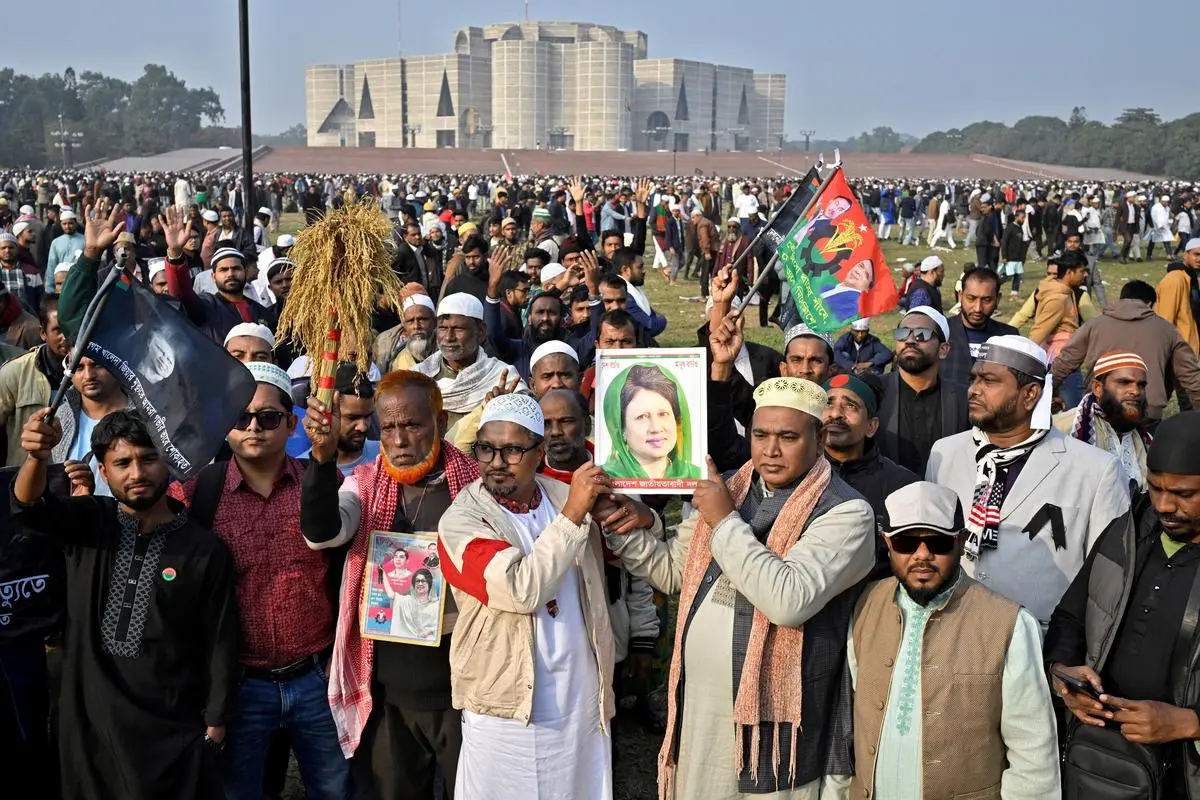
People hold a portrait of Bangladesh's former Prime Minister Khaleda Zia, as they gather to offer funeral prayer for her, at the Parliament building area of Manik Mia Avenue, in Dhaka, Bangladesh, December 31, 2025. | Photo Credit: Fatima Tuj Johora / REUTERS
The Modi government did well to send [External Affairs Minister] Jaishankar for Khaleda Zia’s funeral. What should be India’s approach toward any new government?
Quite clearly, we have to deal with whichever government comes to power in Bangladesh. We have to be cognisant of the past—forgetting the past is not an option. But we cannot be prisoners of the past. We have to remain optimistic and engage with whichever dispensation comes to power. But we also have to make our bottom line very clear. In Bangladesh, our core security concerns are very clear. As long as those are upheld and respected, we would have absolutely no problem at all working with whatever government comes to power in Dhaka.
Equally, the forces of pluralism, inclusiveness, the very values which underlay the Liberation War of Bangladesh—these are forces with which we have traditionally enjoyed good relations. We must continue to extend full support to them, especially if we are to keep the forces of extremism and radicalism at bay. That is in the interest of both Bangladesh, India, and the wider region.
We have a problem on the cricket front. After the decision not to let Mustafizur Rahman play the IPL, Bangladeshis are saying they do not want to come to India to play in the T20 World Cup and want their games shifted to Sri Lanka. How does one deal with this, given how cricket-crazy people are in both countries?
I am not a cricket administrator, but I am a cricket fan. I believe in the power of sport, just like culture and literature, to bring people together. Fundamentally, it is not a good idea to mix sports and politics. I would love to see an IPL or tournament where players from all countries participate. But this is the great danger of overreactions leading to further overreactions and counter-reactions, vitiating the entire atmosphere. It is unfortunate.
To wrap up, where do India and Bangladesh go from here? Some may think that no options are good for India, but ground realities exist. Where does this relationship go?
Irrespective of the election results, the recent past has shown that forces of extremism and radicalism are trying to expand the space available to them in Bangladesh. This is the great danger I see. The best solution is a democratically elected government coming to power. But even any government that comes to power following an election will find it difficult to control some of these forces that appear to have strengthened their influence in recent months.
From our side, we will have to work with any government that comes to power in Dhaka. But at the same time, it would be in our interest to strengthen the forces of democracy, pluralism, inclusiveness, secularism, and the forces which subscribe to the ideals of the Liberation War of Bangladesh. It would be entirely in our interest to extend support to these forces as well.
Amit Baruah was The Hindu’s Diplomatic Correspondent and Foreign Editor of Hindustan Times. He is now an independent journalist .
This transcript has been edited for length and clarity.