


Island on Edge: The Great Nicobar Crisis brings together a set of essays and articles, many of which were originally published in Frontline. Taken together, they form a deeply troubling account of a suite of large-scale development projects proposed for Great Nicobar Island: a transshipment port, a greenfield international airport, power infrastructure, and an associated township. These are being advanced under the banner of strategic and national security interests, framed as essential to India’s geopolitical positioning in the region. The book, however, asks us to look beyond that framing.
Across its chapters, it lays out, with considerable empirical grounding, the social, ecological, and environmental implications of such a transformation. At least 10 highly range-restricted endemic species are likely to be directly threatened. The project could deal a severe blow to populations of the leatherback sea turtle, for which this island hosts one of the most significant nesting sites in the Indian Ocean. And then there is the scale of deforestation. Even conservative estimates by independent scientists suggest that close to six million old-growth trees may be felled—trees that have taken decades, if not centuries, to reach their current ecological function. These are not marginal impacts.
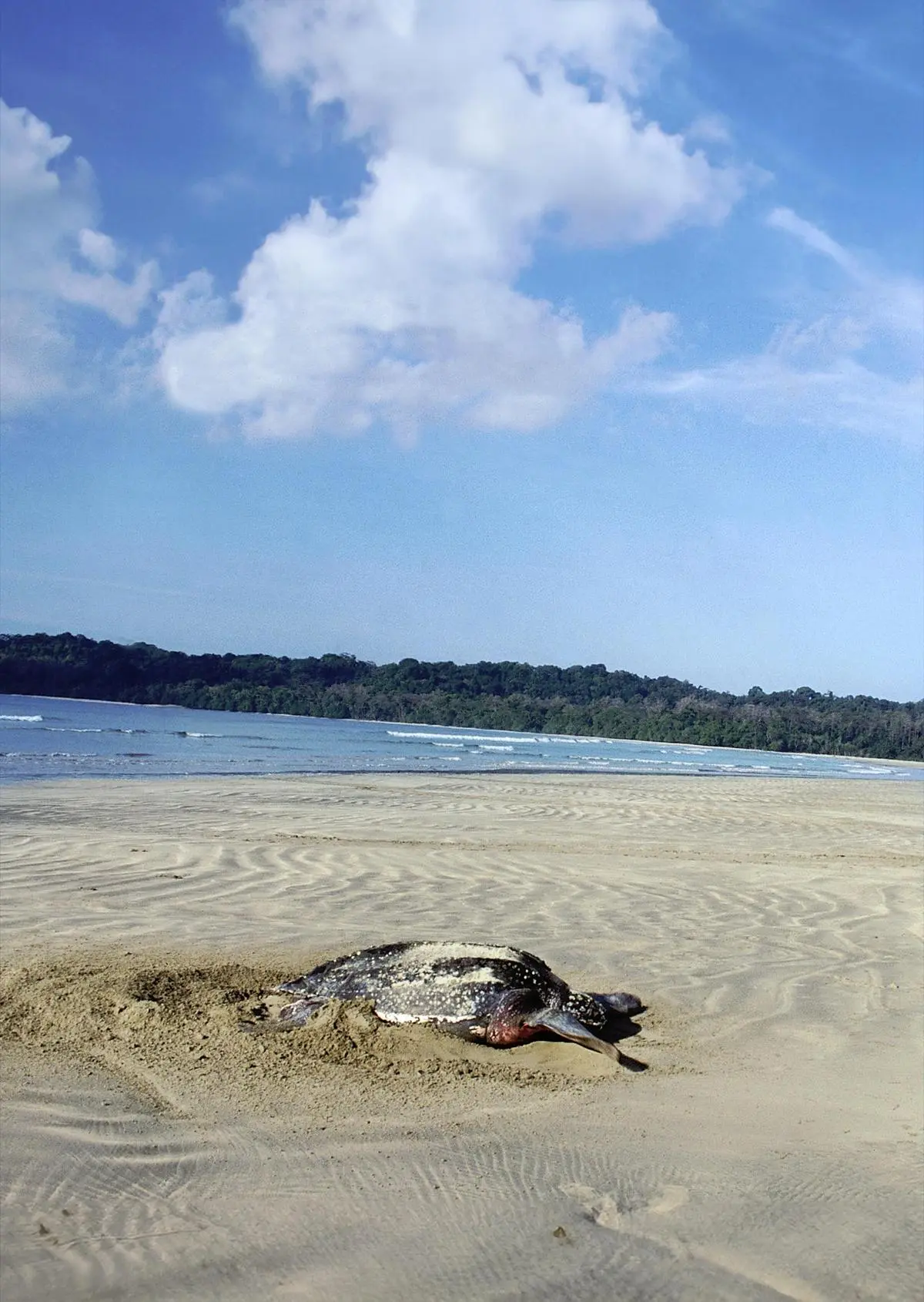
A giant leatherback turtle nesting on a beach on Great Nicobar Island. | Photo Credit: Getty Images/iStockphoto
The issue itself has circulated widely in public discourse for some time now. Even those who have not read the book are likely to have encountered its arguments indirectly through articles, discussions, or commentary. One recent example is Kunal Kamra’s episode of Jan Hith Me Jaari, which brought aspects of the debate into a much broader public space. In that sense, the book has travelled beyond its immediate readership, entering a larger conversation about development, governance, and ecological limits.
At the centre of this conversation lies Great Nicobar Island, the southernmost island in the Andaman and Nicobar archipelago, home to India’s southernmost corner, Indira Point, a place defined by dense tropical rainforests, mangrove systems, coral reefs, and globally significant nesting beaches. It is also seismically active, lying in a region shaped by earthquakes, tsunamis, and cyclones. The memory of the 2004 Indian Ocean tsunami runs quietly through the book, a reminder that this is not a stable landscape in the conventional sense.
Several contributors return to a deceptively simple question: Can ecological fragility coexist with infrastructural gigantism in such a setting?
This reframing is important. Security is often imagined in concrete, steel, and logistics networks but rarely in intact forests, stable coastlines, or resilient ecosystems. The book nudges the reader to consider whether ecological stability itself might constitute a form of strategic infrastructure: less visible, perhaps, but far more enduring.

This book will stand as a record that the warnings were there against the Great Nicobar Project, that evidence was available, and that arguments were clearly made.
Island on Edge
The Great Nicobar Crisis
Edited by Pankaj Sekhsaria
Westland
Pages: 266
Price: Rs.499
The political economy of the project emerges gradually across the volume. Frontier regions, remote islands, border forests, and mineral belts have long served as sites for accelerated development, in part because they remain distant from electoral centres and sustained media scrutiny. Regulatory shortcuts that would provoke resistance in urban contexts often pass with limited attention here. The Great Nicobar proposal fits within this broader pattern: where ambition scales faster than institutional caution.
What gives the volume its sharpness is its refusal to caricature development. Few contributors argue for absolute preservation or isolation. Instead, the recurring call across chapters is for proportionality, transparency, and scientific seriousness. The critique is not of development per se but of haste dressed up as vision.
If there is a gap, it lies in the absence of sustained, first-person articulation from the institutional proponents of the project. Government rationales are analysed in detail, but one rarely hears directly from those driving the initiative. That asymmetry may, in itself, reflect the opacity that often surrounds large-scale decision-making of this kind. However, the letters and exchanges shared in the annexure section do address some of those gaps.
Reading Island on Edge inevitably evokes parallels with other parts of India. Hydropower expansion in the Himalaya, coastal industrial corridors, and forest clearances in central India—all reveal similar tensions between ecological caution, social tensions, and developmental urgency. The Nicobar case is not unique in kind, but it is unusually compressed in scale and visibility. Islands have a way of making trade-offs harder to ignore. There is also a persistent undercurrent of temporal unease. Climate change, rising seas, and increasingly frequent extreme weather events are not distant projections in the Indian Ocean. Yet infrastructure in such contexts continues to receive routine environmental clearances, often based on impact assessments conducted by state-funded institutions, with little acknowledgment—let alone scrutiny—of the obvious conflicts of interest embedded in the process.
Redefining development
For readers accustomed to binaries—development versus conservation, growth versus ecology—the book demands a more uncomfortable engagement. It suggests that the real question is not whether development should occur, but how it is defined, whose interests it serves, and how uncertainty is negotiated in fragile landscapes.
Structurally, the book is organised into thematic sections: “An Imperilled Future”, “Indigenous Landscapes”, “Two Decades After a Tsunami”, “Fragile Ecologies”, “Expert Speak”, and an afterword. Each section adds a layer, moving from ecological description to social context and from governance critique to broader reflection. Read together, they create a cumulative argument: not through rhetoric but through the incremental repetition of evidence, detail, and perspective. On the face of it, the book is straightforward: page after page of facts, documentation, and analysis. One might reasonably assume that such an accumulation of evidence would compel serious reconsideration of the project’s feasibility. And that is precisely where the unease begins because the processes that should enable such reconsideration appear, in many instances, to have been compressed, bypassed, or treated as procedural formalities.
“Development” remains perhaps the most overused—and misused—word in contemporary political vocabulary. It is invoked with such frequency and such elasticity that it risks losing all specificity.
Economists and international institutions have long defined development in terms of well-being, equity, and sustainability, not merely in terms of infrastructure or GDP expansion. It is against that broader understanding that the claims made for projects like this must be evaluated.
For those working in biodiversity conservation, this book does not stand alone. It builds on a body of work that Sekhsaria has developed over more than two decades—work that has consistently drawn attention to the ecological and social realities of the Andaman and Nicobar Islands. What emerges across these efforts is not nostalgia for an untouched landscape but a recognition of a functioning system that continues to hold together despite growing pressures.
Great Nicobar is not pristine, nor is it static. But it remains one of the least fragmented tropical landscapes in India. That integrity is precisely what makes the stakes so high. What is being proposed is not incremental change. It is a fundamental reimagining of the island with a “big bang”. Comparisons to Singapore, often invoked in official discourse, signal not only ambition but also reveal a particular way of seeing the landscape: as something to be remade. On the ground, this translates into a shift from rainforest to port infrastructure, from nesting beaches to airport complexes, and from indigenous habitats to industrial corridors. Each of these transformations can be framed as development. Taken together, they represent something far more consequential and irreversible.
Amid all of this, what remains genuinely heartening is that despite the erasure of all ethics and due processes and co-option of independent institutions by the state today, a book like this exists. Because when the history of this moment is eventually written, and when future generations look back, quite possibly asking how such decisions were allowed to unfold, this book will stand as a record. A record that the warnings were there, the evidence was available, and the arguments were clearly made.
Perhaps that concern with historical judgment sounds self-serving, but it is not entirely so. Much of what we do, especially in fields like conservation, is shaped by an awareness that decisions taken today will outlast us. That what we choose to ignore, or to confront, will shape landscapes long after we are gone.
And when all of this is over, and it will be, one way or another, what may matter most is not only what happened, but who stood against the tide while it was happening and who spoke up when a disaster, blatantly and carelessly framed and repeatedly justified as development, was being set in motion.
Rajkamal Goswami is a fellow at the Ashoka Trust for Research in Ecology and the Environment, Bengaluru.
Also Read | Everything is being done in a hushed-up manner: D. Ayyappan
Also Read | Let’s talk about the Great Nicobar project