


Tamil Nadu’s political landscape has been characterised by a bipolar dynamic, with the two Dravidian parties dominating it since 1967, when the Dravida Munnetra Kazhagam (DMK) emerged as an alternative to the Congress party that had ruled since Independence. From the late 1980s, the DMK and its offshoot, the All India Dravida Munnetra Kazhagam (AIADMK), founded by the matinee idol M.G. Ramachandran (MGR) in 1972, have held power alternatively, leaving little room for other parties to come in. The reason for the Dravidian parties being able to hold Tamil Nadu for seven decades can be attributed to their brand of politics, a blend of social welfarism and infrastructure development supported by a strong ideological framework.
There have been occasional challenges to their dominance since 1967, a few attempts to offer the electorate an alternative, such as the late actor Vijayakanth’s Desiya Murpokku Dravida Kazhagam. And, ironically, both major Dravidian parties too have aligned with the BJP, in 1998 and 1999, respectively, out of political compulsions. But they did manage to remain uncompromising on ideology and could thus confine right-wing politics to a limited space.
Alternatives revisited
Today, Tamil Nadu is seeing another iteration of the idea of an alternative to Dravidian politics, with the actor-politician Vijay’s Tamilaga Vettri Kazhagam (TVK) vying to occupy that coveted space. He has remained firm in wanting to go it alone. The only other party that refuses to join any alliance is Seeman’s Naam Tamilar Katchi (NTK). While Seeman’s impact is comparatively less than that of Vijay’s, together they are seen as ushering in a subtle shift in the State’s politics.
This shift might not yet be tectonic, but it becomes important because this election is seeing Dravidian supremacy being put to the test. With the BJP allying with the AIADMK, the DMK is the only Dravidian party fighting the Hindutva onslaught along with its secular partners such as the Congress, the Left, the Viduthalai Chiruthaigal Katchi, and others. It is against this challenge that the TVK and NTK factor becomes important.
After the Election Commission of India’s (ECI) Special Intensive Revision of electoral rolls, Tamil Nadu’s total electorate stands at 5.67 crore. Of this, nearly 1.05 crore voters belong to the 20–29 age group, while about 12.5 lakh are aged 18 and 19, and are first-time voters. These millennial and Gen Z generations, disillusioned with the heavy monetisation of politics, are the central demographic in Tamil Nadu politics today. A significant number of them, frustrated by the environment of hatred, corruption, and uncertainty, are looking to see a generational shift in politics. It is this demographic, young and social-media savvy, that constitutes the primary catchment area for both Seeman and Vijay. The ECI’s special campaign “Focus on Youth”, launched in colleges across the State to enroll students as first-time voters, has, in a way, benefited both Seeman and Vijay.
While both leaders assert that their ideologies are distinct from each other’s and from Dravidianism, they are largely influenced by the same political legacy and social dynamics. They are both responding to similar electoral aspirations, welfare expectations, and identity concerns, which has led them to compete for the space dominated by the Dravidian parties.
Combative exclusivism
Seeman likes to project himself as a “lone wolf” rather than a popular leader in a herd. His choice to embrace “conscious isolation” in an era of coalition politics has been a subject of debate for a long time. The NTK was formed in 2009, driven by the strong anti-DMK sentiments that suffused the State after the defeat of the Liberation Tigers of Tamil Eelam in Sri Lanka, and since 2016, Seeman has chosen not to align with any party. This is particularly challenging given the strongly bipolar political landscape of Tamil Nadu. Nevertheless, he has been steadfast, remaining independent despite established parties making strong overtures time after time.
Interestingly, his stand has paid off. The NTK has won a consistently higher vote share with each election. According to the ECI’s records, the NTK’s vote share increased from only 1.06 per cent in the 2016 Assembly election to 6.89 per cent in the 2021 Assembly election and 8.2 per cent in the 2024 parliamentary election. In many constituencies, it significantly cut into the votes of the two major parties.
Seeman advocates for an exclusive form of Tamil nationalism, which serves as his party’s political foundation. He contrasts it with the inclusive ideology of Dravidianism, which he believes has compromised the principles of Tamil dignity and culture. His interpretation of Tamil nationalism is rooted in ethnic and linguistic purity. But in order to challenge the inclusive politics of the Dravidian ideology, he tries to deconstruct the image of “Periyar” E.V. Ramasamy, who has deeply influenced the Tamil people, both culturally and ideologically. The NTK founder has been accused of being a “proxy” for the BJP. While he denies it, the allegations cannot be dismissed outright. The NTK is the first Tamil political party, besides Hindutva organisations, to question Periyar’s ideological legacy, and several right-wing Hindutva leaders have hailed Seeman as a bold voice. Periyar and his positions have long been a thorn in the side of Hindutva votaries.
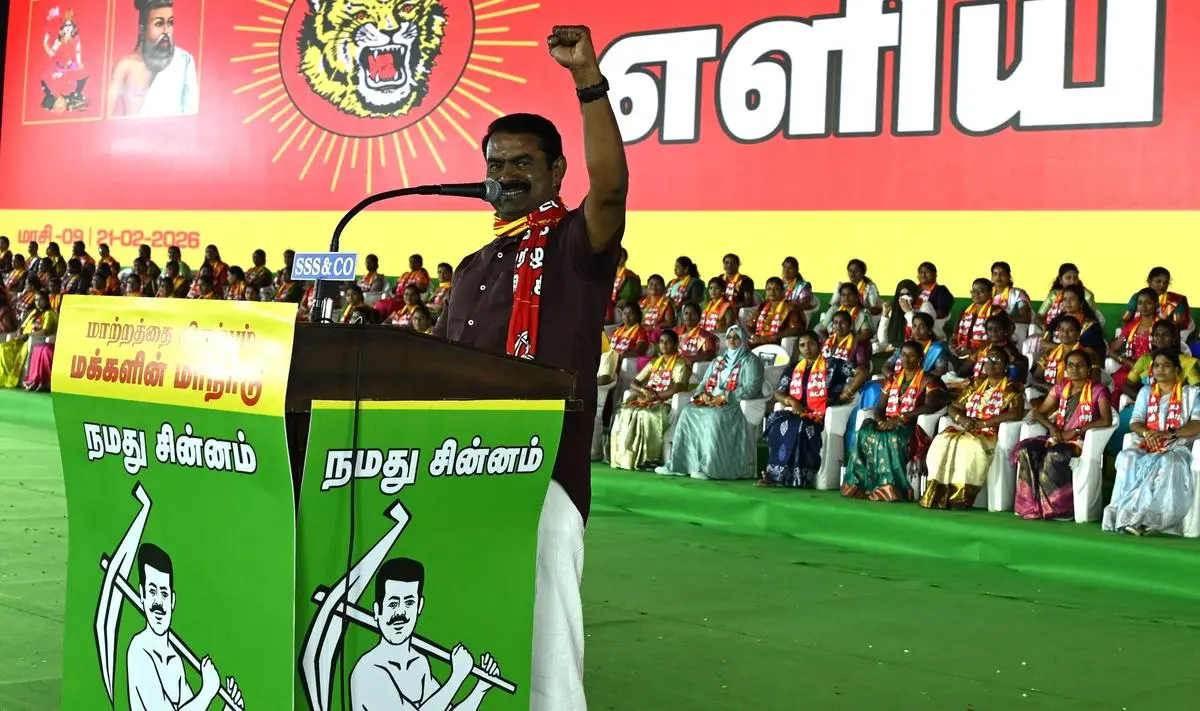
Naam Tamilar Katchi chief co-ordinator Seeman on February 21, 2026 introducing the party’s 234 candidates, 50 per cent of whom are women, at a public meeting held at Tiruchi. | Photo Credit: M. MOORTHY
Seeman seeks to foreground Tamil icons such as Vallalar Ramalinga Swamigal, the poet Subramania Bharathi, and the freedom fighter V.O. Chidambaram Pillai—figures already deeply rooted in Tamil cultural and spiritual traditions—but places them in contrast to Periyar. For the Dravidian parties, Periyar is an abiding symbol of social justice politics, especially for the DMK. The AIADMK carefully avoids any criticism of Periyar but seldom projects him as its primary political or ideological mascot.
Seeman is fully aware that Tamils have long internalised the principles espoused by Periyar as core to their way of life. He has thus carefully constructed a narrative, which first began with criticism of Dravidianism and was followed by a condemnation of the idolisation of Periyar. Since 2021, Seeman has upped the ante, positioning Tamil nationalism in opposition to Dravidianism, and even organised a conference titled “Tamil or Dravidian?”, which raised questions about Periyar’s contributions to Tamil society.
Seeman’s main target: Periyar
Attacking Periyar and the Dravidian movement intentionally reinforces the claims that Seeman subtly promotes a majoritarian Hindutva agenda. The Tamil scholar and sociocultural expert Prof. V. Arasu, former head of the Department of Tamil Literature at the University of Madras, said: “Seeman is asked to target Periyar by forces inimical to his [Periyar’s] progressive ideals. And he obliges.” The perception gets stronger when one considers that Seeman never criticises the regressive and divisive politics of Hindutva as practised by the BJP-RSS combo, which is widely seen to be undermining social and religious harmony in a State that has historically rejected political extremism and religious exclusivism.
Seeman seeks to mask his exclusivist and divisive politics by taking stances that appear to challenge only hardcore Dravidianism. For instance, Seeman announced the names of 8 Brahmins among his party’s 234 candidates for the upcoming Assembly election and pointedly stated: “Tamil Brahmins are Tamils.” He also said that many prominent figures, such as U. Ve. Swaminatha Iyer, had made significant contributions to Tamil language and culture. Seeman sparked a controversy by pointing out that Periyar had called Tamil a barbaric language, conveniently forgetting to add the context in which Periyar had made the statement. The reformer had a layered understanding of Tamil and insisted on its functional advocacy: for it to modernise its script to make it more friendly to typesetting. When Periyar said Tamil was primitive, he was referring to its lack of a modern vocabulary (unlike English), which did not lend itself to rational thinking and scientific studies. Periyar denounced the fact that Tamil had been used primarily to foster blind religious devotion. He said that Tamil should be technically and scientifically relevant and in sync with changing times, which, in turn, would uplift the oppressed, socially and economically. He was also happy to group Tamil with other languages in the Dravidian family, rejecting the idea of language purism.
Seeman has also pledged to remove the word “Dravidam” from Tamil Thai Vazhthu, the State anthem, if he comes to power. Arasu pointed out that Tamil and Dravidam are the same and they denote one language, Tamil. Thus, if one takes Seeman’s statements at face value, one might overlook the subtle narrative he is trying to advance: that Periyar’s Dravidianism, which the BJP opposes stridently, is not a vehicle for social justice and development but instead serves as a platform for “anti-Brahmin” and “atheistic” sentiments.
To his credit, Seeman’s candidate list includes 50 per cent women and considerable representation for oppressed caste groups, something that the major Dravidian parties have been hesitant to adopt. Seeman has fielded Dalit candidates in general constituencies and vice versa. “We fielded Dalit candidates in general constituencies, where OBCs like Vanniyars, Kongu Vellalars, and Maravas are dominant. Do these two Dravidian parties, which claim to be the guardians of social justice, have the courage to do the same?” he asked. His statement is hard to dispute, as both the DMK and the AIADMK are compelled by caste considerations and pressures when it comes to candidate selection.
While Seeman’s social engineering, supported by grassroots activities and speeches, has consistently aimed at weaning the youth of Tamil Nadu away from Periyar’s ideology and inclusivism, Tamil scholars and Dravidian ideologues contend that his interpretation of Tamil nationalism is problematic. According to Arasu: “His popularity among the youth, who are driven by sentiments for Tamil Eelam, is limited. Supported by the backward Nadar caste, which is largely aligned with the BJP, he has become the mouthpiece for right-wing forces. His criticism of Periyar should be viewed in this context.”
The NTK also advocates the “rule of Tamils only”, that is only native Tamils should govern Tamil Nadu. “Will linguistic minorities be allowed to rule in States like Karnataka, Kerala, Andhra Pradesh, and Telangana?” is a question he often asks. This is a problematic position since the entire region was once the Madras Presidency, and after the reorganisation of States along linguistic lines, thousands of Kannada, Telugu, and Malayalam origin families stayed back in Tamil Nadu, their home for generations. Three-time Chief Minister MGR, for instance, was from Kerala.
Cashing in on stardom
The rising popularity of his divisive politics has seen Seeman’s ambitions grow. Now, however, Vijay’s entry has dampened the NTK’s aspiration of being the only alternative to the Dravidian parties. The hugely popular actor’s arrival has unsettled even the major parties, including the BJP, which is trying its best to break into Tamil Nadu. Vijay’s TVK has enormous traction among the 18–30 age group. The party has a strong fan-driven structure, and given his own cinematic charisma, Vijay’s political viability, despite being untested, cannot be written off.
The TVK founder timed his political debut well. A significant chunk of the electorate is disillusioned with both the DMK and the AIADMK, with the former fighting anti-incumbency sentiments. The TVK has managed to gain wide social media reach, even though it is criticised for being built on both misinformation and disinformation. While Seeman’s core group of Tamil nationalists remains with him, the others have shifted to Vijay’s camp, seeing him as offering the alternative they seek. In a way, Seeman himself is to blame. Much has changed in politics since he founded the NTK, and his ideology of exclusive nationalism and unrealistic views on Tamil purism look outdated now and do not resonate with today’s market-driven sociopolitical environment. Disconnected from reality, Seeman stubbornly refuses to acknowledge the dynamics of electoral politics. His party has remained only the “spoiler”.
Vijay, on the other hand, appears more grounded, although his followers, non-political and inexperienced, can often be offensive and unrestrained. They are captivated by his screen image as a solo fighter posed against the system and believe that rule-breaking is par for the course. In contrast to the politically engaged fans of the legendary MGR, Vijay’s fans largely have no belief in any coherent political ideology. At present, they seem eager to change the system but unclear about what will replace it.
Political observers point out that both Vijay and Seeman are promoting a culture of disruptive politics. “A sort of ecstatic fan-based politics is emerging, which is alarming,” said G. Palanithurai, a former professor of The Gandhigram Rural Institute and an expert in grassroots governance. “There has been depoliticisation of the State’s youth for three decades,” he said. “Colleges and universities have rarely engaged in discussions and debates on sociopolitical issues. They have primarily produced graduates for jobs. These youth are disillusioned with the DMK and the AIADMK, and also have a disdain for the BJP.”
“With neither society nor political parties engaging with young people meaningfully, they seek alternatives in cinema and rhetoric,” said Palanithurai, which is one reason why Vijay can play a significant role in this election.
One-man parties
Palanithurai pointed out that Seeman’s party lacks an effective institutional structure and collective leadership. “A similar pattern is visible in Vijay’s political party as well. Both leaders function as political institutions unto themselves. While other parties in Tamil Nadu are centred around dominant personalities, they nevertheless operate within structured organisational systems.”
Unlike Seeman, however, Vijay’s politics is inclusive. At his Vikravandi public meeting, he said that he was open to anyone joining him in his efforts to oust the “corrupt” DMK government. He was also open to other parties joining him and offered them a share in power. He features Periyar, B.R. Ambedkar, and other Tamil icons as symbols on his political propaganda material. He has identified the DMK as his political adversary and the BJP as his ideological enemy, and claims his ideology is centred on secular social justice and a two-language policy, but this is also the centrepiece of the DMK campaign.
Tamil Nadu’s politics is not new to mimetic rivalry, with emerging leaders becoming competitors for the same political legacy. The DMK and the AIADMK are Siamese twins of the same ideology but are fierce opponents. Seen from this angle, Vijay’s ideology falls back on the DMK’s mantras, but his followers are drawn from Seeman’s base of anti-establishment youth and minority voters.
Vijay’s and Seeman’s politics are fundamentally different. While Seeman espouses an exclusivist vision, Vijay projects a more inclusive outlook. Seeman attributes Tamil Nadu’s present challenges to the Dravidian movement itself, whereas Vijay confines his criticism to corruption within the Dravidian parties. Such a strong ideological divergence is likely to impede the consolidation of youth support behind a single political formation.
However, by questioning long-standing political narratives and the dominance of the State’s two principal parties, these two leaders are unsettling entrenched power structures and beginning to redraw the contours of Tamil Nadu’s political culture. While the influence of the century-old Dravidian movement remains largely intact, the two new entrants might nudge the State’s political discourse—and public sentiment—away from it and ultimately towards the Right.
Also Read | The missing isms in Vijayism
Also Read | How Dravidian politics offers a bulwark against the exclusionary politics of Hindutva