







The 4th of May 2026 may well be remembered as the moment India’s most powerful regional satrap fell. For 15 years, Mamata Banerjee and the Trinamool Congress stood as the most formidable regional force in the country, combative in Parliament and claiming a sub-national linguistic identity. Their defeat on May 4 marks the steady unravelling of a political system where regional parties held their own against national power.
This is not an isolated event. Across India, State-based parties are in retreat. In Telangana, the Bharat Rashtra Samithi (BRS) was displaced by the Congress. In Odisha, the Biju Janata Dal—long anchored by Naveen Patnaik—was swept aside by the BJP after 24 years in power. What we are witnessing is not merely electoral churn, but the consolidation of a new political order. (The defeat of the Dravida Munnetra Kazhagam in Tamil Nadu does not, however, fall into this pattern as it is a rooted ideological formation that has been out of office in the past.)
When the Narendra Modi era began in 2014, the BJP did well nationally but fared relatively poorly in State contests. Regional parties often acted as buffers, winning their States even as the BJP expanded nationally. But the post-2024 phase has altered that balance. The BJP, having lost its simple majority and now dependent on allies like the Janata Dal (United) and the Telugu Desam Party in the Lok Sabha, has become more aggressive in the States.
The playbook is now clear: ally, split, absorb, threaten, and finally replace.
In Maharashtra, this model unfolded in stages: first align with regional forces, then engineer splits, and eventually hollow them out. In Bihar, Mandal-era parties were first accommodated, then systematically diminished. Nitish Kumar’s exit from office marks the end of even that pretence of regional partnership.
West Bengal, however, was a direct battle with a powerful incumbent. Here, the BJP combined anti-incumbency with a carefully curated electoral ground. The question that lingers is whether such a dramatic conversion of votes into seats would have been possible without turning the State into what many described as a garrison, with a heavy deployment of Central forces?
The counterfactual is difficult to establish. Would voters have turned out in large numbers against the Trinamool in a State historically marked by political violence without that presence? We do not know. But what is evident is that a template is now in place for “difficult” States, those where sections of the electorate resist the BJP.
More important was the use of administrative mechanisms such as the Special Intensive Revision (SIR), including features like “Logical Discrepancy”, a bureaucratic filter that can potentially exclude voters on technical grounds. Applied selectively, such tools raise troubling constitutional and ethical questions. They begin to resemble a form of disenfranchisement that is procedural in appearance but deeply political in effect.
This marks an escalation of Central influence in State elections.
The implications are immediate. Uttar Pradesh, which votes next year and where the Samajwadi Party delivered a shock to the BJP in the 2024 general election, could be the next testing ground. Punjab, too, is in the BJP’s sights, with the rhetoric increasingly framing border States as requiring “national” stewardship. The AAP, currently in power there, is facing sustained political pressure; several of its Rajya Sabha MPs jumped ship recently to join the BJP.
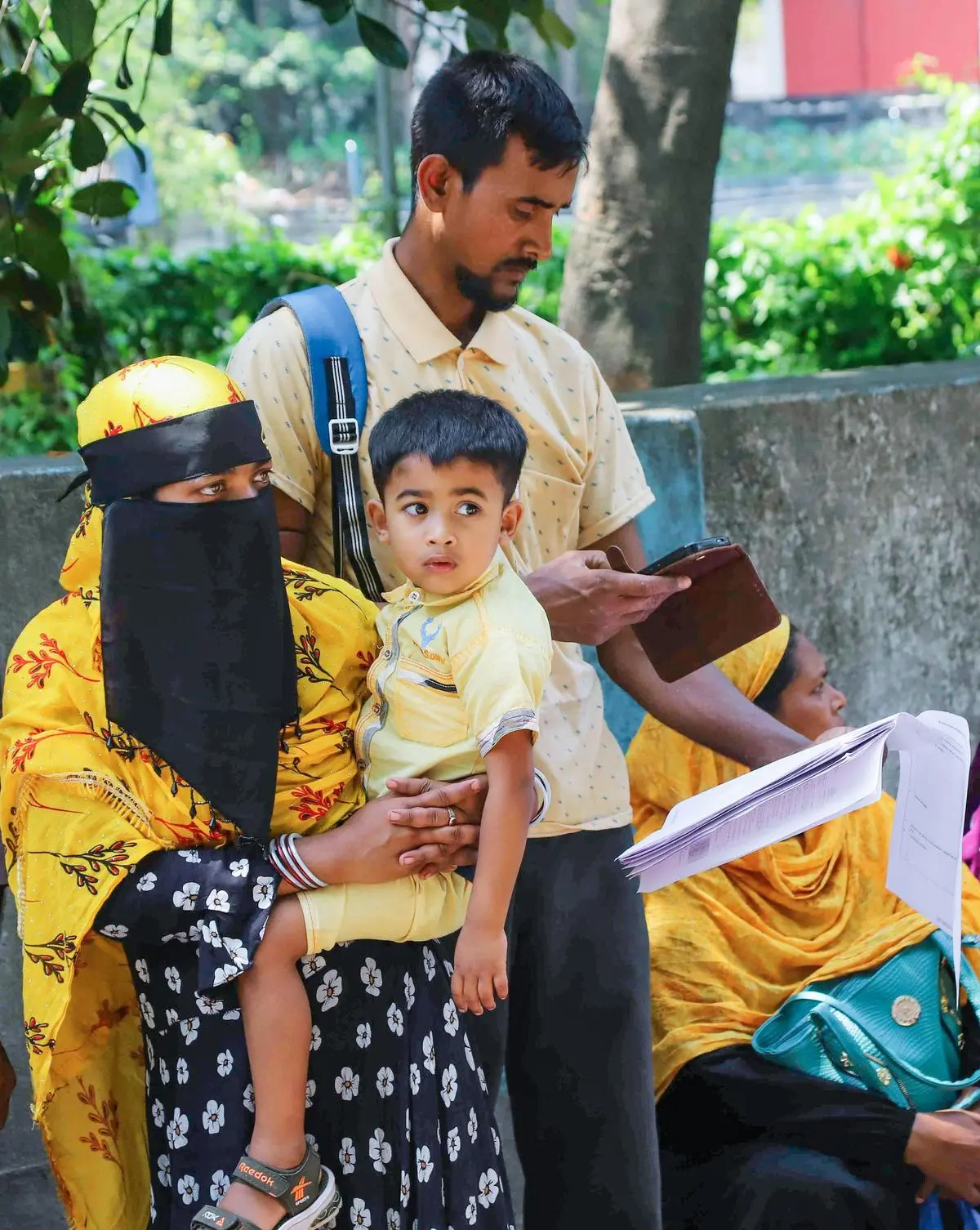
People whose names were deleted from the Special Intensive Revision voter list wait to submit documents proving their citizenship, in North 24 Parganas, West Bengal, on April 11, 2026. | Photo Credit: Saikat Paul/ANI
Delhi, where the AAP was defeated a year ago, and Bengal exemplify two variations of the same approach. In Delhi, the AAP leadership was jailed under charges that were recently rejected by a trial court, while legislative changes stripped the elected government of control over the bureaucracy. In Bengal, the strategy was less legislative and involved greater use of Election Commission diktats. The outcome was similar: the encircling and eventual defeat of a regional force.
The larger design, however, lies in delimitation. The redrawing of constituencies promises to reshape political representation countrywide. While Parliament has yet to pass a comprehensive law (and the BJP was defeated in a recent attempt to do so), the process is visible at the State level. The BJP’s win in Assam was aided by delimitation designed to reduce the electoral clout of the Muslim population.
The Assam model in Bengal
It now seems inevitable that the Assam model, with the “ghuspetiya” or infiltrator rhetoric and the systematic marginalisation of Muslim representation, will come to Bengal. With its similar demographics, the model of exclusion will pick up pace. The political language has already shifted. Suvendu Adhikari, who defeated Mamata Banerjee in her constituency and is a contender for chief ministership, has embraced a rhetoric that rivals that of Assam’s Himanta Biswa Sarma. Both are political imports into the BJP, both rose through systems that later sidelined them, and both have discovered electoral prosperity with pitched rhetoric against Muslims.
There is a greater acceptance of this rhetoric in Bengal now, although anti-incumbency also mattered. One of the most telling conversations I had during the election was with a taxi driver taking me to the Kolkata airport. Once a CPI(M) supporter, he now backs the BJP. There are “too many mosques,” he said, didi had to go. Land reforms during the Left era had helped his family once, but now there were too many local strongmen taking cuts. His wife had benefited from government schemes, but she too would vote BJP.
This seamless shift, from the Left to the Right, from being welfare beneficiary to anti-incumbency, captured the mood of a State in transition. Regional parties everywhere are struggling. Sharad Pawar’s Nationalist Congress Party has splintered and diminished. The BRS, once the vehicle of Telangana’s Statehood movement, is adrift. The Janata Dal (Secular) survives in Karnataka on the margins of relevance with a family seeking to protect its assets and members. The Rashtriya Janata Dal (RJD), despite its legacy drawn from the Mandal movement, appears to be a fading force.
The once-formidable Bahujan Samaj Party led by four-time Chief Minister Mayawati in Uttar Pradesh has been conspicuously absent in the Modi era. It will no doubt make an appearance during the Uttar Pradesh election, possibly to strike deals and protect itself from the criminal cases that reduced the RJD founder Lalu Prasad Yadav into a shadow of his former self. Towering farm leader Chaudhary Charan Singh’s Rashtriya Lok Dal has effectively merged with the BJP, courtesy his grandson Jayant Chaudhary.
India, therefore, is no longer a federal montage with strong State satraps. It has become a Centrally managed political system with State-level variations. The shrinking list of regional parties is a sad little roll call of the defeated, the compromised, and the threatened.
What will happen to the Trinamool without power? The retribution in Bengal could be extreme but Mamata Banerjee is a fighter. She could play a role in national politics but that’s where the contradictions in the opposition camp come in, with the Congress and Left parties uncomfortable with sharing space with the Trinamool. The Congress could see an opportunity in the decline of regional players, but it’s not clear if it has the structures to make the most of it. For now, if the past is an indication of the future, the BJP will have a long innings in West Bengal.
Saba Naqvi is a Delhi-based journalist and author of four books who writes on politics and identity issues.
Also Read | No country for citizens: Lakhs of voters in limbo after Bengal SIR
Also Read | The Bengal laboratory